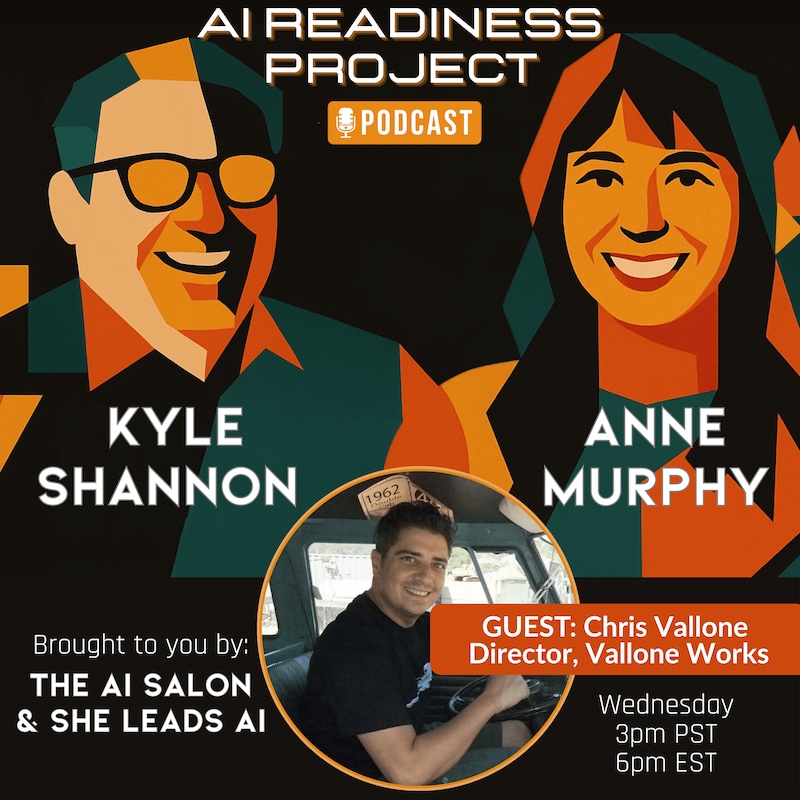
Shownotes
"𝘐𝘧 𝘺𝘰𝘶'𝘳𝘦 𝘢 𝘤𝘳𝘦𝘢𝘵𝘪𝘷𝘦 𝘱𝘦𝘳𝘴𝘰𝘯 𝘢𝘯𝘥 𝘺𝘰𝘶 𝘩𝘢𝘷𝘦 𝘴𝘰𝘮𝘦 𝘨𝘳𝘦𝘢𝘵 𝘪𝘥𝘦𝘢𝘴, 𝘸𝘩𝘺 𝘸𝘰𝘶𝘭𝘥𝘯'𝘵 𝘺𝘰𝘶 𝘶𝘴𝘦 𝘈𝘐 𝘵𝘰 𝘣𝘳𝘪𝘯𝘨 𝘺𝘰𝘶𝘳 𝘴𝘵𝘶𝘧𝘧 𝘵𝘰 𝘭𝘪𝘧𝘦? 𝘐 𝘤𝘰𝘶𝘭𝘥 𝘯𝘦𝘷𝘦𝘳 𝘥𝘰 𝘵𝘩𝘪𝘴 𝘧𝘪𝘷𝘦 𝘺𝘦𝘢𝘳𝘴 𝘢𝘨𝘰... 𝘪𝘵'𝘴 𝘵𝘩𝘳𝘪𝘭𝘭𝘪𝘯𝘨." — Chris Vallone
𝗦𝗵𝗼𝘄 𝗢𝘃𝗲𝗿𝘃𝗶𝗲𝘄
This week, hosts 𝗞𝘆𝗹𝗲 𝗦𝗵𝗮𝗻𝗻𝗼𝗻 (𝗧𝗵𝗲 𝗔𝗜 𝗦𝗮𝗹𝗼𝗻) and 𝗔𝗻𝗻𝗲 𝗠𝘂𝗿𝗽𝗵𝘆 (𝗦𝗵𝗲 𝗟𝗲𝗮𝗱𝘀 𝗔𝗜) start with an honest check-in: the difference between “being busy” and having a practice you can return to—especially when you’re stressed, avoiding something annoying, or stuck in that not-knowing feeling. From there, the conversation widens into what people actually 𝘣𝘶𝘺 when they buy “AI” (and what they don’t), why one-and-done training often falls short, and how community can be the difference between quitting and getting traction.
Then 𝗖𝗵𝗿𝗶𝘀 𝗩𝗮𝗹𝗹𝗼𝗻𝗲 joins to talk about a massive shift in independent film: what happens when your biggest constraint isn’t budget anymore. Chris walks through his creative process, how he works with writing tools without handing over the wheel, what film festival reactions have been like, and why newcomers who ignore these tools may be putting themselves at a disadvantage.
𝗞𝗲𝘆 𝗧𝗮𝗸𝗲𝗮𝘄𝗮𝘆𝘀
• 𝗣𝗿𝗮𝗰𝘁𝗶𝗰𝗲 𝗯𝗲𝗮𝘁𝘀 𝗺𝗼𝘁𝗶𝘃𝗮𝘁𝗶𝗼𝗻. A steady approach helps you work even when you don’t feel like it—and helps you tolerate the “I don’t know how” moment without spiraling.
• 𝗦𝘁𝗮𝗿𝘁 𝘄𝗶𝘁𝗵 𝘄𝗵𝗮𝘁 𝘆𝗼𝘂’𝗿𝗲 𝘁𝗿𝘆𝗶𝗻𝗴 𝘁𝗼 𝗱𝗼 𝗮𝘀 𝗮 𝗵𝘂𝗺𝗮𝗻. Tool-hunting is a trap if you haven’t named your goal.
• 𝗙𝗼𝘂𝗿 𝘂𝘀𝗲𝗳𝘂𝗹 𝗺𝗼𝗱𝗲𝘀 𝗳𝗼𝗿 𝗹𝗲𝗮𝗿𝗻𝗶𝗻𝗴: reflect (how am I showing up?), get curious (play and explore), build (apply), and serve (share, ask, support).
• 𝗖𝗼𝗺𝗺𝘂𝗻𝗶𝘁𝘆 𝗶𝘀 𝗮 𝗳𝗼𝗿𝗰𝗲 𝗺𝘂𝗹𝘁𝗶𝗽𝗹𝗶𝗲𝗿. You don’t have to quietly struggle through every stuck point—especially when tiny settings and small choices can change everything.
• 𝗙𝗶𝗹𝗺 𝗶𝘀 𝗮 𝗰𝗹𝗲𝗮𝗿 𝗲𝘅𝗮𝗺𝗽𝗹𝗲 𝗼𝗳 𝘄𝗵𝗮𝘁’𝘀 𝗰𝗵𝗮𝗻𝗴𝗶𝗻𝗴 𝗳𝗮𝘀𝘁. Chris explains how today’s tools can shrink costs for scenes that used to require huge crews, coordination, and cash—while still demanding taste, direction, and craft.
𝗢𝘂𝗿 𝗚𝘂𝗲𝘀𝘁
𝗖𝗵𝗿𝗶𝘀 𝗩𝗮𝗹𝗹𝗼𝗻𝗲 is a longtime filmmaker and artist (and also a vintage VW Beetle restorer) who’s bringing scripts he wrote years ago to the screen using today’s video tools. From MiniDV-era, shoestring sets to AI-assisted storyboards and trailers, Chris shares what’s gained, what’s lost, and what still matters most when you’re trying to tell a great story.
𝗟𝗜𝗞𝗘, 𝗦𝗛𝗔𝗥𝗘, 𝗦𝗨𝗕𝗦𝗖𝗥𝗜𝗕𝗘
Catch a new episode of The AI Readiness Project every Wednesday at 3pm (PST), co-hosted by Anne Murphy of She Leads AI and Kyle Shannon of The AI Salon. Want to meet others navigating this new terrain with humor and humanity? Visit The AI Salon or She Leads AI to find your people.
Transcripts
Chris Vallone
Introduction: [:Kyle: All right. We gotta lead with what makes us human.
Speaker 4: Our, our theme song and our narrator have synced up now. Yes.
Kyle: Yes. They're, it sounds good.
Speaker 4: Do you like it?
of chill, I, so I will share [:Speaker 4: let's do it,
Kyle: if you don't mind, unless you like kin to, to share something.
Speaker 4: Nope. I'm, I'm all ears.
Kyle: All right. So, so, so this past week we, we launched the AI Salon Mastermind, the practice Lab. Right. We kicked off this thing where people are gonna be designing their daily practices. Right. And, um, I'm really glad we did because like, what I realized is I've essentially been overstressed, hiding, like mm-hmm.
Not being in my power. Just, just like Mm. Having a lot of activity Mm. Without necessarily having any focus or intention. Yeah. And I got really clear on the difference between a habit. Like I show up every night for my Yeah. Learning lab live. A practice where you're actually doing it with some intention and doing it with some thought.
And, and I [:So how I like get it from the vibe coding app to, to my web platform and then get the domain pointed to it. I know there's only a handful of steps and it's figureoutable, but like, it's, it's unpleasant enough that I just keep avoiding it. And so like, I don't even make the, the, the thing because I don't want to confront that thing.
ld were both talking about a [:I don't, I don't want, but there was something about in, in just saying, okay, I'm just gonna sit with it and feel it, even though I didn't do that specific thing. I took a bunch of actions this weekend with, with a level of calmness and lack of anxiety, um, that I, that I haven't felt in a while. And so it's just a big, big reinforcement for me that, that even, even if we let go of the sort of chaos of trying to keep up with the tools, if you're just in a chaotic place
video: Yeah.
Then you're in
Kyle: a chaotic place. And so I'm really excited about this idea of taking a moment to breathe. Yeah. Just be,
ou know? Yeah. You know, um, [:Anne: Mm. I don't, I,
Speaker 4: you know, and it's like, I'm doing the thing. I don't want to feel this way, it's for sure, for sure.
I don't wanna feel this way. Right. And also, I, when I do the thing, I feel this way. And so there's this element of like, when it's a practice, you're not relying on motivation. You are not relying on I feel like it, you are not relying on it, on I feel good. Or the whim the moment has struck me. It's discipline.
It's your, it's the thing of like the most prolific writers, like having a practice, you have to sit down and do the thing and let the, let the source like flow through you. And if you're not sitting there, it's not gonna happen.
Kyle: Right.
Speaker 4: That's kind of my version of what you're talking about.
Kyle: Yeah. Practice.
for me, like I'm calling it [:Speaker 4: Yeah. Which is
Kyle: rather than avoiding the ick, embrace the ick. Yeah,
Anne: we're
Kyle: gonna have Chris, Chris Valone up. I'm, I'm super excited to have Chris up. He is gonna talk about filmmaking. He is been a filmmaker for 20 years and one of the things I'm excited to hear from him is that transition from, here's how I used to make films to
video: Yeah, here's these
Kyle: tools and, and what's that transition feel like?
And does it, you know, does it feel like I'm gonna get replaced or does it feel exciting? Or, you know, how do you go from being masterful at something to a whole new suite of tools that fundamentally alters the workflow?
Speaker 4: Yep.
Kyle: And where you can't, by definition, feel masterful. 'cause no one's masterful right now.
'cause the tools keep changing. Right?
Speaker 4: Yep. Yeah. Yeah. Um, I had a, a, an observation that I think is important for our communities. Are you ready for this one?
Kyle: Lay it on me.
: This is [:Probably a million people come in and out over three days, at least a million. And, you know, they're Tony Robbins fans, right? Mm-hmm. And they're people who know that AI is important. And certainly, you know, I watched it and I was like, well, I mean, this is exactly what I would expect, right? It's, it's sales and there's nothing wrong with that.
People know what they're getting into. They're there to be sold. People like to be sold. That's not a bad thing. A salesy three day infomercial is not a bad thing. I don't think it's a bad thing. And furthermore, we're all adults and we know that if something's free, it's probably you're gonna get what you pay for.
video: Right?
coop on that experience, and [:video: to it. Yeah. Right.
Speaker 4: And it was not
video: cheap
Speaker 4: and it, no, yeah.
The, so the, the program that they're selling, so this is what I, I'm kind of, kind of like unraveling here is, um, that I now have been meeting people who not only attended, but bought the program, the $995 program, because they found Sabrina, because she was one of, Sabrina Ramina was one of the instructors.
ey bought the promise of ai, [:Like we, we made, we didn't buy Tony Robbins, but we gave up all of our time, money, blood, sweat, and tears over the past three years to learn all the shit, right? So they spent 995 bucks. They show up into a jam session with women who are, who are building things, and we discover that they barely know how to use ai,
Anne: right?
Speaker 4: Like, almost not at all, like maybe using it for an email. Now what we provide through our communities is, let's say somebody signed up for something with us because they are excited about the promise of ai. We bring all those other elements along with it that make it possible to learn something, to sit in the discomfort, to be in a space where you suck at something for how many hours on end or years on end.
like cultural backlash. I do [:It's dig. They're making digital twins. That's the whole, that's the whole offer.
Anne: Oh, okay. Is seven
Speaker 4: sessions to make a digital twin. $995. We do this at laws, we do this for free. I was, I was gonna say,
Kyle: I, I, I'm here. Here's my big insight. We're undercharging.
Speaker 4: No, I was thinking, you know, if people feel like that's not the methodology for them and they don't wanna spend $995 to make a digital twin, they can come hang out with us.
thing where in, in the early [:I wanna learn ai. The fact that they chose a digital twin as, as the thing to do, it's like there are so many other things to do. It's like that's gonna be relevant to some small subset of, of the population. And again, this goes back to what are you trying to achieve as a human? Right, right. Are you trying to start a business?
Are you trying to stay employed and make money without having to invest money? Do you want to, you know, make a difference in your community? Do you want to change the world? Like, like what are you up to? Feels to me like that has to be first because here, here's where, where I increasingly, I increasingly answer the question of, I, I hear the question all the time and I know you do too.
-hmm. I try to answer it and [:Yeah. They're getting better. Like, you know, where, where he was a year ago versus where he is today. It's completely different technology. Every single technology out there is some version of good. So the, so the tools don't matter and they're gonna keep getting better, right? So, so if, if there's tools that do everything well, where do you start?
Yeah. Well you don't just pick a technology or an implementation and start there. No, you start with who are you, what are your values, what are you trying to do in the world? And then from there you can say, well, what are the kind of AI tools that I might need to implement to do that? Right? What's the first step?
at words matter and you can, [:Speaker 4: you gotta use 'em. Sometimes you're gonna save of them over on the side.
Um, yeah. So it's, it. So that, that part was really interesting to me was just seeing like, okay, so there's like this very sellable promise. That kind of meets people's interests across the board.
video: Mm-hmm.
Speaker 4: And then they're gonna take that stuff and they're gonna be able to do something a little bit better or different with their skillset, but at the end of the day, they're still on their own.
ally hard week with building [:Something like one woman was saying, you know, she'd worked on something for ages.
video: Mm-hmm.
Speaker 4: Ages and ages. Well, it's the process that you've described about vibe coding. Like, Ooh, I'm gonna make a nap, I'm gonna make it, it's gonna be so great. And it's great. It's great, it's great. And then it's actually in reality, a piece of shit.
Right.
Kyle: Oh, oh, you wanted that to work? That would be another to your life. Oh, you wanted it to work?
Speaker 4: Oh, silly. Silly coyo. But anyway, a lot of people kind of hit that wall of, wait a second, you know, I've created this, I've built my, around this, and now it's kinda like the rug's being pulled out, you know, from under them.
Um.
Anne: Mm-hmm. But
Speaker 4: being able to come together, 40 women's talking about how difficult it is at the end of the day to launch something that you vibe coded was, I think, really good medicine.
antage of the community. So, [:And like I, you know, I literally have thousands of people I can reach out to that would probably answer a question for me, right? Like, but I sit there like, well, I gotta figure it out. Maybe let Chet GPT woes me. You know?
Speaker 4: Yeah.
Kyle: And you know, and I know the communities there, and I, you know, and I know that there's trust and love and support there.
And so people who are not in that, like it, this is, this is very intimidating. It's funny when, when, when we first started doing this AI stuff, it was simple enough that I found it not intimidating. Like you could, you could literally just, you go to chat GPT, you put in words out would come your thing.
t know if you knew this, but [:You can have it be cynical or helpful or whatever. Like that will radically alter your experience. But how would you know that? Right? How do you even know where to begin in a single tool? In a single tool? In a single tool? And there are 10,000 tools, right? So, so, exactly right. But, but, and, and maybe that's part of the challenge right now is you would never think to say, oh, I've gotta learn the internet.
Right? Right. I've gotta, I've gotta learn the worldwide web. Like, what does that mean? Well, it's everywhere, right? So it's like, no, no. What specific part do you need? Well, I wanna start an e-commerce site. Oh, okay. So you need to build a website and you need to hook up an e-commerce thing to it, right? That like we know how to do that.
Right? But that's evolved over 30 years. And so now AI is sort of used as this thing you can go learn, but it is so much bigger than that, which again, like. Where you begin is not with the technology. Where you begin is with you.
: [:But I'm starting to think that training does not work
video: because
Speaker 4: ing Yeah, so we do this whole, you know, AI, educational, you know, I've got five, my AI Academy that I do in my consulting things, it's five workshops, but really it's all, it's five workshops and five office hours. Now because each phase of the five workshops surfaces some specialized need.
with them and saying, okay, [:Right. And I think it's gonna work. 'cause even if it was just, just check GPT, we would never have in five sessions get around to something as intricate as, you know, turning the knob knobs and the dials on the personality thing. Like, I haven't even gotten around to that. It's like, it's a practice. It's not a, it's not a, it's not a terminal thing.
There's no beginning, middle, and end.
Kyle: No, no. And I think that's the fallacy and that's, I mean, I think to your point about the Tony Robbins thing, like it was pitched as you buy this thing and you will have learned it.
Speaker 4: You will have learned it.
Kyle: Right? And, and so people showing up to a thing, well, I bought the thing so I will have learned it.
There's no it to learn. So, [:As we've been putting together the practice, what we realized, we were writing some marketing copy, and it, I think it was Andy Sino that came up with, she, she, um, phrased it as there's different modes that you're in. And she labeled the modes. And so I'm gonna add a fourth one. So there's, there's four modes that you can be in with, with ai, and the first one is reflection mode.
Anne: Okay? And that's
Kyle: where you're not dealing with AI at all. You're reflecting on you, like, where are you right now? Like, like you, like, you know, you come in here, are you stressed out? Are you peaceful? Are you come? Like, like, just reflect. So imagine if on a daily basis you took 10 minutes to just reflect on where you were before you got started, right?
play first, right? But it's [:The the third mode is build mode. And build mode. Is it excellence? So it's like, now I'm gonna take the things I've learned and I'm gonna apply them to something, right? And then the fourth mode is service mode, which is generously lead. And so that might look like, you know, that that cool thing that you just vibe coded, you know, share it with someone or what did you learn in building that or you know, whatever it might be.
Or asking other people questions, reconnecting with community. And so. If you can really think about like, like where are you just mentally, right? And then what mode are you in? Am I in build mode? Am I in curiosity mode? Am I in, I need to connect with other people mode in some way. Yeah. And if we can get it to a place where it's simple, right?
one anything at all with ai? [:'cause it can get really frustrating if you're like, okay, I'm gonna teach myself AI and I'm gonna go build something really cool. Well, you don't even know what's possible. So it's gonna be incredibly
video: frustrating
Kyle: to build something not even knowing what the tool is that you're trying to build, build with.
Speaker 4: Yeah. Yeah. And it, it feels like it's a gap that I should be able to solve. For people, for clients, for community members. Like I should be able to say, oh, no, no, here's the thing that you're missing. But the thing that they're missing is like a vast world of you don't know what you don't know. Yeah. Like, it's like you have to get a little tiny foothold.
hat's showing up and sitting [:Kyle: Yeah. I like that. I, I also, there, there, there's potentially, there's potentially a place where you could actually solve the problem. Let me throw this out as a, as a thought experiment.
Speaker 4: Yeah.
Kyle: Which is you define a, a radically narrow specific problem. Hmm. So, so the problem might be like, I'm gonna come in for an hour, we're gonna solve the problem of. Our emails that we write with AI sound too much like a robot, or they don't sound like us. Okay, we're gonna take that specific problem. I'm gonna come in for an hour and we're just gonna try to solve that.
my problem is based on what [:Because I think part of AI is learning that new things are possible. So I just talked myself out about a solution, but there, but there might be something there.
Speaker 4: There could be one along the lines of, so first of all, did you know that there are people in the world who will have like a whole. Conversation with Che GPT or whatever, and then they will take that chat and they will like have Che GPT, like sum it all up and like put it in whatever formats and all this kind of stuff.
And then they will take some artifact from that and they will archive it where they will go and find it. Again.
are what we call psychopath, [:Speaker 4: but, but I think they're like, they're, they're, I think these people are like, they're among us. Like they're not like angels. Like they, they live, they walk the face of the earth.
Well, what if it, let's just say somebody could have a, you're almost done, but you're not quite done. A little something that you append to the end of your, of your, of your journey, which is something along the lines of, now that we've done this project. Now that I know these things, what else can I do?
Kyle: Mm.
Oh, that's good. That's really good. That's really good. And there's a, but there's also, what, what you hit on and why I called people psychopaths is because I'm so horrible at doing that. Right. I'm, I'm horrible at the organization stuff. In fact, um, this weekend I had to, I have to work on a, a, a thing for my, the book project I'm working on, and I had to go find assets that I created.
It took me two hours [:So, so, so, yeah. So maybe there's, well, maybe there's something about this, about kind of what mode are you in? Are we in discovery mode or are we in problem solving mode? Right? Yeah. And then even if we're in problem solving mode and you get to a a place, it's like we're not just done. Once we get the answer, it's like, okay, what are we gonna do with that?
Kelly camp had this, um, she, she's been using notion to capture all of her ideas.
Speaker 4: That's what I'm supposed to be doing.
t did for her when she had a [:Yes. That's the thing. And she said, and she said about 25% of what she creates is worth saving.
Anne: Yep. But,
Kyle: but again, rather than thinking, oh, I've gotta save everything and a digital hoard everything, and I'm gonna go find it at some point, which you won't. Right. Right. At least I won't.
Anne: Yep.
Kyle: Um, again, that becomes this sort of mindful practice of, okay, I created a bunch of stuff this week or today or this hour.
What do I do with that? Well, this was just a learning exercise. We don't need to say that. Okay, great. Then you don't need to do anything. Right. Or, Hey, we actually got some really good insights here that are important for our strategy, so let's get them, you know, into the notes doc for the strategy and let's get them into the drive and Right.
you to deem something done, [:Because now to your point, not only is it in 15 different places, it's possible that I had the same exact chat in four different AI systems. So where is the end? So maybe if I could, if I started forcing myself to put the things somewhere, I would actually complete more things or, yeah. Maybe give myself a tiny, tiny satisfaction of
Kyle: I was, say I completed
Speaker 4: or I hit a milestone.
Kyle: You would have some completeness, right?
Speaker 4: Some, some maybe.
s. Listen, I wanna get Chris [:Lemme bring about the AI salon. So, um, so the AI salon, uh, go to the salon, do ai, um, really remarkable community. Um, we just started a thing called the, um, AI Salon Mastermind Practice Lab. And if you're a member of the Mastermind, you can actually, we'd our kickoff meeting, uh, recently. So you can go to this URL, sign up for the Mastermind.
You can watch previous weeks and if you join, it's a 10 week cycle that just keeps repeating. You can join at any time. And it's people designing a daily practice around ai. I'm super excited about it. It made a difference for me this weekend. Um, I actually spent the two hours and went and found all my crap.
I love it. And as a direct result of that. So, so with that, why don't you tell the good folks about She leads and then we will bring Chris up.
just gonna talk about social [:So she leads ai, it, our mission is to unite accomplished women to advance AI for global prosperity. And what we mean by that is that it's, it is of course about our own personal and professional growth and, and gain and, and influence in the world. But more than that even, it's about the choices that we make in the spaces where we show up, where we're able to represent the people who aren't in the room.
nt every single Saturday from:Yesterday we had [00:29:00] Suzanne Weel Jones, who actually wrote a book about AI agents and corporate culture. Hmm. And what we'd spent the hour, what, it's a two hour event, but we spent an hour on, uh, learning about her, um, research and her, the work that she does as a consultant. And then really, um, just, you know, had an open mic talking about different applications of it.
But what she, what we were talking about with her was how AI agents actually may be our greatest allies in the workplace because they're going to uncover the sacred cows, the orthodoxy, the way we've always done things.
Anne: Yeah, yeah, yeah. And she's
Speaker 4: anticipating a rash of scandals to come out because those of, I mean, think about it.
We all know like. The dots aren't that hard to connect. Yeah. But in corporate culture, their systems set up to make the car, the car, the, the dots hard to connect, right?
Kyle: Yeah. Well, yeah. [:Speaker 4: on that, right. There's, there's a reason why like the board doesn't have transparency to certain things, and that no matter what happens, the board is never gonna see X, Y, z.
Well, you, you put an agent. On the scene to, let's just say optimize workflow for less, fewer tickets in IT help, I don't know. Right. Well, they're gonna start, they're gonna come back and they're gonna say, oh wow. Here's the following fucked up things we found. Right? And okay, now decision makers, do you wanna pretend it doesn't exist?
video: Right,
Speaker 4: right, right, right. Because the AI doesn't care if it gets fired, so it can speak truth to power. At any rate, that was the conversation we had yesterday, which allowed everyone in the room, and we had like 50, 50 women there, you know, to ask questions about. We, we ended up talking about, God, let me put it that way.
that flew, that flowed into, [:Kyle: Awesome. That's great. Uh, well, let's, let's bring up Chris, uh, Chris.
Chris Valone, uh, from Valone Works. Uh, Chris, thank you very much for being here. Thank you for your patience getting this thing up and running and, uh, all good. Um, why don't you do the, do, do us a, a favor, introduce yourself. Tell us what you're up to. I'm so excited to hear about, you know, your journey and all that stuff, but catch us up on, on who you are.
Terminator and Predator and [:You know? Um, and ever since I was a kid, I always wanted to tell stories, so I've been probably telling stories for 30 years or more. Um, and, uh, when I got outta college, I jumped in on filmmaking and, uh, I got involved with the d in the DV revolution in the early two thousands when, you know, mini DV tape came into play.
And you were able to get a camera for pretty inexpensively, uh, for the time, uh, broadcast quality and, um, shoot on tape. And it was, it was, uh, somewhat of an acceptable format if you were to screen at say, a festival or something. Uh, even though back then, you know, a lot of filmmakers who shot on film were negating it because it's, oh, that's not real filmmaking.
You're using a tape, you know, that kind of thing. So technology always has, it's
. It's not, it's not as high [:Chris Vallone: Yeah. Right. Like, that's exactly it. But, uh, so I, I pumped out probably, I don't know, eight, 10 films I did in, in a course of like eight or 10 years or so. And, um, and then I got to the point in New York where I'm like, all right, I got into film festivals, got into Tribeca, went to California, got into some festivals, that kind of thing.
It was a good time, but in the end, living in New York, I had to start making some money. So I started my own business and I used my arc talent to run my business for the last 20 years. Uh, but now, uh, fast forward to now and AI came into my life, uh, a little over two years ago. And I said, wow, you know, I wrote so many stories back in the day that I could never film.
'cause I didn't have the budget. I didn't have the cast, you know, the, or the connections. And I always had some grand ideas, you know, way outta my budget league, you know, to make anything. Um, 'cause the stuff that I made on MiniDV was all shoestring budget. I mean, I didn't pay any of the actors we had, I had a stunt team.
I didn't [:Kyle: yeah. Role as, as a guy with an acting degree. I can, I can vouch for that. That we'll do anything for free. You just for free. We'll do it
Chris Vallone: all. I did, I provided you free food that my mom cooked, you know, so she's Sicilian and, uh, you know, so we got some good food, but, um, yeah, but we, we did have a good time.
But, uh, you know, fast forward to now and I'm like, wow, I could resurrect a lot of my old stories that I wrote that I could never, ever do. Um, let me just start dabbling in that. And, um, it's been thrilling to say the least. I can say, you know, to see my old characters and old designs and story ideas come to life today that I can bring together on a five-year-old laptop, right.
And, and put something epic together, uh, is is pretty exhilarating. You know, I gotta say.
Kyle: Um, do you wanna show, I've got a a, a trailer teed up here for, for one, he works. Why don't you want, you wanna show that and then, and then just, we'll sort of dig in from there.
Chris Vallone: Sure. Absolutely.
Kyle: [:there we
video: go.
s horrible. This is so scary.[:video: Oh,
Kyle: damn. Um, you know what strikes me about that is, is, um, hang on, lemme switch. There we go. Uh, what strikes me about that is, um, a lot of those shots, if you were to shoot them with actors and films and like the cost, the cost of just doing that trailer. Would be insane.
Chris Vallone: Yeah, that's, that's exactly it. And that, that's my latest one that I've done.
I mean, I, I've done several already the past year or so. Um, uh, and, uh, yeah, it, it's one of those things where I'm, I'm driven heavily by music, um, similar to what Looney Tunes was like and what Walt Disney did with Fantasia. Um, he would listen to music and then the music would in essence speak to him.
would be. So he got a lot of [:video: Right. Right. So people were
Chris Vallone: like, oh, we're using a Christmas song.
It's like, no, no, no. That song Talk to me as something else. You know? So I, I grabbed that and I, I listen to music. I, I mean, I'm in the gym and I'm listening to cinematic stuff. I'm listening to Braveheart music, gladiator music, and then, you know, YouTube throws out some other feeds, some real artists today, and I can listen to a song and come up with a story, and it's like a, it's like a blessing and a curse at the same time, because then I can't go to sleep all night long.
I'm thinking of this story, this music's running through my head and I'm basically plotting the whole story together. But, so that's Echoes of Antietam. I mean, it's something that, um. Uh, it, I was just going to bed one night and just boom, it just popped right in my head and I'm like, I gotta fledge this out.
hink I, I put that together. [:video: Mm-hmm.
Chris Vallone: And I wrote that 18 years ago.
video: Oh, wow.
Chris Vallone: And I was totally, I said, I gotta bring her to life. Um, and again, inspired by Apocalypto, Braveheart, gladiator, left to the Mohicans, um, even a little bit of a, you know, dances with wolves, you know, I like that kind of stuff. And, um, I just wanted to put that together. But, you know, with AI, as you're making a movie that, and it's taken me that long to make, and you're seeing how the technology's moving so fast.
I
Kyle: was gonna say, and I'm like, if you're making it over four months, the text's probably different by the time you get to the Oh, my,
Chris Vallone: the first month. I'm like, what? Do I go back and remaster it? Do I change it? I mean, do I just keep streaming ahead, you know, you know, per, you know, uh, plowing ahead. And that's what I did.
uh, she, she took off. She, [:Kyle: you put that in festivals and things like that, right?
Is that, yeah, that journey.
Chris Vallone: All of them. I, I've been submitting all of 'em to film festivals and, you know, I, I always have this topic of a conversation with other filmmakers, uh, AI filmmakers in the film group that I, I've started here in Florida for a year now. You know, are festivals still relevant? I, I, I guess they still are.
,:video: Yeah, yeah.
Chris Vallone: You know, so, um, but yeah, it's, it's been submitting them.
ou, when you gotta go up and [:Kyle: is that because you're, you're in a festival where there's some AI film, some not.
Is, is this an anti AI thing? Were you getting the half claps?
Chris Vallone: Yeah, I think so. And, and, and some of the festivals I get into, I'm the only AI film. So there's still a lot of festivals out there that are still very traditional, which is great. I'm, I'm all for it. Um, but you know, there's this pre notion that they think you're going to chat GPT typing in a prompt and boom, your whole movie's done.
Kyle: I know.
my sound mixing. And a real [:Uh, so, you know, if, if, if you're in a creative person and you have some great ideas, why, why wouldn't you use AI to bring your stuff to life? I mean, I could never do this five years ago, 10 years ago. So it, it's thrilling. Um, but then there's AI festivals you get into, and of course you're, you're mingling a little bit better, of course.
Speaker 4: Can you talk a little bit about the experience of the creative process, including hours and hours and hours of prompting versus hours and hours and hours of other activities, other things you do with your brain, your fingers, and your body, and the, you know, the environment that you're in.
Chris Vallone: So, uh, since I went to school for art, you know, I did work with my hands for years.
Yeah. Uh, my business for 20 years is restoring vintage Volkswagen Beetles.
Anne: Yeah.
h my hands. Um, you know, I, [:And so my, my stories are written by me. I use chat g pt, as I say, a writing partner. Yeah. And, and, but not to take over the whole story, bang ideas off if I was sitting with a friend of mine and we're writing this script together, you know, that kind of thing. Um, but I, I always have the idea to, to bang out first.
Um, but um, yeah, I As long as you keep the human element in this still, uh, I I think it's gonna be okay.
Kyle: Mm-hmm. What, what feels different to you from when, when you were doing films with, with, uh, on, on dv when you were doing the films in the, in the early two thousands, like
Anne: mm-hmm.
Kyle: Does it feel like the same process?
Do you [:Speaker 4: that's one of the things I was wondering about, like versus hanging around with actors and the Yeah, yeah.
Chris Vallone: Yes.
Speaker 4: Grip people and,
Chris Vallone: yeah, and I'm a people person myself, you know, so like, even.
Uh, I, I love face-to-face communication. Uh, I grew up on that. I grew up in the eighties and the nineties where we used to jump on our bike and tell my parents, see you later. I'm gonna go call for my friends. Um, so I, I hate actually being on the screens all the time. And yes, I do miss being with my actors and my stunt team and, and giving them the direction, um, that, you know, the only thing you had back then was, you know, limit to budget and time, money, of course, you know, it was a huge factor.
ou know, sword fighting and, [:I mean, just to, you know, the makeup alone and the effects alone to do that. Um, but I, I, again, yeah, I do miss the human side of it. Oh, it's really cool. But at the same time, we did have problems with actors and actresses. Right. They didn't show up
video: exactly
Chris Vallone: right. Oh, I got a stomach ache today. I can't make it.
video: Yeah.
Chris Vallone: You know, or you know what? I can't get a ride there. I'm sorry. You know that 'cause I used to shoot in Rockland County, New York, which is just Northern New York City. Uh, so a lot of the actors that I had from Manhattan would take a train or a bus up to me and then I'd have to pick them up and, you know.
eally on a budget and people [:Right? And, you know, we're done at 6, 5, 6 o'clock in the morning and then the people gotta go to work the next day. So,
video: you
Chris Vallone: know, there was issues with that. Yeah, no, for sure. And I was a rebel without a crew. I mean, I followed Robert Rodriguez's book, you know, just, you know, I didn't have a crew and, you know, if any of my guys were standing around doing nothing, I'd tell 'em, here, hold the boom pole or, or grab a light here and, and help me out.
You know, it was one of those things. So, um, it, it is, you know, uh, with the streamlining with AI and be able to do a production and maybe k as involved as it was. Four months only to make it, it was about four grand of my money though, to make it. Yeah. But still a fraction of what it would actually cost to make that, that would've been a million, 2 million, 10 million bucks to make what I put together in 10 in, uh, you know, in four months.
So. Amazing.
Kyle: Amazing.
Chris Vallone: Wow.
Kyle: Um. [:Speaker 4: I have a question.
Kyle: Sure, go.
Speaker 4: So it's related to the barrier that is budget and how, I'm wondering if up and coming filmmakers would be doing themselves a real disservice to not have ai, generative AI in their repertoire. Because even in competing for funding, they're going to those without, without any of the AI components.
Generative AI components are inherently gonna be much more expensive projects.
Anne: Yeah.
e art because it's not gonna [:Chris Vallone: Well, that's it. And, and that's what's taken it by storm. And that's why, you know, the whole notion online right now with Hollywood is that they're fearful in a way. They're fearful for their jobs and stuff. Um, and then you got some, some New York schmuck like me, some outsider guy that's saying, Hey, I, I, I, I can make a story because you know how many times I went to, you know, we'd go to movies when, you know, back in the day and we would leave the movie theater, say, man, that movie really sucked.
Like, who the hell did they get to write that? Yeah. And but now you don't have to feel like that's really bottom of the, the barrel anymore to say, we need a contact to get it. Or how are we gonna make this thing? We can't do it now. I mean, you got the idea. I mean, you can literally fledge it out and make it Yeah.
s ago, a full feature length [:And if I can make the short or the trailer. To it. Now that's Pitchable material. Ooh. You know, so that helps too. An indie who would never have, you know, even the, the way to make the trailer or the, they can do it now. Um, and more power to it, you know? And, and so that's why I say some filmmakers who poo-pooed the whole idea.
I'm like, you know, I, I remember listening to it, uh, a Walt, uh, uh, a Walt Disney animator when CG was coming in, CGI, Pixar, that kind of 3D animation was coming in. And he did traditional cell animation. He worked on, um, beauty and the Beast, and he said he was irritated. And I, I rate that CG was coming in.
'cause a lot of the artists that were making the CG at the time were just tech techies. They weren't artists. They were,
video: yeah.
Chris Vallone: They didn't have a, they didn't have a fine art background like this guy had, but he said, if I don't jump on this train, I'm gonna lose my job. Yeah. And I, I tell that to my students.
t, I'm not saying you gotta, [:Um, so I tell filmmakers as well, I'm like, you gotta get on it to some degree. You know, even if you use it part AI and part real live action.
Kyle: Yeah. You
Chris Vallone: know, the fact that you could do VFX now with it is, is great.
Kyle: Yeah. It's crazy. I remember I was watching a, a TV show not that long ago, maybe a year ago, and it was this, it was this scene where they, they rush from the barracks out to like a dirt airfield, right.
And there's four Russian helicopters and, you know, five or six trucks and like the people all rush out of the barracks and climb into the different vehicles and the helicopters take off and the truck's drive away. And I'm like, I was just looking at that and it was. 20 seconds of film. Like it wasn't that that long.
ht? Yeah. But like, that was [:But, but for the most part you can like, like you can do stuff that, that would be a major, major production,
Chris Vallone: no doubt.
Kyle: For, for, in that case, that was really just to establish, right. This was a big operation and, you know, they had some, some stuff figured out, so I had to establish a point dramatically, but, but man, the cost of that was crazy.
Right? Yeah. And just, you know, that goes away.
video: No doubt. Yeah.
I didn't remember any of the [:Mm-hmm. And it, as it was drawing the scenes, it immediately brought the story back to me. I'm curious what your experience is of taking something that's 18 years old and being able to go, yeah, let's, let's just go make this, like, what's that like emotionally for you to, to be able to resurrect those old ideas?
Chris Vallone: It's invigorating. It really is. I mean, you know, and of course my mindset's a little different back then what I wrote back then. I'm like, I'm wiser today. I can make the story a little bit better. But, but, uh, but what's great with, with chat is that, like I said, you use it as a partner. And if I dump in the script or the, um, the synopsis of the film, of the, the screenplay, I mean, and what it bangs back out to.
t, I like number two. I like [:Maybe we could combine those two. What do you think? And I'm literally chatting with it like this.
video: Yeah.
Chris Vallone: Um, and I'm typing it in and it's, it's
Kyle: right. You would say that to writing partner if you were working with a writing partner. What if we, that's it, right?
Chris Vallone: Yep, that's exactly it. You know, uh, it's, it's really great.
I, I really. You know, if you suffer from writer's block, this can help you. You know, I mean, it, that stuff is gone now. 'cause all it sometimes takes is from writer's block, just a little ign, ignite, you know, just a little match and like, oh, there we go. Now I know where he got, he's gotta go the hero. You know, that kind of thing.
Um, it's, it's really great. You know, I, I, like I said, it's thrilling. It's like, I know people, it's, it's scary and thrilling at the same time. Everyone thinks Terminator, you know? But, uh, I, I, I don't know. I'm, I'm on the train right now and I'm, I'm having a good time with it.
cultural touchstone, and we [:But, and I guess it kind of depends on what corner of the internet the algorithm has you pegged in. But I've been kind of surprised by the response to the AI generated holiday ad for code. Yeah. And one it in that my corner of the internet seems to be. Very ready to pounce and say it's not good enough.
Right. And I wondered what your perception of the ad is and what you think it means for like, where we are in the public being ready to enjoy or appreciate this kind of storytelling.
Chris Vallone: If this is the worst you're seeing of it, it's only gonna get better.
video: Right.
that was generated in ai and [:And it looked like any, any other commercial you see when you're watching a football game that they always go to. 'cause so many of the commercials, they're all cg, you know? Mm-hmm. All those cars are not real. Um, and if, if you tell the people it's an AI commercial, they pounce on it. But if you never told them it was an AI commercial.
They would never pick up on it. And, and some of the things, I see some of the comments below the Jeep commercial and I'm like, this guy's just saying it because he hates the whole fact that AI is here. You know, like this is the, these are those people, you know, you're gonna have those naysayers. And it's with any new technology, you know, like back, go back the late 18, when, when were we doing photography with like the late 18 hundreds when you took a snapshot and you called it art and hey, stop, that's not art.
Whatcha talking about you just took a shot.
video: Yeah.
he fact that you can undo an [:So any new technology, you always gotta have these naysayers. But I always laugh because even on my Volkswagen channel, uh, I have some AI videos there, and some of the people are pissed off, oh, I hate ai, I hate that. You know, we're using ai. I am like, well. So if you hate ai, get off YouTube right now. Yes.
Because YouTube's ai, you're on social media. Get rid of that too. You get rid of your phone, get rid of your tv. It's all ai. What do you think? Where do you think we are? You know, so, uh, yeah. It's just, it, it's just an, I just go, you know, whatever. You just keep going and, uh, it's only gonna get better. And I can't believe from when I did my first film last October to now, and the, the amount of change and the, and the, the quote unquote, fidelity has gotten so much better.
Yeah. Uh, it's really remarkable.
let me, um, we asked this of [:video: know.
Kyle: Um, but, but lemme shift gears a bit and, and, you know, we talk about AI readiness here. What does AI readiness mean to you? And what would you say to someone who is maybe ready to, you know, jump in or, or wade into the shallow end even of.
Chris Vallone: Like what you said, jump in for a week and play around. Make your mistakes, get your feet wet, and just go with it. And there's so much education and information on the YouTube. I mean, it'll blow your mind how much education is out there. Um, and just keep watching. And I tell my students, too, just take this slow.
p like Flux, or there's nano [:Uh, and just pick, pick a handful of them, try 'em out and, and go from there. Um, it's like anything else. Make your mistakes and just in the end, have fun.
Kyle: Yeah. Yeah. Yeah. That's great. That's great. Uh, well, Chris, this has been absolutely awesome. Um, what's next for you? I wanna put, if people want to get in touch with you, your YouTube channel is Valone Works, is that correct?
Chris Vallone: Yep. Valone Works. Uh, I'm on X with Valone Works and Instagram. And, um, yeah, you can reach out to me there. I haven't made a website yet. I'm getting there, but, uh, I keep posting my videos up there on YouTube and, um, yeah, I got stuff coming down the pike still. I, I got so many story ideas that even myself, sometimes I gotta slow down because I got a list, I got a sticky of a list of, of films I want to jump on.
in the beginning of December [:I got a couple festivals up there. So, yeah, it's, it's all good, you know, like I'm having a good time and so,
Kyle: yeah. Beautiful. And what's, what's the thing you're most excited about coming up? Like technology wise? Any, anything. Anything that's got your curiosity peaked.
Chris Vallone: Ah, to make a feature.
Kyle: Ah,
Chris Vallone: you know, I mean, I made that short.
That was 15 minutes. It took me four months. I'm like, all right. So, okay. Maybe it takes me a year to make a feature.
Kyle: Yeah. Elon Musk said the next, when, when they do grok five, he said, we're gonna go from 15 second videos to 30 minute videos. Yeah.
video: Wow. It's crazy.
Kyle: You make a leap like that where you can just knock out a five minute scene with a prompt.
The, the, the shot from, you know, there to a feature is not maybe as far as it, it seems, but we'll see. Yep.
ming because they're already [:Kyle: Oh, nice.
Chris Vallone: The filmmaker and, yep. He's got a new production company called Brass Knuckle Films, and where he does somewhat, kind of like a crowdsourcing thing on, on this website called Republic
video: Uhhuh.
Chris Vallone: And if you're an, you could be Joe Schmo, like me, it could be an investor to his new production. And then if the movie makes money and it gets produced, I mean, that you get kickback on that, so, which is really cool.
But what was great is, as being an investor, I have first dibs to pitch to him.
Kyle: Oh, wow.
and I sat down [:Because we both liked Frank Frazetta. So Frank Frazetta was also a big inspiration to, for me to make this film. Um, and it was really cool. I mean, he didn't select it. He one, two other guys. But you know, just to get to that point, and this is where we are in this tech. I mean, the fact that, like I said, I got the script and the now the short to showcase it's pitchable and to be able to reach to somebody like him, I mean, I'm just so grateful I even got to that point, you know?
So. Wow. Yeah, it's really cool.
Kyle: Cool. Well thank you so much. Let's stay in touch. Absolutely. Can't wait to see what you do next.
video: I appreciate you guys.
Chris Vallone: It's been fun. Thank you.
video: Bye.
Chris Vallone: [:

