Shownotes
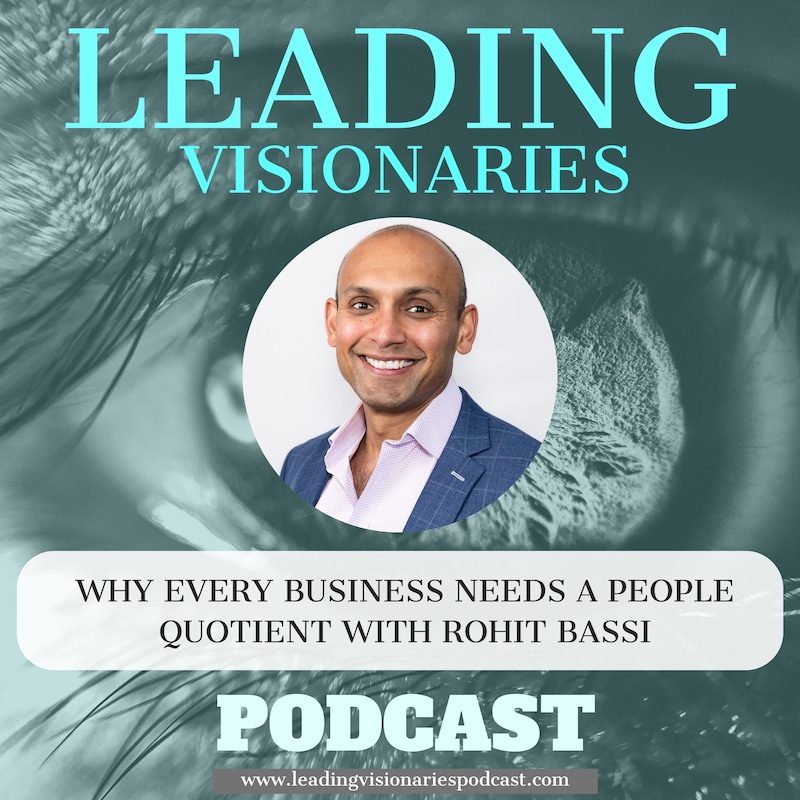
What happens when you stop looking at people as a business expense and start seeing them as the force that creates value? In this episode of Leading Visionaries, host Anjel B. Hartwell sits down with Rohit Bassi, the founder of People Quotient and the creator of PQ, a framework that defines an organization’s capability through its people.
Rohit shares how his childhood vision for global impact shaped his leadership journey, what he learned from working with more than 100 businesses, and why translating a big vision into something tangible is essential for creating real-world impact. He also explains his five-year vision for bringing PQ to businesses around the world.
What You Will Learn:
Why having a big vision requires both imagination and practical structure.
How to connect what you are solving for with the value you want to create.
Why people are fundamental to turning a vision into measurable business value.
What People Quotient, or PQ, means and how it applies to leadership, organization, and talent.
Why businesses benefit from thinking about their people proactively instead of only reacting to employee issues.
Why bringing a vision to life requires other people, not just the person who created the vision.
How a big idea can become a tangible framework that other people can understand, use, and apply.
FAQ:
What is People Quotient?
People Quotient, or PQ, is a framework for thinking about an organization’s people through three areas.
Why are people important to business success?
People are responsible for carrying out the work that creates value within an organization.
How is People Quotient different from IQ and EQ?
Rohit describes IQ and EQ as familiar ways of thinking about individuals, while PQ focuses on the people and organizational side of a business.
Connect with Rohit Bassi
Join the Leading Visionaries Community
Transcripts
LVP 153 Rohit
===
Ad: [:Now, here's your host, Anjel B. Hartwell
Anjel: Welcome to another episode of the Leading Visionaries podcast, where we celebrate the ingenious, insightful, innovative, and inspired leading visionaries of our time and provide our listeners with world-class examples of the kind of courage, clarity, and confidence it takes to bring visions into reality.
al guest, Rohit Bhasi. Rohit [:He has spent two decades as an investor and operator reshaping over 100 businesses, assessing 1,000-plus management teams worldwide, and operating a business whose sale to KKR led to a $2 billion-plus merger. Wharton MBA, McKinsey alumnus, engineer with a thermodynamic equation in his name, host of the People Quotient Podcast, global citizen, seven countries, five languages, unapologetic fitness nerd.
Welcome to the show, Rohit. [:Rohit: Thank you for having me. Yeah. Mm-hmm. It's like I, I, listening to you is just very, uh, you know, so hear the word nerd. But here I am, so thanks for having me.
Anjel: Yeah. Well, you know, the, the Revenge of the Nerds was a movie when I was- Yeah ... in my teen years. So We know all about the nerds.
Right. Anyway, we're excited to have you here today on Leading Visionaries, and I love to start these conversations either going down the path of leadership or going down the path of vision. And I think I wanna start with you around vision. So Rohit, were you the kid who had big dreams and big visions, or did your visionary capacity come online as a result of, you know, your life experiences over decades?
y that is life allowed me to [:And so no, right from the very beginning as a kid, I used to do things that one would consider visionary for a kid. But yeah, I always had sort of the bigger like, you know, reshaping the world or having a global impact. Those are the things I would talk to my parents about right from very early on, and, uh, do it in a very tiny, meaningful way for myself as a kid with my kid friends.
But no, it's been there, I think, all along. Now I'm just trying to bring it to reality, and obviously things have sh- reshaped along the way.
Anjel: Mm. Beautiful. Well, you know, I think it's very interesting that you had global impact vision when you were little. Yeah. I remember when I first felt like I was called to serve on a global level, and I started- Yeah
bout it, and I had a lot of, [:Rohit: A lot of encouragement.
You know, my, you know, my parents, when, when ... Just to take a step back, when I talk about global impact, I often, I remember distinctly talking to them about, like, I would like to do something at a global scale. I'd like to do something that touches a lot of people, and I didn't know what that meant. I was a kid, you know, I didn't know what that meant.
And so I, I started doing things in my community and organizing things, and just that was my interpretation of big, right? And what I got from my parents was constant support, and, um, particularly mom sort of always said like, you know, "You can do whatever you want." And my dad always was showing me things he was doing that was outside of his own, uh, reach, and so a kind of inspiration.
d so it wasn't a direct, um, [:Anjel: Beautiful. So one more vision question. I'm curious, Mm ... because m- people receive visions in different ways. Are you like a visual visionary? Like, do you get like a vision, like you see it? Or are you like a th- a cognitive visionary, where you, like, uh, the big idea just drops in? Or do you hear it from your spiritual team or your, your muses- Yeah
or whatever? Like, tell us a little bit about your own experience being on the receiving end of vision.
no one single source, and w- [:It's almost like something's pulling you towards it. Mm-hmm. Hard to describe that. A lot of... I'm a, I'm, I'm an intellectual sort of calculation-minded person, so- Mm-hmm ... oftentimes I get confused. Is it the mind thinking, or is this the universe pulling- Mm ... or is it both? And, and what I've realized, Anjel, over the years is that I've stopped worrying about the, the why.
Just go for- go with it. Because the analytic brain wants to explain-
Anjel: Mm-hmm ...
Rohit: what's happening, and I'm 100% guilty of that. And so I'm learning as I'm getting older is like, you know, stop worrying about why it is happening. Just enjoy the pull- Mm ... and enjoy the vision. So I think it's a little bit of head meets heart, if that, if that makes sense.
think, and correct me if I'm [:Rohit: Yeah, 100%. I think you've got to have the, the head allows your vision to become real practical, so it's actually useful and usable- Mm
by people, which is what I, where I sort of live. And, um, for me, if I'm my... I'm ho- totally driven by helping, like, I want to help. I, I want to provide a service. Um, but it needs to be delivered in a way that people can receive it and use it. And of course, I'm running a business, and so the idea of my service through the lens of a business, while it's still about people, 'cause I think people are the single biggest asset we all have- Mm
ct with people on heart, but [:Anjel: Totally. Yes.
Rohit: Yeah.
Anjel: Very helpful. And it, to me, the want to help part for you is the heart part. Like, that's, that's really- Correct ... you know, the part where your heart is Holding that bigger field of service, right? Yeah. In the pull.
Rohit: Other service.
Anjel: Yeah. Beautiful. Let's talk about leadership now. Were you the kid that was, like, organizing the block and, or, you know-
Rohit: Yes.
Anjel: Yeah. Okay, great. So tell us a little bit about your leadership journey.
now, military people on camp.[:And so I still remember this one thing that I wanted... I, I had always been into sports, and I wanted to be a good athlete, uh, an aspiration that still lives with me. And so, uh, the idea was let's organize an event. So I organized the whole community of kids, and we actually organized almost like a pentathlon of different events, and I got the moms to be the judges.
And so I orchestrated all of that, and I actually made certificates by hand so that you had... You know, I didn't have medals 'cause it's too expensive, so I just made it by paper. And point of it is that that's the very first memory I have of leading a project, but with intentions towards, like, celebrating something within the community of kids that we had.
her things that have allowed [:I just don't think leaders... Labels are good way for us to be put in a box. Uh, but, um, I think you can be led by somebody much younger than you, senior than you, horizontally, doesn't really matter. Ev- everyone can be a leader. I just have to look for that leadership- Mm ... is really what I sort of think about.
Anjel: Mm.
Rohit: And, um, and so I think about leadership more than I think about leaders. Uh, and, uh, I don't know if that makes sense, but that's, that's my current way of thinking about leadership.
Anjel: Yeah. Beautiful. Well, I love the story about organizing you know, all the kids in the neighborhood to, to do this thing, and then there was a reward at the end.
o some kind of structure and [:strategy into money.
Rohit: Yeah. Look, there, there's so many different elements or prongs to that journey. I think from a literal perspective when I think about- Whether you're a listener who's running a personal life project or a business or you're part of a team, I think a- at the end of the day, I always ask the question, it's two questions.
professional endeavor or an [:And so for me, it's really comes down to those two questions and connecting the dots, and my manifestation of that happens, uh, you know, I fundamentally believe happens through people. So you can, you can sit and have clarity about what you wanna do, but whether it is bringing a community of friends or bringing a community of colleagues or, you know, sponsors or investors, the point is that you will need people to actually get to that point of value creation.
It's independently very few people get things done. I think they think they're doing it by themselves, but it's really a lot of other people around them making that happen. Mm. Um, and so to me, that's how I think about the translation of what are we doing, why are we doing it, and then how it kind of becomes a reality in especially when it comes to things that are monetizable.
e're gonna let our listeners [:Maybe you're monetizing your vision, but not at the level your calling requires. Maybe your leadership experience is worth far more than it's currently earning you. Or maybe you've built a successful business, but your revenue has plateaued. At Creative Age Consulting Group, we work with visionary founders and seasoned leaders to monetize their vision, expertise their leadership, or further capitalize on what they've already built.
The Big Money Business Strategy Intensive is our introductory engagement designed to provide clarity about the revenue amplifying strategy required to move forward. If you're ready to explore what's possible, tell us what you're working on at explore.creativeageconsulting.com. We wanna say thank you so much to all of our listeners who are downloading, rating, and reviewing Leading Visionaries.
[:Ad: The Leading Visionaries podcast is brought to you by the Creative Age Consulting Group. Are you the one who thinks differently? Who is called to create a significant conscious change in the world? Who is seeing and dreaming of a better way for your industry, your community, humanity? Creative Age Consulting Group is hired to guide leading visionaries just like you who want to break through the static in order to clearly express and confidently enroll support for their vision in a way that makes it inevitable that it will come to pass.
ate your vision is essential [:The book is yours by visiting gift.leadingvisionariespodcast.com.
ons f- coming up with People [:So I'd love to have you speak a little bit about how your belief about how important it is to be engaging people has translated into this intellectual property that you've created.
Rohit: Yeah, no, uh, thank you. And it happened over the years, and it happened through reflection, and it happened after 20 years of working with people that I sort of realized when I stepped back and said, "Okay, what makes businesses, what makes communities successful?"
And it's like, the answer was obvious. It's people. But how do you then translate into a structured way, going back to the previous part of our conversation, is to make it so that people can use it in a tangible way. And so that's when I, as I reflected on the thinking behind, okay, how do I bring it all together?
right? We, we're so used to [:From top, the CEO, all the way to the people in the field, and how do you capture that? And that's the People Quotient. And so that's three things, really. It's leadership, it's organization, and it's talent. Um, and so for me, Anjel, it came by when I started working as an operator. My first real, uh, responsibility of owning a P&L was running a landscape business out in the northeast in Pennsylvania.
ry single gardener showed up [:And it's like, if that person didn't show up, we wouldn't make money, and no one would get paid. And so it was a collection of-- we had 9,000 employees, and it was a collection of every single employee that actually allowed us to build a business. And I didn't start that business. I was just-- I was also an employee, albeit somebody who was managing a few businesses within it.
ly well, it had great people [:Not perfect people, there is no such thing, but great people and a great team. Mm. And I started to study that even more. So I went back and, you know, you referred to the 100-plus businesses I've reshaped. I, I went back and studied them again and said, "What was I doing in those businesses, and where did I make an impact, and when did I make a change, and how did I make a change?"
So I've been a student of data, and through that came out, like, that was when I realized I was doing three things consistently in businesses which allowed them to be outliers in performance. Mm. And so for me, that's the key, and that's... And it started in, in the field literally-
Anjel: Mm ...
Rohit: and now it's translated into, uh, corporate life, and private equity, in, in, in finance, in every other format, and that's where I think the world needs.
ed a lens through which they [:No, that's reactive to a situation. I wanted to get ahead that to me, people are way more important than the capital structure because that's what creates the capital structure and, and actually creates value for you. And so I needed to provide to the world a system or a methodology or a structure which is People Quotient so they can apply that consistently in their, in their businesses.
I'll pause there. Mm. But that's how... that's the journey that I've been on and-
Anjel: Mm ...
Rohit: and it's only beginning 'cause People Quotient as it's coined is new and I'm, I'm looking for people to help me take this vision-
Anjel: Yes ...
Rohit: and make it a global reality.
g to me about this vision is [:Rohit: Mm-hmm
Anjel: that everyth- you... that your paycheck was dependent upon the people at the front lines, and there are many, many, many people in high level positions that just, you know, the people are just numbers on the screen. Right. There's no connection there. So I think that that consciousness shift it seems to me is kind of baked into this vision, Yeah
to help, to, to help people in leadership to make that consciousness shift. And then the other thing that I wanted to just point out that I want our listeners to hear, anybody who's founding their own thing, is this a- again, the idea of having the tangible structure that can be communicated clearly. Mm-hmm.
municated clearly. So I just [:for the next five years for Rohit and the People Quotient?
Rohit: Yeah. My vision is always, uh, you know, I, I often, often dream at a much accelerated pace than I can sometimes deliver. So and this is where I need the world to help me, you know, deliver it. And I genuinely mean that, 'cause I, I actually do believe that I, I alone am not going to deliver it on my s- by myself.
million [:I'm talking about the small, medium business market- Mm ... um, that are in, like, four... three continents. So US- Mm-hmm ... you know, Australia and New Zealand, you touched on it, and- Mm-hmm ... and UK. And the idea is that there are far too many more beyond that. And so when I say a million, it's a big number on its own, but it's a fraction-
Ad: Mm
Rohit: of the businesses. And for me, it's, Angel, not just the businesses, it's the, the people that, in those businesses that'll be touched by this concept, right? So the idea is not... The business is just a, a vessel or a channel through which I can reach the people that then it touches. So we're talking about impacting millions of lives-
Anjel: Mm
years, if PQ becomes a very [:Ad: Mm-hmm.
Rohit: That would be huge. And, uh, a million businesses in five years would be amazing. If it goes beyond, who knows? But that's my- Yeah ... that's my goal. And it's a... Last thing I would say is that it is a global thing. It's not specific to a type of business or type of organization. Doesn't even have to be a business.
This has to be a team-oriented, you know, in s- from sports teams to non-profit organizations. Mm-hmm. It... The point is, if you have a collection of people PQ is within you already. Mm-hmm. It's just a matter of now practicing the investment in PQ.
Anjel: Mm. Beautiful. Well, we've only got a couple minutes left, so in the last couple of minutes, I'm curious, because, you know, we do wanna know whether you're walking your talk.
Like, [:Rohit: Yeah, no, I'm, I'm building a team. A lot of my, So I've got clients that are already implementing PQ that are worldwide, many in the US, some in Europe, some in Australia.
But my whole thesis is I'm, I'm carefully figuring out how I can actually bring the right people in and where, where does it get to start to scale. Mm-hmm. And so, I am still learning from the market as to how to bring it to market- Mm ... in a way that is sort of part of that hockey stick. So I'm the early part of the hockey stick.
very different conversation [:Mm-hmm. And so you've caught me, uh, at the forefront of the, the beginning stages, I think, which is really beautiful and exciting. Uh, because in five years when we talk again, and hopefully we'll talk before then- Mm ... you know, I'd love to be able to talk about, like, how PQ has taken hold- Mm ... in our, in our communities.
Anjel: Yeah. Beautiful. You have one minute left to say- Mm ... anything you'd like about leadership, vision, or PQ before we have to go.
Rohit: I'd say two things. Number one, to anyone who's listening is that, you know, if, you know, dream. I, I think please dream because, uh, th- that's where the visions start for me. Like, you know, you have, you don't worry about where it's coming from.
a reality for businesses and [:So, you know, if you're listening to it, reach out to me. I'd love to get your thoughts. I'd love to get your help. I'd love to, uh, help you in the process. So, you know, I'm here to help and serve. So I'd love to, love to hear from people on the website. Yes. Yeah.
Anjel: Fabulous. And that is rohit-basi.com. All right, we are at the end.
Thank you so much for being with me today. It was my pleasure. Listeners, we do love feedback. Please let us know what you thought of today's show by joining our community, sharing your takeaways, asking questions, or submitting guest suggestions. Be sure to share the show within your own spirals of influence with the people who would benefit most from these conversations.
your eyes, ears, and hearts [:Ad: Thanks for tuning in, downloading, and listening. Be sure to rate and review Leading Visionaries on Apple Podcasts and share with other people you know who can benefit from today's episode. Leading Visionaries is the premier podcast series for informing, activating, and inspiring the leading visionaries who are called to create conscious change and know that now is the best time to welcome wealth and cultivate a web of collaborative support to bring their vision to life.
notified of new episodes at [: