Shownotes
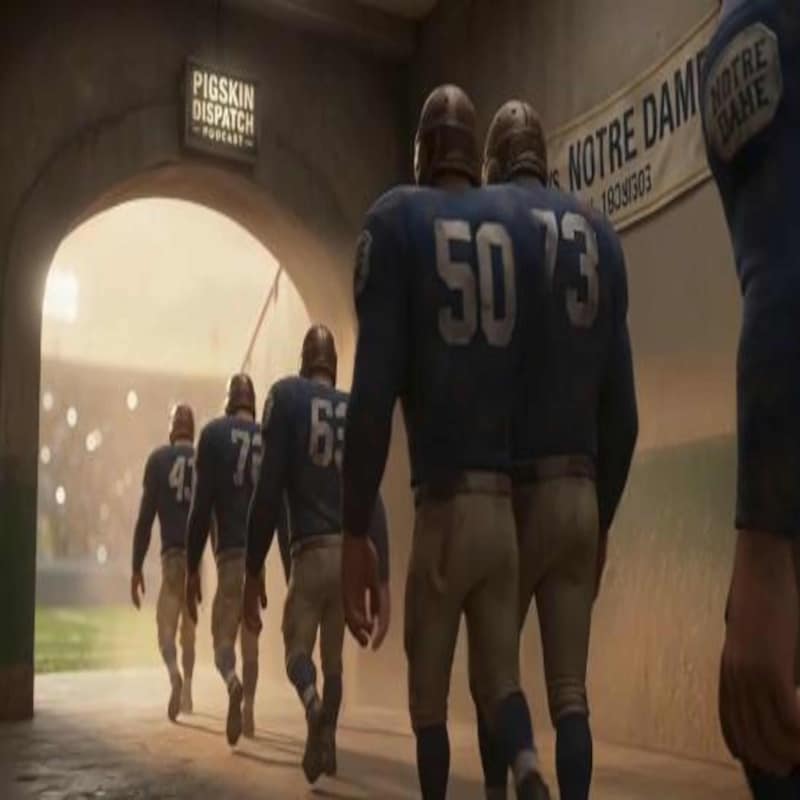
This podcast episode delves into the intriguing narrative of Notre Dame's halftime jersey switch, a phenomenon that exemplifies the historical quirks of football. Our esteemed guest, Timothy Brown, shares his fascination with these lesser-known tales, which not only illuminate the evolution of football attire but also reflect the broader cultural shifts within the sport. The discussion traverses the challenges teams faced with uniform colors, particularly during intense rivalries, and how these challenges gave rise to innovative solutions, such as adopting practice jerseys for clarity on the field. As we explore this captivating story, we also touch upon the eventual establishment of regulations regarding contrasting jerseys, driven by the advent of televised broadcasts. Through this exploration, we uncover the rich tapestry of football history, one narrative at a time, inviting listeners to appreciate the depth and significance behind what may seem like a mere anecdote.
This conversation is based on Tim's research and story titled: Notre Dame's Halftime Jersey Switcheroo
Join us at the Pigskin Dispatch website to see even more Positive football news!
Don't forget to check out and subscribe to the Pigskin Dispatch YouTube channel for additional content and the regular Football History Minute Shorts.
Miss our football by the day of the year podcasts, well don't, because they can still be found at the Pigskin Dispatch website.
Transcripts
You know, almost every rule and fundamental form of football has a ghost story, if you go back in the past and take a look at it.
And tonight we have a gentleman, Timothy Brown, who joins us each week that loves to hunt down these stories and talk about some of the amazing facts and people and also some interesting stories like we have tonight. Tim, welcome back to the Pig Pen.
Tim Brown:Hey, Darin, good to see you again. And I think this should be a colorful episode.
Darin Hayes:Yeah, I, I think this will be very colorful for more reasons than one.
You know, this story that you wrote, and I'm not sure when you wrote this, and I read it recently, but it just amazed me, and it just puts a little smile on your face and a little bit of awe. And you. You titled it the Notre Dame Jersey, Notre Dame's Halftime Jersey Switcheroo. And what can you tell us about this tale from the past, Tim?
Tim Brown:Sure.
Darin Hayes:Yeah.
Tim Brown:You know, so this, this goes back to the days when, you know, teams bought one set of, you know, one uniform, one set of jerseys, one pair of pants. Sometimes they'd have two pairs of pants, but they basically had one jersey that they wore all season long.
And so, you know, if you were navy, if you wore a navy blue jersey and your opponent had a navy blue jersey, well, that's just what you did. You know, you dealt with it. So navy blue and black, lots of different reds and maroons and, you know, those kinds of colors.
And so if you, you know, if you played an opponent, and especially, like there were rivalries, like, you know, Colgate, Cornell was a big rivalry, but they both had red or maroon, you know, just army navy, you know, black and navy blue, and then Notre Dame navy blue. So anyways, so eventually people realized I was kind of dumb. And so the first thing that they.
That I found where, you know, I mean, I'm sure there were some places where somebody changed the jersey, but mostly what one of the first steps they did was it was actually Cornell. They started wearing, you know, what we think of now as practice jerseys.
You know, the, like every high school or whatever, they've got, you know, white jerseys, yellow jersey, red jerseys that you slip over your. Your jersey and shoulder pad.
Darin Hayes:The pennies, you're talking.
Tim Brown:Yeah, the pennies. Yeah. I mean, there's different, you know, there's all kinds of different names for them.
But so, you know, Cornell would put those on when they were going to play a team that also wore red jerseys. So, you know, if you look back at their yearbooks from that era, that's what they've got going on.
And then, you know, there were other teams that had, they might have a second jersey, like their secondary color, if they were black and gold, you know, if they normally wore black, but they were meeting another team with the dark jersey, they might wear a gold jersey for that game.
And there are even instances of schools that would, they borrow the local high schools jerseys, you know, wouldn't have anything to do color wise with their team, but it was just a way to not spend the money on new jerseys. And yet you get to, you know, differentiate, differentiate yourself from, from the opponent.
imes they'd wear green. So in:And in that game everybody is hacked off because they didn't order them in time to get all the numbers, the same numbers on the jersey.
So the, the numbers in the program didn't correspond to the numbers that the guys wore on the field that, who know that that may have been a little gamesmanship too, but the story was, it was innocent. So, so anyways, so Notre Dame had a tradition of sometimes wearing green.
And then in:So Iowa had black jerseys, Notre Dame had navy blue. And there's a scoreless tie till late in the first half. And then Notre Dame threw an interception like inside their own 10.
And a couple years, a couple plays later, Kinnick scores. So, you know, and they convert. So it's seven nothing.
They go into half for halftime and in the second half, Notre Dame comes out wearing green jerseys with, you know, it was an old style, but, you know, the, the colors of the shoulder pads were different, right? And in this case there was green and then gold shoulder pads or yellow shoulder pads.
And you know, it didn't really help them too much because it wasn't until the fourth quarter that they finally scored and then they failed on the conversion. So they ended up losing the game seven to six.
But, you know, it's just one of those things is the only story I've come across of a team switching jerseys at halftime. You know, now Notre Dame would like come out, there's different times where they came out, like in practice, pre game wearing their navy blue.
And then they come out at the start of the first half wearing green jerseys. And that was a big, you know, psych up thing. But at. This is the only story I've come across where somebody switched at halftime.
But, you know, then of course, since, you know, it became sensible that in 49, the NCAA said the home team is responsible for making sure that the. The two teams were contrasting colored jerseys.
So since the home team was at home and presumably had access to two different color jerseys, that's what they did. And then, and then here's a question for you.
When do you think the NCAA required teams to, you know, we, we then went to the home and away, you know, system with the away team wearing a lighter jersey than. Than the home team. When do you think that changed officially from an NCAA standpoint?
Darin Hayes:If I'm not mistaken, I think it might have been like the early 70s.
Tim Brown:Yeah, it was 83.
Darin Hayes:83. Oh, wow. Okay. Even more recent than I thought.
Tim Brown:Yeah. You know, and the funny thing was, you know, that was driven by television.
You know, I mean, they first did it because while you could tell, you know, green and blue apart in a stadium, you couldn't tell those two apart on a black and white television. So television is what drove the move to the white away jerseys.
But it's one of those things that, like the pros did that and then basically everybody went that way. And even though it wasn't required. So like high schools, I mean, we had home and away jerseys in high school. We certainly weren't on television.
Right. And, you know, every college, you know, went that direction.
So it's just one of those funny things that, you know, people mirror what the high, you know, the highest level are doing, even though the actual functional reason for the, for them doing it doesn't apply at the lower levels.
Darin Hayes:Yeah.
You know, this story and a lot of these little side stories that you're saying, it really hits home with me because little does anybody know, I was part of a game that the national federation, who does most of the. The high school. The states are in the play high school football, go by the nfhs, change their rule on this, the jerseys for home and away teams.
You know, about 20 years ago, it used to say the home teams were darks and the away team would wear a contrasting color, lighter color. It was something like that. It didn't say the word white in it. So we had the biggest rivalry here in Erie.
The two major prominent big schools play every year the first Friday in October. It's a breast cancer awareness benefit, and it packs a stadium, whether it's the one school or the other school stadium. They have the home and home.
Every other year, the home team was wearing their dark blue jerseys, white pants, warming up, and they go in the locker room seven minutes before kickoff, and they usually come out three minutes before. Well, they came out wearing all gray, the visiting team wearing all white. And they both had. One had black helmets, one had dark blue helmets.
So they came out and I'm like, going, oh. And, you know, all the. Both of the coaches are my age.
So one night was a grade behind me at the high school I went to, and the other one was a rival high school. But I played, you know, softball and stuff with this guy for years. I knew them both very well. So I'm caught kind of in a pickle. I'm the referee.
Tim Brown:I'm.
Darin Hayes:The guy's gonna make the decision. So I'm like, going, okay. I'm not. And I know they did it to get each other. Well, the guy to change the jerseys to get the other guy's goat.
He's wearing light gray as his home thing. So I'm like, oh, my God. So I talked to my umpire, and I'm like, you know what? I can't. I'm not throwing a flag in this big game.
To start the game, to change this jersey, let's see if we can get by. I'd talk to my crew. I said, can you. Can we discern which teams which. So we don't have, you know, a white jersey foul, and it's really light gray.
And we figured out we. We could. So we played the game, didn't throw a flag on it, but it ended up becoming a big thing here in Western Pennsylvania.
Went down to state, I got phone calls, and it was just a big mess. I had to go to the school and review film with the coach that did it and why he did it. And he ended up getting fired for it, I guess, because.
Because they end up losing the game. But the National Federation the next year changed it. And I believe it probably had something to do with it.
They changed the wording to the way team must wear white jersey.
Tim Brown:So, yeah, yeah, I mean, well, it's just one of those things. I mean, originally there was an economic reason. You know, people just couldn't afford.
You know, they were lucky to have everybody wearing the same color jersey. And so to have two, you had to be a pretty big program to really make that pay.
But, you know, now you just can't even imagine, like, you know, little, little league, you know, travel type stuff. Everybody's fully kitted out.
Darin Hayes:And, you know, we're lucky if a home team wears the same jersey twice in a season. You know, now they have jersey for every game. It seems like it's crazy.
Tim Brown:Well, not in Pennsylvania they don't. They don't understand. The times have changed there.
Darin Hayes:Yeah, we have Penn State as our. Our modern schools, they just wear all white with white helmets. You know, it's boring. Was boring uniform in the world. But yeah, that's.
That's what we like here.
Tim Brown:Yeah, that's fine.
Darin Hayes:But yeah, that's good stuff, man. I can't imagine what I would have done if a team would have changed at halftime. So that's just sort of blows my mind. And that's a game.
Definitely gamemanship. You're trying to get the other team getting their heads a little bit. It works people up.
Tim Brown:Yeah, well, they still lost, so. Right, right.
Darin Hayes:And so did the one that. That I was talking about that I had that team lost too. So just crazy.
Tim Brown:Then Layden later becomes the NFL commissioner and he's the guy who instituted. You have to wear socks up to your knees, so.
Darin Hayes:Right.
Tim Brown:Hey, he's a big uniform guy.
Darin Hayes:Which Roselle even kept enforcing while he was still in there from. And no head writing on the headbands with the.
Tim Brown:Well, now it's going to be an NCAA rule. You gotta work, gotta wear socks up to the knees.
Darin Hayes:Really? Wow.
Tim Brown:I don't like it.
Darin Hayes:God, their pants are above their knees. They're gonna still have.
Tim Brown:Well, they're changing that. That's part of the. The entire leg has to be covered now.
Darin Hayes:Really? Okay, interesting. I didn't hear that one. But we'll have to follow that and have some upbreaking breaking news this season maybe on that.
What's going on. But Tim, you know, that is just a fascinating story. And you dig deep into the.
Your research that, you know, the old newspapers, the old books, the old advertising, you find interesting stories to share with us, which, you know, 50, 60, 100 some years ago were big stories of the day that we've sort of forgotten and we'd love to have you doing that. And maybe you could share with folks where they could catch some of these stories that you write.
Tim Brown:Sure. Just go to footballarchaeology.com it's a substack site.
So either subscribe where every time I set create a new story, you'll get an email that, you know, has the story, or you just, you know, bookmark it, come in, visit whenever you want, and, you know, have at it.
Darin Hayes:So all right. Well, Tim, we really appreciate you coming on today and as you do every Tuesday and we'd love to talk to you again next week.
Tim Brown:I'll be here.
Speaker C:That's all the football history we have today, folks. Join us back tomorrow for more of your football history.
We invite you to check out our website pigskindispatch.com not only to see the daily football history but to experience positive
Darin Hayes:football with our many articles on the good people of the game as well
Speaker C:as our own football comic strip cleat marks comics.
Pigskindispatch.com is also on media social social media outlets, Facebook, Twitter, Instagram and don't forget the Big Skin Dispatch YouTube channel to get all of your positive football news and history. Special thanks to the talents of Mike and Gene Monroe as well as Jason Neff for letting us use their music during our broadcast.
Speaker D:This podcast is part of the Sports History Network, your headquarters for the yesterday of your favorite sport. You can learn more@sportshistorynetwork.com.




