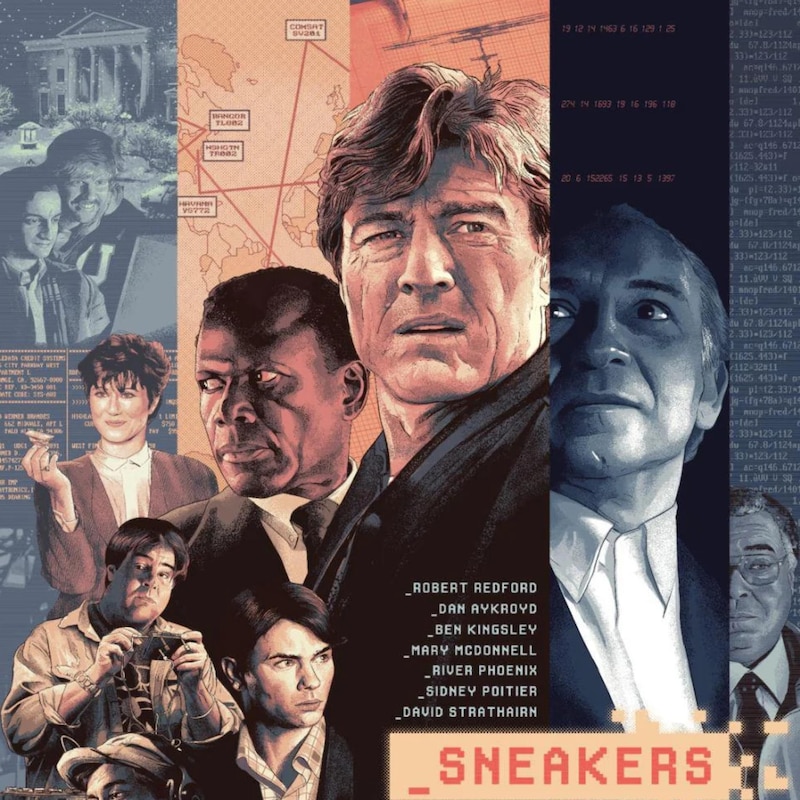
Shownotes
At first I was going to simply just write about my love of Phil Alden Robinson's spy thriller, Sneakers (1992), but then I decided it was time to start recording my voice again in hopes of returning to our regularly scheduled program next month. Since I needed something to lift my spirits, I asked friend and Chicago Film Critic Erik Childress to join me to talk for 2 hours all about a movie that means a lot to me. Another "Jim and his dad love this movie" example.
Instead of only talking about why it's so great as a bonus episode, I thought a feature-length commentary track was in order, something I haven't done since recording last year with Bill Ackerman for the 4K release of At Close Range, another all-time favorite that I'd consider to be underrated. Erik was kind enough to take time out of his busy schedule to play a game a Scrabble, hop inside an unmarked van and wire-tap a mathematician in order to get our voyeuristic kicks. Even if you're not a fan or don't own this film to listen along as the film plays, feel free to simply just listen us nerd out for a couple hours about this all-star ensemble cast killing it every step of the way. It's a prescient film that has a lot to say and manages to be a blast the whole way through. Grateful to Erik and hope you enjoy what we have to say here!
00:00 - 05:31 - Intro
05:32 - 02:11:17 - Commentary Track
02:11:18 - 02:17:59 - Outro
Transcripts
Sam.
Speaker B:Hi, my name is Jim Laszkowski.
Speaker B:My voice is my passport.
Speaker B:Verify me.
Speaker B:Or rather, my name is Jim Laszkowski.
Speaker B:Directors Club is my podcast.
Speaker B:And after about a three month break, I am back with something very special here.
Speaker B:Get out your Scrabble tiles, a discreet unmarked van, and your 49ers cap, because this is a bonus episode and that is no longer a secret.
Speaker B:As much as I would have loved to have assembled maybe an entire team of hackards and wizards to join me, I managed to ask one of my dear friends and favorite Chicago film critics, the host of Movie Madness, the co host of the Friendship Dilemma, and an all around true blue cinephile, the one and only Eric Childress.
Speaker B:Welcome back, man.
Speaker C:Thank you, man, for having me.
Speaker C:Appreciate it.
Speaker B:Absolutely.
Speaker B:So we're, we're here to discuss and provide another live commentary track.
Speaker B:We did this in the past for the Last Starfighter and Cloak and Dagger too, right?
Speaker B:If memory serves.
Speaker B:Yes.
Speaker B:So kind of veering away from the video game theme a little bit, but.
Speaker C:But still in the tech world.
Speaker B:Yes, yes, exactly.
Speaker B:And courtesy of the same writing team of War Games, which is interesting.
Speaker B:Like, I was looking at, you know, their, their filmography, and it's true of the director.
Speaker B:Not, not a whole lot to their credit, a lot of producing, but certainly it's just interesting to see the.
Speaker B:I don't want to say just, oh, they just never, you know, successfully collaborated again after, you know, a certain period of time.
Speaker B:But it's wild to think, like it did take them a long time to complete this script for Sneakers after doing War Games, but.
Speaker C:Yeah, you know, go ahead.
Speaker C:Yeah, no, I'm just, I was just thinking about, like, because, like, this is a screenplay.
Speaker C:We'll get into this.
Speaker C:Like, that goes back, you know, even like pre war games.
Speaker B:Yeah.
Speaker C:Or I'll talk about it a little bit at the beginning here.
Speaker C:But it's just.
Speaker C:Yeah, there's, there's, there's.
Speaker C:I hope there's a lot to talk about.
Speaker C:I think there is between the two of us.
Speaker A:So.
Speaker B:Yeah.
Speaker B:And, and again, I was listening to the, the commentary between the writers and the director, and they find themselves so wrapped up in the movie that sometimes they don't talk, which I always find.
Speaker C:That we're gonna try to avoid.
Speaker C:Yeah.
Speaker C:Because those commentaries that I hate are the ones where people start, you know, I don't mind if they're laughing.
Speaker C:You know, I enjoy a good Kurt Russell, John Carpenter commentary, but, you know, I don't like dead air during the commentary.
Speaker C:So we'll try to keep that avoid that as much as possible.
Speaker B:So right after a film like the Conversation and before Enemy of the State and a couple of years before Hackers, there was this little movie called Sneakers.
Speaker B:And you know, instead of just doing like a big preamble and going, hey, what was your first time and your first experience?
Speaker B:We're gonna do that in the actual film.
Speaker B:So I just want to get things rolling here because it is a two hour film and we're just excited.
Speaker B:I am very excited to hear what Eric has to say because unfortunately, I did miss when you hosted a screening of this.
Speaker B:And God, I would have loved to have been there for that because it's a movie that I adore and haven't seen on the big screen.
Speaker B:But at the same time, it's, it's, it's had a nice cult following behind it.
Speaker B:And even upon doing more research, I was surprised to read and find some middling reviews and even, well, talk a little bit about my partner's impressions of the film.
Speaker B:It's just because she had.
Speaker B:It wasn't necessarily like a full blown negative reaction.
Speaker B:She's like, I've seen this kind of stuff before.
Speaker B:It wasn't anything that blew her mind.
Speaker B:But I also, you know, brought to her attention that I don't want to say, like, oh, you know, a lot of the movies that I end up doing commentary tracks for are fueled by like, I've seen this 30 times or I have nostalgia for it, or it was a connection that I had with my dad and all that.
Speaker B:So there's, there's a lot of reasons why now watching it today, I can go, maybe you can critique this, critique that.
Speaker B:But I can't.
Speaker B:It's just not in my DNA.
Speaker C:Well, hopefully logged our current re watch of this.
Speaker C:We will discover exactly why this one stands apart from a lot of the movies that she might have been thinking that she's seen before.
Speaker B:Yeah, yeah, I agree.
Speaker B:So, everybody, let's do this.
Speaker B:If everybody can get out their copy and pause two seconds in the second you see the light peering around the earth for the Universal logo, hit pause.
Speaker B:That way you can sync up your copy of Sneakers with us.
Speaker B:I will count us down and then about two seconds in, you're gonna hear two huge fans of this really special film and about what it means to us.
Speaker B:So sync up your copy, right?
Speaker B:And I will count us down from three, you hit play, and then you're gonna join us on this cinematic journey.
Speaker B:Or you can just simply just treat this as a podcast and listen along.
Speaker B:I know, folks, just do that without even watching the movie, especially if they're very familiar with the movie and they've watched it 30 times like I have, so that's an option as well.
Speaker B:But here we go, everybody.
Speaker B:I'm gonna count you down right now.
Speaker B:Three, two, one, play.
Speaker B:All right, so where to begin with sneakers?
Speaker B:Obviously, I'm curious about your first experience watching it and what you thought.
Speaker C:My first experience.
Speaker C:It's one of more memorable experiences I had just because it was a fluke, honestly.
Speaker C:We were two friends, two co workers that I worked with at my first job of video store.
Speaker A:These.
Speaker C:These credits are lovely.
Speaker B:Oh, yeah, Anagrams, we love them.
Speaker C:A little.
Speaker C:Little puzzles.
Speaker C:Just a little.
Speaker C:Get your neurons going right at the beginning here, try to put this together.
Speaker C:A few laughs.
Speaker C:But no, we were.
Speaker C:We were going to see a comedy show, actually.
Speaker C:The comedian Jake Johansson was in town to do it.
Speaker C:A little comedy club, I think Naperville, Aurora, something like that.
Speaker C:Chicago, outside of Chicago.
Speaker C:And I was only 17 at the time, and that didn't stop me before from seeing, actually, Bill Hicks live, uh, in person.
Speaker B:Wow.
Speaker C:Yeah.
Speaker C:Uh, that was.
Speaker C:You know, that's a whole other story.
Speaker B:But then you immediately went and did mushrooms right after.
Speaker B:Because I did not.
Speaker C:Yeah, I did not.
Speaker C:Uh, but I couldn't get it.
Speaker C:They would not let me in because I wasn't 18, and this was a smaller comedy club.
Speaker C:It was in the suburbs, not the city.
Speaker C:And I was completely bummed because I basically blew the evening for my two friends and co workers, and they just kind of tried to cheer me up.
Speaker C:Oh, there's the clock tower, by the way.
Speaker B:Yeah, you know, that.
Speaker B:Yeah, that.
Speaker B:That.
Speaker B:That courthouse looks quite familiar.
Speaker B:I don't know where I've seen it before.
Speaker C:Little snowy right now, but pretty, if you're paying attention, is a Universal movie.
Speaker C:This, that.
Speaker B:That kind of shot on the same lot.
Speaker C:Yeah, yeah, yeah.
Speaker C:So anyway, so we ended up there.
Speaker C:There, sort of like, I. I was completely bummed out.
Speaker C:They're just like, well, let's just.
Speaker C:We'll just go see a movie.
Speaker C:Let's let.
Speaker C:Let make the evening destroy.
Speaker C:Throw it away.
Speaker C:And it was opening night of movie, this movie Sneakers.
Speaker C:And we went to the Woodfield one and two, the big theater, and watch this movie.
Speaker C:And man, did.
Speaker C:It was like the best, like, breath of fresh air, surprise.
Speaker C:We weren't expecting a whole lot out of it, but we walked out so enthusiastic after watching it.
Speaker C:Like, that movie.
Speaker A:Did it.
Speaker B:Did you think you were going into a movie about shoes?
Speaker C:I did not.
Speaker C:No.
Speaker B:I. I do at Least one thing I'll say is that I'm not the biggest fan of the title.
Speaker B:I don't, I don't know, it doesn't really say much about the movie and I don't know if it was marketed very effectively.
Speaker B:You know, just even the post market.
Speaker C:Tagline, it was marketed as a thriller too.
Speaker C:I mean, I think that's the thing that really surprises is that we were not expecting it to be as funny and as lighthearted right as it was.
Speaker C:I mean, it certainly delivers as far as the thriller is concerned.
Speaker C:But I, I do have to say right at the top here that the casting of these two actors.
Speaker B:No.
Speaker C:As young, Young Redford and young Kingsley are like some of the best young casting I have ever seen in a movie.
Speaker B:I completely agree.
Speaker C:I know, like, it's up there with like the young Leota Pesi from Goodfellas.
Speaker C:I mean, that's, that's a whole other topic to think.
Speaker C:Think of this.
Speaker C:But like, I mean, you watch this and just like, my God, where do they find these guys?
Speaker B:You know, you know, who helped consult them on the little sleight of hand, of course, was the great Ricky J.
Speaker B:That he stopped by and helped them out with.
Speaker C:Yeah, there you go.
Speaker B:Yeah.
Speaker B:Oh, James Horner's score, everybody.
Speaker B:One of my all time favorites.
Speaker B:And it gets stuck in my head.
Speaker B:And now that I've watched this a couple of times in prep for this, I'm like.
Speaker B:And yeah, the saxophonist or the hope and the oboe.
Speaker B:Yeah, like Brand.
Speaker B:Brand Marsalis.
Speaker C:I mean, the, it's.
Speaker C:The Marcellus work in this movie is what always stands out to me.
Speaker C:I mean, hoarders.
Speaker C:I mean, you could recognize hoarder score because, you know, he, you know, he does tend to recycle this stuff over the years, you know, from before this and even after this.
Speaker C:But not that it's not enjoyable, but it's Marcellus's like that jazzy feel that you got.
Speaker C:It just kind of just.
Speaker C:It's like a war bath in a way, watching this movie and just kind of, kind of like a sit back and just.
Speaker C:Yeah, it's just, it's, it's water.
Speaker C:This is a, you know, a great little opening here, establishing these two characters and how it'll eventually, you know, come back and haunt the Martin Bryce character.
Speaker C:Yeah, you think you think about this, like, you know, you think about friends in your life.
Speaker C: a very early age in the late: Speaker C:Idealists, you know, want to change the world.
Speaker C:They talk about and.
Speaker C:And one of them, you know, gets arrested and, well, so we assume dies in prison and the other one goes on the run for the rest of his life.
Speaker B:And now we begin the very conversation, like intrigue here where it's the thing I love about this movie, especially watching it again and again was just kind of like there's a lot of just misdirection thrown at you throughout where it sets up an expectation and it turns out to be something completely different.
Speaker B:And, you know, even.
Speaker B:Even here and you're talking about, like, you know, the fact that this was, you know, marketed more as a thriller and you're expecting the thrills, and it does bring that.
Speaker B:But the camaraderie between all these guys in this, you know, contained environment is just so incredibly infectious.
Speaker B:I mean, like, I, I've.
Speaker B:I want to hang out with these guys, you know, like, they don't.
Speaker B:They.
Speaker B:They're nerds and they totally endear themselves to you and to the audience.
Speaker B:And they're all distinctive.
Speaker B:That's the thing I think I really appreciate too is, like, it's not a case of someone like Kevin Smith writing where almost every character speaks the same language.
Speaker B:Everybody here is very different.
Speaker B:And I love that.
Speaker C:Yeah, they're defined by their traits.
Speaker C:And, you know, you might say that, you know, they each have one specific trailer.
Speaker C:Aykroyd is obviously the conspiracy guy.
Speaker C:And, you know, Kreese has got a CIA background to him, but again, just like the humor immediately right off the bat here, the, the.
Speaker C:They're laid it out that, you know, these guys are.
Speaker C:They're a great team, they're comfortable with each other, but they do kind of get on each other's nerves a little bit too.
Speaker C:At least the Ackroyd character certainly does.
Speaker C:And you got.
Speaker C:Here's the funny thing, like all this whole team.
Speaker C:And you could throw in Mary McDonald, who will be introduced to later.
Speaker C:All of these actors, with the exception of one at the time, Oscar nominees.
Speaker B:Oh, that's right.
Speaker C:Or winners.
Speaker C:You know, some of them, obviously, you know, Redford had won and Kingsley had won.
Speaker C:Poitier obviously had won, but only one person, and that person would eventually get a nomination many years later, and that would be David Strathairn.
Speaker B:Oh, yeah, and it's pretty wild too.
Speaker B:I kind of randomly, on a day off, threw on Mate one because I hadn't seen that in a long time.
Speaker B:And I was just curious about revisiting it since Criterion Put it out fairly recently.
Speaker B:And I was like, oh, my gosh, there's, like, so many people from sneakers in this.
Speaker B:Well, three.
Speaker B:Three main ones, for sure.
Speaker B:Here's a little.
Speaker C:Here's a little blackface gag for.
Speaker B:The great River Phoenix, who was just coming off of my Own Private Idaho.
Speaker B:And kind of like, since that movie really got to him and it was.
Speaker B:Affected him deeply, and he was so, like, emotionally involved in every aspect of that story, he actively sought out something lighter for him to do.
Speaker B:And I'm kind of glad.
Speaker B:It's nice to just see him having fun.
Speaker B:And it's similar with Redford, too, because, like, Sharon, my partner, was like, I don't know about Redford.
Speaker B:He just always seems so smug.
Speaker B:And I have a hard time, you know, getting on board with him because, like, yeah, he just comes across that way.
Speaker B:And I was kind of like, but he's.
Speaker C:Look at.
Speaker B:He just tripped and fell.
Speaker B:You know, he's that Mr.
Speaker B:Confident throughout this whole movie.
Speaker C:No, there's.
Speaker C:There's a great balance that he brings.
Speaker C:Like, Redford is so good at, you know, for lack of a better term, light comedy.
Speaker C:Yeah, just moments throughout this movie where it's.
Speaker C:It's just.
Speaker C:It's.
Speaker C:It's like, just like, north of ridiculous a little bit.
Speaker C:Like, you know, you establish a character like that by having them trip over the thing.
Speaker C:And that's kind of a, you know, too old for the kind of gag.
Speaker C:But.
Speaker C:But it shows that, you know, these guys are.
Speaker C:They're professionals and they know what they're doing, but they're not, you know, immune from stupid mistakes and things.
Speaker C:And Redford balances that throughout this movie because, again, you'll see these.
Speaker C:Of these moments of light comedy, but there are moments there where he has to turn on the intelligence.
Speaker C:It has to be the idealist version of Redford that we've seen in movies over the years.
Speaker C:We'll get that with what he has seen with Ben Kingsley later.
Speaker B:Yeah, for sure.
Speaker B:It's just.
Speaker B:It's like Three Days of the Condor is a buddy picture almost, you know, and it's.
Speaker B:I think that's kind of what I love about it.
Speaker C:Yeah.
Speaker C:And just to go back to that opening scene, I mean, Redford in Three Days of the Condor, his character goes out for sandwiches and comes back to the.
Speaker C:To the massacre of his.
Speaker C:You know, his.
Speaker C:Where he works, and here he goes out for pizza, and his best friend gets arrested.
Speaker A:Well, I just had this weird feeling that my money wasn't safe here anymore.
Speaker B:Yeah.
Speaker B:And again, I just love the Mis.
Speaker B:Yeah, exactly.
Speaker B:I was just gonna say the same thing.
Speaker C:Yeah.
Speaker C:It seems like.
Speaker C:Like they just pulled off, like, a little bank heist here.
Speaker C:But then, you see, he goes up there and we find out exactly what this crew is up to.
Speaker C:And there's a.
Speaker C:They get a.
Speaker C:He gets a real.
Speaker C:It's a great little moment of writing, but just like, the snest remark he gets from the person who cuts his check in a moment here is just like.
Speaker C:Like, wow, that was some unnecessary shade, I think.
Speaker B:Yeah.
Speaker C:Here we go.
Speaker C:Little exposition here.
Speaker A:Places.
Speaker A:Make sure no one can break into their places.
Speaker A:It's a living.
Speaker C:Damn.
Speaker C:Makes me think of the Jerry Seinfeld line.
Speaker C:You're a cashier.
Speaker B:Yeah.
Speaker C:Wow.
Speaker B:But, you know, and it's.
Speaker B:There's, you know, coming up, there is a little bit of an exposition dump, but it's not.
Speaker B:I don't know.
Speaker B:The way they handle it, I think is appropriate given the situation that they find themselves in.
Speaker B:But I just love that this movie starts out with them doing their job and you get to know them through action and not just like, oh, let's explain everybody who.
Speaker B:What they do and what they.
Speaker B:What they are.
Speaker B:So that's just a great way to set up and kind of show people being good at their job, but also, like you mentioned, you know, being imperfect.
Speaker C:Timothy Busfield going through things right now.
Speaker B:Yeah, unfortunately, that was a little.
Speaker B:Little.
Speaker B:Little icky.
Speaker C:It's a little.
Speaker C:Yeah, yeah, it's more than that.
Speaker B:Unfortunate.
Speaker B:Yeah, that's.
Speaker B:I. I had to do a screening of Ferris Bueller for an.
Speaker B:For an author who wrote an entire book on Ferris Bueller.
Speaker B:And I'm just like, all right, somebody asked a question about Jeffrey Jones and where his career went, and we were like, let's move on.
Speaker C:Yeah.
Speaker C:Just remember that Timothy Busfield has played a character not played Timothy Busfield in this movie.
Speaker B:Yes, exactly.
Speaker C:That's.
Speaker C:That's the way to look at it.
Speaker C:I mean, since you went back, you mentioned, like, the start of.
Speaker C:Of this.
Speaker C:I mean, the screenplay that you talked about in the intro.
Speaker C:The.
Speaker C:It was first, you know, brought to Lord Glasgow and Walter Parks were working on board games.
Speaker B:Right.
Speaker C:And they were doing.
Speaker C:And they were doing research for it, and they discovered that there were, like, kid programmers who worked at IBM who were known as Sneakers.
Speaker C:So that's.
Speaker C:That's where the title comes from.
Speaker C:And they were at a computer convention in Chicago and they started, like, asking around, you know, about sneakers.
Speaker C:And they were.
Speaker C:They're basically, you know, for, you know, what we know now as Black Hatters.
Speaker C:You know, they were.
Speaker C:They were hackers, basically.
Speaker C:And that's where sort of like, the.
Speaker C:The impetus for the story began.
Speaker B:Yeah.
Speaker B:And it's.
Speaker B:They were like these tiger teams of security consultants that would do what we see them do in the beginning that just, like, test out security.
Speaker B:And I guess, like, their initial idea or their pitch was like, you know, like Dirty Dozen with computer hackers, you know, and it's kind of, I don't know, like an interesting way to start thinking about how to, you know, incorporate all of this.
Speaker B:And it's just funny, too, we missed, like, them talking about River Phoenix's character.
Speaker B:It's a nice callback to War Games.
Speaker B:Right.
Speaker B:Because he was caught hacking into the school's computer trying to change his grades.
Speaker C:Yeah.
Speaker B:So, like, I like it when they do little Easter eggs like that for fans who.
Speaker B:You know, again, like, at the time when this first came out, it's not like you can do research and figure all this stuff out the way we can today, but it's.
Speaker B:It's just kind of cute.
Speaker B:I like that stuff.
Speaker C:Yeah.
Speaker C:And this is.
Speaker C:I mean, this is nine years after War Games.
Speaker C:Not that people have forgotten about War Games at the time, but, I mean, it was.
Speaker C:I mean, that was a huge, huge movie when I was growing up, just, you know, committed to my own knowing, learning about computers and also my fear of nuclear war.
Speaker C:That was a pretty big movie when I.
Speaker C:When I was growing up.
Speaker A:So.
Speaker C:Yeah, so you got a little expos.
Speaker C:Exposition dump here.
Speaker C:Word to background on all the characters.
Speaker C:And you do that through basically their, you know, their intelligence dossier.
Speaker B:Yeah.
Speaker B:And that's.
Speaker B:That doesn't make my eyes roll.
Speaker B:I think that's actually a great way to do it.
Speaker B:I think it's a great way to introduce all these characters.
Speaker C:You know, here's a little Redford joke here.
Speaker C:Yeah, that's.
Speaker B:That wasn't in the original script.
Speaker B:That.
Speaker B:I mean, maybe they put those posters there, but still.
Speaker B:Yeah, that was.
Speaker B:That was nice.
Speaker C:Yeah.
Speaker C:This is before the night.
Speaker C: These came out before the: Speaker A:Became president.
Speaker B:And, folks, you should pay attention.
Speaker B:I know it's an odd thing to think about, but pay attention to Timothy Busfield's hair and how it changes later on in the film because it was a deliberate decision on his part to, like, have this kind of hairstyle for, you know, a representative of the government or the NSA to almost, like, mirror the way Robert Redford looks.
Speaker B:And then later on in the film, when we find out, you know, who he really is, his Hair is all slicked back, just like Cosmo.
Speaker C:Yeah, it's true.
Speaker C:We should.
Speaker C:Yeah, we should draw more attention to Tiffany Busfield, by the way.
Speaker C:Just for people.
Speaker B:The only thing.
Speaker B:The only thing I'll bring up when.
Speaker B:In regards to his character.
Speaker C:No, it's.
Speaker C:It's a.
Speaker C:It's a great little.
Speaker A:We don't know what CTEC stands for.
Speaker C:The good cop, bad cop routine they got going here.
Speaker C:This is the actor Eddie Jones, right?
Speaker C:Who is it?
Speaker C:You know, he.
Speaker C:He, you know, went after dad Aykroyd another movie some years ago.
Speaker C:Same years.
Speaker C:Same year's War Games, actually.
Speaker C:He's, uh, the cop in traded places that, uh.
Speaker C:Take off his clothes.
Speaker B:Yeah, that's right.
Speaker B:Of course,.
Speaker A:The FBI can't work for us without approval from a congressional oversight committee.
Speaker A:We don't have the time, so.
Speaker A:Why?
Speaker A:Frankly, because.
Speaker B:Yeah.
Speaker B:I mean, and also, you know, what.
Speaker B:What you were talking about earlier, just about, like, having these ideals when you're younger, watching it now, it really is.
Speaker B:It really highlights this idea of a movie about aging to some degree and how someone like Redford, even in this profession, is trying to continue his ideals.
Speaker B:But also the outside world can corrupt it through influence the government, organized crime, or broken relationships or just.
Speaker B:Yeah, like a past that you can't escape from entirely.
Speaker B:And here it's about to kind of like, bite him in the ass in a way to where he's obligated to do this job.
Speaker C:Yeah, I mean, we just.
Speaker C:We're just coming off a year where, you know, one of the best movies.
Speaker C:I mean, for Pipe, for both of us.
Speaker C:The best movie of last year was one battle after another.
Speaker C:Oh, yeah.
Speaker C:So I'm kind of curious, like, I mean, which is a movie all about, you know, the idealism of your youth and you're trying to change the world.
Speaker C:And then you do have a kid and you grow up and you have to kind of leave that behind.
Speaker C:But the past is not gonna let.
Speaker C:Let that happen for you.
Speaker C:And I. I bet PT is.
Speaker C:PTA is a fan of this movie.
Speaker B:I. I would.
Speaker B:I would imagine so.
Speaker B:He's an insane fan as well, he should be of Midnight Run too.
Speaker B:So, like, you know, I think those types of movies, like, they're just so rewatchable and, you know, they speak to, like, our generation, I think, and certainly PTA as well.
Speaker B:Yeah, they're just like, good movies with good characters and, you know, like, it doesn't skimp on the entertainment.
Speaker B:It doesn't skimp on the action or just the set pieces or getting you really involved in a major way.
Speaker B:That's what I really love about this film in particular too, is that, you know, I know that someone like Evert really emphasized, like, that this is thin or, you know, not everything comes together in a satisfying way or something.
Speaker B:But to me, it's the complete opposite experience.
Speaker B:And I felt that was when I first watched this.
Speaker B:My dad and I rented this from the video store just based on the cast not knowing a whole lot about it.
Speaker B:I mean, I would assume I must have seen the Siskel and Ebert review of it, and maybe I kind of dismissed it and didn't, like, make it a priority until we saw it at the video store, rented it, took it home, and it became one of those movies like we've called before, A Remote Dropper, where if it was on cable, my dad and I would watch it at any point in the film and just get wrapped up in it in, you know, time and time again.
Speaker C:Yeah, I mean, it is an immensely rewatchable film.
Speaker C:And the, you know, I know Ebert, you know, he gave it a modest, like, two and a half star review.
Speaker C:Cisco gave.
Speaker C:Cisco gave it a thumbs up.
Speaker C:But as we're going to see here, this movie just builds and builds and builds, and it's hard for me to think of somebody watching this and, and thinking that is thin.
Speaker C:If anything, if you, you know, you think you've seen it before and, you know, maybe you've seen, you know, tens and hundreds of movies like this with teams and stuff like that, that maybe you just, maybe you're.
Speaker C:That could just be.
Speaker C:You're not interested in some of the things that they're doing.
Speaker C:I mean, they're basically, they're.
Speaker C:I mean, they got a McGuffin, they got their team.
Speaker C:They have to go after the McGuffin, and they find new ways to accentuate how they have to pull off this hype.
Speaker C:I mean, this is the, the first, like 45 minutes of this movie, maybe even the first hour of it.
Speaker C:You got to establish all these characters.
Speaker C:You establish what, you know, that they set you up with a sort of like an initial heist.
Speaker C:Basically.
Speaker C:It tried to get this black box that will eventually be called, and then they escalate it, and then it escalated some more, and then the team has to figure out how to pull off another heist and, and, and get.
Speaker C:Get themselves out of all this.
Speaker C:And they do it in such, like, every seed in, like, the second half of this movie is like an idea that I don't recall ever seen in a movie, at least done in the way that it is.
Speaker B:Yeah.
Speaker B:Now that's a good point.
Speaker B:And one of the first movies that my dad really loved, and I think a lot of it had to do with the ending, too, was the natural.
Speaker B:And the jacket that Robert Redford wears throughout most of this film is the exact same one.
Speaker B:It's just one of those Cute jacket.
Speaker C:Is it.
Speaker C:Is it this jacket or.
Speaker B:I don't think it's this one.
Speaker B:I think it's the.
Speaker B:It's almost like the letterman like, jacket that.
Speaker C:The one that he wore when he pulled up to the.
Speaker C:To the bush side.
Speaker B:Yeah, yeah, yeah, it's that one.
Speaker C:Interested?
Speaker B:Yeah.
Speaker B:He must have just kept it from.
Speaker B:Yeah, from the natural and just like, decided to keep wearing it.
Speaker B:Maybe because it looked good on him.
Speaker B:Well, I mean, he's Redford, so, I mean, right.
Speaker B:Just about anything's gonna look good on him.
Speaker B:Mary McDonald.
Speaker B:Talk about her for a little.
Speaker B:Yeah, imagine John Sales.
Speaker B:So, yeah, there's a little button at.
Speaker C:The end of that scene where they set up this relationship between Redford McDonald and they clearly had some sort of, you know, intimate relationship in the past.
Speaker C:And they.
Speaker C:They play it off like there's kind of disinterest there.
Speaker C:But the end, he pulls a kind of a Macaulay Culkin, like.
Speaker A:Yes.
Speaker C:Little moment there at the end.
Speaker C:Nice little thing.
Speaker C:Yeah.
Speaker C:I've.
Speaker C:I've always been curious about this relationship because you mentioned the friendship dilemma podcast that I do with Morgan guy.
Speaker B:Oh, yeah, there you go.
Speaker C:I've thought about.
Speaker C:I've thought about this relationship because I don't think that they.
Speaker C:I can't.
Speaker C:I. I always forget if they actually do have a kiss moment later in the movie or if they don't.
Speaker C:I know she kind of like nurses him back to health a little bit.
Speaker B:Yeah.
Speaker C:Tends to his wounds.
Speaker C:But I don't think they.
Speaker A:There's.
Speaker C:There's clearly there's something there, but they never.
Speaker C:By the end, there's never assumption that they're going to get together at all.
Speaker C:So I think this actually would make a great fit for.
Speaker C:For that podcast.
Speaker B:I think so, too.
Speaker B:I mean, obviously they were together at some point.
Speaker B:Romantically involved.
Speaker C:The first role for Dotto Logue, by the way.
Speaker B:Yes, his.
Speaker B:His.
Speaker B:His screen debut here, looking a. I don't know, looking like he should be a Die Hard.
Speaker B:Yeah.
Speaker B:With the long hair and the white suit and him standing in the background there with all that.
Speaker B:All that code and that text and that.
Speaker B:The.
Speaker B:The equations.
Speaker A:To come and learn your scientist.
Speaker B:And of course, you have to introduce a Russian consulate that's right.
Speaker B:So we suspect him as being involved at this time.
Speaker C:The great thing about movies is that Russia's villains will never go out of style.
Speaker B:No, it's true.
Speaker B:It's true.
Speaker C:Yeah.
Speaker C:Hello, Greg.
Speaker C:Yeah.
Speaker C:Seemingly introduced as potentially an important character, but we'll find out that, like you said, it's sort of a misdirect here as well.
Speaker C:And I like that.
Speaker C:Again, the dynamic that Redford McConnell.
Speaker C:They don't really want to talk to this guy.
Speaker C:They don't like Redford.
Speaker C:Just pause him off on the coddle and she's like, oh, great.
Speaker B:Yeah.
Speaker B:And it makes me wonder, like, why does she know him, too?
Speaker B:Like, how.
Speaker B:How involved has she been in with his, you know, sneaks or whatever he's been a part of in the past?
Speaker B:It's kind of interesting.
Speaker C:Yeah.
Speaker C:It's a way to use a character, an ancillary character like that to maybe, you know, make you think more about the relationship between Redford and McDonald, that.
Speaker C:How.
Speaker C:How long have they been.
Speaker C:Were they together?
Speaker C:That they knew this guy from back during the.
Speaker C:Basically the Cold War days.
Speaker C:Because this would be post Cold War.
Speaker A:I don't trust that.
Speaker A:That guy.
Speaker B:Oh, yeah.
Speaker B:See, setting things up like that by just saying, I don't know if I trust this person.
Speaker B:I don't know if I trust that person.
Speaker B:And there's a lot of talk of trust throughout this.
Speaker C:Yeah.
Speaker B:Throughout this movie, you won't know who to trust.
Speaker C:And here comes another Phil Alder Robinson staple from Field of Dreams.
Speaker B:Yes.
Speaker C:Book batter Lee Garlington.
Speaker A:Can I call you.
Speaker B:I started to revisit because I don't think I'd seen it since the theater, but I didn't get to finish it.
Speaker B:The Sum of All Fears, which is, I remember thinking, was good but not great.
Speaker B:And, of course, when she popped up at one point, I was like, oh, I know her.
Speaker B:I've seen her.
Speaker A:Yeah.
Speaker B:In several things.
Speaker C:She's also the villain in Cobra.
Speaker B:That's right.
Speaker C:One of the villains in Cobra.
Speaker B:Yeah.
Speaker C:The main one.
Speaker A:But.
Speaker C:Yeah.
Speaker B:Did you ever see.
Speaker B:Because I. I'm assuming you've seen it.
Speaker B:I. I never got around to.
Speaker B:I think it was Phil Alden Robinson's last film, the Angriest man in Brooklyn, which I don't remember getting great reviews, so maybe that's why I steered clear of it.
Speaker C:That's the Robin Williams film.
Speaker B:Yeah.
Speaker C:I never did see that.
Speaker B:Yeah.
Speaker B:Just because.
Speaker B:Yeah.
Speaker B:Again, like, it wasn't thought of as a good film.
Speaker B:So I was just like, you know.
Speaker C:Yeah.
Speaker C:When we talk about.
Speaker C:When we talk about Phil Alden Robinson.
Speaker C:We, you know, we think that, you know, his directorial career was not.
Speaker A:It was not.
Speaker C:It's not a huge resume.
Speaker C:Right.
Speaker C:As.
Speaker C:As you can see.
Speaker C:But when you go back to when last year, Parks, you know, have brought.
Speaker C:You brought this idea to Robinson way back in the day.
Speaker C:This is like the early 80s, that Robinson deals, asked them to develop the script.
Speaker C:And Robinson went off and he was writing his own scripts at the time.
Speaker C:He wrote, uh, all of Me.
Speaker B:Yeah.
Speaker C:Lily Coblin, and he did uncredited rewrite on Fletch.
Speaker B:Oh, wow.
Speaker B:Yeah, it's a really weird.
Speaker B:All you have to do is look at his writing credits and kind of see peaks and valleys and ups and downs and just kind of a varied career in terms of going from.
Speaker B:In the same year from Rhinestone to All of Me.
Speaker C:Yeah, well.
Speaker C:Yeah, there you go.
Speaker B:Yeah.
Speaker C: his directorial debut was in: Speaker A:Basically.
Speaker C:Yeah.
Speaker B:Under understood and a hard movie to find now.
Speaker C:I bet I could find it.
Speaker B:Yeah, I'm sure.
Speaker B:But it's.
Speaker B:Yeah, I want.
Speaker B:It's another.
Speaker B:I want to revisit again because I. I know I borrowed it from Colin like, many years ago, and I just never got around to revisit.
Speaker C:No, it's not.
Speaker B:It's.
Speaker C:It's a pretty enjoyable movie, basically.
Speaker C:True story of this, like, Te.
Speaker C:Maybe I don't know how it plays now.
Speaker C:I mean, teenage scenarios maybe that Patrick Dempsey played way too many of in that era that I never.
Speaker C:This is.
Speaker C:Well before he was known as, you know, McDre.
Speaker C:So I. I did never quite understood the Patrick Dempsey thing at this period.
Speaker C:And then, yeah, here's.
Speaker C:Here's them on the job and basically all being reduced to little boys.
Speaker C:All of them are released of teenage boys.
Speaker C:You know, Peepee Toms, you know, spied on this thing.
Speaker C:I mean, River Phoenix reaction.
Speaker C:Please let me look at Sidney Poitier.
Speaker C:You're like, you grow up.
Speaker C:And then he's like, let me take a look.
Speaker B:And I really do like that this.
Speaker B:This particular line keeps getting repeated.
Speaker B:And you don't think much of it at first, but of course, it's Whistler who's like, hey, wait a second.
Speaker B:Listen.
Speaker B:You don't have to look.
Speaker B:Just listen.
Speaker C:Yeah, this movie is well ahead of the day of Disclosure Day.
Speaker B:Indeed, indeed.
Speaker B:I think at one point, I think it's during the party sequence, Dan Aykroyd brings up aliens, and I'm just laughing my ass off at that now.
Speaker C:Yeah.
Speaker C:And again, like, here's, like, what you were just saying there, that, you know, we're sort of keyed as moviegoers, as visual.
Speaker C:Right.
Speaker C:You know, as a visual medium and as.
Speaker C:As spies, you know, we associate that with, you know, looking in on things that we're not supposed to be looking at, and we ignore the.
Speaker C:The other sense that to listen is just as important.
Speaker C:I mean, that's spies eavesdrop and stuff like that.
Speaker C:But here is just try to figure out someone's password.
Speaker C:And they think they failed because they haven't been able to see the keyboard strokes necessary.
Speaker C:And Whistler picks up on a very key point.
Speaker B:Whistler would be a huge podcast fan, I have a feeling, because, you know, there's this, like, people who love to listen.
Speaker B:I know.
Speaker B:You know, there's.
Speaker B:And I've.
Speaker B:I'm one of those, you know, and certainly there's.
Speaker B:I think, like, again, it's been inherent, and you can kind of go back to just.
Speaker B:Even the.
Speaker B:The work of Hitchcock is like, highly emphasizing voyeurism as this ultimate cinematic theme, because that's exactly what the audience becomes.
Speaker B:And, yeah, I. I like that.
Speaker B:I like it when it just comes up in even something like this, which, again, market is like, oh, look at this great cast, and you're gonna have a great time.
Speaker B:And it's a thriller and everything, but still, there's.
Speaker B:There's more to it than just that.
Speaker B:That's what I really appreciate about this movie.
Speaker C:Of course, here's another one of Ackroyd's mother's conspiracy theories about the.
Speaker C:The Apollo moon landings being faked.
Speaker C:It becomes like a, you know, a who's who of conspiracy theories that are brought out throughout this movie.
Speaker C:This is, you know, you know, nine months removed from jfk, you know.
Speaker B:Oh, yeah, yeah, yeah.
Speaker C:And well before, you know, Mel Gibson conspiracy theory that, you know, have had a little bit of fun with all that stuff.
Speaker C:But, yeah, this is.
Speaker C:We laugh at it.
Speaker C:You know, obviously we laugh at how ridiculous his conspiracy theories are.
Speaker C:And then you think in the 25 years since this movie that some people really do believe that stuff, and it's become.
Speaker C:Some of those things have become mainstream in some respects, that's scary shit.
Speaker B:Yeah.
Speaker B:I mean, there's tons of Reddit threads nowadays, and I don't know, it's just.
Speaker B:It's funny to think, too.
Speaker B:Sharon brought up the fact that.
Speaker C:I.
Speaker B:Want to say this.
Speaker B:Did this come out before or after the X Files because of the Lone Gunman you know, like that.
Speaker B:That interplay.
Speaker B:Yeah, yeah.
Speaker B:There was the spin off.
Speaker B:And it's basically like, yes, Sneakers only with, you know, with.
Speaker B:With the Lone Gunman.
Speaker B:Basically just like having that camaraderie, that interaction, but also being all about conspiracy theories.
Speaker B:And if you watch the pilot of the Lone Gunman, you know, just watch that episode sometime and be completely freaked out by the fact that it.
Speaker B:They talk about these planes crashing into the World Trade Center.
Speaker B:And this.
Speaker B: episode came out in March of: Speaker B:It is just so eerie and so weird.
Speaker C:Yeah.
Speaker C:The X Files actually premiered almost one year to the date of the release of this movie.
Speaker B:Wow.
Speaker C:And just to get sidetracked here for a moment, but here's a perfect example of talking about.
Speaker C:About Redford light comedy.
Speaker B:Oh, this?
Speaker B:Yeah.
Speaker B:This, to me, almost like summed up the movie.
Speaker B:Like, you know, it's.
Speaker B:It's like, you think it's going to be this high tech.
Speaker B:All right, let me figure out this code.
Speaker B:Let me, you know, get some ideas.
Speaker B:And then, no, I'm just gonna kick it down.
Speaker C:Right.
Speaker C:And they set up like you could kind of see the joke coming in a way.
Speaker C:I mean, I think that joke's been done to death probably since this movie.
Speaker B:Yeah.
Speaker C:But just watching Redford, you know, again, listening, inherent.
Speaker C:We don't hear what's on the other end, but just inherently listening and just, you know, taking in the step, so to speak, of how to break this door down or to get it.
Speaker C:Get past this thing.
Speaker C:And it's just all.
Speaker C:All they told him to do is kick it.
Speaker C:And here a perfect.
Speaker C:Here's a perfect example of a seed that, you know, is.
Speaker A:It's.
Speaker C:They set it up like it's going to be like a suspenseful seed, and it turns into a seed of pure comedy.
Speaker B:Yeah.
Speaker B:And it showcases how good Redford is at this, too.
Speaker B:And.
Speaker B:Oh, yeah, and.
Speaker B:And this is mainly, like, Phil Alden Robinson himself.
Speaker B:Like, he wrote this scene independently of the other two writers, and they just loved it so much.
Speaker B:And rightfully so.
Speaker B:It's just.
Speaker A:It's.
Speaker B:It's really beautifully done.
Speaker B:And again, like, it's the Roxanne kind of dynamic of like, listening into another somebody else, like, feed them dialogue.
Speaker B:I always like.
Speaker B:But way to go, Redford.
Speaker B:Here.
Speaker C:Yeah.
Speaker A:Oh, yeah.
Speaker C:Who do you think paid for your.
Speaker A:Little love job to Mexico City?
Speaker B:Quick thinking.
Speaker C:Yeah.
Speaker B:So when.
Speaker B:When straight.
Speaker B:When David Str.
Speaker B:Aaron came out for Little Prayer.
Speaker B:Did he come out for Little Prayer?
Speaker C:No, that's right.
Speaker C:Skill Festival, we had a book that's Right.
Speaker C:He ended up getting a.
Speaker C:A job gig, an acting gig that they wouldn't let him come.
Speaker B:Ah, that's right.
Speaker C:I don't know specifically what it is.
Speaker C:I have some theories, but I. I don't know who basically told him he could because he was booked.
Speaker C:We.
Speaker C:Everything was booked.
Speaker C:He was coming with Jade.
Speaker C:Levy was coming too, and it just.
Speaker C:It just didn't work out.
Speaker B:Ah, darn it.
Speaker B:I would have loved to have just.
Speaker C:Brought this up, but seriously, like, one of the nicest people I have ever dealt with and having not met them, in trying to get someone to.
Speaker C:To come to the film festival, just, I mean, just.
Speaker C:You just see it in his.
Speaker C:In the emails I received from him, you could tell what, just a match, this guy.
Speaker B:Yeah, I can tell for sure.
Speaker A:Yeah, yeah.
Speaker A:Sometimes I don't understand myself here, look, I might lose my license for this.
Speaker A:My client is addictive, bitter woman.
Speaker A:Yeah, this.
Speaker C:I mean, this is a pretty lengthy scene, when you think about it, in the middle of this movie.
Speaker C:And it's just there to.
Speaker C:It's done for comedy, but it's done to, you know, get them out of this building, to get them away from this.
Speaker C:This heist.
Speaker C:You know, he just pulled off a very simple heist.
Speaker C:He just walks in the room and takes it, you know, but gets caught by this woman that Janik is having an affair with.
Speaker B:Yeah, I was.
Speaker B:I was listening to the commentary from the.
Speaker B:From the director and the writers, and it's interesting because I always thought this going back to when I first saw is like, so how did he just walk out of the building with the box?
Speaker B:You know, I mean, like, it just sort of.
Speaker B:I love the cut.
Speaker B:Don't get me wrong, I think it's a great cut to.
Speaker B:To the dance sequence coming up here.
Speaker B:But at the same time, I was like, was it that easy to just smuggle that box out of there from this point forward?
Speaker B:But they had a whole additional scene of him like, like putting it on a mail cart or a mail truck or something.
Speaker B:And I don't think you needed that.
Speaker B:And I think that was a wise choice.
Speaker B:Just like, you know, you know, chew the.
Speaker B:Cut the fat out of the scene and sequence.
Speaker C:And also, you don't expect, you know, a reference to giving head in a PG13 movie.
Speaker B:No, you don't.
Speaker C:It's great that the FDA let that one go.
Speaker C:Or maybe they didn't know what it was.
Speaker B:Yeah.
Speaker B:And of course, having.
Speaker C:Right.
Speaker B:Having a memory of my dad laughing at that when I was younger and going, what?
Speaker B:What?
Speaker A:What?
Speaker C:I. I Was.
Speaker C:I think.
Speaker B:I think I knew.
Speaker B:I think I knew that was.
Speaker B:Yeah.
Speaker C:Y.
Speaker C:Of course, there's one person here we don't see dance with.
Speaker B:Oh, really?
Speaker B:Oh, Redford, Right.
Speaker C:Yeah.
Speaker B:Yeah, that's true.
Speaker B:There we go.
Speaker B:That's.
Speaker B:That's Ackroyd in a nutshell right here.
Speaker B:I think he.
Speaker B:Yeah, I think he came up with all this on his own, much like.
Speaker B:Like.
Speaker B:Like Tobolowski did later on, which we'll talk about when we get to him.
Speaker B:And he's wearing a tragically hip T shirt, which is a Canadian band that he revered.
Speaker C:What's interesting, that dad Ackroyd, when he was offered the chance to do this movie, he wanted to play Cosmo.
Speaker B:Oh.
Speaker B:Interest.
Speaker C:He wanted to play.
Speaker C:He wanted to play the Ben Kingsley role.
Speaker C:And, you know, well, they told him, like, well, Kingsley.
Speaker C:We already reached out to Kingsley, and he's interested, and he's like, oh, well, hell, you got to go with him.
Speaker B:Yeah, no kidding.
Speaker C:Yeah.
Speaker C:And Ackroyd, you know, he's, you know, could be kind of a weird guy, and he's definitely got, you know, a lot of thoughts on character work and stuff like that.
Speaker C:And he was gonna play the Cosmo role.
Speaker C:He said he had this character idea that he was gonna, like, base him off of Jerry Garcia.
Speaker B:What?
Speaker C:Yeah, I don't know.
Speaker C:That.
Speaker C:That.
Speaker C:The look or, you know, the fact that, you know, he's creates songs.
Speaker C:I don't know what that is, but.
Speaker C:Yeah.
Speaker B:Has that Aykroyd ever played, like, a straight up villain?
Speaker B:So I. I just can't.
Speaker B:I just can't picture that.
Speaker B:Maybe it's gross.
Speaker C:Point blank.
Speaker B:Okay.
Speaker B:Yeah, yeah, yeah.
Speaker B:But still kind of a playful, fun villain of sorts, you know, I don't know.
Speaker C:It's.
Speaker A:Yeah.
Speaker C:Well, apparently there was an early draft of the screenplay where Whistler mother owned a recording studio and recorded punk bands.
Speaker C:Oh.
Speaker B:Oh, I missed that.
Speaker C:That was an early draft of the movie.
Speaker B:Wow.
Speaker B:No, they made a lot of changes over a long period of time, that's for sure.
Speaker B:Like, the ending is completely different, or at least.
Speaker B:Yeah.
Speaker B:I mean, we'll get to it when we get to it.
Speaker C:But, yeah, very tacked on.
Speaker C:I mean, attacked on a good way.
Speaker C:Oh, yeah, it's a good page.
Speaker C:But anyway, you think.
Speaker C:You think of, like, Aykroyd's progression through his film career and whatnot.
Speaker C:You see him getting closer and closer over the years to be, like, probably what it means to be Dan Aykroyd, you know, I mean, obviously, you go through the Ghostbusters phase.
Speaker C:And he's going through all of the.
Speaker C:This, the spiritual, supernatural stuff.
Speaker C:I like how Whistler just fills his drink here.
Speaker C:He just completely just.
Speaker C:Yeah, he.
Speaker C:I've always.
Speaker C:Like, he just.
Speaker C:He just.
Speaker C:To do this lie.
Speaker C:He just spills his drink there.
Speaker C:Okay.
Speaker C:By the way, scrunchie is a word.
Speaker B:Yeah, it's a.
Speaker B:It's a thing that you tie your hair with.
Speaker B:Right.
Speaker B:Like, I.
Speaker B:But that was, like, introduced later or maybe it was around this time that those.
Speaker C:I. I was.
Speaker C:I swore that I had.
Speaker C:I mean, I do have sisters.
Speaker C:I did have sisters at this time, but I still do.
Speaker C:And I'm pretty sure that they were referred to as scrunchies.
Speaker C:And you can spell them two ways.
Speaker C:You can spell them with a Y or an ie.
Speaker C:So that's.
Speaker C:I think Mary McDonald, just her character just.
Speaker B:Well, her hair's so short.
Speaker B:Maybe she just wouldn't have had any use for a scrunchie then.
Speaker B:So she probably didn't know what.
Speaker B:There's such nerds.
Speaker B:They're playing Scrabble.
Speaker B:They're just hanging out and having a nice dinner party.
Speaker B:Playing Scrabble.
Speaker C:Yeah.
Speaker B:I think between this and the conversation, there was always this desire to own a giant loft where I can just walk around and have all this space to do whatever I want, like, set up different, you know, like, this would be the music corner.
Speaker B:This would be the podcast corner.
Speaker B:This.
Speaker C:Yeah.
Speaker C:Artist, tech people, they all have to have giant loss.
Speaker C:I don't know why you need a giant loft like that.
Speaker C:You just need a lot of space to walk around.
Speaker C:Say, like, I don't know if this painting works, but.
Speaker C:But the tech people, I completely understand.
Speaker C:You got to set up a whole studio and you have all this equipment.
Speaker C:So.
Speaker B:Yeah.
Speaker B:And then later on, they managed to do that in the.
Speaker B:In her apartment, which is kind of a.
Speaker B:Kind of a feat in.
Speaker B:Of itself.
Speaker B:But I always thought this was a.
Speaker C:Weird thing that, like, he goes, oh, Ctech astronomy doesn't mean anything.
Speaker C:Well, there's probably a lot of company names that don't mean anything.
Speaker C:And whether they're anagrams or not, it's.
Speaker A:It's.
Speaker C:It's.
Speaker C:Yeah.
Speaker B:Where does he get the.
Speaker B:Where does he get this epiphany from?
Speaker B:You know?
Speaker B:Yeah, I don't know.
Speaker B:It's.
Speaker B:That's a good question.
Speaker B:There's again, like, it's.
Speaker B:I can understand having those questions watching this movie, but you kind of.
Speaker B:When you're invested in.
Speaker B:You're kind of just going with it.
Speaker B:You don't think about it as much but.
Speaker C:And this is.
Speaker C:Yeah, it's a marvelously edited sequence too, because these two different factors, the Whistler, you know, trying to figure out, you know, how to put this box together, and the way these two seeds are.
Speaker C:These two moments are going to come together at roughly the same time.
Speaker C:It's just.
Speaker C:It's a wonderful bit of editing here.
Speaker B:Yeah.
Speaker B:I know originally he was trying to get an anagram from no More Secrets, but he just never could come up with anything.
Speaker B:So that's why they went with Too Many Secrets.
Speaker B:But I think you mainly hear no More Secrets.
Speaker B:I think more later in the film from Ben Kingsley and a couple other characters rather than Too Many Secrets.
Speaker A:How about my Socrates note?
Speaker A:No.
Speaker C:Nope.
Speaker B:I wonder what if they're recording on that reel to reel?
Speaker B:Because it's.
Speaker B:It is.
Speaker B:It is on.
Speaker B:I don't know if it's just there for production value and like.
Speaker B:Yeah, give credit to the production designer too, because, man, they did some great work just with this loft alone.
Speaker C:Got a PG13 movie.
Speaker C:That's references to head and semen, by the way.
Speaker C:Just.
Speaker B:Yes.
Speaker B:Yeah.
Speaker C:Yeah.
Speaker C:I mean, I think that anytime you have, like, old school tech people, you have to have a reel to reel that just shows that they.
Speaker C:They have been.
Speaker B:They're old school.
Speaker B:Yeah, exactly.
Speaker C:They're old school.
Speaker C:Yeah.
Speaker C:It doesn't matter what's on it.
Speaker C:It's just part of their milieu.
Speaker C:That's a very.
Speaker C:That's also just a great reflective shot there of the computer in Christmas glasses.
Speaker C:It really.
Speaker C:It kind of recalls.
Speaker C:That's causing you, like, Flash Gordon a little bit.
Speaker C:Yeah, it's a.
Speaker C:It's a great look there.
Speaker B:Yeah.
Speaker B:And that's why you put that in the trailer to sell people and get them interested.
Speaker B:Like, what's that?
Speaker B:You know?
Speaker C:Yeah.
Speaker C:We don't know what this means, but it's numbers and digits and.
Speaker B:Wow.
Speaker B:And him just going, holy cow, look at that.
Speaker B:Yeah.
Speaker A:Yeah.
Speaker B:Again, we'll get to some, like, especially once we get to the Ben Kingsley character, how this turns out to be very prescient in some of the things that they're saying and conveying to the audience here now more than ever.
Speaker B:But.
Speaker B:So now is he.
Speaker B:Is it.
Speaker B:When he has that revelation, when he puts together what CTEK astronomy means, is he thinking of Cosmo in that moment or, like, why is he thinking just.
Speaker B:Yeah, too Many secrets, you know?
Speaker C:Well, I think that this is something that this character has likely held with him since his days, you know, his early days, changing the world.
Speaker C: ean, what the movie starts in: Speaker C:So, you know, Watergate hadn't even happened yet.
Speaker C:You know, all these.
Speaker C: edford were to go through the: Speaker C:So I think just the idea that that's always the back of it.
Speaker C:I mean, clearly they show that he's got a mistrust of the government.
Speaker C:Right, Right.
Speaker C:Working with the NSA is not really on his radar.
Speaker C:But, hey, they need the money, so everyone's got to sell out a little bit to.
Speaker C:To the band.
Speaker C:But once you discover what this thing does, you see, you know, an idealist like this will always see the worst potential for it, which they clearly do.
Speaker C:And Pote, I mean, Pote is.
Speaker C:He's got moments of comedy, this movie, but he is like the intense intensity driver of this thing, because he is the one that, you know, we're going to see him, you know, pull out a gun.
Speaker C:Oh, gold star for you Mystery Science Theater fans there.
Speaker C:Oh, gold star.
Speaker C:Yeah, that.
Speaker C:That might.
Speaker C:That might drive down his tech guy stock a little bit.
Speaker C:Uh, but maybe, hey, maybe that's all they could afford, too.
Speaker C:Yeah, it works.
Speaker C:You know, sometimes you gotta buy.
Speaker B:You know, they didn't have a Commodore 64.
Speaker B:I'm shocked.
Speaker C:Or an Apple IIC.
Speaker B:Yeah,.
Speaker A:Okay, Mother.
Speaker B:No, and.
Speaker B:And interestingly enough, wasn't it a few years before this that Potier and River Phoenix were in a movie together?
Speaker C:Yeah, they were in Little Nikita together.
Speaker B:That's right.
Speaker C:And yeah, this was.
Speaker C:That was like.
Speaker B:Another spy movie anyways.
Speaker C:Another spy movie.
Speaker C:A Russian spy movie.
Speaker C:And when River Phoenix got the.
Speaker C:The job for Sneakers, when he got the phone call that he was going to be in this movie, the.
Speaker C:I think it was Robinson that might have called him.
Speaker C:Uh, he heard Phoenix in the background on the phone talk to his mob, and he said, hey, Bob, guess who's going to play Kreese?
Speaker C:He's like.
Speaker C:He was just so excited to work with Sidney Potier.
Speaker B:Oh, that's great.
Speaker B:Yeah.
Speaker B:I mean, who wouldn't be excited to work with these guys, man?
Speaker C:Serious.
Speaker C:I mean.
Speaker C:Oh, seriously, like, why would, like, you would side out instantly with this cast?
Speaker C:I mean, even if the screenplay wasn't as good as it is, I mean, the opportunity to work with a crew like this, I mean, again, this.
Speaker C:I mean, this is.
Speaker C:There have been so many, like, team movies over the day, and there are a lot of movies that have, you know, six very successfully pulled off the team dynamic or big cast and whatnot.
Speaker C:And sometimes you see them all working together.
Speaker C:Sometimes it's A.
Speaker C:A team thing where you go like, well, it's a horror movie or a western.
Speaker C:Like, how many of these people are going to die by the end of the movie?
Speaker C:And yet this is nine years before they finally got Ocean's Eleven off the ground.
Speaker B:Yeah.
Speaker B:Yeah.
Speaker C:So this is definitely a precursor to that remark, I think.
Speaker C:Again, this is, this is intense stuff here, too.
Speaker C:I mean, Pony basically saying that you can't leave and drawing some suspicion on to, to her character, Liz's character.
Speaker A:And I'm leaving.
Speaker B:Yeah, no, he, he.
Speaker B:And he makes perfect sense.
Speaker B:And he's also looking to protect her as well.
Speaker B:Like, it's a, you know.
Speaker B:And plus, just the way he delivers this line coming up is just classic Poitier.
Speaker B:It's like, ladies and gentlemen, Sidney Poitier delivers this line perfectly.
Speaker A:There isn't a government on this planet that wouldn't kill us all for that.
Speaker B:Another trailer moment, right?
Speaker C:Yeah, totally.
Speaker B:And again and again, another misdirect because, like, you know, he says government, but it's not.
Speaker C:We're thinking this is.
Speaker C:Could be a grander conspiracy.
Speaker C:This is like a Parallax View or Three Days the Condor type situation.
Speaker C:I mean, a little bit, it feels that way.
Speaker C:Eventually, the government does get involved in this story.
Speaker C:But I mean, this is, this is personal game.
Speaker C:This is a, you know, evil corporation.
Speaker C:This is James Bond type stuff in a way that, you know, this, this.
Speaker C:Another idealist is trying to get a personal gain out of this situation.
Speaker B:Yeah.
Speaker B:When he's loading the gun, you know, that could mean trouble.
Speaker B:And then, of course, the Delivery of Mary McDonald's line here is just wonderful.
Speaker A:It's.
Speaker C:Yeah.
Speaker B:And, you know, there's a lot that can be said about what makes this kind of a cut above the rest.
Speaker B:You know, for me is.
Speaker B:Is really about how time takes away your ideals and your dreams and this hope that you could maybe fix or change the system, even in small ways with money, by, like, making sure it gets to the right people and not those in power.
Speaker B:But then, as we see, like, authorities will get involved.
Speaker B:Those in power will always want to take down those who want to make a difference, whether it's in this country with our health care or how wars are funded, or even how technology itself becomes controlled by those with bigger bank accounts, especially now when it comes to AI.
Speaker B:So, yeah, that's something else I think about when I watch this movie and subsequent viewings over time.
Speaker B:The solutions to a lot of the things they.
Speaker B:They managed to go through are actually low tech, you know, like, and old school, like We've talked about where, you know, he just distracting the concierge with the delivery of Drano or kicking down the door or.
Speaker B:Or.
Speaker B:Yeah, just like, little things that don't necessarily involve technology in a major way.
Speaker B:It's like kind of.
Speaker B:I don't want to make this comparison to being like.
Speaker B:Well, it's like CGI versus practical.
Speaker B:But I don't know.
Speaker B:I think there's something special about the fact that a lot of the things that they managed to do throughout this movie don't involve technology directly.
Speaker B:It involves, like, walking slowly, you know, or just doing practical things.
Speaker B:Things in, like, not necessarily in a MacGyver kind of fashion, but still, it's.
Speaker B:I think that says something.
Speaker A:Oh, got his check.
Speaker B:And we don't really see a gun here, right?
Speaker C:Yeah, that's the question I was going to ask.
Speaker C:I mean, the fact that Jadic is dead means that they have, you know, that they've killed this guy, right?
Speaker C:Yeah.
Speaker C:I mean, it's not clearly not a coincidence, but I highly doubt that they're going to kill him in broad, broad.
Speaker B:Daylight in front of everybody.
Speaker B:Yeah.
Speaker C:With nobody else around.
Speaker C:I mean, there's nobody else around, but there's people, you know, there.
Speaker C:If they would have just paid these people off and let them go, you know, I mean, if they didn't know what this box was.
Speaker B:I always thought there's like a quick split second here where it looks like they're gonna get up and go after him.
Speaker C:Well, I think at this point now, they realize that they know something.
Speaker C:So I think at this point, it's a point that they have to take care of these guys.
Speaker B:Yeah.
Speaker C:Eventually.
Speaker C:That's.
Speaker C:You know, they're.
Speaker C:I think I have a feeling that they might have just gotten paid.
Speaker C:Yeah.
Speaker C:Like there.
Speaker C:Yeah.
Speaker C:I'd be out of there, too.
Speaker B:Sure.
Speaker C:But I. I think that.
Speaker A:Yeah.
Speaker C:I mean, it doesn't get the check.
Speaker C:Yeah.
Speaker C:I mean, there's.
Speaker C:I mean, because they would have to hunt down all seven of these people afterwards.
Speaker C:That's a lot.
Speaker C:That's a lot of work.
Speaker B:Yeah.
Speaker C:First, I mean, they're not.
Speaker C:Ctec.
Speaker C:Astronomy doesn't seem to be a big organization that.
Speaker C:That is full of assassins.
Speaker C:So, you know, killing Janic, because he's, you know, obviously he's the one responsible for that.
Speaker C:Phil Alder Robinson using, like, almost.
Speaker C:Almost an identical shot here.
Speaker C:The way that he pulls the.
Speaker A:Apart.
Speaker C:The place before the.
Speaker C:The flag and whatnot, so you know exactly where he's at.
Speaker B:And you see the bush post of posters again.
Speaker B:Yeah.
Speaker C:And again, kind of a perfect little misdirect that they took away by home.
Speaker C:And he's, of course, just referring to the building.
Speaker C:He was referring to the building they're taken away by home.
Speaker C:That that's where he lives.
Speaker B:Yeah.
Speaker C:But, yeah, I. I have a feeling that they would have just paid these people off and let them go.
Speaker C:But, you know, potiers in the business and he probably.
Speaker C:He's probably.
Speaker C:He was probably on the other end of these situations in the past.
Speaker C:So he's a little.
Speaker C:Obviously a little more paranoid, a little more cautious, and is clearly, if they believe that the government is involved with this, that they are not past doing things like this.
Speaker B:And we don't.
Speaker B:We.
Speaker B:Yeah, we don't know at this point in time that Cosmo is responsible for all of this.
Speaker B:But I think, Yeah, I do think Cosmo would eventually wanted to reconnect with his friend, so to speak, because it does seem like he had a strong connection with him.
Speaker C:And that is one of those unfortunate things that, you know, you got to sell this movie.
Speaker C:You got to put Kingsley, you know, his name on the poster.
Speaker C:You have to, you know, you're establishing that Kingsley is going to reappear in this movie.
Speaker C:He's in the trailer, obviously, and you watch that opening scene, you know, that's clearly young Redford.
Speaker C:And the character they keep referring to as Cosmo, well, he looks a lot like Ben Kingsley.
Speaker C:So clearly that character is going to show up at some point.
Speaker C:So it's.
Speaker C:It's not like the biggest reveal in the world.
Speaker C:You, you know, if you're a savvy movie goer, you know, eventually he's going to show up.
Speaker B:I forgot to.
Speaker B:Was that David Pamer who played the young Kingsley?
Speaker B:It looks so much like him.
Speaker C:It looked.
Speaker C:It looks like him, but it's not.
Speaker B:Oh, wow.
Speaker B:Yeah, I thought for sure it was.
Speaker B:Oh, they probably shouldn't have had those waiters behind there because they probably would have seen the gun.
Speaker B:Oh, I love a good glowing pool with mist above it.
Speaker C:Oh, yeah.
Speaker B:Nice reflective shot there.
Speaker C:Yeah.
Speaker B:And I guess it's a good place, too, to talk a little bit more about Redford and Kingsley.
Speaker B:You know, how they started out.
Speaker B:Their characters start on the same wavelength, but because of circumstances, they really do end up as very different people representing, you know, kind of the good way to make money with what they do, what the sneakers do in the case of Redford.
Speaker B:And then there's the nefarious way with Kingsley's character having entered organized crime, not by choice, really, but by necessity, in order to get out of prison, survive.
Speaker B:And they.
Speaker B:And they both could have ended up partners, but they're just so different in how they see the world.
Speaker B:Like, Redford's more of a pragmatic and realistic person who sees the reality that things are the way they are for a reason.
Speaker B:And you can make a little dent, but maybe not a major one, especially since, you know, technology and those who control it are always in this position of power and wealth and Kingsley's Cosmos coming from this place of wanting to change the world, but from a very unrealistic standpoint by thinking this black box is the answer and not thinking about the consequences.
Speaker B:So how'd this movie fare at the box office?
Speaker B:Since you're an expert at this too, that's something else you can.
Speaker C:We had financial trouble.
Speaker C:This was a success.
Speaker C:I mean it was.
Speaker C:You would refer to it, you know, as a modest success in many respects.
Speaker C:I mean it, you know, it opened number one.
Speaker C:It was number one for two weeks at the box office.
Speaker C:Opened in early September.
Speaker C:And uh, it made over.
Speaker C:Opened like $10 million.
Speaker C:Made over $51 million.
Speaker C: pening, which, I mean this is: Speaker C:So that wasn't as uncommon as it is today for a movie to, you know, to more than five times it's opening and whatnot.
Speaker C:Especially if the word of mouth is good, which clearly was enough of, of this movie and it made another.
Speaker C:A good match that number with international dollars and oh, okay, so a 23 billion dollar budget grossed over a hundred billion dollars worldwide.
Speaker C:So this was a success.
Speaker C:I think not a lot of people refer to it like that because it's not.
Speaker C:Was like a gigantic blockbuster that year.
Speaker C:And people sort of the way that it's been talked about over the years, like this is a movie that had to be rediscovered.
Speaker C: It was discovered in: Speaker C:People did go see this movie, but.
Speaker C:But it does seem like one of those ones that you do have to introduce to people over the years that.
Speaker B:Yeah, that's interesting to me.
Speaker B:Like given the cast and you know, I mean it's, it's weird when I even listened to an episode of the Rewatchables, hearing them talk about.
Speaker B:Nobody talks about this movie.
Speaker B:Nobody really thinks of this as an all time classic.
Speaker B:It's more of a sleeper hit or a cult classic or whatever.
Speaker B:And I'm kind of like surprised by that given.
Speaker B:I mean again, like I'm coming at it from a place of like.
Speaker B:Well, this to me is a movie I've seen over and over Again.
Speaker B:And have recommended to other people.
Speaker B:And for the most part, most people will at least say, oh, I enjoyed my time watching that movie.
Speaker B:Maybe they don't think of it as a, you know, all time classic or even something like Ghostbusters, of course.
Speaker B:But it's, you know, I, I feel strongly about it.
Speaker C:I may have spoken too soon about CTEK Astronomy and their assassins, because really, two people are.
Speaker C:Two more people are now dead.
Speaker B:Yeah.
Speaker B:And of course, you gotta do the frame job here.
Speaker C:Yeah.
Speaker C:It's too many secrets.
Speaker B:Yep.
Speaker C:Yeah.
Speaker B:And nice.
Speaker B:Keeping this guy blurry for a little while.
Speaker B:Wondering who that is.
Speaker B:And then of course, he comes into frame and focus.
Speaker C:That's a hell of a hit.
Speaker C:I'd read.
Speaker B:Yes.
Speaker C:As far as, like, he gets a couple of those.
Speaker C:He does.
Speaker B:And it's.
Speaker C:It's a great.
Speaker C:Again, that, that pays off in a great way later on, thanks to Redford.
Speaker C:And then.
Speaker B:Yeah.
Speaker C:Here, silent again, listening.
Speaker C:You know, what are we.
Speaker C:Where is he going?
Speaker B:Like, everything gets paid.
Speaker B:We've talked about this with Zus.
Speaker B:Like, almost everything gets paid off or everything has a purpose, like you would think.
Speaker B:Like, why are we just in the back, you know, in the trunk of the car with it, other than to show where, where he is.
Speaker B:But like, even in this shot, Three Days of the Condor again, being in a trunk.
Speaker B:No.
Speaker B:Yeah, but it's, it's very much like, yeah, we're gonna understand why later we are hearing what he's hearing or experiencing what he's experiencing.
Speaker C:Right.
Speaker C:And again, so you're kind of a lengthy sequence too.
Speaker C:I mean, they could.
Speaker C:People watching this go like, why don't they just cut to the, you know, wherever they're gonna take him.
Speaker B:Yeah.
Speaker C:Here they.
Speaker C:They're even stopping and they're going to knock him out again.
Speaker B:Calling back to some.
Speaker B:To cloak and dagger too.
Speaker B:Little Davey winds up in the trunk and gets hit.
Speaker B:And now we get to discover who's behind all of this.
Speaker C:Yeah.
Speaker B:And the one consistent critique I came across throughout my research was why did they give Ben Kingsley an American accent?
Speaker B:It's so bad.
Speaker B:It's like, I only.
Speaker B:I only hear like, I only.
Speaker C:Is it an American accent?
Speaker B:I don't, I don't know what it is.
Speaker C:What his accent is actually in this movie.
Speaker B:Disaster.
Speaker C:Yeah.
Speaker C:Yeah, it's.
Speaker C:I don't.
Speaker C:I mean, is that like pseudo Bostonian?
Speaker C:Like, what is.
Speaker B:Yeah, that's what it's.
Speaker C:Where's it coming from?
Speaker C:I mean, it's not even like a Forrest Gump thing where he like took on the accent.
Speaker C:Of the guy.
Speaker C:The young version of him played him, because I don't think that guy had the accent at all.
Speaker C:Is this an accent he picked up in prison?
Speaker B:That could be.
Speaker B:This is what happens when you hang out with the Mafia.
Speaker B:I don't know.
Speaker B:I don't know.
Speaker C:It's like.
Speaker C:It's like.
Speaker C:It's like part Boston, part Italian.
Speaker B:I'm willing to forgive it because it's Ben Kingsley.
Speaker B:You know it.
Speaker B:He's so good.
Speaker C:Hey, that's a choice, you know?
Speaker C:Body.
Speaker B:Yep.
Speaker C:Body.
Speaker C:Hey, you remember it, right?
Speaker A:Oh, of course.
Speaker C:That's more than you can say.
Speaker C:Even.
Speaker C:Even if you don't buy into whatever accent he's doing, you kind of want to start doing that voice.
Speaker B:Yeah, no, exactly.
Speaker A:Go.
Speaker A:Yes.
Speaker A:We could trust them not to go running to the FBI.
Speaker A:Or if they did, we could trust the FBI not to believe them today.
Speaker A:Can't trust anybody.
Speaker B:Oh, boy.
Speaker B:Can't trust anybody.
Speaker A:Yeah.
Speaker C:And I'll talk a bit.
Speaker C:A bit more about this.
Speaker C:His backstory here.
Speaker C:Talk more about Whistler in a little bit.
Speaker C:There's connection to characters that.
Speaker C:Whistler, Davis, or Third's character is based on that.
Speaker B:Oh.
Speaker C:Back to this whole backstory of him.
Speaker C:How he.
Speaker C:I'll get to that in a bit.
Speaker C:A little tease for everyone, let us say.
Speaker A:Good family, organized crime.
Speaker A:It's not that organized.
Speaker C:Good line.
Speaker B:Yep.
Speaker B:Absolutely.
Speaker A:Release.
Speaker A:From my unfortunate incarceration, I begin to perform a variety of services, reorganize their entire financial.
Speaker C:I think it was George Carlin that said that if you really want to get the.
Speaker C:The bad guys, you know, go after, you know, the drug trade and whatnot, go after the bankers that hide their money.
Speaker C:You know, like, this is.
Speaker C:This is exactly who George Carlo was talking about.
Speaker C:Right.
Speaker C:Here is the.
Speaker C:The real smart guys who can organize the crime.
Speaker B:Yeah.
Speaker C:To get.
Speaker C:Let them get away with it.
Speaker C:These are the ones that, you know, that hide the files, that, you know, corrupt the files, that you need to put some of these really dangerous, evil people away.
Speaker B:Never underestimate someone who is good at Excel and organizing things, including you, for a whole film festival, for crying out.
Speaker C:I feel like I missed my calling.
Speaker C:I could have been a Cosmo.
Speaker B:Yes, you probably could have.
Speaker B:It's not a.
Speaker B:It's not about the money.
Speaker B:It's about who organizes the Excel sheet.
Speaker B:I think that's what the original dialogue.
Speaker C:That was the original dialogue at the end.
Speaker C:It did play very well.
Speaker B:No, no, but it's.
Speaker B:It does.
Speaker B:Like I've been hinting at, it foreshadows, like, just.
Speaker B:Yeah.
Speaker B:Big data and the weaponization of information, you know, and just how it's used to do these types of things and very easily nowadays, including.
Speaker B:I don't know what.
Speaker B:I don't want to get too political and certainly go on and on about what our current president is hyper fixated on in terms of the voting system.
Speaker C:But look at that design in the background there.
Speaker C:It's like.
Speaker C:It's very cloak and dagger.
Speaker A:It's.
Speaker C:Oh, very much, you know, character was holding a briefcase.
Speaker B:Yeah.
Speaker B:And like having to have this conversation in this sequestered room by, you know, right in front of these giant super computers.
Speaker C:Yeah.
Speaker B:Glowing red like that.
Speaker B:Yeah.
Speaker C:It's like part War Games, part Trod, you know, part, you know, the robot black hole, Maximilian.
Speaker C:It's.
Speaker C:It's a lot of.
Speaker C:I mean, there's a lot of exposition going on here, but fascinating to watch these two actors play it and to sort of rediscover their friendship a little bit.
Speaker C:But reckon, you know, Redford recognizing that his friend has been corrupted.
Speaker B:Yeah.
Speaker C:And that baby.
Speaker C:And the baby, it's.
Speaker C:It's an interesting play too, that like, he see the downside to what he was maybe doing, you know, back in the day, that the, the idealism that he had and the, the changes that he wanted to make, that maybe there is a downside to some of it, which is not that he doesn't do some of it at the end of this movie, but to use that power, you know, you know, to go against the government, but then to use that power for other nefarious purposes doesn't make you the good guy, Right?
Speaker B:No, that's a great point for sure.
Speaker B:I mean, it's, it's.
Speaker B:It's too bad though that like, Redford's character is kind of like dismissing him as crazy, because I think that's ultimately what leads him to, you know, Cosmo to decide to do this and just like, oh, man, maybe you should just went with it for a little bit longer.
Speaker B:Oh, the classic split diapter shot.
Speaker B:I love that.
Speaker C:Oh, yeah, get the scene reminds me a little bit.
Speaker C:This is a weird reference, but it reminds me of Daven Oban 2 in a way.
Speaker B:Oh, wow.
Speaker C:Yeah.
Speaker C:Because there's a Scene of David Oba 2 where Damien, his half brother, like, he wants, you know, basically to join him.
Speaker C:He's like, you know, join, you know, come with me.
Speaker C:And he's, he's not saying join Satan and whatnot, but he's just like, I, I love you.
Speaker C:I want you to, you know, be with me.
Speaker C:And the brother recognizes that he's, you know, evil and whatnot.
Speaker C:And Damien has to eventually, you know, choke him out and kill him with his powers.
Speaker C:And here's the same case of where you have these two guys that were thick as thieves.
Speaker C:They were brothers basically.
Speaker C:And he tries to get him to come along with his scheme.
Speaker C:And when he recognizes that he's not gonna do it, there's Mr. Busfield with a slick back hair.
Speaker C:Yeah, what a kiss ass.
Speaker C:I mean that, that's, that's a, that's some trump like behavior right there.
Speaker C:That is, that is, you know,.
Speaker A:But.
Speaker C:Yeah, that, you know, Cosmo recognizes that he's not going to come with them.
Speaker C:So like, oh, that's okay.
Speaker C:Well, I, I gave you your shot.
Speaker C:Now I'm sending you to jail or at least I'm, I'm putting you in a position where you're going to be on the run again for the rest of your life.
Speaker B:And yeah, ah, you can tell that San Francisco and the streets where Bullet was filmed, you can always tell the way.
Speaker B:Yeah, those hills are, man, they're so steep.
Speaker B:Let's see where we get our first glimpse into her place.
Speaker B:It's clear that she's doing pretty well for herself.
Speaker B:Maybe that's why at the end she decides she doesn't need anything.
Speaker B:It's like she's doing pretty good.
Speaker A:Terrific.
Speaker C:It's a nice little screen ready technique to have them do each other's dialogue, basically.
Speaker B:Yeah.
Speaker B:Yeah.
Speaker B:So this movie definitely holds up better than something like the net or, or, or hackers.
Speaker C:Oh, God.
Speaker C:Oh, yeah.
Speaker B:In terms of, yeah.
Speaker B:Like just the technology part of it.
Speaker B:And I mean a lot of people can be, can harp on that sort of thing like we did with, with, with Gold Star or something, but it's, it's still grounded enough and like a moment like this is very tender and sweet, you know, and I.
Speaker B:To where you like care about these people.
Speaker C:And also this is just confirming the fact that it'll be a great film for the friendship dilemma because clearly they just hug here, so I must have put it on the list or do they kiss?
Speaker C:Do they kiss here?
Speaker B:I don't close.
Speaker C:I don't think they do.
Speaker B:I don't, I, I, I don't even remember her giving him a peck on the cheek at all in this movie.
Speaker B:No, no.
Speaker B:There you go.
Speaker B:Now you got, now you got a, now you got a podcast episode to plan.
Speaker C:Yeah.
Speaker C:So that's a, that's a whole.
Speaker B:I'd like to hear, I'd like to hear Morgan's taken.
Speaker B:And certainly, like, some speculate, like, what was their prior connection like, you know, I, I, I think that's one thing that Sharon brought up, too, is, like, there, it's all in the present, which doesn't bother me.
Speaker B:Like, we, we don't need a flashback other than the opening, you know, to learn about every little thing that's happened to them in their lives.
Speaker B:But maybe she wanted a little bit more character development.
Speaker C:Well, it's always great when you don't have all that stuff spelled out for you entirely.
Speaker C:I mean, that's not really important necessarily to the plotting, you know, what their relationship is.
Speaker C:But you could, you know, through the, the performances and through little, you know, hints and gazes and things like that, you can draw your, you can.
Speaker C:You draw your own backstory to them.
Speaker C:Clearly, they were involved at some point.
Speaker C:How much she had to do with the, you know, him, the hacking of whatever he was doing at the time is another story she might have had, had nothing to do with it.
Speaker C:They might just been a couple.
Speaker C:Maybe that's what led to them being apart.
Speaker C:But they've clearly been, you know, friendly.
Speaker C:This is great.
Speaker B:Oh, yeah.
Speaker C:Destroyed her apartment here.
Speaker B:This is pretty much when I have to, you know, take my podcast recording equipment to another location, just have to set it up all over somebody's room.
Speaker C:And here's exactly what I was referring to earlier, that now we're, you know, we're 70 minutes into this movie, and this movie's about to go to a whole other level.
Speaker C:Oh, yeah, all.
Speaker C:All these scenes, one after.
Speaker C:Even.
Speaker B:Even the, Even the camera work changed, like it's handheld now to create a little bit more suspense and tension.
Speaker C:Yeah.
Speaker C:It develops itself as a thriller.
Speaker C:I mean, this is a pretty.
Speaker C:A wonderfully suspensive scene just watching, you know, a phone call being traced, which we've seen countless times before.
Speaker C:The cliches of, you know, you only have so much time before you got to hang up on the phone and whatnot.
Speaker C:And Whistler sets it up beautifully.
Speaker C:Like, I bounced this thing off of, like, 97 satellites and everything, so it'll.
Speaker B:Be the hardest trace.
Speaker B:Yeah, yeah, yeah.
Speaker C:And then you see how quickly they do it.
Speaker C:It's just like, oh, no, give me research.
Speaker A:It's an emergency.
Speaker B:And then we had that exact same phone.
Speaker B:So as a kid, I didn't totally nerd it out.
Speaker B:I was like, oh, they're using their phone.
Speaker B:Smart thing.
Speaker C:Yeah.
Speaker C:Not played for laughs.
Speaker C:It's a boom.
Speaker C:Here we go.
Speaker A:Click.
Speaker C:The ticky clock begins.
Speaker A:It's my dime.
Speaker A:I'll ask you questions.
Speaker A:Who are you?
Speaker A:Say my name is Mr. Abbott.
Speaker A:True.
Speaker B:And you know, everybody's part, you know exactly what they're doing.
Speaker B:I mean it is explained to you, of course, but still I think it's just cutting the way they do throughout.
Speaker B:This whole sequence is beautifully done, beautifully edited.
Speaker C:Yeah.
Speaker C:And so much so that like I don't even know how many people recognize who the other voice is on that phone initially.
Speaker B:I don't think.
Speaker B:I don't think I did the first time.
Speaker C:Yeah, I didn't.
Speaker C:I. I know I certainly didn't.
Speaker A:You've got about 20 seconds.
Speaker A:If I come in with what I know, can you guarantee my safety?
Speaker A:Do you have the item?
Speaker C:A little, a little spoiler grab.
Speaker C:A few people have seen this.
Speaker B:Oh yeah.
Speaker C:So obviously the voice on the other end is James Earl Jones.
Speaker C:And you know, if you've seen the Sting as well.
Speaker B:That's right.
Speaker C:Redford's partner in the movie who was killed early in the film is played by Robert Earl Jones, who is James.
Speaker B:Oh, that's wild.
Speaker B:Yeah.
Speaker B:Yeah, just like me watching Mate 1 and going, oh my God.
Speaker B:James Earl Jones.
Speaker B:Oh my God.
Speaker B:Mary McDonald, oh my God.
Speaker B:Davis Trick there.
Speaker B:Everybody was in that movie.
Speaker C:This was developed as BATE1 too, actually.
Speaker B:No.
Speaker B:And like his character, Bernard Abbott was named after Robert Abbott who was a technical consultant on the film, who, yeah, just happened to be about the same age and complexion and was very instrumental in creating one of the first time sharing computer systems.
Speaker B:So yeah, he.
Speaker B:They did their homework and maybe that's also why it took so long too to complete the script.
Speaker B:They took their time with it and wanted to make sure everything was.
Speaker B:Yeah.
Speaker B:Like right for before.
Speaker B:Here you have.
Speaker C:Yeah.
Speaker C:And so here you have like Whistler again.
Speaker C:Now taking this to another level to take us back to where we were just about 20 minutes, 15, 20 minutes ago in Martin's journey in that car.
Speaker C:And it tried to pinpoint what he had heard.
Speaker C:And using those sounds as the basis to figure out exactly, to basically retrace the steps in a way with as.
Speaker C:As a blind man basically not knowing where he, where he could have been at any given time.
Speaker C:So this is a good time to talk a little bit about the character of Whistler who he was based on two.
Speaker C:Two guys.
Speaker C:One of them named Joseph in Gracia and another named John Draper.
Speaker C:John Draper is gonna get some shout outs here, uh, a couple times and one actually already because his nickname was Captain Crunch.
Speaker C:And the reason he was named Captain Crunch is because he figured out that the toy whistle that could be found as a toy in some of the Captain Crunch cereal boxes.
Speaker C:It was the perfect toad, perfect pitch that computers and phones would use to make long distance calls.
Speaker B:That's right, yes.
Speaker C:So if you were able to utilize the to toy whistle and you did it three times and you press three, you could make free phone calls.
Speaker C:And John Draper, when it was eventually discovered that he did that, he went to jail for it.
Speaker C:And in jail, he was introduced to the mafia and they threatened him if he didn't put together their information.
Speaker C:So hence, that's where the, the backstory for Cosmo comes in.
Speaker C:And the other guy, that's Joseph Gracia, his nickname was Joy Bubbles.
Speaker C:And there is a documentary that was just premiered at Sundance this year called Joy Bubbles that's all about his life and what the, the hacking.
Speaker C:What the.
Speaker C:What he was ultimately, you know, I don't remember if he was thrown to jail or not, but he.
Speaker C:What he was accused of was something very along the lines of what the Captain Crunch guy had done.
Speaker B:Wow, that's nuts.
Speaker B:I'm very curious to see that document I don't like again.
Speaker B:Like, it's.
Speaker B:It's never been something like, geez, I want.
Speaker B:I wish I could invest time and energy in figuring out how.
Speaker B:How all this is done myself.
Speaker B:But I am fascinated by, yeah, like, everything that has to do with hacking and the fact that people have gotten away with it or have done it for reasons that are similar to what the sneakers ultimately do at the end of the movie.
Speaker C:And you think of that.
Speaker C:To go back, what you were saying earlier about the way that we make sort of like Joker, I'll make.
Speaker C:Have Cab make fun of movies like the Net and Hackers.
Speaker C:Because those movies, along with, you know, being a product of the time and all that kind of stuff, they were so they're.
Speaker C:They're like, the arrogance of those movies is just like, we're gonna show the audience something that they don't even know, you know, something that they don't even aware of.
Speaker C:This stuff that's happening Sneakers is not like that.
Speaker C:Sneakers is, you know, a technological based movie, but it's not like, you know, we're gonna show you things that you don't know what's going on.
Speaker C:This isn't like a sign of the times.
Speaker A:This.
Speaker C:I mean, this movie's about characters.
Speaker C:It's not about the tech.
Speaker C:The tech is all.
Speaker C:Yeah,.
Speaker B:I think that's what's the most surprising to me is like going back to it too, is like I mentioned Is that a lot of the things that they're able to get away with is sleight of hand or misdirection or in the case of.
Speaker B:We're gonna see them with, with the gardener outfits.
Speaker B:Like, it's, it's not about, you know, hacking into some complex computer system.
Speaker B:It's about like doing things practically or pragmatically or just, you know, by being human.
Speaker B:It's social engineering in a way.
Speaker C:And here we're not quite sure what they're doing.
Speaker C:I mean, they're, they're listening.
Speaker C:Again, they're.
Speaker C:They're spying and listening.
Speaker C:So they're using, you know, both senses here.
Speaker C:And we're not quite sure exactly what this has to do with their plan.
Speaker C:And we're gonna.
Speaker C:What.
Speaker C:We discover that just like.
Speaker C:Well, that's ingenious.
Speaker B:Yeah.
Speaker B:Again, it pays off.
Speaker B:It's all set up to something else that eventually we learn more about.
Speaker B:It's not just there to be.
Speaker B:To add, you know, something to the running time.
Speaker B:I think that's what makes this a really special screenplay and story is that everything is connected and means something.
Speaker C:Yeah.
Speaker B:And this is.
Speaker B:I just love this stuff too.
Speaker B:The time lapse photography and then figuring out who's there.
Speaker C:The lights on all night, so we.
Speaker A:Have to assume the sensors are on too.
Speaker A:It won't be easy getting in there.
Speaker A:Okay, run this on ahead and let's figure out who works next door.
Speaker A:It's fascinating.
Speaker B:And another thing I kept coming across too is that like, oh, River Phoenix isn't given whole, whole lot to do.
Speaker B:But hey, he got these blueprints.
Speaker B:Come on.
Speaker B:And he jumps from the ceiling and saves the day.
Speaker C:The blueprints.
Speaker C:Yeah, well, he's part of a lot of the m. I mean, he's, he's there as a misdirect guy.
Speaker C:I mean, he does it earlier with the, the, not the balloons, but the, the liquid dreideau that you mentioned to get Redford in there.
Speaker C:A little joke.
Speaker C:You know, Bob, it was not a good time to come over.
Speaker B:Yeah,.
Speaker C:Yeah, right.
Speaker C:You're setting up this, the security system?
Speaker B:Yep.
Speaker B:Amazing that they can just replicate it that well.
Speaker B:But look, they just got it from Radio Shack or something.
Speaker C:Yeah.
Speaker C:How much is set up here that they guys, they set the, the voice print thing, they set up the, the motion sensor.
Speaker C:How are they going to overcome all this?
Speaker C:Yeah, and it's very practical stuff too.
Speaker C:I mean, I always hate heist movies where they have large scale equipment that always seem like they're.
Speaker C:Those pieces of equipment are only good for heists.
Speaker C:Like, you know, I don't even know, like, the practical uses of some of the devices that some heist movies come up with.
Speaker A:But.
Speaker C:But here it's like.
Speaker C:It's a very practical solution.
Speaker C:Like, we, you know, they have motion sensors.
Speaker C:We got to get around that.
Speaker C:It's a voice print thing.
Speaker C:We got to figure out how to do that.
Speaker C:This is.
Speaker C:I mean, this isn't.
Speaker C:I mean, again, this is four years before they do Mission Impossible for the first time with Tom Cruise.
Speaker C:And they have to do similar things like that there, where they have to, you know, find a way to get into the.
Speaker C:The code room at the.
Speaker C:The records are.
Speaker C:But the CIA, likely.
Speaker B:Yeah.
Speaker B:And the.
Speaker B:And in the pilot episode of the Lone Gunman that I brought up earlier, the literal homage to the.
Speaker B:To Mission Impossible, but before Mission Impossible even came out is him jump.
Speaker B:Dropping down from the ceiling via wire and like, having to get something from a computer.
Speaker B:And I'm just like.
Speaker B:It's so weird how all this ties together somehow.
Speaker C:Yeah, Yeah.
Speaker B:I should just get this as my license plate and see if anybody gets the reference.
Speaker C:180 IQ.
Speaker B:Yeah.
Speaker C:That's a very arrogant.
Speaker B:Yeah, sure.
Speaker C:Once you get cute,.
Speaker A:Carl.
Speaker A:Let's do this guy.
Speaker A:His name, Werner Brennan.
Speaker C:And little do we know, set it up.
Speaker C:Pure comic relief here.
Speaker B:I know.
Speaker A:Vertebra between six and seven every night,.
Speaker C:Which I think here.
Speaker C:Okay.
Speaker C:Now here we're introducing the great Stephen Tobolowski, who has been doing movies for several years at this time.
Speaker C:This is pre.
Speaker C:This is pre Groundhog Day.
Speaker C:This is more than a few months before Groundhog Day comes up and that everyone will.
Speaker C:Will know for.
Speaker C:For the rest of his life, basically.
Speaker C:But I would argue that this character is even better than I. I would agree.
Speaker B:I think he's even funnier here.
Speaker C:Yeah.
Speaker B:And he does some improvisation later in the film.
Speaker B:Oh, great.
Speaker B:Now he gets thrown.
Speaker B:This is protocol.
Speaker C:Yeah.
Speaker B:And if you look really quickly, you'll see a tombstone.
Speaker B:Single.
Speaker B:As a hint.
Speaker B:Singles.
Speaker B:He's single.
Speaker B:Let me find out why there's a.
Speaker C:Couple little Easter eggs here in the trash to Captain Crunch.
Speaker B:Right.
Speaker C:There's a Captain Crunch box that, you know, obviously a reference to the.
Speaker C:The Whistler inspiration that I refer to.
Speaker C:But also, if you look at Akroy's T shirt here, you'll see at one point, he's wearing the T shirt of River Phoenix's band.
Speaker B:Oh, that's right.
Speaker B:I forgot the name of it.
Speaker B:Begins with an A.
Speaker B:But yeah.
Speaker C:Another lovely, lovely piece of writing here is they're trying to figure out how to get this guy a date, you know?
Speaker C:And they know all these people in the past that they've worked with, and one of them's married, and one of them married a cop.
Speaker C:I love River Phoenix's that.
Speaker C:That delivery is great because you can see the, like, oh, yeah, she's buff.
Speaker C:And you could tell that he probably hit on her at some point and was probably rejected.
Speaker B:I love this.
Speaker B:Yep.
Speaker B:Everybody looks.
Speaker B:Including Whistler.
Speaker C:So we've had references to head semen and Adel in this movie.
Speaker C:Just pointed that out.
Speaker B:Oh, my God.
Speaker B:This is a dirtier movie than I realized.
Speaker B:Until.
Speaker C:Vertebratis is about to make in a little while.
Speaker C:Make reference to pounding breasts.
Speaker B:Oh, boy.
Speaker B:Oh, boy.
Speaker C:Yeah.
Speaker B:I don't know if that was improvised, but it.
Speaker C:It wasn't.
Speaker C:It actually was improvised.
Speaker B:Oh, nice.
Speaker C:Because Tobolowski.
Speaker C:Okay, here's the great Stephen Tobolowski here, Master storyteller, fantastic character actor.
Speaker C:And Phil.
Speaker C:Phil Alder Robinson basically gave him one piece of direction.
Speaker C:It's like, just try to make her laugh.
Speaker B:That's a great piece of direction.
Speaker B:That's all you need.
Speaker C:Yeah, yeah.
Speaker B:No, when I first talked to him after the passing of Harold Ramis, I was just like, it's kind of amazing to think Groundhog Day sneakers, memento, just like those.
Speaker B:Being in those three movies alone, you know, just.
Speaker C:Yeah, it's.
Speaker B:It's something remarkable to come across those scripts and to be in them and to have such distinctive and different types of characters in all three that you don't forget, really.
Speaker B:You don't forget Sammy Jenkins, and you don't forget Ned Ryerson, and you don't forget Werner Brandis.
Speaker A:Yeah.
Speaker C:Verna Brandis.
Speaker C:Terrible date, by the way.
Speaker B:Yes.
Speaker C:Immediately.
Speaker B:You know, never end a date with phone you or nudge you.
Speaker B:Don't, don't, don't.
Speaker B:Don't end the date like that.
Speaker C:I don't care how date.
Speaker C:Well, the date goes.
Speaker C:That's not a great thing.
Speaker C:But also, like, he immediately goes up, gets his food and starts eating it before she's like.
Speaker C:They barely even been introduced.
Speaker B:Yeah.
Speaker B:At least get to know each other for a little bit.
Speaker B:Then have.
Speaker C:Have a drink, take a moment, go up to get your food together.
Speaker C:There's a reason why this guy is single.
Speaker C:And the guys with guns, you'll probably do.
Speaker A:Since when am I the one.
Speaker B:The same model answering machine that Yannick.
Speaker A:Used for the shell of his box.
Speaker A:Now, that's what you'll be carrying across the floor at 2 inches per second.
Speaker A:I got that for you because I Figured.
Speaker B:That's a.
Speaker B:It's a.
Speaker B:This is a very, like.
Speaker B:Yeah, Raymond Spangler kind of delivery of dialogue here throughout this.
Speaker B:Oh, boy.
Speaker B:The.
Speaker B:Anytime you meet Stephen Tobolowski, just go up to and be like, can you please say my favorite word?
Speaker C:I know.
Speaker B:I'm sure he doesn't get that at all.
Speaker A:No,.
Speaker C:I love this guy.
Speaker C:Yells.
Speaker C:Basically yells at him like, get out.
Speaker B:Get out of here.
Speaker B:What are you waiting for?
Speaker C:And he just looks at him.
Speaker C:He clearly doesn't understand anything he just said.
Speaker C:He just kind of gives him of this look.
Speaker B:And what a fun date this must have been to have to be there that long until closing time.
Speaker B:Man, I always thought it was kind.
Speaker C:Of n. And of course, Kingsley puts the button on this entire, you know, setup when he goes, wait, a computer matched her with him?
Speaker B:I don't think so.
Speaker B:Yeah.
Speaker C:And never.
Speaker C:Yeah.
Speaker B:I don't know.
Speaker B:It depends on if you swipe left or swipe right.
Speaker B:I don't know.
Speaker C:But watch Barry's delivery of this line here.
Speaker B:Yeah, she's fantastic.
Speaker C:Just great.
Speaker C:Come on.
Speaker B:Yeah, come on.
Speaker B:I mean, like, geez, you never.
Speaker B:You'll never hear the word passport the same way again.
Speaker C:Nope.
Speaker B:When you hear her deliver it, you'll.
Speaker C:Hear it in one of two ways.
Speaker C:You'll either hear it in her voice or you'll hear it at verders.
Speaker B:Yes.
Speaker C:Tone.
Speaker C:Oh, boy.
Speaker B:That's a little icky owed you.
Speaker C:Or dude, you.
Speaker A:Jack, please.
Speaker C:Yeah.
Speaker C:I mean, confidence.
Speaker C:I mean, props for confidence, I suppose.
Speaker B:Yeah, sure.
Speaker B:But.
Speaker A:Yeah.
Speaker A:Hi, my name is Werner Brandis.
Speaker B:That must have been fun to edit together.
Speaker B:This is before Audacity.
Speaker C:I was just a little old school, like Columbia College editing there.
Speaker C:This is even.
Speaker C:I mean, this came out before Columbia College for me, but I remember, you know, editing actual film like that and sound stuff, and it just did, you.
Speaker B:Know, with the razor blade and everything.
Speaker C:With the razor blade of the little editing kits and everything.
Speaker C:Here we go.
Speaker C:More distraction.
Speaker B:Again.
Speaker B:A hollow.
Speaker B:A Halloween costume.
Speaker B:I'm always like, I could dress up like this, but nobody would know what.
Speaker B:What the hell I'm dressed up as.
Speaker C:Only I would know.
Speaker C:It feels like that should be a spirit Halloween costume.
Speaker C:Random.
Speaker C:Random gardener or something like that.
Speaker B:Ah, it's always fun to walk up in the ceiling.
Speaker C:Yeah.
Speaker C:You never fail after another key seat at a stall.
Speaker B:That's true.
Speaker B:Yeah.
Speaker C:River Phoenix.
Speaker C:Not quite as lucky as Sean Penn.
Speaker B:Was with that scene, but to say the least.
Speaker B:Was that a gender neutral restroom?
Speaker B:It looked like it had both.
Speaker B:I guess it must be.
Speaker C:It might have been.
Speaker B:Oh, Weird.
Speaker C:The movie's very progressive now.
Speaker B:They're.
Speaker C:But it's just male.
Speaker B:Okay.
Speaker B:It's weird.
Speaker B:Like I saw the door and it had both on them at one point.
Speaker B:H. Oh, wait, see, there's, there's that there.
Speaker B:That's.
Speaker B:Maybe that just means men or women can go into that room at any given time.
Speaker B:Okay.
Speaker B:This is really good timing on their part to get this all.
Speaker C:Yeah.
Speaker B:And now he just knows, like, oh, I can leave.
Speaker B:Okay.
Speaker B:Again, things like you can critique and just.
Speaker C:But why, why.
Speaker B:Just go with it.
Speaker B:Have a good time.
Speaker C:Yeah, that's clearly, I mean that obviously that's part of their plan.
Speaker C:They recognize that someone's, they know someone's not going to come out of that bathroom.
Speaker C:He gets to do a little diehard here.
Speaker C:River Fist gets to do plenty of this movie.
Speaker B:Yeah.
Speaker B:I don't know, maybe it's because of the expectations of, you know, coming off of something like My Own Private Idaho.
Speaker B:Maybe they want him to do more.
Speaker B:But it's, it's an ensemble piece, you know, it's.
Speaker B:It gives everybody a moment, I'd say.
Speaker B:Oh, boy, here he is pounding breasts.
Speaker C:That's right.
Speaker B:I'll join you as soon as I'm.
Speaker A:Through pounding these breasts.
Speaker C:Yeah, yeah, he's.
Speaker C:This guy is not subtle.
Speaker B:No, not at all.
Speaker C:Only 400 calories.
Speaker B:Wow.
Speaker B:He really does care about what he eats.
Speaker B:Yeah, yeah.
Speaker C:And like going back, I just remember like opening night watching this movie.
Speaker C:We were already, you know, somewhat pressed.
Speaker C:At least I was that couldn't get to see the comedian and here like Tobolowski is delivering laughs per second.
Speaker C:Everything he says.
Speaker B:Yeah.
Speaker C:The ideal diet is the bottom of a monkey cage.
Speaker C:What does that even mean?
Speaker C:Right?
Speaker C:Like what, what is he referring to?
Speaker B:Well, he's, he's, he's multi talented.
Speaker B:I mean, he, he, I don't.
Speaker B:He co wrote True Stories.
Speaker B:Right, The David Byrne movie.
Speaker B:Yeah, he's.
Speaker B:He's done a lot in, in his life.
Speaker C:Yeah.
Speaker B:And he's one hell of a storyteller.
Speaker B:Like one of the all time greats.
Speaker C:Yep, absolutely.
Speaker B:If there was a, if there was a TV series where it was just him telling stories like Stephen Toblosky's birthday party as a series.
Speaker B:I would watch it all the time.
Speaker C:100, 100 Just every week.
Speaker C:He just commented.
Speaker C:He, like, he tells like a great showbiz story or a story in his life.
Speaker C:He has odd, like maybe a celebrity from, you know, someone he's worked with before.
Speaker C:They share horror stories or, you know, great stories.
Speaker B:Yeah, that's.
Speaker C:That seems like, okay, that's copyright.
Speaker B:Yeah, pitch it.
Speaker B:You know.
Speaker C:Yeah.
Speaker B:So Redford's definitely been in other spy movies.
Speaker B:Like it literally spy game down the road game.
Speaker C:Three Days of the Condor, obviously he was, you know, the hot rock.
Speaker B:Oh, that's right.
Speaker B:That's a.
Speaker C:That's a good one.
Speaker B:Yeah.
Speaker C:Yeah.
Speaker C:And this, I mean, Redford's like involvement of this, like, I mean, this is a period in Redford's career where he was not exactly.
Speaker C:I mean, everyone knows who Redford is, obviously, but as far as like a box office draw at the time, he was not living the, the high life.
Speaker C:You know, I mean, this is, this is 60.
Speaker C:I mean, legal Eagles was six years earlier, which was kind of a notorious Bob.
Speaker C:That summer, just two years prior to this, he was in Havana, the Sydney Pollock movie, which was a gigantic bomb.
Speaker C: e was not the biggest bomb of: Speaker C:You know.
Speaker B:Wow.
Speaker B:Yeah.
Speaker B:So.
Speaker C:So Redford was not exactly, you know, not that he wasn't, you know, Persona on grata in Hollywood and whatnot, but he wasn't exactly considered a box office draw and busy directing more than acting.
Speaker C:That too, certainly, you know, blogger Beadfield War, you know, not exactly a gigantic hit.
Speaker C:His first, you know, directorial efforts since winning the Oscar for Ordinary People.
Speaker C:But, you know, I guess agent had come up to Phil Alder Robinson because he was attached to this movie and said they were trying to get Robert Redford to, to be in it.
Speaker C:And Robinson was completely interested in it, but he didn't want to send it to Redford because he thought it might be something that he thought was beneath him.
Speaker B:Yeah, yeah.
Speaker C:And then.
Speaker C:But apparently the agent said, sorry, I already sent it to him and Redford wanted to be in it.
Speaker B:Well, I think originally Alden Robinson, because he had a good experience with Costner, thought he would be good for the lead.
Speaker C:I mean, you could see that in.
Speaker C:At this period.
Speaker C:You could see Costner like fitted into a movie like this.
Speaker C:But it would not have been obviously.
Speaker B:Oh, no.
Speaker C:And not that Costner hasn't been funny and given great comic performances.
Speaker C:This movie.
Speaker C:I think what Redford brings to this movie, not just obviously the light touches and the gravitas that from the movies that included this movie has some associative tissue with.
Speaker C:But he also, he said what they're put talking about doing this movie together.
Speaker C:He told Robinson that as a kid he was obsessed with breaking into things.
Speaker B:Huh?
Speaker C:Yeah, he said he did.
Speaker C:He told a story about how when he was in high school, he used to sneak in with friends to the Fox Theater tower, and apparently, they're like.
Speaker C:They're like these big lights on the outside of the theater that spelled out Fox.
Speaker C:Well, they figured out, apparently, how to turn off the.
Speaker C:The top of the lights to the O.
Speaker C:And, well, that's spelled F U, X. Yeah.
Speaker C:So it's kind of interesting that it.
Speaker C:It reminds me of the.
Speaker C:The.
Speaker C:The joke in Life's Too Short with Liam Neeson where he said that he got cast as Oscar Schid.
Speaker C:Making lists, which is one of my favorite jokes of all time.
Speaker C:But just the idea that Redford would want to do this movie because he just, like, break it into things.
Speaker A:That's just.
Speaker C:That's wonderful.
Speaker C:That's just f. That's fantastic.
Speaker B:You always wonder, like, yeah, what.
Speaker B:What draws an actor to a role.
Speaker B:And something like that is just not something you'd think of at all.
Speaker B:But that's just.
Speaker B:That's funny.
Speaker C:Here's again, another.
Speaker C:This unexpected little great joke.
Speaker C:Throwaway.
Speaker C:Come on.
Speaker C:I mean, what child wants that toy?
Speaker C:I mean, it's a voice recognition chip, so it does other things, but the fact that he would actually program it to play dead is.
Speaker C:Come on.
Speaker C:And again, again, little bit of, you know, foreshadowing, because you don't expect it to do this.
Speaker B:Right.
Speaker C:It's a setup for.
Speaker C:For this reveal here.
Speaker B:Yeah.
Speaker B:And then you see.
Speaker B:Then you get to see a creepy Tobowski in a minute.
Speaker B:You're like, ooh, well, he was already.
Speaker C:He's already.
Speaker B:Well, yeah, no, that's true.
Speaker B:True.
Speaker B:But like.
Speaker B:Yeah, more like sinister.
Speaker B:Yeah, but, yeah, it's just.
Speaker C:But if you were him.
Speaker C:I mean, again, you know, we.
Speaker C:We're following these, you know, anti heroes, so to speak, throughout this movie.
Speaker C:But if you were him and you were some woman at a dating site, you know, got into your home.
Speaker B:Yeah.
Speaker C:And with a.
Speaker C:You know, I mean, you would be a little on edge with that.
Speaker C:I don't know if I'd react to it this way.
Speaker C:Like, hey, let's go for a ride.
Speaker C:Go to my place of business.
Speaker B:Right.
Speaker C:That's.
Speaker C:He's all filled in shadow there, too.
Speaker C:And here's the callback to the, like, the Jack Flack.
Speaker C:They got the wall here, basically.
Speaker B:Oh, yeah, totally, totally.
Speaker C:And this is.
Speaker B:I mean, there's cloak and dagger touches throughout.
Speaker B:Yeah, yeah.
Speaker C:This is brilliant.
Speaker C:I mean, a heist movie where you have to go as slow as possible.
Speaker A:No, they shot him, but they didn't kill him.
Speaker C:There you go.
Speaker A:That's It.
Speaker A:I've had it.
Speaker A:I don't want to talk to you anymore.
Speaker C:You gotta work at the JFK angle.
Speaker B:Oh, yeah.
Speaker A:It was the same people who framed Pete Rose.
Speaker C:Oh, you do not want me to start about Pete Rose.
Speaker B:Okay, save that for another commentary.
Speaker B:Is there.
Speaker B:Is there a movie about Pete Rose?
Speaker B:I'm surprised.
Speaker C:I don't think there's a movie about Pete Rose.
Speaker C:But, yeah, I have issues with Pete Rose.
Speaker A:Pulled up.
Speaker A:He's got Liz with him.
Speaker A:Martin, I think you better hurry.
Speaker B:Now, does Stephen Tobolowski's character realize what's going on in the office next to him at all?
Speaker B:Like, is he aware that basically this toy company is a front?
Speaker B:Or he's like, I'm working for a legitimate toy company, or does he.
Speaker C:No, I don't think.
Speaker C:I don't think he knows at all.
Speaker C:He don't thinks he's working for a toy company.
Speaker C:And he on.
Speaker C:All he knows is that this woman that has misrepresented herself probably stole his id.
Speaker B:Right.
Speaker C:Okay, well, he doesn't know that yet.
Speaker C:He's gonna find this out now that she stole his idea.
Speaker A:Missing.
Speaker B:Yeah, because I just wonder, like, how much does he know or how involved as he is with, like, maybe by day, like, Cosmo's just like your regular everyday boss.
Speaker B:Just like, all right, make sure that dog works.
Speaker B:Make sure that toy works.
Speaker C:Yeah, I mean, it does.
Speaker C:I mean, it does kind of call the question, because, again, he does.
Speaker A:He.
Speaker C:He didn't realize his ID was stolen.
Speaker C:He just knows that this woman is lied to him.
Speaker C:And he immediately makes the leap to something is going down at the office, which would.
Speaker C:Would possibly suggest that he does know something is going on, who he actually works for.
Speaker C:But at the same time, I don't think he does.
Speaker C:Because, like, he barely even knows who Cosmo seems to be.
Speaker C:Cosmo's working?
Speaker B:Yeah.
Speaker C:By the way.
Speaker B:Yeah, I was gonna say he's.
Speaker B:Is he just a.
Speaker B:Maybe he lives thick.
Speaker C:It makes you think, like, they've been pulled this off the entire time.
Speaker C:But Cosmo's been there the whole time.
Speaker B:Yeah, that's true.
Speaker C:Break it into his office.
Speaker C:I'd be like, if you were at that building, wouldn't you be in your office?
Speaker A:I don't.
Speaker C:That's, you know, nitpicks, I suppose, but.
Speaker A:And.
Speaker B:And leaving the box kind of out in the open, not secured in, like, a safe or some.
Speaker B:I. I mean, again, yeah, I'm willing to let all that go.
Speaker B:It's fine.
Speaker B:It's just sometimes you want to think overthink things.
Speaker B:But you don't need to in this case, Right?
Speaker C:Well, yeah.
Speaker C:We've seen this 25 times a piece, so we could be forgiven that we're nitpicking a little bit.
Speaker C:But in the moment, again, that's not the kind of things you're thinking about when you're watching this movie for the first time.
Speaker C:At least hopefully you aren't.
Speaker C:Look at the kiss ass over there with his slick hair.
Speaker B:Yeah.
Speaker B:Right.
Speaker B:And how does she get found out?
Speaker B:She shouldn't have said what she said.
Speaker C:Gives it away.
Speaker B:Yep.
Speaker C:I love this.
Speaker C:Referred to as a computer date.
Speaker C:Never heard it.
Speaker C:Ever referred to as a.
Speaker B:This isn't Electric Dreams.
Speaker B:We're not actually dating a computer.
Speaker C:Even Redford, earlier in the movie when they.
Speaker C:They discover what their ruse is going to be to verter he goes.
Speaker C:He's a computer dater.
Speaker B:Yeah.
Speaker C:Which makes it sound like he's dating computers.
Speaker C:It makes it sound like he's Rip Walking Phoenix.
Speaker A:And her.
Speaker B:Great delivery of a name.
Speaker B:Just scream it out.
Speaker B:Come on.
Speaker C:With the accent.
Speaker B:Yep.
Speaker B:Oh man.
Speaker B:Here come the guards.
Speaker C:Big guys.
Speaker C:If he were in full thriller boat.
Speaker C:The guys in the van.
Speaker C:The classic trope.
Speaker B:And how will he get out of this?
Speaker B:Yeah.
Speaker B:Although it makes me wonder, do they need to go through all the trouble with the.
Speaker B:Verify the passport.
Speaker B:He probably couldn't Redford have just done what River Phoenix had did just like crawl, get up.
Speaker B:I mean go through the bathroom.
Speaker B:Go, go.
Speaker B:You know, walk or crawl up through the ceiling.
Speaker B:Through the.
Speaker B:All those viaducts up there and everything and just like.
Speaker B:Yeah, get, get through that way instead of having the do the voice is my passport approach.
Speaker C:Yeah.
Speaker B:That's a lot of.
Speaker B:That's a lot of extra work.
Speaker B:But maybe it is.
Speaker B:And it's such a shame too.
Speaker B:Like his friends are trying to help him but that ultimately gives him away.
Speaker B:Coming up here.
Speaker C:Again, all smart stuff like you don't like think that an earpiece would be enough of a sound thing to.
Speaker C:To give him away.
Speaker B:Yeah.
Speaker A:Oh, no.
Speaker A:What?
Speaker A:Don't say oh no.
Speaker A:This is wall.
Speaker B:Yeah.
Speaker B:Very much so.
Speaker B:Speaking of fun American accents, Alan Rickerman has to do that.
Speaker A:Yeah.
Speaker B:Oh, We're coming up in one of my favorite moments here.
Speaker B:Just this whole sequence is really beautifully done.
Speaker B:Like just the close up of him talking on the phone.
Speaker B:And then we see all of these exterior shots or the shots of into like the building and different perspectives, the stairwell.
Speaker B:All this is just.
Speaker B:Yeah.
Speaker B:Having just recently rewatched back rooms too.
Speaker B:It looks a little bit like that.
Speaker B:These liminal spaces and I guess they like, cut.
Speaker B:I mean, like, they.
Speaker B:They edited it very differently to make or, you know, like each hallway had a distinctive reverb.
Speaker B:Like, they really went all like blowout kind of detail with the way they did the sound editing for that.
Speaker B:For that sequence.
Speaker A:Not until now.
Speaker B:And like the flickering light in the background.
Speaker B:Oh, so well shot.
Speaker B:So well shot.
Speaker A:Y.
Speaker B:And like, him getting emotional too.
Speaker B:It's just a really nice touch.
Speaker B:Like, it's.
Speaker B:It's easy to just like paint him as a villain.
Speaker B:Like a stereotypical.
Speaker B:I want to, you know, end the world.
Speaker B:In a way.
Speaker B:He.
Speaker B:He's framing it differently.
Speaker B:He's almost framing it like, Tyler Durden, like, I want to save.
Speaker B:I want to free people.
Speaker C:People.
Speaker C:Right.
Speaker C:No, it is.
Speaker C:Yeah.
Speaker C:No, his.
Speaker C:His scheme is.
Speaker C:You know, it's not so much for.
Speaker C:I think I referred to it mistakenly so much as like.
Speaker C:Like a financial gain.
Speaker C:It's more about just like.
Speaker C:It's a.
Speaker C:It's an fu.
Speaker C:That's.
Speaker C:That's what it's.
Speaker C:It's all been based upon.
Speaker C:And he's not gonna let you know, anyone.
Speaker C:Like, I mean, in his mind, you know, his friend has been corrupted by the people that he's now tried to take down.
Speaker C:Which that's, you know, the ultimate sort of like tragedy of this friendship too, is that if these two would figure out a way to, you know, sort of meet in the middle, which is sort of like the case of so many things in life, they would have realized, probably realize that they both have the same instincts.
Speaker C:They're just going about it.
Speaker C:It's classic comic book type stuff that, you know, the two friends that want, you know, they.
Speaker C:They have different viewpoints of how to change the world.
Speaker C:So the.
Speaker C:So like at Redford, I think kind of acknowledges again, just a music little like, hey, how you doing?
Speaker B:Well, you know, Sneakers.
Speaker B:The original Avengers, maybe, you know, because.
Speaker C:Yeah.
Speaker C:And like, he's.
Speaker C:He's prepared for him to betray him.
Speaker C:But there's also probably somewhere deep down that he hopes that, baby, there's some humanity left in him that he sees.
Speaker B:Yeah.
Speaker C:But then he's got those two guys version of Cosmos.
Speaker C:Yeah.
Speaker A:God damn it.
Speaker A:You give me your word.
Speaker C:This is a bit.
Speaker C:That's been overdone.
Speaker B:Yeah, for sure.
Speaker B:But just the way that Kingsley, like, delivers the lines here, like.
Speaker B:And we get to.
Speaker B:When we get to the roof too.
Speaker B:It's just.
Speaker B:I don't know.
Speaker B:This might have been my first Ben Kingsley movie.
Speaker B:Now I think about.
Speaker C:Really.
Speaker C:I don't.
Speaker B:Yeah.
Speaker A:Interesting.
Speaker B:93.
Speaker C:He had a Nice little run here.
Speaker C:Sneakers.
Speaker C:Searching for Bobby Fischer the year after this.
Speaker B:Species.
Speaker C:Species.
Speaker C:I like Species.
Speaker B:Yeah, I like it too.
Speaker B:It's fun.
Speaker B:Yeah, it's dumb fun.
Speaker A:Now.
Speaker A:Damn right.
Speaker A:Now, Carl.
Speaker B:Now.
Speaker C:Again.
Speaker B:Yeah, perfect.
Speaker C:Phoenix puts the nice button on the scene too.
Speaker B:Yep.
Speaker C:And she gets the.
Speaker C:Gets in on the action too.
Speaker B:Now, I mean it.
Speaker A:I'm an excellent marksman.
Speaker A:Woman.
Speaker B:You know, in Ebert's review, he did mention, like, a glaring flaw of, like, how would River Phoenix know exactly where to jump or, you know, where to fall to?
Speaker C:I don't know, land on that.
Speaker B:That's what I thought.
Speaker B:Like, and I, And I always thought like, that Redford is like, priming him when he says, I'm going in.
Speaker B:Do you hear me, Carl?
Speaker C:Yeah, yeah, I think that's.
Speaker C:That's the impetus right there.
Speaker C:Is that, like, here where I am to hear my voices, listen again.
Speaker C:Listening becomes such an important, you know, thing about this movie.
Speaker C:And again, again, here we go.
Speaker C:That, you know, it just could easily, very easily be an escape sequence.
Speaker C:They're gonna get out.
Speaker C:The.
Speaker C:The van is out there waiting for them.
Speaker C:And then you're gonna throw another additional wrinkle in here.
Speaker A:Here.
Speaker C:And I got a big question about.
Speaker C:I'll tell you about the seed here in a second.
Speaker B:Are you gonna ask where all the security guards are?
Speaker C:People can ask that if they want, but, you know, hey, your screenwriter, you have to solve problems sometimes.
Speaker C:And sure, sometimes the.
Speaker C:The answer is simply like, well, there are just no security guards.
Speaker C:Yeah.
Speaker C:Okay, here they are.
Speaker B:There's a couple.
Speaker C:I want everyone to hear this line here for a sec.
Speaker C:One second.
Speaker C:Okay.
Speaker C:Now, when I first saw this movie, I was not aware that he was doing a racial slur at that moment.
Speaker C:I.
Speaker C:Because there is so much mystery around Kreese through this entire movie.
Speaker C:And like, there's a moment where Red Redford says to him, he's like, what did you do with the CIA?
Speaker C:And he won't tell him.
Speaker C:Like he, you know, like, we all have our secrets.
Speaker C:Right.
Speaker C:I thought that this was some implication that Midnight was his code name.
Speaker B:Yeah, yeah, I can see that's.
Speaker C:That's.
Speaker C:Maybe that's 17 year night.
Speaker C:Yeah.
Speaker C:Because I'd never heard that used as, you know, a slur right before.
Speaker C:I never, I just, I never put it together that that's what he was saying in that.
Speaker C:And then.
Speaker C:But that again, leads to a gag that.
Speaker C:You know why Kreese was excommunicated from the CIA?
Speaker B:Yeah.
Speaker C:And at the same time, setting up this joke that the blind guy has to drive the van.
Speaker C:Now, is that a Mr. Magoo type gag?
Speaker C:That is thou.
Speaker C:Frowned upon?
Speaker C:I don't know, but it's fantastic.
Speaker B:Yeah, I don't.
Speaker B:People don't take that.
Speaker B:That seriously.
Speaker B:Just.
Speaker C:Yeah, stop it.
Speaker C:Yeah, here we go.
Speaker A:No,.
Speaker C:It's a very simple explanation why he was bounced from the end.
Speaker C:It's amazing to me that that would get you bounced from the CIA.
Speaker B:Apparent.
Speaker B:Yeah, but maybe he was that violent towards people.
Speaker A:I don't know.
Speaker A:Mess with me.
Speaker A:I split your head.
Speaker C:Okay.
Speaker C:An MF F bomb.
Speaker C:That's an MFer F bomb.
Speaker C:That is implicating sex, which is supposed to be the.
Speaker C:No, no.
Speaker C:With using the F bomb in PG13 movies.
Speaker C:So maybe, like, was having too much fun with this.
Speaker B:They overlooked it.
Speaker B:They're like, we want.
Speaker B:We want more people to see this, including teenagers.
Speaker C:So, yeah, we want to set up the next generation of sneakers.
Speaker B:Oh, you don't want to think about a legacy sequel, do you?
Speaker B:Is it all the.
Speaker B:All the Sons or.
Speaker B:Yeah,.
Speaker C:Well, that's.
Speaker C:That sets up a whole question of who you.
Speaker C:Who you going to cast and do you.
Speaker B:Oh, geez.
Speaker C:You know, Redford.
Speaker C:Redford's gone.
Speaker C:Which I don't think you could do a legacy sequel.
Speaker C:I mean.
Speaker C:I mean, they have the moment where, you know, there'd be a picture of Redford in somebody's office or something like that.
Speaker C:His dad or something like that.
Speaker C:But you can still have.
Speaker C:You can still have Ackroyd Poitiers gone, obviously.
Speaker C:River Phoenix is gone.
Speaker C:Yeah.
Speaker C:We've lost way too many sneakers.
Speaker B:I know.
Speaker B:Sad.
Speaker B:Yeah.
Speaker B:Well, let's just hope that any movie we do a commentary track for, there isn't a legacy sequel.
Speaker B:Because again, like, as much as I would like to know what happened to, you know, Alex and the Last Starfighter when they went up there together, I don't know if it would play well today.
Speaker B:I don't.
Speaker B:I don't know if I need that.
Speaker B:I don't know if I need the.
Speaker B:The Son of the Last Starfighter.
Speaker C:Just let it be.
Speaker A:I think I'll stop right here.
Speaker C:Great stuff.
Speaker B:I know.
Speaker B:It's though.
Speaker B:You can see this becoming like.
Speaker B:I mean, that's essentially what the Lone Gunman was.
Speaker B:I mean, a series.
Speaker B:I don't want to say remaking this because we don't want to.
Speaker B:We don't want another Cape Fear, which.
Speaker C:Is just not that TV series.
Speaker A:No.
Speaker B:Oh, Lord, it is a train wreck.
Speaker B:I'm watching it.
Speaker B:I'm like, hate watching it.
Speaker C:That's a.
Speaker C:That's a whole other Podcast.
Speaker B:Oh, yeah, for sure.
Speaker B:Oh.
Speaker B:Just.
Speaker C:But, yeah, this is a wonderfully.
Speaker C:This is a wonderfully written scene, too.
Speaker B:It is.
Speaker B:It is beautifully done.
Speaker C:Give me the box right now or I'll kill you right now.
Speaker B:Yeah.
Speaker A:No.
Speaker B:And they sort of act like children in this scene, you know, like.
Speaker B:Like they're.
Speaker B:They're playing on the playground or something.
Speaker C:I missed on purpose.
Speaker B:I don't want it.
Speaker B:You win, I lose.
Speaker A:That's what you want, isn't it?
Speaker C:The music's waterfall here, too.
Speaker B:Yeah.
Speaker C:It's emphasizing there's a tragedy between these two guys that were the closest of friends.
Speaker A:I'm sorry, C. Could have shared this with you.
Speaker A:I know.
Speaker A:Could have had the power.
Speaker A:I don't want it.
Speaker A:Don't you know the places we can go with this?
Speaker A:Yeah, I do.
Speaker A:There's nobody there.
Speaker B:Oh.
Speaker B:Cause just wait until.
Speaker B:Wait until AI comes along.
Speaker B:Then you'll have everything you need.
Speaker B:Yeah.
Speaker C:That's such a great light.
Speaker C:There's nobody there where you want to go with this.
Speaker A:I don't expect other people that understand.
Speaker A:Understand this.
Speaker B:And I think that's why Cosmo really wants his friend.
Speaker C:Yeah.
Speaker B:He knows he's all alone.
Speaker B:Yeah.
Speaker B:Yeah.
Speaker A:Was a prank.
Speaker B:But again, like, they.
Speaker B:They have different ideals or they see it very differently, and that's kind of what undoes their friendship entirely.
Speaker C:That's also the idea that recognizing that they were young and stupid and whatnot.
Speaker C:And it's not that they're.
Speaker C:I mean, the things they were doing weren't going to change the world.
Speaker C:They were just with people.
Speaker A:Right.
Speaker B:Yeah.
Speaker C:Which they will do again at the end of this.
Speaker C:End of the film a little bit.
Speaker C:But.
Speaker C:But in a great way.
Speaker B:For sure.
Speaker B:In a way that.
Speaker B:I don't know if I came across this chip.
Speaker B:I would hope to do things like.
Speaker A:That, but if you want to stop me, you'll have to pull the trigger.
Speaker A:You.
Speaker B:Although, I wonder, do they still get all the things that they asked for even if the box doesn't work?
Speaker B:You know, I mean, does the NSA be like.
Speaker C:Yeah.
Speaker C:I mean, you got.
Speaker C:Got to be some sort of proof of delivery on this.
Speaker B:Yeah.
Speaker C:And like Cosmo.
Speaker C:I mean, you have to assume here, too, that, like, Cosmo just stops going after them, like, even box.
Speaker C:Right.
Speaker C:That he's.
Speaker B:Yeah.
Speaker B:I'm surprised they go back to their loft or.
Speaker B:Yeah.
Speaker B:You know, their secret hideout.
Speaker C:Right.
Speaker B:After all this.
Speaker B:Because, man, why isn't.
Speaker B:Yeah.
Speaker B:The.
Speaker B:The two henchmen waiting for them there at this point.
Speaker C:Right.
Speaker B:Well, the movies.
Speaker B:The movie's got to end eventually, so yes.
Speaker C:Yeah.
Speaker B:Right above a movie theater.
Speaker B:I didn't realize that until just now.
Speaker B:Looks like a movie theater.
Speaker B:Wasn't this the same locate, like location as Jurassic park or something?
Speaker B:I. I read.
Speaker B:Maybe that was one of the trivia things that I came across.
Speaker B:Like this.
Speaker B:This location was.
Speaker C:I don't know if I saw that.
Speaker B:Okay, yeah, maybe I misread that.
Speaker A:I'm Bernard Abbott, National Security Agency.
Speaker A:We spoke on the phone.
Speaker A:I believe you have something that belongs to me.
Speaker A:It's interesting, don't you think, you guys, that the NSA is here,.
Speaker B:The FBI.
Speaker A:Was supposed to do this kind of thing?
Speaker A:Absolutely.
Speaker A:This is outside the NSA's jurisdiction.
Speaker B:Man, these guys are just so smart.
Speaker B:They can just talk their way through anything.
Speaker A:I keep thinking about something.
Speaker C:This is nine years before the Patriot act, too.
Speaker B:Yeah.
Speaker B:Yeah.
Speaker B:Good call.
Speaker C:Here we go.
Speaker A:So this box really wouldn't work on them.
Speaker A:Only thing it really be good for is spying on Americans.
Speaker C:Big go.
Speaker A:Oh, sure.
Speaker A:With a box like that, they could read the FBI's mail.
Speaker A:CIA.
Speaker B:And this whole sequence here, folks, was not even originally like, this movie probably could have been, what, five to 10 minutes shorter if it weren't for this payoff.
Speaker C:Was this sequence at.
Speaker C:I thought.
Speaker A:I don't know.
Speaker C:I thought.
Speaker C:I thought the only thing that they added was the television bit at the end.
Speaker B:Well, I think originally it was gonna end with them throwing the chip into the river and just being like, that's.
Speaker B:That's.
Speaker B:That's.
Speaker C:That was the original ending that was originally screened for Universal.
Speaker C:And they just felt it was too boring.
Speaker C:Which, weirdly enough, it's almost kind of.
Speaker C:When you read about it, I don't know if it's ever been seen, but if you read about it, it kind of sounds like the end of oceans 11 where all of them, you know, sort of gather there.
Speaker C:They all kind of walk off one by one.
Speaker C:But I. I think this scene.
Speaker C:I mean, this scene is too good for it not to have been in there because they set it up earlier with all the things that they want.
Speaker B:Well, I think that the original ending was them doing that and walking off.
Speaker B:But then one of the producers or somebody involved said, oh, no, you do have to have a payoff with all of them getting something out of this whole experience, you know, and have, you know, having a little bit of an uplift and not just like, all right, we got the box, throw the chip away, everything's fine.
Speaker B:No, you should have this.
Speaker B:Of everybody getting something out of this whole thing.
Speaker B:Yeah, but you're right, though, in that the Final moment, the very final moment was kind of just like this thing they did, like, very quickly where they had like, one of the.
Speaker B:One of the news anchors just like, literally FedEx them a videotape of them saying, oh, they did stuff with the box on top of everything else or with the chip.
Speaker C:This is fantastic.
Speaker C:River Phoenix's request here is fantastic.
Speaker C:All of them just enjoyed how ridiculous it is.
Speaker B:But, yeah, the other agents laughing.
Speaker B:That's.
Speaker C:That's other agents laughing.
Speaker C:And he's talking about chaperoning.
Speaker B:Yeah.
Speaker B:She's still pointing the gun at him.
Speaker C:Yeah.
Speaker C:All you want is my phone number.
Speaker B:Understandable.
Speaker B:I mean, especially if you're lonely and you're single, but, you know, you're.
Speaker B:You're also Phoenix.
Speaker B:You're gonna have no problems finding somebody.
Speaker B:So.
Speaker C:Yeah.
Speaker C:Earl Jones.
Speaker B:Yeah.
Speaker C:Fantastic.
Speaker A:Whistler.
Speaker C:Again.
Speaker C:Does it go up to him because he moved?
Speaker B:Yep.
Speaker C:And here we go.
Speaker C:Perfect.
Speaker C:Okay, we'll try.
Speaker A:All right.
Speaker A:I'll see what I can do.
Speaker C:That's all I ask.
Speaker B:Sadly, they did not follow through on that promise.
Speaker B:We're still struggling to this day.
Speaker B:Things are kind of getting worse.
Speaker B:I don't want to be too pessimistic for the future of this country, but right now, looking bleak.
Speaker B:So.
Speaker B:Yeah, no.
Speaker B:No peace on earth and goodwill towards men at this particular moment.
Speaker A:You know, it doesn't work.
Speaker A:It never did.
Speaker A:That's not important, is.
Speaker A:It was really important.
Speaker A:Important is that none of this ever happened.
Speaker A:This box doesn't exist.
Speaker A:I never saw it before.
Speaker A:Remember that?
Speaker C:And I was never here.
Speaker C:Little hut for October.
Speaker C:Almost call back there.
Speaker B:Ah, yes.
Speaker A:Yep.
Speaker C:And that's a smart choice.
Speaker C:You don't need them throwing the.
Speaker C:The chip away.
Speaker B:Right.
Speaker B:You know, I completely agree with that.
Speaker B:I think this is a.
Speaker C:This is the right call.
Speaker C:Right here.
Speaker B:It is.
Speaker B:And it ties into the beginning because that's what exactly what they were doing.
Speaker C:Here you go.
Speaker B:It's a good payoff, really.
Speaker C:The Republican National Committee is bankrupt.
Speaker B:Why can't we hear that right now?
Speaker C:We have so much money there yesterday, we don't know where it is.
Speaker B:Oh, sneakers.
Speaker B:Where are you with that chip right this moment?
Speaker B:We need you.
Speaker C:I mean, seriously.
Speaker C:Took the money away from Republicans and gave it to charity and good causes.
Speaker C:Like, that's.
Speaker B:That's how you goodwill towards people.
Speaker B:Yeah.
Speaker C:That is how you create goodwill towards bed.
Speaker C:You take away the Republican's buddy and you give it to good causes.
Speaker C:That's how you do it.
Speaker B:Exactly.
Speaker B:I don't know.
Speaker B:We got to get a hold of this chip, Eric.
Speaker B:You and I, we Can start our own sneakers team with all the film critics.
Speaker C:I don't think we have the.
Speaker C:The technical.
Speaker C:Know how to hide.
Speaker C:I think we, I think we would be caught quicker than that trace scene happens.
Speaker B:You're probably right.
Speaker C:Yeah.
Speaker B:But what a joyful movie.
Speaker B:I don't know, it just puts me in the good spirit, good mood, like.
Speaker B:Yeah, it's one of those.
Speaker B:If I'm in a shitty mood and I just want to feel good.
Speaker B:Put this on.
Speaker C:No, it absolutely does.
Speaker C:It's.
Speaker C:It's just a.
Speaker C:Well, they talk about crowd pleasers.
Speaker C:Yeah, it's over utilized.
Speaker C:This is absolutely what that is.
Speaker C:I mean this is.
Speaker C:It's a.
Speaker A:It's a.
Speaker C:It's a classic, you know, team story.
Speaker C:It's a heist movie.
Speaker C:It's a comedy.
Speaker C:It's got, you know, real world intrigue and, and it's ingenious in the way that ties all these things together and does so in a.
Speaker C:In very nifty two hours as well.
Speaker C:I mean there's really very little fat on this movie.
Speaker B:I know.
Speaker B:It's just amazing to me how it plays today.
Speaker B:Like it's, it.
Speaker B:There's.
Speaker B:I mean I understand like pointing out some dated elements, but at the same time I don't.
Speaker B:I don't feel that way watching it.
Speaker B:I feel like it's.
Speaker B:It's grounded and you care about everybody and at this, at the same time it's just a good old fashioned escapist entertainment that works on every level and I'm just so glad it exists.
Speaker B:More people need to seek this out if they haven't.
Speaker B:And if you, you know, obviously if you listen to this whole commentary track, I'm assuming you love it as much as we do.
Speaker B:But at the same time I, I hate to end on this note because it is a cliche, but I think it's apt.
Speaker B:They don't make them like this anymore.
Speaker B:And I want more movies like this.
Speaker B:I really do.
Speaker C:Yeah, it's.
Speaker C:It's.
Speaker C:It's a shame really.
Speaker C:I mean there.
Speaker B:Because wasn't there like this Ben was there.
Speaker B:Was there even just recently on Apple tv like a Ben Affleck Matt Damon heist or like there's not.
Speaker C:Well, there's a good.
Speaker C:That's a much different tone.
Speaker C:A movie called the movie called the Rip Top Thriller than like a heist movie.
Speaker B:Yeah, that's a good one.
Speaker C:It's a good one.
Speaker C:I mean I like team movies.
Speaker C:I. I really enjoy tea movies.
Speaker C:Especially when you get, you know, cat.
Speaker C:I mean they are making another oceans movie.
Speaker C:It's going to be a prequel.
Speaker C:Bradley Cooper, Margot Robbie.
Speaker C:I mean, so, I mean, that could be fun.
Speaker C:I wasn't a fan of Oceans 8, but I liked, like, only a couple of the Ocean's movies at least.
Speaker C:Yeah, but, yeah, I mean, this is, this is one of those movies that you sort of lament that you don't want to see a remake or a reboot kind of thing, but you kind of lament that you never got a sequel to.
Speaker C:Like, this is one of those movies that you really, you know, you could have put them on a new adventure, but then at the same time you go like, it's such kind of a perfectly contained movie that it just.
Speaker C:A sequel might have ruined it.
Speaker C:It might not have been as strong as this one.
Speaker C:It would have tainted its legacy a little bit.
Speaker C:It's just this perfect, you know, two hour concoction that you could, you know, go in and like, it really is like a warm bath every time you, you watch it.
Speaker B:Yeah, it really is.
Speaker B:And that's.
Speaker B:I think I'm just hoping, like I said earlier, that maybe the films that we do commentary tracks for, they won't try to do a legacy sequel or a sequel or a remake of any kind of.
Speaker B:Yeah, I think they're, they're just good as they are.
Speaker B:And again, this is a really personal film just because of my experience watching it with my dad and kind of enjoying it.
Speaker B:Like, he was, he was so huge into technology and kind of nerdy and it was also a part of his job working at the telephone company as an engineer.
Speaker B:So he kind of kept up with the latest tech and all that stuff.
Speaker B:So it makes sense why him and I both enjoyed this movie the way we did and, you know, and who knew, like, months after this, Groundhog Day would come out.
Speaker B:And that was another movie that we just instantly bonded over and loved.
Speaker B:So that's why we both.
Speaker B:That's one thing I brought up to Tobolowski is like, I'm so grateful to have had such positive experiences with two movies that he's been in that also involved my dad.
Speaker B:So anytime I watch either one, I feel like a warm feeling inside.
Speaker C:So, yeah, not to, not to end this on a sour note, you'll have to come up with a way to counteract this, if you will.
Speaker C:But I mean, Universal, you know, we, we said that they don't make movies like this anymore.
Speaker C:Universal made a pretty big franchise out of a gigantic team.
Speaker C:I think 12.
Speaker C:We're gonna be going on 12 movies at this point.
Speaker C:That emphasizes the broad as Opposed to the brains, you know?
Speaker C:You know what I'm talking about.
Speaker B:Oh, God.
Speaker C:Fast and the Furious, baby.
Speaker C:Yeah, that's.
Speaker C:That's, you know, maybe that's just sort of like the side of the changing times, the manosphere and whatnot.
Speaker C:We ended up with movies like that as opposed to like even a movie like the A Team, which I fully back.
Speaker B:Oh, they're gonna make another one, aren't they?
Speaker B:They're gonna make another one of those, I think.
Speaker B:So.
Speaker C:That's the truth.
Speaker C:You've made by day.
Speaker C:I haven't heard this rumor, but I.
Speaker B:Would love every once in a while, even though sometimes I cringe going to the world of real website, because I don't know.
Speaker C:Oh, yeah, you should do that.
Speaker B:I know.
Speaker B:And then I read comments.
Speaker B:I'm like, why am I doing this to myself?
Speaker B:But that's.
Speaker B:I think that's where I saw the news on that.
Speaker B:And Bradley Cooper might be involved.
Speaker C:Well, yeah, it's been 16 years right now without even a green light.
Speaker C:So I just, I don't think that's going to happen.
Speaker C:That.
Speaker C:That was a movie that didn't do particularly well at the time.
Speaker C:And yet I. I on another podcast on the Scott Weinberg's overheaded podcast, wherever.
Speaker C:Yeah, I basically said, like, that was.
Speaker C:That was pre.
Speaker C:I mean, it was already in the middle of Fast and Furious, but it was the moment in between where the Fast and Furious became something different.
Speaker C:You know, it was.
Speaker C:It was.
Speaker C:It was right before Fast Five, if I.
Speaker C:If I recall.
Speaker C:And the.
Speaker C:The first four Fast and Furious movies are much different than what those movies became after Fast Five.
Speaker C:So the eight, and I think the A team was partly responsible for that.
Speaker B:Yeah.
Speaker B:Oh, this was so much fun.
Speaker B:Eric, really, really appreciate you taking the time to talk about a film that we both love and.
Speaker C:Absolutely.
Speaker C:My pleasure.
Speaker B:Yeah, we'll do it again for sure.
Speaker B:Please tell everybody where they can find all of your amazing work.
Speaker C:Yeah.
Speaker C:The Movie Badness podcast that's available twice a week.
Speaker C:You check that out the.
Speaker C:The Substack page or at the Now Play Network.
Speaker C:Also, the friendship dilemma that we've referenced a few times with Morgan G. As we talk about male and female friendships and how they are portrayed in the movies.
Speaker C:And maybe Sneakers will now become an upcoming film on that podcast.
Speaker C:I think it will at some point.
Speaker C:Yeah.
Speaker C:I've read Box Office column for Rotten Tomatoes.
Speaker C:And if you're in the Oak Road Village area, the critics classic series is.
Speaker C:Every other week we put a classic movie on the big screen and do a discussion very Much like this.
Speaker B:Yes.
Speaker C:I did Sneakers there just a year ago, and people.
Speaker C:People really enjoyed it.
Speaker B:As well they should.
Speaker B:And I'm sure, like, people who hadn't seen it for the first time were delighted by it, so.
Speaker B:As well they should be.
Speaker B:Yeah.
Speaker B: f the podcast, like, it's the: Speaker B:And he's going to be on alongside my dear friend Kate Blair to talk about Nicole Holof center and talk about a director that will be, you know, kind of a nice, I don't want to say, you know, light way to return to the official round of directors and the monthly tradition.
Speaker B:It's just going to be a joy to revisit the majority of her filmography just because her movies really are consistent and enjoyable and it's delightful.
Speaker C:Great run.
Speaker C:Yeah, it's a great run.
Speaker C:I don't think.
Speaker C:I think I've said before, I don't think she's made a bad movie.
Speaker B:Exactly.
Speaker B:That's why I was like, this is a great pick.
Speaker B:It's there to be a lot to talk about.
Speaker B:She's done a lot of great interviews.
Speaker B:There's a lot to.
Speaker B:To say about her work.
Speaker B:And other than just like, this is like a female Woody Allen, I wouldn't ever say that.
Speaker B:That's terrible.
Speaker B:That's very reductive.
Speaker B:So there's going to be a lot to say about that particular director come August.
Speaker B:So I'm glad to have taken some time to, yeah, like, recharge my batteries and get things, you know, where they should be mentally, physically, everything I need to get done.
Speaker B:And this is a nice treat to have Eric do a commentary track for me.
Speaker B:And, you know, I'm glad that I'm still keeping on keeping on.
Speaker B:Thanks, everybody, for listening and thanks so much to Eric for joining me for this episode on Sneakers.
Speaker B:Thanks, man.
Speaker B:Really appreciate it.
Speaker C:My pleasure.
