Shownotes
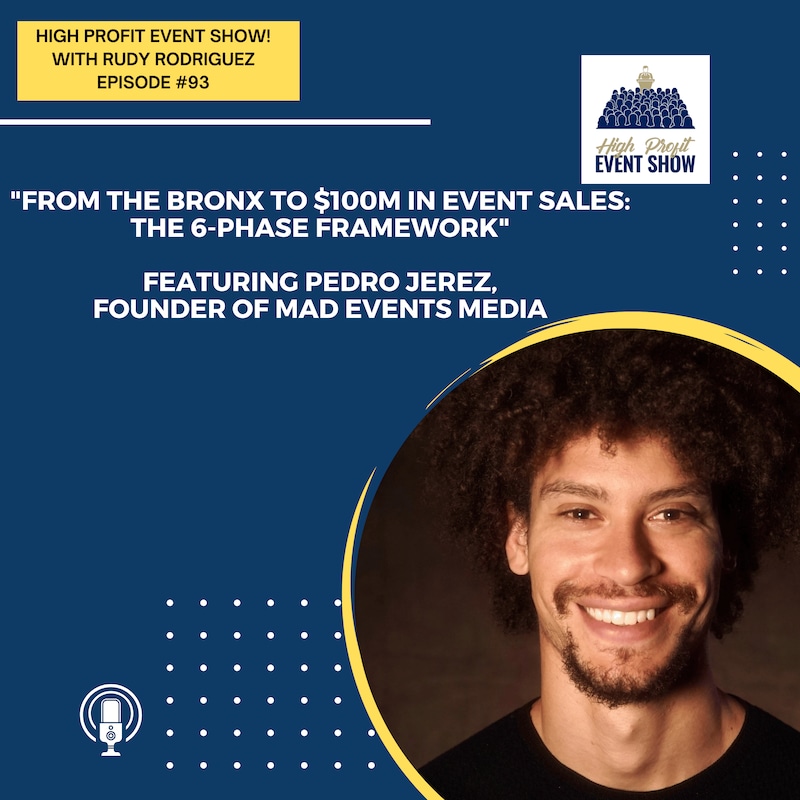
On this episode of The High Profit Event Show, host Rudy Rodriguez welcomes Pedro Jerez, the founder of Mad Events Media, for a powerful and tactical conversation on how to build, fill, and scale high-converting events with purpose and precision. Pedro is no stranger to impact—he’s the architect behind the largest paid virtual event in the coaching industry and has helped generate over $100 million in event revenue since 2017. His experience ranges from serving under Tony Robbins to running events that serve tens of thousands of attendees with tight, six-week timelines. This episode goes deep into his step-by-step framework that has transformed how event leaders approach growth, profitability, and purpose.
Pedro begins by sharing his journey from growing up in the Bronx to dropping out of university at 18 to work under Tony Robbins. That early exposure to a multi-nine-figure event machine became his real-world education and the foundation for his current success. From that foundation, Pedro developed what he calls a six-phase framework for filling and scaling events. The conversation dives into each phase—from capturing underpriced attention with content-first strategies, to executing lean, data-driven marketing campaigns, to optimizing for backend revenue and lifetime customer value.
A major highlight of the episode is Pedro’s unique focus on operational discipline and precision. He breaks down the daily workflow his team follows to monitor KPIs like opt-in rate, average order value, and net customer acquisition cost. His approach emphasizes real-time responsiveness and rapid testing—often deploying multiple split tests per day—to create ideal conditions for profitable scaling. Rudy and Pedro also discuss the mindset shift required to treat events as ecosystems rather than one-time experiences, showing how thoughtful event design can open the door to long-term client relationships, new verticals, and even brand acquisitions.
Equally important is Pedro’s emphasis on purpose. He believes that successful event leaders approach their work with generosity, integrity, and intention. Whether it’s embedding impact into your brand message or engaging attendees emotionally from the first touchpoint, Pedro shares how the best events don’t just generate revenue—they create movements.
If you’re ready to take your event strategy to the next level with a proven, scalable system, this episode is a must-listen. Pedro’s insights are tactical, actionable, and rooted in experience at the highest level of the industry. Tune in and learn how to create events that perform, inspire, and endure.
Want to connect with Pedro?
Email: [email protected] -for free 60 minute presentation
Website: http://madeventsmedia.com/
LinkedIn: https://www.linkedin.com/in/businesswithintegrity
Facebook: https://www.facebook.com/pedro.jay.900/
Instagram: https://www.instagram.com/pedroajerez/
Transcripts
All right. Good afternoon. Good evening. Good morning. Wherever you're tuning in from. Welcome to today's episode. We have a super special guest with us that I am so excited to introduce you to Mr. Pedro Jerez with Mad Events Media. Welcome sir. I'm really excited to have you here. You and I were introduced by one of our mutual friends and mentors, Yanik Silver, who's a remarkable human being that runs the Maverick 1000 groups and the people that he knows are world-class that are in the world, not just running profitable, impactful businesses, but also having fun while doing it. I'm glad that he connected us, man, because right away when I met you, I was like, man, this is my guy. I just immediately fell in love with you and your mission, what you're doing with virtual events and holy smokes, man, you got a track record to back it up. I know you've helped run, gosh, I think you ran the biggest paid virtual event in the coaching industry. You've been doing virtual events since 2017, generating over a hundred million dollars for you and your clients. You're an expert, man. You are a G when it comes to filling events, engaging in conversions, and I'm just so excited to hear about your proven framework that you've used to do that.
Pedro Jerez:When I hear those things read back to me, man, I'm like always really floored by it because I'm just someone who I grew up in the Bronx in New York city, extremely poor. No one ever gave me anything other than an opportunity and the opportunity just came from just waking up knowing I had my breath and an opportunity to get after it and I knew that's always all I needed.
Rudy Rodriguez:I love that perspective, man. I don't want that to go unnoticed because every day that we get to wake up and have a breath in our chest and a heart and beat in our heart, man, that is a gift and make the most of that. I love how you, as successful as you are, you still continue to bring your awareness and attention on that and just continue to take things one step at a time, one day at a time.
Pedro Jerez:That's it, man. That's the secret sauce right there. Be grateful for what you have and use the season that one is in to fortify what's next. Like have it prepared, mold your mind to become who we need to become to step into that next season.
Rudy Rodriguez:Absolutely, man. You're speaking my language, brother. Thank you. Well, my friend, the floor is yours. I would love to hear a little bit about your background and kind of what brought you into doing events and then I know you have a proven framework that you've been using for you and your clients to help fill virtual events and live events. I know that's the top of mind question for a lot of people listening to the show is how did you do it? How did you create the biggest paid virtual event in the coaching industry? I mean, that's quite the accomplishment.
Pedro Jerez:I'll give a quick overview of my background. Just people that won't spend so much time there so you can spend more time talking about more tactical stuff. But yeah, when I dropped out of university at the age of 18, I wanted to go and work for Tony Robbins. I read one line in a book that drastically changed my life. It was Rich Dad, Poor Dad and it just simply said, poor people go to work for a paycheck, rich people go to work to learn. There was a whole story that he shared in the book, which I won't go too deep into. But the whole premise of that was that there's more value in learning than there is in maximizing what you're learning in certain seasons of life and when I was just getting started, there was more value in learning for sure than any money I could have gotten paid like, hey, you get paid $2 more an hour or what do I go and learn from? In my case, it was Tony Robbins, worked for Tony for four years and I went to every event that he did for four years. It was my real life education. I immersed myself in what a multi nine figure event based business looked like from the inside out. It gave me access that I would have never had otherwise and it laid the foundation for then being able to build on all the things that I learned based off what the world needed at different seasons and different times. But that laid the foundation for everything. To answer your question about this whole model in terms of how to fill events, I think about it in six phases. I mean, I'm a huge fan of specifically lean thinking principles because what lean thinking does is it basically removes waste.
Pedro Jerez:So it looks at where's the waste, how do you actually remove the waste? And then how do you minimize getting to your outcome with the least amount of variables along the way? Meaning like what actually matters and what I see so many people do is that they're focused on too many things and therefore nothing actually truly matters and what matters is what you give focus to and what you're looking at any given time and what you're focused on optimizing. So when I'm thinking about filling any kind of event, doesn't matter if it's virtual or if it's live, I think about it in six steps. Number one is you have to be able to get attention. The name of the game is you got to be able to get attention. You have to be able to get under priced attention, meaning you have to be able to get attention that works for the economics of your particular business. If you can crack the code on that, then you're going to be able to crack the code on making your wildest dreams possible. It's literally the difference between your dreams dying on your lips or you having a possibility to truly make the difference that you want in the world and the reality is that there's a cost associated with that attention, that cost associated with that attention is changing by the day and it's dynamic and you need to understand that and just a super high level overview on that is that just understanding what's kind of happened over the last couple of years, I think is really key. So I don't know how many people know this, but the world of advertising and social media changed entirely thanks to one company and it's Tiktok. It's because they introduced a new algorithm called the interest graph algorithm and basically what it did is that it moved who got attention to who got the most followers to who made the best content because they were just optimizing for one metric and it's watch time.
Pedro Jerez:And everything else is literally a secondary metric from there. Understanding that is really, really key in understanding why maybe it's gotten more difficult for people to get more eyeballs on social media or advertising on other content. So one was optimized for follower count, the other one was optimized for content quality and that's really important because now anyone who wants to really learn this game can come in and the playing field is entirely leveled. If you actually learn how to capture people's attention and matter to that individual, you can start with zero followers and you're going to be able to penetrate the market in ways that was not possible unless you took years to build the following. Now why am I mentioning this? I'm an advertising guy. Why the hell is Pedro even talking about this? What a lot of people don't realize is that the same content that you try to advertise with the same video creative, image creative, it lives on the same exact feed as the creative that you post organically and if you can learn how to crack the code organically, you're going to learn how to crack the code through paid and it's just translating those learnings over and you're going to notice that your acquisition costs go down significantly, but that's just kind of like the first phase of it. The big question that I really encourage everyone to answer for themselves is that, do you know without a shadow of a doubt what the person that you're trying to matter to is paying attention to right now? Most people that I asked that question to nine out of 10, the answer is always no.
Pedro Jerez:So how do we expect to actually run these large events to penetrate the market, to be able to have the impact that we have when we don't even know what our target demographic is actually truly paying attention to? And if we don't know what they're paying attention to, then we don't know the costs associated with capturing their attention. Therefore we're just kind of throwing things at the wall hoping that something sticks. So much of the secret sauce is really number one, first just understanding the price associated with getting their attention so that then we can make informed decisions on how we get to create creative to actually capture their attention and that's all just kind of phase one of this entire process. So to go quickly over the other ones, phase two for me is what I call, I don't care if you've been doing this for 10 years or if you're just starting out. Phase two is all about looking at your event campaign as a lean marketing campaign and what I mean by that is that there's really only kind of three steps that you really need to look at when you're first, when you're still very early on and you haven't made the economics work to really make code traffic a consistent strategy inside of a business. Like number one, you've got to be able to capture people for your event and which means that you have to be able to acquire them at a net cost that makes sense for your business. Number two, you got to make sure those people are willing to show up and that they're willing to stick around for your pitch and that they're willing to buy and then you can look at some simple backend metrics, which is like, what was your collected revenue? What was your promised revenue? And what was your ROAS? When you look at those key metrics, it's like, does the math work?
Pedro Jerez:If the math doesn't work, why are you even thinking about your followup and your backend and all these different things? Like those are really important things that could probably move the needle. But the reality is that until you get these first kind of front end metrics where you want them to be, the analogy that I always give is that if you go out and you get a blood test and the blood test shows that you're not healthy, which is the equivalent of these numbers for a lot of people when they're running events, focused on getting those metrics healthy before you start working on biohacking as an example, or start looking at longevity medicine. First, take care of your foundation because your foundation is going to allow you to explore deeper things that will improve your health over time. So that's phase two and part of optimizing this is really understanding conversion rate optimization and the game of conversion rate optimization. Anybody who thinks about advertising without putting conversion rate optimization in the same sentence, run away as fast as possible. They'll never make your events work. You'll never be able to scale your events. They live in the same exact ref and both of those people, the advertising team and your marketing team have to work together as if they were never apart. They are an ecosystem and they need to work together to really drive the results because getting those metrics healthy, the analogy that I give for determining whether you can actually scale an event is the following. Imagine that you have a beautiful sports car. You're like, man, this thing can go 200 miles an hour, but you're driving through the back hills of Malibu.
Pedro Jerez:Well, how far, how fast are you really going to be able to drive? There's a certain point where you get over a certain percentage of mileage per hour that you're going to fly off the freaking mountain and so I use that analogy to say that if you're marketing, if these front end metrics that I'm alluding to are not in a healthy place and you try to hit the floor and scale your marketing, it's going to push all of your costs out of whack. There's no way that you're going to be able to scale in that environment and so the name of the game is how quickly can we ultimately optimize to get in a healthy environment, which is the equivalent of getting that beautiful sports car on a racetrack. So now you can freaking floor the gas and hit that gas as fast as possible. That's really where you're going to be able to scale and so just understanding how to create that environment is absolutely key. So reviewing the data daily, understanding what it means, understanding what actions to take on a daily basis to refine those key, simple metrics into phase two. It's rapid optimization. It's really what it is and you want to go through your sales cycle as quickly as possible. So I don't want to run events at this stage every two months, every three months, I want to run them weekly, biweekly. Why? Because I want to refine this as fast as possible. I'm creating my machine and I'm optimizing it so that then as I go bigger, I can create more space between my events, knowing that I'm optimizing something that actually works and I have more confidence in what I'm spending. Phase three of this entire process is now you can enter what I call maximization and optimization.
Pedro Jerez:That is now the way I like to optimize. Campaigns are always from back to front, because that's where you're going to see the biggest needle mover in terms of sales. Now that you've refined those key metrics, now you can bolt on your follow-up and really that entire piece of things you might layer in things like retargeting ads and mirror ads. You might extend your campaign. There you might introduce behavioral marketing. There's all different sorts of things you can do and then you start to optimize your engagement phase. That's everything between when people purchase your event or sign up for your event, all the way leading up to your event. For me at that phase is all about speed to lead. How quickly can you get to the lead? How quickly can you make a great first impression? How quickly can you ultimately do that? Then you can work your way all the way to the front, which is the acquire phase that might be introducing new upsells, increasing your average order value might be different things that you might bring into that mix, creative diversity, et cetera, et cetera. The whole thing is that if you're spending $5 and you're getting 10 out of those $5, the question is how can you spend those five and get 15? That's the question that we're trying to answer at phase three. Phase four is all about enhancing your ROAS and Ltv by up-leveling your brand positioning. One of my favorite ways of doing this is by introducing an impact component to your events, introducing a bigger story, a bigger meaning. Every company can decide to be a champion for something. Don't just be another fricking event, be an event that has a purpose, be an event that actually stands for something and so I love finding what the person who's running this event, like what do they want to be a champion for, and then finding a way to include that essentially into our brand architecture.
Pedro Jerez:So when you purchase the event, here's the good that you're doing. Let's remind them of that in their receipts. Let's remind them about it in their welcome emails. Let's remind them of that in all of our marketing communication all the way through, let's remind them of that when they show up for the event, let's remind them of that when they buy our backend offer, let's engage with them emotionally. The name of the game is speed of trust, but if you can do this with authenticity, you're going to see measurable lifts in your ROAS, in your LTVs, in your upsells and in your ascensions when you do this. So that's phase four of this entire process and then phase five of all of this is scaling. I always say scaling is the easiest part of this entire thing because scaling all it is, it's creating the environment for scale. It's everything that you needed to do to get out of the Malibu hills onto the track. That's what phase one, two, three, and four of this entire process is. By the time you get to case five, it should be like a walk in the park, specifically horizontal scaling. So there's two types of scaling, horizontal scaling, and then vertical scaling. Horizontal scaling, it's basically how can you increase your existing advertising channels and ultimately scale them? If you've done all these things up to phase four, it's just really a matter of adding a lot more creative into the mix to allow you to really scale confidently, but you trust your data at this point, so you're going to feel comfortable in double, tripling, quadrupling your ad spend and feel really, really good about it. It's about allocating dedicated conversion rate optimization resources at this point.
Pedro Jerez:That's going to lead to ultimately enhanced revenue. Now, horizontal scaling is something completely different. Horizontal scaling is leveraging new channels and part of leveraging new channels is acknowledging that there are native nuances to every single platform that you advertise. So your funnel, your campaign is going to look entirely different on a different platform than it's going to look on another one. You almost need to start the framework all over again. Don't think that you're just going to take what you made work on meta and make that work on Google. That's not how it works. It's an entirely different event design, event marketing strategy. It's important that that entire strategy is native to how people consume content and how they behave on these different platforms so that you don't lose their interest along the way. You can also enter new markets at this stage as well. So horizontal, horizontal scaling definitely takes a bit more work, but it's another way that you can grow. Then the final piece of all of this is what I call expanding ecosystems and integrating them vertically into your world. I'll share this last piece, which is that I come from the fundamental belief that events are the beginning and not the end. If you think that events are your end, then you're thinking too small about your business. Events are a phenomenal foundation, but it's what becomes possible when you truly build your event empire. Cause you've created the environment ultimately where you can serve your customers in a wider range of ways by creating what I call again, your event ecosystem, and all that means is what are the products and services that your business don't currently do that your audience wants.
Pedro Jerez:So as an example, if you're teaching somebody about some, let's say trading as an example or investing. Well, what are the broader things that they're probably interested in? They're probably interested in different things that help them become financially free and enhance their wealth building journey. They're probably interested in legacy. They're probably interested in all these wide range of things, protecting their assets. If your business is an offer that currently guess what? They're going somewhere else to do that. You're probably sending affiliate business. You can partner with other people. You can start brands. You can white label services. You can do all sorts of things as a way, and then finding ways to inject that into your customer journey as a way of creating more value for that customer. Now if you ever want to sell, what you're doing is you're selling an ecosystem of companies that create a multiple value, but it all started by getting really good at running an event. So that's a high level Rudy of how this all works, man.
Rudy Rodriguez:It's phenomenal, man. So copious notes as you're chatting there, man, this is a great interview to go back and there's going to be, there's a transcript that's attached to this interview, go back and read the transcript, look at the show notes. We'll have a blog post associated because like your steps were very clear, succinct, and you can follow. So for our audience, like definitely we should visit this information that says in gold. Yeah. I love your steps, man. It's very clear, step -by -step methodical. Well thought through and clearly you have a formula that works for you and for your clients. I know I'm taking a big step back here at the beginning of what you said, but I love the fact that you went to work for Tony Robbins and you went to work not for the dollars, but for the learning and skills and clearly being under the hood of a multi nine figure event business has definitely paid its dividends for you and your clients over the years. That's phenomenal, man.
Pedro Jerez:What I learned, one of the big things that I learned in that journey was I would never forget when I first saw the run of show for UPW, it blew my mind. I honestly had no freaking clue what to do with it. Like I was, I don't know, 21 at the time or something like that for 20 years old and most papers like eight by 11, like normal, like this paper was super wide and like even goes off my screen. It was like small letters and like play by play every five minutes of everything that was happening, every story. If you just watch the syntax and then you watch Tony, and by the way, each paper only represented one day. So if you just watch the syntax and you just watch Tony, you watch the syntax. It was like watching a show and what that taught me was that preparation, thoughtfulness, it was an experience, like it was an experience that was designed and when you're there, it's like watching your favorite musician. Who's like just down to the T when he plays that exact note in the song evokes an emotion in you. It just showed me the value of preparation. It showed me the value of being thoughtful about your events and how you design your events and thinking about that all the way through the very first time they see you on a video or an image all the way through to the very end and even what happens beyond that level of thoughtfulness for every single piece of your event, what gets that, what becomes possible then? I see just too many people that are just winging it and then they're wondering, man, like why aren't my events doing better? Well, and that's why there's only one Tony Robbins.
Rudy Rodriguez:Yes and you talked about this idea of doing as many as you can and creating machine optimizing. I know Tony's been doing them since he was probably in his early twenties and he's done hundreds of them, I'm sure at this point and he's kept building and building and building and refining and capturing and learning to the product that is today. I've also been to several Tony Robbins of them. I'm a big fan. If you're listening to this, highly recommend, go to Tony's UPW if you haven't already, while you still can, while you can still see him. It's not the AI, Tony, it's really a special experience. Thank you, man. Thanks for giving this overview. I'm curious, Pedro, maybe you can pull the curtain back a little bit more on how you've applied this system in how you ran the largest paid or virtual event in the coaching industry. I think that would be a really great value nugget for our audience. If you can talk to us through how you apply this.
Pedro Jerez:Yeah, I'll give you two really big ideas here. Let's see if I can articulate them. But that whole analogy that I was giving about like, hey, it's just a race to get into the ideal environment. So when I promote events, I'm usually working in a six week cycle. So I have six weeks to generate tens of thousands of customers to join into that. Okay. Well, how the hell do you pull that off? Well, the way you pull that off, number one is by knowing your numbers. If you don't know your numbers, you're dead. So you have to know what your KPIs are along the way. Like, so if one of our key KPIs is net cost, that's our ultimate KPI when it comes to acquisition, we know what we can afford to spend net to acquire that customer, well, what are the metrics that now influence that well, as it relates to my funnel, it's going to be my opt-in rate, what's going to be my checkout rate that equals my sales rate, ultimately my average order value, how much collected revenue from my funnel. And then what's my cost per acquisition? My cost per acquisition minus my average order value is going to equal my net costs. My hard costs, what it actually costs me to acquire this customer. So by understanding what influences that, I now know what to focus on. If I don't have the right sales rate. So I knew I was shooting for at least a 4% sales rate. What that means is 4% of the people who land on my landing page end up purchasing my event. That was the target. Okay. So now that I know these numbers and also we had our metrics on the front end with our advertising and this all kind of led to one number, which is our net cost.
Pedro Jerez:So again, it's a race. So day one of the campaign is live and this was an established business. So literally you wake up in the morning, you look at the data, you make sense of the data, and then you decide that day what the team needs to do in order to create that environment, if there's any KPI that is off, your media buyer is only going to be able to scale as fast as your team is able to optimize those KPIs, get them in an ideal environment so that then they can hit the gas. The big nugget, number one is like literally very simple, but no one's willing to do it and because I've shared this with so many people at this point and the amount of people who are doing this or who are willing to do this, it is tiny and it's a simple workflow. You wake up every morning, you know exactly what numbers you're optimizing for, you understand what's at KPI, what's not at KPI, and then the next question is what tests do you need to deploy that day? At times we're deploying three to four tests in one day. What tests do you need to deploy that day to get the KPIs that are going to move the needle the most so that you can achieve the net cost per acquisition that you need to get so that your media buyer can hit go. If you can achieve that within the first week, well, guess what? You have a long runway to hit the gas on that car, knowing that at some point you're going to hit an obstacle.
Pedro Jerez:So fortunately when we were running that event, we came out the gate strong. Everything was just working in our favor. So we just wrote it for all she wanted for about the first three to four weeks. Usually the way it works is that we get 45% of our acquisitions the last two weeks, but for whatever reason, the environment was just perfect the first four weeks. So we just pushed the hell out of the machine for the first four weeks. Then things went wrong the last two weeks and we were just kind of scrambling to get back in that ideal environment. It's like, oh, your tire loss pressure? Well, you got to slow down. Otherwise you're going to kill yourself. So that's the workflow. That's the mindset. It's like what environment I am in. If I'm in a great environment, go. That's because all your numbers are working in your favor. You can be proactive in coming up with additional split tests. If things are not working in your favor, then you have to strategically think about how do you approach solving the problem? Chances are there's a lack of congruency between your advertising and the experience that you're providing. Maybe it's a lack of clarity. Maybe what the market is desiring has shifted. So one of the things that I love to do is every single person who buys an event ticket from us, we always serve at them. Like, hey, why did you join? What's the biggest problem you're trying to solve? And guess what? I have tens of thousands of responses of people who have answered that single question. And guess what? Every single week, I'm understanding where's the market at? Where's the temperature at? How does that reflect on our messaging? We're refining this all in real time to make sure that again, we're in an ideal environment so that we can scale.
Pedro Jerez:So that's one of the big things. It's simple. It's not difficult, but it's precise. Workflow, understanding what numbers you're optimizing for, and then knowing how to approach solving those numbers to get those numbers healthy so that your immediate buyer can buy. So honestly, that's probably the thing that made the biggest difference, but it's the level of excellence that that process is executed. I literally had a team. All they would do is just wake up in the morning. We'll look at the data together and then they knew what to do that day based off that data. They had no other responsibility other than waking up that morning and understanding what they needed to do to move the needle the most that day. That's their only job.
Rudy Rodriguez:Dude. So much gold in what you shared there. So much wisdom. I think, honestly, this has probably been one of the best interviews that I've done on this show because you just added so much value. So practical, so clear, so succinct. I'm going to go back and listen to this. I'm going to share this episode with several of our clients as well. You clearly have it down to a science. What I think I appreciate about you is that not just you have the science of achievement and filling events with thousands of people in six weeks or tens of thousands of people, even, but you also come from a place of occupation. I know you, what part of your greater mission is to be able to a billion dollars to charity through your work and through your partnerships and efforts. I just love what you're bringing to the table, man and I highly recommend as listening to this, check out the website, mad events, excuse me. What's the website? Let me pull it up real quick.
Pedro Jerez:Yeah. Madeventsmedia.com.
Rudy Rodriguez:Madeventsmedia.com. And right there, you also have a blueprint that they can download. They can see this in blueprint, correct?
Pedro Jerez:Yeah. So it's not on the website, but what I wanted to share with folks is I recently gave an extended presentation. It's about an hour long where I talk about this process more in detail, where I take my time explaining more of the individual pieces and if that's something that people want, then kind of the only way to get it currently is by me sending it to you. So if someone wants that, they can send us an email at [email protected] and my team knows just to forward that presentation over to you guys. Happy to share it.
Rudy Rodriguez:Nice man. I'm just making a note of that. Cause I'm doing that. So do that right thing and type in your email browser. [email protected] and request that hour long presentation of the six steps that Pedro just went over with us today. This has been awesome. As we wrap up here, just the final minute or so, well, any final words of guidance or advice to give to our audience?
Pedro Jerez:Yeah. The biggest piece of advice that I can give people is that I truly, truly, truly believe like to have a level of impact, you want to have events. There's so many easier ways, man, to make money. I don't think that there's any way that's more scalable or more enjoyable, more lucrative, but they're definitely easier ways. There's a certain level of generosity that is required to be somebody who owns an event-based business. I just believe that the impact that you want to have is truly lives on the other side of how generous you choose to be, how generous you choose to be with people you want to serve. How generous you choose to be with how you approach your events. Like I give the example of Tony Robbins, like how methodical he is in his thing. That methodicalness actually gives you space for humanness. If you're in Tony's presence, you'll know he's the most human person that you can possibly imagine. You feel his heart, you feel his soul, you feel his being, but that comes from a thought of preparation. I would just encourage everybody just like, hey, if you're not having the level of impact you want to have, just like how generous are you truly being inside of your business? It could be a sobering thought. Hey, have I gotten a little complacent with it? No, or is this kind of just an invitation to really step up and maybe learn more from Rudy? I know you have so much wisdom in what is it that you're teaching and doing and helping people with on the sales side, which is such a key piece of events. Then my call to action to everyone is you can run your business or you can choose to make a difference. I think choosing to make a difference is a much more rewarding, fulfilling way to go about building your business and the hard times will simply just be like little pebbles in your journey because you have a bigger why for what is it that you're doing.
Rudy Rodriguez:Amen, man. Thank you for that. That's a quotable if I grab down, put it on a quote, post it on our socials. Thanks Pedro for being with us here today, man. It's been an honor and a pleasure.
Pedro Jerez:Yeah, appreciate you Rudy.



