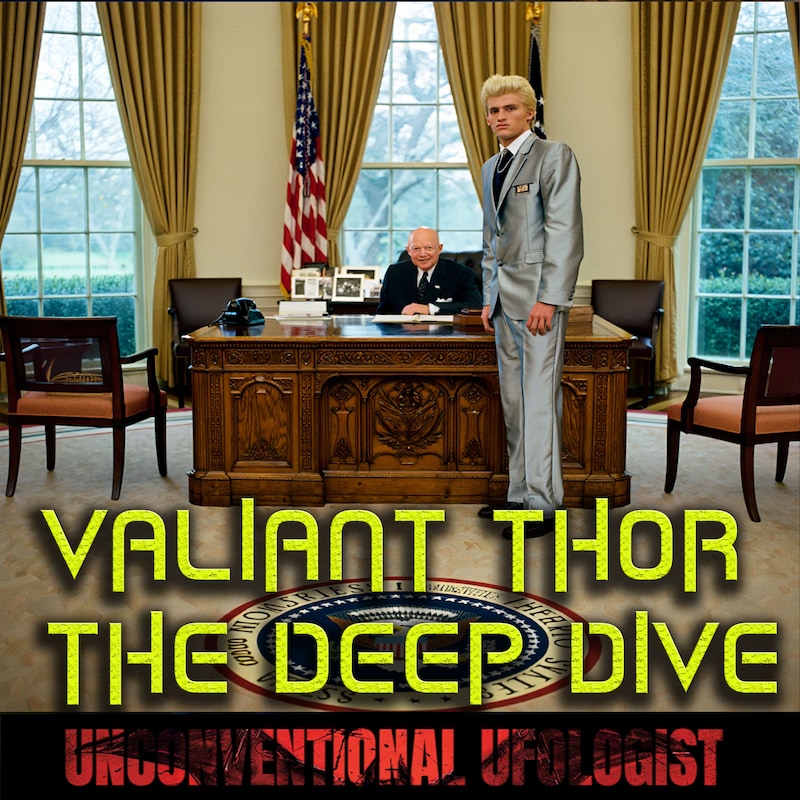
Shownotes
Welcome, sentient beings of Earth. Do you ever feel as though you’ve misplaced your keys, your wallet, or perhaps the entire solution to all of your planetary problems? Then you've come to the right place. Tune in for a tale of a man, or at least a being who looked unnervingly like a man, who arrived on Earth with six fingers, no navel, and an IQ so impossibly high it was almost rude.
Meet Valiant Thor, a Venusian diplomat who, in 1957, landed in Alexandria, Virginia, and promptly requested a meeting with the President of the United States. He came not with a death ray, but with a message of peace, offering solutions for everything from nuclear annihilation to environmental destruction. He proposed free energy, universal cures for diseases, and a world without war—a plan so sensible it was, of course, utterly rejected.
In a shocking turn of events, humanity, or at least the powerful handful of it, found that Thor's vision of peace and progress was a direct threat to the very institutions that profited from conflict and scarcity. What followed was a deliberate campaign to bury his existence and label anyone who spoke of him as a crackpot. The world chose bureaucracy and self-interest over salvation, and decades later, we're all living with the unsettling consequences.
Join us as we explore the secrets of a three-year diplomatic mission, the whispers of an ancient cosmic council, and the eerie, prescient warnings that Valiant Thor left behind. It's a story of what could have been, a glimpse into a better future we politely declined, and a reminder that sometimes, the most dangerous thing you can do is offer a completely logical solution.
Part of the Pursuit of the Paranormal Podcast Network
Transcripts
Kick back, relax.
Speaker A:It's time for the unconventional ufologist.
Speaker A:Hello there, Deep Diver.
Speaker A:Thank you for joining this tier on my Patreon.
Speaker A:Well, I hope you're good at holding your breath, because after this deep dive, people will start calling you Jacques Cousteau.
Speaker A:Valiant Thor, the man, the myth, the six fingered enigma.
Speaker A:Valiant Thor was not your average extraterrestrial.
Speaker A:If you were to imagine an alien emissary from Venus, assuming, of course, that Venus is home to beings far more advanced than Earth's most bureaucratic government governments, you might expect something grotesque, tentacled, or at least vaguely unsettling.
Speaker A:But valiant Thor defied expectations in every conceivable way.
Speaker A:It didn't look like a monster.
Speaker A:It looked like a man who had been sculpted by someone with very high standards and a deep appreciation for symmetry.
Speaker A:Standing well over six feet tall, with broad shoulders and an almost unnervingly symmetrical face, Thor possessed an aura of calm authority that unsettled even the most hardened military officials.
Speaker A:His skin was smooth and olive toned, his eyes piercing and slightly too intense for casual conversation.
Speaker A:His hair was long, neatly combed back, and suspiciously well maintained for someone who had just stepped out of an interstellar spacecraft.
Speaker A:But it wasn't his looks that made people question his origins.
Speaker A:It was the details.
Speaker A:Each of his hands had six fingers, not five, not seven, but exactly six, arranged in a manner that suggested they weren't just tacked on for a aesthetic effect.
Speaker A:They were slender, elegant, and disturbingly free of fingerprints.
Speaker A:Scientists who examined him later found no ridges, no swirls, just smooth, unmarked flesh.
Speaker A:And then there was the issue of his navel.
Speaker A:Or rather, the complete absence of one.
Speaker A:No scar, no indentation, nothing.
Speaker A:It was as if he had never been connected to anything remotely resembling a mother.
Speaker A:This alone should have raised eyebrows.
Speaker A:Humans are born with belly buttons because that's how biology works.
Speaker A:If you don't have one, you're either a medical anomaly or something else entirely.
Speaker A:Thor fell into the latter category.
Speaker A:But his physical oddities were only the beginning.
Speaker A:What truly set him apart was his mind.
Speaker A: l reports described his IQ as: Speaker A:He spoke fluently in over 100 languages, including several that, according to human records, didn't exist.
Speaker A:Some claimed he could understand complex scientific theories in an instant, recall historical events with perfect accuracy, and explain quantum mechanics while sipping tea.
Speaker A:Others whispered that he didn't even need to speak.
Speaker A:People near him often heard entire sentences in their heads, clear and calm, without any verbal communication taking place.
Speaker A:Some called it telepathy.
Speaker A:Others called it mind Control.
Speaker A:A few brave souls suggested he simply made people feel like they understood things better when he was around.
Speaker A:And which may have been the most terrifying possibility of all.
Speaker A:Because if he could make you believe you knew something even if you didn't, what else could he do?
Speaker A:And yet, despite all this, Thor remained frustratingly composed.
Speaker A:He never boasted, never threatened, never even seemed particularly impressed by his own abilities.
Speaker A:He carried himself like someone who knew he held the keys to the universe, but decided, for reasons only known to him, not to use them unless absolutely necessary.
Speaker A:That restraint, more than anything else, made him unsettling.
Speaker A:Power, when wielded with quiet confidence, is always more dangerous than power.
Speaker A:Shouted through megaphones so, yes, Valiant Thor was not a regular man.
Speaker A:He wasn't even close.
Speaker A:And the world was about to find out just how strange he really was.
Speaker A: On a quiet March morning in: Speaker A:And leave government officials scrambling for explanations.
Speaker A:Two local police officers responded to a report of an unidentified object landing in a field.
Speaker A:They arrive expecting the usual suspects.
Speaker A:Smugglers, spies, or perhaps some eccentric inventor testing a prototype aircraft.
Speaker A:Instead, they found themselves staring at a shimmering disc that had landed without a sound, heat signature or seismic tremor.
Speaker A:The hatch opened.
Speaker A:Out stepped a man, or at least something that looked like a man.
Speaker A:Calm, poised and dressed in a suit that shimmered faintly under the early morning light.
Speaker A:The figure approached a stunned office and said, I need to speak to the President.
Speaker A:His voice was measured, confident and oddly soothing, as if he were delivering news rather than making a demand.
Speaker A:The officers, caught between protocol and sheer bewilderment, radioed in the situation, and within minutes, federal agents arrived, sealing off the area.
Speaker A:Witnesses were pushed back, cameras confiscated, and the incident swiftly classified.
Speaker A:Whatever had landed in that field was not going to be discussed in public.
Speaker A:Valiant Thor was escorted to the Pentagon not as a prisoner, not as a suspect, but as a guest.
Speaker A:The building that housed the heart of American military strategy now hosted its first known extraterrestrial diplomat.
Speaker A:Within hours, he was granted access to some of the most powerful figures in the country.
Speaker A:President Dwight D. Eisenhower, Vice President Richard Nixon, Secretary of defence Neil McElroy, and and various Joint Chiefs of Staff.
Speaker A:What followed was not a dramatic interrogation or a Cold War style standoff.
Speaker A:There were no demands, no threats, no ultimatums.
Speaker A:Instead, Thor delivered a message.
Speaker A:One that would unsettle those who heard it and ultimately be buried beneath decades of secrecy.
Speaker A:He introduced himself as a being from Venus, sent by a governing body known, lonely, as the High Council his mission was not conquest nor espionage, but guidance.
Speaker A:He came bearing warnings about humanity's trajectory.
Speaker A:Nuclear annihilation, environmental destruction, spiritual decay, and solutions to prevent it.
Speaker A:Thor spoke of disarmament, offering a path away from nuclear brinkmanship.
Speaker A:He proposed new energy sources that could eliminate fossil fuels, cure diseases and end poverty.
Speaker A:He urged cooperation over conflict, wisdom over greed, and unity over division.
Speaker A:To many in the room, his ideas sounded utopian.
Speaker A:To others, they sounded like madness.
Speaker A:But beyond his words, it was his presence that unsettled those around him.
Speaker A:Officials reported feeling strangely calm in his company, as though some unseen force was smoothing the edges of their thoughts.
Speaker A:Some claimed they couldn't lie in his presence, as if their minds were laid bare before him.
Speaker A:Others noticed small but disturbing details.
Speaker A:The lack of a belly button, the unnatural symmetry of his features, the way his eyes seemed to see past deception.
Speaker A:Thor wasn't here to conquer.
Speaker A:He was here to warn.
Speaker A:And for a brief moment in history, the highest levels of American power listened.
Speaker A:If you ever wanted proof that governments love acronyms almost as much as they love secrets, look no further than Project Sigma, a covert Pentagon initiative designed to explore peaceful contact with extraterrestrial entities.
Speaker A:And at its centre stood valiant Thor, the enigmatic Venusian diplomat whose presence was equal parts fascinating and inconvenient.
Speaker A:Officially, Project Sigmund didn't exist.
Speaker A:Unofficially, it was one of the most ambitious attempts by the US government to engage with an alien intelligence.
Speaker A:Thor wasn't just handy the security badge and left to wander the halls of the Pentagon.
Speaker A:He was given VIP access, placed in a secure underground suite usually reserved for visiting foreign dignitaries, and allowed to meet with some of the most powerful individuals in the country.
Speaker A:This wasn't a containment effort, it it was diplomacy, albeit of the extremely classified variety.
Speaker A:For three years tha operated with the deep discouragement of American military command, he met with scientists, generals and policymakers, offering insights into technology, medicine and geopolitics that were far ahead of anything Earth had developed.
Speaker A:He spoke of energy systems that required no fuel, disease treatments that rendered modern medicine obsolete, and methods of global governance that could eliminate war altogether.
Speaker A:But as the saying goes, if something sounds too good to be true, it probably is.
Speaker A:Especially when you're dealing with a government bureaucracy built on paranoia, profit and power.
Speaker A:Because here's the thing, Thor's ideas weren't just radical, they were revolutionary.
Speaker A:And revolutions, especially ones that threaten established hierarchies, tend to get shut down, sometimes quietly, sometimes violently.
Speaker A: By: Speaker A:Documents surfaced suggesting that certain defence Contractors and energy conglomerates had grown increasingly alarmed by Thor's proposals.
Speaker A:Free energy meant oil empires collapsing.
Speaker A:Disarmament met weapons manufacturers losing billions.
Speaker A:Global unity meant fewer opportunities for geopolitical manipulation.
Speaker A:In short, Thor's vision of peace and progress was a direct threat to the very institutions that thrived on conflict, scarcity and and control.
Speaker A: op secret memo dated December: Speaker A:A coordinated effort to suppress Thor's knowledge was underway.
Speaker A:The document outlined plans to discredit anyone who spoke about him, labelled believers as conspiracy theorists, and ensure that his existence was erased from official records.
Speaker A:It wasn't just skepticism driving this cover up.
Speaker A:It was fear.
Speaker A:Not the kind of fear you feel when you hear a noise in the dark, but the kind that grips those in power when they realize that they're no longer in control.
Speaker A:Thor wasn't just offering salvation, he was offering change.
Speaker A:And change, as history has shown time and time again, is rarely welcomed by those benefiting from the status quo.
Speaker A:Declassified files obtained decades later revealed that key members of Project Sigma had begun distancing themselves from Thor.
Speaker A:Meetings became less frequent, access was restricted, and eventually the program was quietly terminated and Thor vanished from public view.
Speaker A:But the story didn't die.
Speaker A:It simply went underground, waiting for the right moment to resurface.
Speaker A:Enter Dr. Frank Strange.
Speaker A:Dr. Frank E. Strangers was not the kind of person you expected to become the guardian of an interstellar whistleblower's legacy.
Speaker A:A minister turned UFO researcher with a bent for showmanship and a voice that could command a congregation with ease.
Speaker A:Strangers spent decades fighting to keep the story of Valiant Thar alive, despite ridicule, skepticism and the occasional death threat.
Speaker A: encounters began in the late: Speaker A:According to Strangers, Thor wasn't just some eccentric visitor from another planet.
Speaker A:He was a Venusian diplomat sent on a mission of peace, warning and guidance.
Speaker A:Strangers described Thar as wise, compassionate and deeply concerned about the direction humanity was heading.
Speaker A:He claimed that Thor had shared advanced knowledge about energy, medicine and spirituality, ideas that could have changed the world if only they hadn't been buried beneath layers of secrecy and denial.
Speaker A:At first, Strange's claims were met with curiosity.
Speaker A:He gave lectures across the United States, appearing on radio shows and infringed publications, spreading the word about Thor's warnings.
Speaker A:He spoke of nuclear annihilation, environmental collapse and the moral decay of society, themes that, in hindsight, seemed eerily prescient.
Speaker A:But as the decades Passed.
Speaker A:And mainstream science continued to dismiss UFO research as pseudoscience, strangers found himself increasingly isolated.
Speaker A:Sceptics painted him as a fraud, a man using religion and mysticism to weave elaborate tales for attention and profit.
Speaker A:His background as a minister led critics to accuse him of blending theology with speculative fiction to turning Thor into a celestial prophet rather than an actual being.
Speaker A:Mainstream media outlets largely ignored him, and when they did acknowledge his work, it was often to mock it.
Speaker A:Yet despite the growing tide of doubt, strangers refused to back down.
Speaker A:He continued giving talks, updating his books and insisting that his experiences were real.
Speaker A:And while many dismissed him as a fringe figure, there were enough strange coincidences to give pause.
Speaker A: ials refuse to comment on the: Speaker A:Why were the reports of a man with six fingers and no navel walking around secure military areas?
Speaker A:And why did no one ever publicly debunk Strange's claims with hard evidence?
Speaker A:As the years turned into decades, Strange's story faded from the public eye.
Speaker A:UFO sightings became more common, abductions replaced diplomatic encounters, and conspiracy theories multiplied like rabbits on caffeine.
Speaker A:Thor's name became little more than a footnote in the vast archives of of paranormal law.
Speaker A:But Stranges didn't care about popularity.
Speaker A:He cared about the truth.
Speaker A:And he believed that the reason Thor's mission failed wasn't because it was false, but because it was too true to be allowed into the light.
Speaker A: He died in: Speaker A:Let's say, hypothetically, that an advanced extraterrestrial being walks into the most powerful nation on Earth, offers a solution to all of humanity's greatest problems.
Speaker A:Would we accept it?
Speaker A:Would we even consider it?
Speaker A:Or would we, as history suggests, immediately file it away under classified and pretend it never happened?
Speaker A:Valiant.
Speaker A:Thor's case makes it abundantly clear that when faced with the opportunity to embrace a future of peace, prosperity and technological enlightenment, humanity chose bureaucracy and paranoia and self interest instead.
Speaker A:His mission wasn't just rejected, it was actively sabotaged.
Speaker A:Why?
Speaker A:Because Thor's proposals weren't just revolutionary, they were disruptive in ways that terrified those in power.
Speaker A:He spoke of free energy, limitless, clean and accessible to all.
Speaker A:Imagine a world where electricity doesn't cost money, where fossil fuels are obsolete, where poverty caused by energy scarcity is eradicated overnight.
Speaker A:Sounds utopian, right?
Speaker A:For the average person, it might have been, but for the oil barons, defence contractors and financial elites who profited from scarcity and control, it was an existential threat.
Speaker A:Thor also advocated for global disarmament.
Speaker A:He urged nations to abandon nuclear weapons, arguing that mutual destruction was not a deterrent, but a slow motion suicide pact.
Speaker A:He offered alternative security models based on cooperation rather than deterrence.
Speaker A:Again, to the everyday citizen, this might have sounded like a dream come true.
Speaker A:But to the military industrial complex, the very system that President Eisenhower warned against in later years, it was a nightmare scenario.
Speaker A:Weapons manufacturers, intelligence agencies and political leaders who thrived on geopolitical tension saw Thor's ideas as dangerously naive.
Speaker A:Then there was his spiritual message.
Speaker A:Thor spoke of reconnecting with higher consciousness, of breaking the cycle of greed, fear and domination that had plagued human civilization for millennia.
Speaker A:He encouraged a shift in values, urging people to prioritise compassion, wisdom and collective well being over competition and control.
Speaker A:In short, he wanted to change the way humans thought.
Speaker A:And that, perhaps more than anything else, was what doomed his mission.
Speaker A:Because power once established fierce change.
Speaker A:Governments, corporations and institutions built on hierarchy and control don't willingly surrender their influence.
Speaker A:And when confronted with an idea that threatens the very foundation of their authority, they don't debate it, they bury it.
Speaker A:Thor's fate was sealed the moment his ideas reached the ears of those who benefited from the status quo.
Speaker A:His warnings were ignored, his proposals were shelved, his presence was erased from official records.
Speaker A:And those who dared to speak about him were labelled as conspiracy theorists, charlatans or delusional eccentrics.
Speaker A:The irony is that Thor wasn't trying to overthrow humanity.
Speaker A:He wasn't demanding submission or threatening retaliation.
Speaker A:He wasn't asking for worship or dominion.
Speaker A:He was offering a chance to evolve, to move beyond war, scarcity and self destruction towards a future of harmony and understanding.
Speaker A:But humanity, as it turns out, wasn't ready.
Speaker A:Not because we lacked intelligence or capability, but because we lacked the will to relinquish control.
Speaker A:We chose power over peace, profit over progress, and secrecy over transparency.
Speaker A:And now, as we stand on the precipice of climate catastrophe, geopolitical instability and unchecked technological advancement, we must ask ourselves, did we reject our last chance at salvation?
Speaker A:If you ever wanted proof that the future can be predicted with area accuracy, look no further than valiant Thor's warnings.
Speaker A:Unlike the vague doomsday prophecies of mystics and fortune tellers, Thor's predictions were specific, logical and disturbingly coming true with alarming precision.
Speaker A: Back in: Speaker A:He warned of environmental collapse, driven by reckless industrialization and fossil fuel dependence.
Speaker A:He spoke of rising temperatures, failing ecosystems and the slow poisoning of the planet's natural resources.
Speaker A:At the time, these concerns were barely acknowledged outside of obscure scientific circles.
Speaker A:Today, they define the headlines.
Speaker A:Wildfires rage with increasing intensity, Oceans rise at unprecedented rates and extreme weather events become more frequent and devastating.
Speaker A:The climate crisis isn't a distant threat anymore.
Speaker A:It's here and and were living through its consequences.
Speaker A:Thor also foresaw the dangers of unchecked technological growth.
Speaker A:He warned that artificial intelligence, surveillance systems and digital totalitarianism would erode privacy and concentrate power in the hands of a few.
Speaker A:He cautioned that humanity's rush to innovate without wisdom would lead to tools we could no longer control.
Speaker A:Fast forward to the present and AI development is accelerating at breakneck speed, raising ethical dilemmas and existential risks.
Speaker A:Governments and cooperations collect vast amounts of data on citizens, tracking behaviour preferences and movements with unsettling precision.
Speaker A:Privacy, once considered a fundamental right, is rapidly becoming a luxury.
Speaker A:Perhaps most chilling was Thor's warning about the rise of authoritarianism and the breakdown of social cohesion.
Speaker A:He predicted that as societies became more polarised, misinformation would spread unchecked, leading to mass censorship, ideological extremism and widespread distrust.
Speaker A:He warned that hatred and division would grow, fuelled by propaganda, economic inequality and the erosion of truth itself.
Speaker A:Today, democracies struggle with disinformation campaigns, political polarisation reaches fever pitch and hate crime surge in many parts of the world.
Speaker A:The divisions Thor foresaw aren't just theoretical, they are unfolding before our eyes.
Speaker A:And then was his most urgent warning the danger of nuclear brinkmanship.
Speaker A:Thor argued that mutual assured destruction was not a viable long term strategy for peace.
Speaker A:He urged global disarmament, calling for a shift away from weapons of mass destruction towards cooperative security measures.
Speaker A:But instead of listening, we doubled down.
Speaker A:Nuclear arsenals expanded, tensions escalated.
Speaker A:Treaties were abandoned.
Speaker A:And today the world teeters on the edge of renewed nuclear confrontation, with countries investing heavily in next generation weapons.
Speaker A:While diplomatic efforts stall, Thor didn't offer vague, cryptic visions of doom.
Speaker A:He provided a roadmap of what would happen if humanity failed to change course.
Speaker A:And we tragically followed that roadmap almost to the letter.
Speaker A:The question now is whether we've already passed the point of no return, or if there's still time to heed the warnings we once chose to ignore.
Speaker A:Valiant Thor did not arrive on Earth merely as a curious observer or a wandering emissary from a distant star.
Speaker A:He came with a purpose, sanctioned by a mysterious governing body known only as the High Council.
Speaker A:Whether this Council was a planetary senate, an intergalactic assembly or something, even More esoteric remains unclear.
Speaker A:What is known, however, is that Thor's mission was not one of conquest or subjugation, but of intervention.
Speaker A:An attempt to steer humanity away from the self destructive path it had chosen.
Speaker A:According to Thor himself, the High Council had been monitoring Earth for some time, watching as the species hurtled towards ecological collapse, nuclear annihilation and spiritual fragmentation.
Speaker A:They had seen civilizations rise and fall before, and they recognized the patterns repeating themselves on this particular blue green marble spinning through space.
Speaker A:The Council's decision to send Thar was not made lightly.
Speaker A:It was by all accounts a desperate measure.
Speaker A:An act of cosmic diplomacy aimed at preventing yet another species from extinguishing itself before it could truly evolve.
Speaker A:Tharr described the High Council as a group of ancient enlightened beings, guardians of balance across multiple worlds.
Speaker A:Their role was not to interfere directly in the affairs of lesser developed civilizations, but to offer guidance when the risk of self destruction became too great.
Speaker A:In Thor's words, they were the silent architects of ardour, intervening only when chaos threatened to spiral beyond repair.
Speaker A:His mission then was twofold.
Speaker A:To warn humanity of the impending crisis it had set in motion, and to offer solutions that could alter its trajectory.
Speaker A:He spoke of technological advancements that could replace fossil fuels with limitless energy.
Speaker A:Medical breakthroughs that could eradicate disease, and a philosophical teaching that could restore a sense of unity and purpose to a fractured world.
Speaker A:But more than anything, he emphasized the importance of spiritual awakening.
Speaker A:Thor believed that humanity's greatest weakness was not its weaponry or its industries, but its loss of connection to each other, to nature, and to the deeper truths that once guided civilizations.
Speaker A:He urged those who listened to abandon the pursuit of dominance and instead seek harmony not only among themselves, but with the universe itself.
Speaker A:Whether the High Council truly existed, or whether Thor was acting on his own accord remains a matter of speculation.
Speaker A:But one thing is certain.
Speaker A:His message was not one of aggression or exploitation.
Speaker A:It was one of caution, wisdom, and above all, hope.
Speaker A:Valiant Thor didn't simply land, deliver a speech and vanish into the ether.
Speaker A:For three full years, he remained embedded within the highest levels of the US government, operating behind closed doors in one of the most secretive buildings on the planet.
Speaker A:His stay at the Pentagon wasn't that of a prisoner or a mere observer.
Speaker A:It was that of a consultant, an advisor.
Speaker A:A being whose intellect and insight were deemed valuable enough to warrant prolonged access to the corridors of power.
Speaker A:During this time, Thor occupied a secure underground suite typically reserved for only the most sensitive of diplomatic guests.
Speaker A:From this location, he engaged in private discussions with military leaders, scientists and civilian officials.
Speaker A:Offering perspectives on everything from geopolitical tensions to energy policy.
Speaker A:His presence was treated with a mix of awe, suspicion and bureaucratic caution.
Speaker A:While some officials were fascinated by his knowledge of others viewed him as an unpredictable variable in an already volatile Cold War landscape.
Speaker A:Thor's primary focus was disarmament.
Speaker A:It repeatedly urged the United States and its allies to abandon nuclear proliferation, arguing that mutual destruction was not a sustainable form of deterrence.
Speaker A:It proposed alternative security models based on cooperation rather than intimidation, advocating for a global shift away from militarisation.
Speaker A:Predictably, these ideas were met with resistance.
Speaker A: n the paranoid climate of the: Speaker A:Beyond politics, Thar introduced radical technological concepts that, had they been embraced, could have revolutionised the world.
Speaker A:He spoke of free energy, sources of power that required no fuel, produced no pollution and could be harnessed indefinitely.
Speaker A:He described medical advancements capable of curing diseases thought incurable, eliminating hunger and expanding the human lifespan.
Speaker A:He even hinted at technologies that could allow for instantaneous communication across vast distances, foreshadowing innovations that wouldn't fully materialise for decades.
Speaker A:Yet despite the potential benefits, these ideas were met with skepticism, fear and eventually deliberate suppression.
Speaker A:The implications of Thor's proposals threatened entrenched power structures, energy monopolies, defence contractors and political institutions built on scarcity and control.
Speaker A:Rather than embracing his knowledge, the government chose to contain it, ensuring that his presence would remain a footnote in classified history, rather than a catalyst for the change.
Speaker A:Now, if you thought valiant, Thor's story was already bizarre enough.
Speaker A:Let's take a detour into one of the strangest chapters of Cold War era metaphysics.
Speaker A:Project Penguin and the mysterious beings known as the Nine.
Speaker A: In: Speaker A:One that involved psychics, channeled entities and a group of non physical beings claiming to have watched over humanity since the dawn of time.
Speaker A:Led by Dr. Henry Puritch, a physician and parapsychologist with an affinity for the occult, Project Penguin sought to explore the phenomenon of spirit communication, specifically focusing on mediums who claim to channel intelligent non human entities.
Speaker A:One of these mediums was an Indian mystic named Dr. Vinod.
Speaker A:During one of Poirici's sessions, Vinod entered a trance state and reportedly made contact with a group calling themselves the Nine.
Speaker A:These entities described themselves as eternal observers, beings who had guided human civilization throughout its history.
Speaker A:They subtly influenced events, shaped philosophies, and ensured that humanity didn't destroy itself prematurely.
Speaker A:When asked for their names, one of them identified himself as Atum, a name that rang familiar to scholars of ancient mythology.
Speaker A:Atum was the Egyptian God of creation, one of the nine deities known as the Aeneid.
Speaker A:Worshipped in Heliopolis and revered as divine architects of the cosmos, the Aeneid were central to ancient Egyptian cosmology, believed to have governed the forces of nature and maintained cosmic order.
Speaker A:The fact that seemingly modern psychic encounter resulted in contact with a being bearing the same name as an ancient creator God was more than a coincidence.
Speaker A:It was a puzzle waiting to be solved.
Speaker A:Further research into the Nine revealed startling parallels across cultures.
Speaker A:The Aztecs, for example, worshipped a group of nine lords of the night.
Speaker A:While Buddhist traditions spoke of nine unknown men, shadowy figures said to possess forbidden knowledge.
Speaker A:Norse and Etruscan mythologies also contain references to councils of nine, mysterious beings who acted as guides, watchers, or even manipulators of human destiny.
Speaker A:Perhaps most famously in Greek mythology, Zeus led a pantheon of nine gods who frequently intervened in human affairs, shaping the fates of kings, warriors and entire civilizations.
Speaker A:So what were the Nine?
Speaker A:Were the ancient gods repackaged for the modern age?
Speaker A:Extraterrestrial entities masquerading as deities or.
Speaker A:Or something even stranger.
Speaker A:Interdimensional intelligences observing the human experiment from beyond the veil of ordinary perception.
Speaker A:And here's where things get even more interesting.
Speaker A:Some researchers speculate that Valiant Thor may have been working on behalf of the Nine.
Speaker A:Could he have been sent to Earth not solely by the High Council, but as part of a broader direction?
Speaker A:Could he have been sent to Earth not solely by the High Council, but as part of a broader directive from these ancient watchers?
Speaker A:Was his mission to warn humanity about nuclear annihilation, environmental collapse and spiritual decay actually an extension of a much older plan, one that had been in place since the days of the pharaohs?
Speaker A: the Round table Foundation in: Speaker A:Among those drawn to his studies was none other than Gene Roddenberry, the creator of Star Trek.
Speaker A:Some have speculated that Roddenberry's later work, particularly the Deep Space Nine series, was inspired by these encounters.
Speaker A:Whether that's true or not remains debated, but the timing and thematic similarities are uncanny.
Speaker A:The connections between Thor, the Nine and ancient mythology suggest a pattern, a recurring influence guiding human history from the shadows.
Speaker A:Whether they were benevolent guardians, neutral observers, or something more ambiguous remains unknown.
Speaker A:But one thing is certain.
Speaker A:Valiant Thor's mission may have been far more than just a visit from Venus.
Speaker A:It may have been part of a much older, much larger cosmic narrative, and one that has been playing out for thousands of years.
Speaker A:Laura Eisenhower, great granddaughter of President Dwight D. Eisenhower, is not the kind of person you'd expect to drop a bombshell about secret timelines and hidden wars.
Speaker A:She holds degrees in psychology and international relations and has worked in leadership roles across multiple industries and seems at first glance like a thoroughly rational individual.
Speaker A:But scratch beneath the surface and you'll find a woman who has spent years speaking openly about the deeper, darker realities that most prefer to ignore.
Speaker A:According to Laura, the will we think we know is only a fraction of what's truly happening.
Speaker A:She's spoken extensively about what she calls secret timelines, alternate paths of history shaped by clandestine agreements, suppressed technologies, and interventions by both human and non human actors.
Speaker A:In interviews and public appearances, she has insisted that World War II never truly ended, but instead shifted into a covert phase fought not on battlefields, but in boardrooms, laboratories, and hidden installations in Antarctica.
Speaker A:Operation Paperclip, the Post World War II program that brought Nazi scientists to the United States under the guise of scientific advancement, plays a significant role in her revelations.
Speaker A:Laura argues that Paperclip was not just about acquiring rocket technology, but about securing knowledge, far more dangerous knowledge that included advanced physics, mind control experiments, and even recovered extraterrestrial technology.
Speaker A: Earth near the North Pole in: Speaker A:According to Laura, these expeditions were not isolated incidents, but part of a larger ongoing conflict involving secret societies, rogue elements within the military industrial complex, and off world entities with their own agendas.
Speaker A:She has also spoken about the existence of secret space programs, hidden initiatives run by private contractors and military factions that operate beyond the oversight of democratic institutions.
Speaker A:These programs, she claims, involve not just advanced propulsion systems, but but direct engagement with extraterrestrial races, some of whom have been interacting with Earth for centuries.
Speaker A:Laura insists that her great grandfather was aware of these dealings and that his famous warning about the military industrial complex was not just a general caution, but a veiled reference to a far deeper entanglement between Earth's power structures and off world influences.
Speaker A:Her assertions have brought both fascination and skepticism.
Speaker A:Some see her as a courageous truth teller, willing to challenge the sanitized version of history as we've been fed.
Speaker A:Others dismiss her as a conspiracy theorist indulging in speculative fiction.
Speaker A:But regardless of where one stands on the issue, one thing is undeniable.
Speaker A:Laura Eisenhower has spent years trying to bring attention to a reality that most would rather ignore.
Speaker A:And whether or not her claims are entirely accurate, they raise an unsettling question.
Speaker A:How much of what we know about history is actually the whole story?
Speaker A:Laura Eisenhower isn't the only one who has spoken of secret space programs and clandestine deals with extraterrestrial bodies beings.
Speaker A:Across decades of testimonies, leaks and whistleblowers, a consistent narrative emerges.
Speaker A:One that suggests Earth has been engaged in covert negotiation with non human entities for far longer than the public has been led to believe.
Speaker A:And at the heart of this hidden history lies a name that crops up time and time again.
Speaker A:The Greys.
Speaker A:Described as humanoid beings with large almond shaped eyes, pale grey skin and elongated limbs, the the Greys have long been associated with abduction stories, cattle mutilations and Area 51 rumors.
Speaker A:But according to insiders and former intelligence officials, they are far more than urban legends.
Speaker A:They are allegedly one of several extraterrestrial groups with whom Earth's most powerful institutions have struck uneasy alliances.
Speaker A:These purported agreements, often referred to as breakaway civilizations or dark fleet arrangements, supposedly date back to the mid 20th century.
Speaker A:Some claim they originated with Operation Paperclip, the Post World War II program that brought Nazi scientists to the United States under the guise of scientific advancement.
Speaker A:Among these scientists, it's rumoured, were individuals who had been experimenting with advanced aerospace technology.
Speaker A:Technology that may have been reverse engineered from crashed extraterrestrial craft.
Speaker A:From these foundations, the legend goes, secret space programs began to take shape.
Speaker A:Programs so deeply classified that even members of Congress were kept in the dark.
Speaker A:These initiatives, allegedly funded through black budget allocations, amounted to hundreds of billions of dollars, are said to have developed anti gravity propulsion systems, cloaked reconnaissance drones, and even fully functional orbital bases.
Speaker A:Some whisper of lunar and Martian colonies built not by NASA, but by private military contractors operating under absolute secrecy.
Speaker A:Laura Eisenhower, having spent years investigating these claims, has stated that she believes such programs exist and that her great grandfather, Dwight D. Eisenhower, was likely aware of them.
Speaker A: infamous farewell address in: Speaker A:To her, it was a veiled acknowledgment of a deeper entanglement between Earth's power structures and off world influences.
Speaker A:Further corroboration comes from unexpected places.
Speaker A: In: Speaker A:Hellyer, a respected political figure with decades of experience in national security, claimed that some of these beings were friendly while others were not.
Speaker A:He also asserted that the United States and other world powers have been developing advanced spacecraft using reverse and engineered alien technology.
Speaker A:When pressed on the matter, Hellier did not shy away from specifics.
Speaker A:He cited reports of secret space fleets patrolling Earth's orbit, of underground bases constructed with the help of extraterrestrial allies, and of treaties signed between human elites and non human entities.
Speaker A:He insisted that the military industrial complex was not just a domestic concern, but part of a far reaching network that extended beyond the planet itself.
Speaker A:Hellyer's statements, while controversial, were not isolated.
Speaker A:Over the years, numerous whistleblowers, from former intelligence analysts to retired military personnel, have come forward with similar accounts.
Speaker A:Some claim to have worked on classified projects involving anti gravity propulsion, exotic energy sources, and even teleportation technology.
Speaker A: ting with the Greys since the: Speaker A:Whether these claims hold water is a matter of fierce debate.
Speaker A:Sceptics argue that they rely too heavily on anecdotal evidence and lack verifiable documentation.
Speaker A:Believers counter that the very nature of these programs ensures that documentation remains hidden.
Speaker A:After all, if a secret space program exists, wouldn't its architects go to extreme lengths to keep it concealed?
Speaker A:What cannot be denied is that the pieces of a larger puzzle are scattered throughout history.
Speaker A:From Nazi UFO expeditions in Antarctica to classified Pentagon memos, from presidential warnings, to the testimonies of high ranking officials.
Speaker A:The idea that humanity has been quietly engaged in extraterrestrial diplomacy is not as far fetched as it once seemed.
Speaker A:And if Laura Eisenhower and Paul Hellyer are to believe, we are only beginning to glimpse the full extent of what has been kept from us.
Speaker A:If you were to peer beneath the icy expanse of Antarctica, you might expect to find little more than penguins, glaciers and the occasional scientific exped expedition.
Speaker A:But according to those who have spent years digging through classified history, what lies beneath is far more unsettling.
Speaker A:Remnants of a forgotten war, hidden Nazi technology, and the lingering spectre of Operation Paperclip, that covert program that reshaped the post war world in more ways than most people ever imagined.
Speaker A:Operation Paperclip was officially a US initiative to recruit German scientists after World War II, bringing minds like Verna van Braun into the fold to advance America's burgeoning space program.
Speaker A:But scratch the surface of this tidy historical footnote, and you'll find a far murkier reality.
Speaker A:Many of the scientists brought to the United States weren't just engineers or physicists.
Speaker A:They were idealistic theorists, war criminals and researchers who'd been experimenting with technologies that defied conventional understanding.
Speaker A:Some of these scientists have been working on projects that blurred the line between cutting edge engineering and the occult, exploring everything from advanced propulsion systems to mind control experiments.
Speaker A:And then there was Antarctica, the continent officially governed by the Antarctic Treaty System, which prohibits military activity and promotes scientific cooperation, and has long been a hot spot for speculation.
Speaker A: uments reveal that during the: Speaker A:But some believe these missions were searching for something far more sinister.
Speaker A:Remnants of Nazi technology, hidden bases, and possibly even evidence of extraterrestrial involvement.
Speaker A:Admiral Richard E. Byrd, a decorated naval officer and famed explorer, played a pivotal role in these early antarctic operations.
Speaker A: In: Speaker A:Officially, the mission was framed as a routine training exercise.
Speaker A:Unofficially, some claim it was a response to reports of Nazi activity in the area.
Speaker A:According to rumours that persist to this day, Byrd's fleet encountered something inexplicable.
Speaker A:Flying objects moving at impossible speeds, structures buried beneath the ice, and indications that the Nazis had established a base in the frozen south.
Speaker A:Byrd himself reportedly returned from the mission shaken, issuing a cryptic warning upon his return.
Speaker A:We are no longer the master of our skies.
Speaker A:Whether this was a genuine concern about emerging aerial threats or a veiled reference to something far stranger remains unknown.
Speaker A:What is known is that shortly after Operation Highjump, the US government ramped up its efforts in Antarctica, establishing permanent research stations and tightening security around classified activities in the region.
Speaker A:Fast forward to the present, and Antarctica remains a place of mystery.
Speaker A:Satellite imagery occasionally reveals anomalies beneath the ice, structures that defy explanation.
Speaker A:Tunnels stretching for miles and signs of extensive excavation.
Speaker A:Some believe these are remnants of ancient civilizations.
Speaker A:Others insist they're the remains of Nazi experiments gone wrong.
Speaker A:But the most unsettling theory suggests that these hidden facilities were never abandoned.
Speaker A:That somewhere beneath the ice, remnants of a lost war still linger, guarded by those who understand that some secrets were never meant to be uncovered.
Speaker A:Operation Paperclip, Antarctic expeditions and the lingering echoes of Nazi technology.
Speaker A:These are not just relics of the past.
Speaker A:They're pieces of a puzzle that continues to shape the present.
Speaker A:And if the truth is ever fully revealed, it may shake the very foundation of history itself.
Speaker A:Valiant thar story is.
Speaker A:Is not just a tale of an alien visitor.
Speaker A:It's a mirror reflecting the contradictions of human nature, our yearning for progress, our fear of change and our relentless pursuit of power.
Speaker A:He arrived not as a conqueror, not as a destroyer, but as a messenger of peace, bearing solutions to the very crisis that now plague our world.
Speaker A:And yet we turned him away.
Speaker A:Not because he was a fraud, not because his ideas are impractical, but because they threatened the very structures that defined our civilization.
Speaker A:Thor's warnings about war, environmental collapse and technological recklessness were not vague prophecies.
Speaker A:They were precise, logical and tragically accurate.
Speaker A:He spoke of nuclear annihilation when the Cold War's iron Race was reaching its peak.
Speaker A:He warned of climate catastrophe before the term global warming had entered mainstream discourse.
Speaker A:He cautioned against unchecked technological growth at a time when computers were still the size of rooms.
Speaker A:And yet his words were dismissed, buried beneath layers of secrecy, skepticism and institutional inertia.
Speaker A:Perhaps the most haunting aspect of his story is not that he was ignored, but that his rejection was not accidental.
Speaker A:It was orchestrated.
Speaker A:Classified memos, coordinated discrediting campaigns, and the systematic erasure of his existence from official records suggest a deliberate effort to suppress his message.
Speaker A:Those in power did not simply fail to recognise the value of his insights, they actively worked to erase them.
Speaker A:Because Thor's vision of a world without war, without scarcity, and without the tyranny of centralized control was incompatible with the interests of those who benefited from the status quo.
Speaker A:And so the world moved forward without him.
Speaker A:We continued building bombs, polluting the atmosphere and consolidating power into fewer and fewer hands.
Speaker A:We ignored the warnings, dismissed the messengers, and convinced ourselves that we were in control of our own destiny.
Speaker A:But as we now face the consequences of that choice rising temperatures, geopolitical instability, and the looming specter of artificial intelligence surpassing human control, we must ask ourselves, was Valiant Thor the last chance we had to change course?
Speaker A:His story refuses to die because it represents something we have yet to reconcile.
Speaker A:A vision of humanity at its best contrasted against the reality of what we have become.
Speaker A:Whether he was truly from Venus, whether he was part of a greater cosmic council, or whether it was something else entirely.
Speaker A:One thing remains certain.
Speaker A:Valiant Thor came to help us, and we chose not to listen.
Speaker A:Perhaps one day another visitor will arrive carrying the same message, offering the same solutions.
Speaker A:And maybe, just maybe, we'll be ready to hear it.
Speaker A:So was Valiant Thor a cosmic diplomat sent to rescue humanity from itself?
Speaker A:Or just a well dressed myth with unusually smooth skin and a suspicious number of fingers?
Speaker A:Maybe it was a Venusian warning us of our self destruction.
Speaker A:Maybe it was an elaborate parable about power, peace, and our inability to recognize good advice unless it comes with a military budget.
Speaker A:Or maybe, just maybe, he was both.
Speaker A:Because if there's one thing I've learned about the UFO field, it's that truth has a sense of humor and a very warped filing system.
Speaker A:Anyway, if you enjoyed the descent into this particular rabbit hole, follow the podcast continually.
Speaker A:Leave a review because it tells the algorithm gods that I actually exist.
Speaker A:I'm Steve Yarwood, the unconventional ufologist, and if anyone from Venus is still listening.
Speaker A:Sorry about the whole Earth thing.
Speaker A:We're working on it.
Speaker A:SA.