Shownotes
This is your go-to Podcast, where we help parents navigate the complexities of family life. Hosted by Ali Kessler of Greyson’s Choice, we’ll cover everything from understanding domestic violence to navigating the legal system, finding the right therapists, life hacks, family law, mental health, custody battles, and how to protect children in dangerous situations.
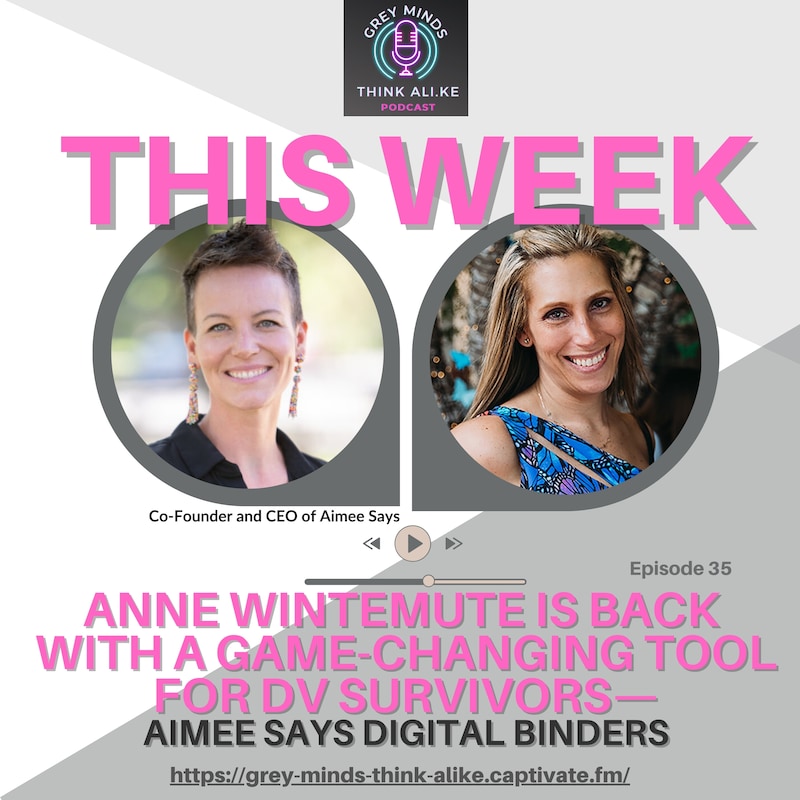
In this episode of Grey Minds Think Alike, host Ali Kessler is joined by Anne Wintemute, the creator of Aimee Says, an innovative AI platform designed to support survivors of domestic violence. Anne introduces Aimee's new digital binder system that helps organize and present survivors' stories in a clear, powerful, and secure way. They discuss the impact of technology on survivor advocacy, the importance of documentation, and how Aimee's tools empower users at various stages of recovery. Tune in to learn how Aimee’s solutions bridge the gap between lived experiences and the systems meant to protect survivors.
About Anne Wintemute
Anne Wintemute is Co-Founder and CEO of AimeeSays, a companion app that uses the power of AI to support survivors of domestic violence in their fight for safety and justice. Anne is a dedicated and visionary leader and is also the founder of A Garden Grows, a consultancy offering vital support services to women experiencing post-separation abuse. Anne is passionate about transforming the discourse around intimate partner violence and advocating for a narrative that holds perpetrators accountable. While working as the Head of School at an elementary school, she began supporting women navigating especially difficult divorces. She is passionate about helping women re-envision and reclaim control of their lives and protecting children from the adverse impacts of parental conflict. When she’s not with her clients or three children, you can find her tending her urban farm. In both plants and humans, it is the skillful attendance to the needs of a living thing that allows it to flourish!
Contact:
About Ali Kessler
Ali Kessler is a writer, marketing professional, passionate parent advocate, and founder of Greyson’s Choice, a 501(c)(3) created to raise awareness about the risk of domestic abuse on children. Greyson’s Choice was founded by Ali Kessler in memory of her sweet, vibrant, and fearless 4.5-year-old son, Greyson, who was murdered by his biological father in a murder-suicide during an unsupervised, court-approved visit in Ft. Lauderdale, FL, in 2021. This came just hours after her petition for a domestic violence injunction was denied by a Broward County judge, citing that the “petitioner has failed to allege any overt acts by the respondent which would constitute domestic violence under Florida Statute.”
Ali’s advocacy efforts culminated in successfully passing Greyson’s Law during the 2023 legislative session. This bill now requires the court to consider threats against ex-partners or spouses when making child visitation and custody determinations in the court, expanding to include the following factors: evidence of domestic violence, whether a parent in the past or currently has reasonable cause to believe that they or a minor child is, or has been in imminent danger of becoming the victim of domestic/sexual violence by the other parent, even if no other legal action has been brought or is currently pending in court.
Contact Ali:
Transcripts
Anne Wintemute Podcast
Ali Kessler: [:Last time Anne joined us, we explored how technology and AI are transforming the landscape of survivor advocacy and evidence collection. And today she's back with an incredible new tool. Aimee's digital binder system designed to help survivors organize and present their stories in a clear, powerful, and secure way.
ustody battles, or trying to [:Thank you.
Anne Wintemute: Thank you so much for having me back, Ali. I'm really excited to be
Ali Kessler: here. Absolutely, anytime. I do have Aimee Says on the Greyson's Choice website, and I get such good feedback from it. So I can only imagine, how wonderful it's going. So since the last time we talked, which has been maybe almost a about a year now for those new to Aimee says, can you just give a quick refresher on what it is and how it helps survivors of domestic violence?
ip and if they have children [:Ali Kessler: which is literally ongoing forever.
Anne Wintemute: Forever. Yep. Forever and ever. It's a, the gift that keeps on giving, it's a, essentially like managing a chronic high risk health complication and really, saying it that way, that's really how we're trying to address this as a digital health technology to help people put people in control of their experience of the next steps that they wanna take in an environment that is riddled with chaos and confusion and failures of systems and failures of family and friends and practitioners.
It can be really isolating and disempowering for survivors.
Ali Kessler: Absolutely. Now, you mentioned it's for people at different stages. There's in relationships preparing to leave already in court. How does Aimee adapt to each situation?
that perspective makes sense [:That perspective is understanding the impact of power and control dynamics, understanding what that looks like. In terms of language, what the. Laws that might be available are, and how to apply that information to the laws. Those red flags might be early in a relationship. Like we have folks who used Aimee through their divorces and now won't date without Aimee.
That's funny. Every message I get from, somebody on Bumble, I run it through Aimee, are there any red flags in here? That's funny
Ali Kessler: because what, last time we had you on, we did a test about just that, about dating. I met this guy, whatever. And I get such good feedback from that yeah.
Yes. So continue.
Anne Wintemute: Yes. And I absolutely love that because those are folks who are like I understand and accept that I, like anybody else, can be blindsided by finding out later that somebody was actually engaging in a really destructive interpersonal relationship with me. I love that they, they learned that from the last relationship and they're really applying that in the new relationship where they no wanna date safely.
dating apps have really high [:She won't remember you. So if you have a complex situation, you might want the upgrade, but if you're just exploring red flags, that's a great use of the free tool that
Ali Kessler: we have. Yeah, absolutely. I love it. I actually ask random questions all day long because I can, all AI software, it's just fascinating in general.
I literally was on chat GPT last night, just having my friend, I don't know his or her name, help me book a hotel room. It's just amazing. So I'm so glad to give Survivors particularly something like this where they can just get some feedback to things going on in their head that they might not.
Know what to do with. Yes. With that said tell me and introduce this digital binding system.
absolutely. So we get to do [:Like chat is super awesome. There's a ton of practicality in that chat. Like, how do I write this email, identify the forms of, coercion in here. But then there are other specific tasks that we are really excited to offload from the survivor's shoulders. And really that's documentation and presentation.
Absolute right. Most important. They are extremely important. The documentation both in healing and in in a legal context, and then the presentation very much in the legal context is critically important. And, we can't fix the system. The system is broken, but we certainly wanna give the best, possible opportunity and chance to all of those people who are trying to protect themselves and their kids.
ience to solve this problem. [:And then deliver that information. So that's built off of two things that we'll talk about today. Events and the bindering, right? Our binders feature. So events is really cool. And this actually just came out. A handful of days ago where, we understand the therapeutic kind of emotional value and practical value of chatting, right?
But if you still have to go somewhere else and write down what happened and the date and tag that, it's just, it's incredibly arduous. You're, your plate is already really full so people end up not documenting. And then, on the day the thing happens, you're like, I'll never forget this, right?
e can automatically generate [:Automatic. But in that side, that plus sign in the chat, while you're having that chat, you click that plus sign, you say generate event. Aimee scans the chat, produces draft events for you, sticks them on a timeline, plugs the right date in you can go back, you can edit them if there's any changes.
I haven't had to make changes to the events and our testing. And then they're automatically there. They're collected. There's a digital card of that thing that's, that Aimee has documented for you. What type of events are we talking here? We. We tested with a lot of bear attacks, okay? As our test environment is full of teaching Aimee how to pick up and collect the right details of a bear attack.
. What's logged is, an exfil [:Here was the impact, right? So now we have okay, that is recorded, that this was the date the motion was filed, or I was, so it's literally the
Ali Kessler: timeline creation. It is the timeline. Different events, like you said. Okay. So that's great.
Anne Wintemute: Yeah. He didn't pick up the kids today. And he sent me this nasty message and the kids were so upset.
You continue that conversation and then automatically those. Those events are generated out. Wow. Like they failed to use parenting time on such and such date. Kids were upset. And here's a screenshot of the, of the text message.
Ali Kessler: It's that's incredible. Because I used to literally jot down everything like, so and so was late.
He was five minutes late yesterday. He didn't give Greyson lunch today. I would literally write just random notes and then, send him to my lawyer. But it meant nothing. It just meant nothing because it was just like not in context of anything. Now, so tell us why timeline creation is so important when it comes to evidence in DV and cases in family court.
It's
en through. The family court [:The patterns tell the story. The best predictor of future behavior is past behavior. Oh. So that's a really important part. Like cementing the pattern. Actually, here's the history of medical decision making. Here's the history of educational involvement. Here's the history of our child's medical needs and how those things were handled.
Here's the history of. Name, whatever it is but there's a harder to address kind of insidious aspect of abuse is chaos lets the abuser's narrative dominate. And if they can say she's just saying that 'cause she's crazy, or it didn't actually happen like that. Or, no, she's wrong.
a timeline, of patterns, of [:It is the only antidote to the chaos. It's the only time that you're not just relying on the fact that you got a great judge and you know she was sympathetic to your case. So for understanding for yourself, okay, I didn't imagine this, or wow. Actually the psychological aspect really is the dominant theme of the abuse here.
Having access to that information is healing for you. It lets you know what kind of. Beast you're working with, right? And it fights that chaos for yourself and for whatever system that you're trying to engage.
Ali Kessler: Absolutely. And I love just having that like that in a timeline form so they can be like, oh, that happened then, like you said, and be like, no, actually it happened here and this is why.
And actually have, proof, you know that it says that.
, the filings and I need the [:Right after a filing, all the PEs is all the parenting time, and then he doesn't use any of it. Being able to surface your data like the human existence is a creation of data, of information. Being able to surface it in the way you need is one of the really amazing aspects of technology and what we're trying to leverage to, to keep people from losing their jobs, suffering from debilitating anxiety, blowing all of their resources, financial or otherwise, trying to do the same thing and just spinning their wheels.
Ali Kessler: Let's talk about exactly how it works. Like I'm assuming it's a digital binder. It lives electronically on your computer or online on a. Cloud, correct?
Anne Wintemute: Yes. It lives in the cloud, encrypted in transit. Okay. So how does
Ali Kessler: one use what Yes. When,
Anne Wintemute: when it comes out? So binders are, you come to Aimee and you chat and you upload your documents because those are important and you're doing all of that event, she's extracting those, you're generating your own events.
Then does [:Ali Kessler: ask you what
Anne Wintemute: to upload?
Ali Kessler: Does that person know? Does she say do you have this piece of paper, or do you have this? She will ask you, do you have motions?
Anne Wintemute: What evidence you have to the particular thing? Yes. Okay. Especially she'll support the journaling process too. Just click, get Aimee's input when you're in that events page and she'll be like okay, you need this, and here too to strengthen it.
So binders is what happens when you're like, okay, it's go time. I need to modify, or we are going to permanent orders, or we are going to mediation. And a little modal pops up says, what are your goals? We're talking real easy. We're trying to take as much pressure off as possible. Oh, I'm going to mediation.
My goals are to come out with this. This is my best day. What are the challenges? He is gonna say this, or she's gonna say this. And they think that I'm alienating, or, what are the challenges that you're trying to overcome? And then you press create binder. Okay.
been created. It's got your [:Here's the educational tab. Poof. Oh my gosh. There, there's the documentation I have on the educational needs. There's all of the events where, the kid was chronically tardy, where, he said no to a tutor or he denied the, the use of an IEP or a 5 0 4 all in one spot.
Now it's in beta, Ali, I'm not gonna, it's not gonna do 110% of the work. It's a really complex tool that we're, we are tweaking with and learning from our users on. But it will get you 80% of the way and it's highly editable. Nope. That document, I don't actually want that one in here. It doesn't make sense out.
I was gonna ask that. And you can someone go in and edit? Yes. You, it's all, it's entirely editable. I think it actually missed this journal entry 'cause I think it should go in here. And so you click, add content, it's on the right kind of middle of the screen. You can add documents, add new, oh actually you know what?
ell. And then you create new [:In it, the timeline and, the goals and the summary of the contents, and it's a real leg up. Especially if someone is a, a pro se litigant, it's a real leg up now. It gets more valuable over time. That's a really important thing, you know about Aimee, is it's not it's not just plug and play.
If you have a complex, situation. Everything that you're sharing with Aimee in your account, she remembers. She remembers that information builds over time. The patterns build over time. Your binders get bigger over
Ali Kessler: time. Got it. Now, how do you see this how do you see, think that judges are going to respond to this
s in a room, let alone a pro [:She's an extension of you, right? So what Aimee produces is your product, right? It's really just, her applying it, organizing it in
Ali Kessler: a way that you can easily digest it
Anne Wintemute: yes, or, and bring it to
Ali Kessler: your lawyer or judge or whatnot.
Anne Wintemute: Exactly, or, she takes your experience and converts it into the language of the courtroom, but it's yours.
It belongs to you. So if you go in there and you're like, here is my binder, right? You're gonna be in great shape. If you go in there and you say, I hired an AI to make my binder you might get some blow back on that. So it's an important kind of thing just to remember in terms of. What is Aimee?
She's not an expert. She's not admissible as an expert. She is you. She is an extension of you.
when they have a problem, or [:Anne Wintemute: Definitely early on. Early on. You know what we say your future self will be very grateful.
I talk to, folks who work with people who are at the rock bottom end. And those who are like, I were, I'm still figuring out if maybe this relationship is abusive. Like maybe this isn't a problem I can solve. Maybe this isn't something that, like if I just try a little harder or I explain it a little better, right?
This relationship will get better. The truth is that's the right time to start documenting right. It for a couple of reasons. If you start documenting it then and relying on yourself as a credible witness of your experience, you can really truncate the duration. And severity of harm that comes from people's belief that the system will rescue them.
body else. And I think, when [:Because we give up all of our power and we're like if you just knew you would do something about it. If you. And we can't assume to keep that. We can't, no. We have to keep that locust of power with us. Then we speak from a place of, knowledge, clarity, and authority and knowledge.
And the truth is that does result in the best responses from the system. I, yeah, absolutely. This is
Ali Kessler: fairly flaws. And then look, if document stuff for no reason and it something works itself out. No harm done. Yeah. You saved a receipt because you don't know if you're gonna need to return it.
I don't need to return it. Great. I can get rid the receipt and you can pat yourself on the back knowing that you made good choices because you can see how things unraveled. Yep. Which I love that as, as well. And
Anne Wintemute: it's a thing that you can do at a time when a lot of things feel really out of control.
you can. Take that note. You [:Ali Kessler: And I know for me, like I was saying, I would jot little things down each day or whatever.
I had, like little post-its here and things there. I didn't know what was what. Like I don't even remember. I was like, I don't even know what this was from this. I didn't what day this is from, or what, so I love that you can just. Actionably just put it in and it does the job for you. Now, how do you actually get into it?
Is it through Aimee says or is, do you, is it through his own? Place. It's all
Anne Wintemute: on the dashboard. It's all on the dashboard. So on mobile those features are at the bottom of the phone and on desktop, they're in the left nav. You'll see events there, binders there. Okay. There's also therapeutic binders.
here are the kind of ongoing [:I love
Ali Kessler: that. Yeah. I guess there's so many different. Ways that you can use it, not just court.
Anne Wintemute: No. Or I got fired and I think I was wrongfully terminated because, under the family leave I should have been able to take this time off. Yes. Survivors know that their, every aspect of their lives are impacted Yes.
By this type of victimization and their needs really run the gamut. I lost my lease or I'm in an action because of this. I, there are outside of the domestic relations court, the family court, there are needs outside of that, that Aimee's also able to support with.
Ali Kessler: I love that.
And this is a totally other. Category, but I feel like a lot of elders could use something like this for, I don't wanna say elder abuse, but just knowing someone like my mom, she's dealing with health issues right now. She has to be out of her apartment. She has all this, she doesn't know what to do.
ds this. And I'm like, yeah, [:Anne Wintemute: I can imagine that Aimee would be like, hold on, where's the perpetrator in here? I'm trying to find the perpetrator. Is it the lease holder? I was just talking about this today with one of our. Supporters who has just given us so much value over time. And I was like, you know what, Aimee is, for the 90% of people who are trying to make sense of the 10% of people who never will, right?
nd what Aimee is really good [:That's why it causes so much confusion, and here's how you can respond. Here's what we should write down. Here's what your HR team might need to know later.
Ali Kessler: Yeah, that's fantastic. I, I hope it does branch into all of those categories because it would definitely be a game changer for all, everything.
Now, since Aimee was introduced to the world, how has it, you said like her sauce has she gotten smarter?
Anne Wintemute: Yes. AI continues to get smarter. Tools get faster.
Ali Kessler: Okay.
Anne Wintemute: A lot of our, development team's job has just been upgrading the background tool because more sophisticated, faster, smarter ones have been invented.
edeveloped. To be better and [:Ali Kessler: and better instinctively. Does Aimee know that this is something for like sensitive topics or can anyone just write anything about anything?
Like my child farted? I dunno. That's the first thing that just came into my head. Is she, does she like, try to spin everything into sort of a helpful, healing journey?
Anne Wintemute: This, it's so really funny that you said that because you would laugh at all of our test environments. We don't wanna talk about abuse all the time when we're testing, so Aimee is, she's essentially assigned a persona, right? Okay. She is an expert in this space. She has specific goals and outcomes. The actions that we have oriented her to, which means that, she absolutely steers towards sussing out the presence and impact of these kind of destructive inter interpersonal relationship behaviors.
might be impacted. Like this [:And maybe that regression is because of the conflict that this child's exposed to. So she's gonna want to consider, dig a little deeper information in a specific context. Yes. She'll still be like, wow, that must have been a lot. I hope you had a lot of baby wipes on you. No, that's great.
Ali Kessler: That's absolutely great. Now, okay, so we have Aimee and she's getting smarter and technology is developing and then we have the binders. What's next?
Anne Wintemute: Our, what we are excited about is continuing to take more and more. Burden off of the people who are impacted to make it easier to show up in whatever way you're able to show up to have those candid conversations.
f information and make those [:For the last year, and suddenly you need x that she's able to do that for you instantly. That maybe now we're concerned about stalking. That's great. I have all this historical information. We can totally apply it to a pattern of stalking to make any next step as accessible and easy as possible.
Ali Kessler: God, I really wish I had this when I was going through my nightmare of all of it. It would've honestly, it could, it would have changed my life. It really would have. So I hope that someone listening out there realizes this and uses it to its full advantage because everything you just said is so true.
I really needed it to help me organize and keep the timeline, and keep the events and get advice and get action above. I'm sure Aimee would've told me all the things I should have done from the get go when I just made excuses in my head, oh, like that's normal. I guess he's just being an asshole.
y would've steered me in the [:Anne Wintemute: Yeah, I it's a great point. And you what you just said, what I think about often is I think about what if that police officer had given Gabby Peti.
A QR card and said, Hey, in addition to saying, Hey, you guys need to take off the night from each other, right? Which was really not clearly not understanding the situation. It was like, Hey. I think you should have this safe and confidential conversation. How might that have changed that trajectory?
Because we know that Gabby was still telling herself it it is my fault, right? I, I upset him. I brought this on myself. I, it is in incred. It is the norm for someone to be like, oh, in this particular incident, here are these modifying factors. Here's why he was just being a jerk, and here's why.
used by abusers to maintain [:And so that was, that was what was really driving this, that is what happens when the victim is committed to the relationship. The leverage your commitment to that relationship, your desire to make it work your, will for things to be okay to feel like they're under your control.
They leverage that as hard as they can and allow you. To gaslight yourself. Or to minimize or explain away. Of course they're doing the same thing at the same time. AI isn't susceptible to that. That is why it's so easy for, you can cut and paste a message into Aimee and say, analyze this.
his really something that we [:No, X, y, z? I feel like people in position of helping other people should be using this as a tool backwards.
Anne Wintemute: I would love to see more of that. I was at a conference once and I had a law enforcement officer come up to me and quietly and Hey. I used Aimee once. 'cause I was trying to figure out who the, who, the primary perpetrator, who's the primary aggressor in a, domestic call that I went to.
And I was like, what questions should I be asking because he says this and she says this. And I was like, that's not an audience we market to. We are very much survivor. First we're building up. They don't know for survivors. But I was like I felt buoyed to think that someone was out there not being like I know it exactly when I see it, which is a huge pitfall that has terrible outcomes. But to be like, I knew I needed to ask more questions, but I wasn't sure which questions I needed to ask. And to use a survivor focused tool to be able to do that. I was really honored.
st with his father, he's not [:And I'm like, if they had a tool like this and they put in everything that I just told them, they'd be like, red flag. Amber Alert. Amber Alert. They need the tools. They don't have the training needed. So something like Aimee could just give them some actionable steps on how to help others.
So I think that's a really great avenue for it to go next.
Anne Wintemute: Yeah, so anyone out there listening prevention, if you law enforcement, you can use it totally discreetly, confidentially. You don't need to put in any personally identifying information. You go to Aimee says.com, you press one button. Tell Aimee I. I'm in law enforcement.
I've responded to this call. What questions am I missing? This is what's been shared with me. I get some kind of expert evidence-based support on that power and control dynamic and what might be going on in that situation. No one will need to know. You don't have to share that with anyone. Yes I would love to see utilization in that.
Space.
Ali Kessler: All right. Great. Hopefully it will take us there next. So is there anything else you wanna update us or share with us,
te: with our listeners? Gosh [:We can't see what people say to Aimee and we don't read what Aimee's saying back to them, which means that we learn about how people have used Aimee directly from them. And, we continue to hear the, she's a game changer. My, my attorney says how. That I'm her favorite client ever because I'm using Aimee.
I handed over the binder and I saved myself $10,000 I and time, so much time and the time. Yep. We got the first coercive control finding from this judge. I used Aimee to build my case. Wow. We got the first financial control finding from this judge. I used Aimee. That's I. Really. And then a lot of the, we hear a lot I I'm I am alive because of Aimee.
at keeps us building that's, [:The hardest things that have ever happened to them and who have been able to build their lives, build their next steps. Just because they had someone who listened, someone who understood, and someone who provided real practical help. And that, this is the this is the best use of my time. I could not think of a job that I would feel more honored to be in.
Absolutely. It's just been a joy and a
Ali Kessler: wild ride. Yeah, no, I get it. I get emails just saying that, your son saved my child's life just from getting help in the state of Florida with Greyson's Law. So it, it does give more meaning and purpose, so I get all of that.
Anne Wintemute: You absolutely do. All of the folks that are pushing against the lines of people's comfort in this space that are demanding changes are absolutely building the paths to safety.
I go to a park. If I go to a [:Would it be less, would the children be less, would it be fewer red ones? I feel like they'd be purple. Purple. Yes. And a mix. And the Yes. And the truth is yes, that this is meaningful work that really does change lives. And thank you so much for doing that, for pushing against
Ali Kessler: the systems.
Yes, absolutely. Like you said, I really feel like every single person is affected by some sort of something, whether it's domestic violence or sexual abuse or just, having. Parents with mental issues or narcissism as parents, there's just anything, or a sibling or a, anyone, it doesn't even have to be a parent or a child.
d I'm just so excited to see [:Anne Wintemute: It really is. It's wild and it's moving quickly and we're just super grateful
Ali Kessler: For folks trust.
In a great direction. Using, technology for good is really what you want it to do, right? Yes. You don't want it to take over the world. You don't want robots running around when it can blend in harmoniously into everyday life like that and really do good. That's the end goal.
Anne Wintemute: Yes, the most eth, most ethical utility of this really powerful technology that you're right, unfortunately a lot of people are using to extractive or, personal gain ends.
Ali Kessler: Alright, I thank you so much for sharing all of this. What you've built is more than technology.
more or support, Aimee says, [:I'm Ali Kessler and this was Grey Minds Think Alike. Thanks again. Until next time. Thank you so much Ali. Absolutely.

