Shownotes
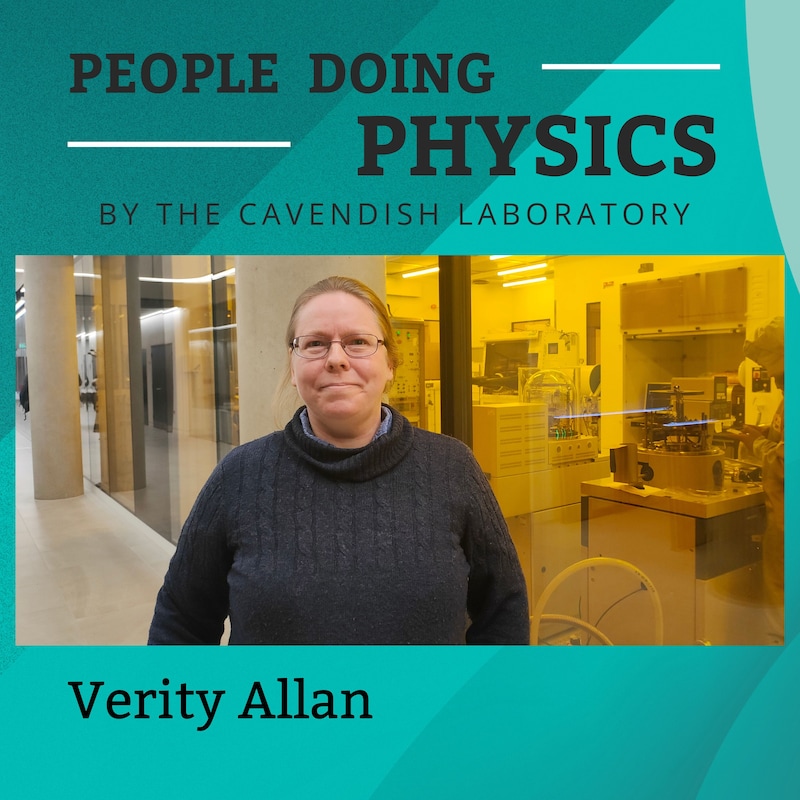
Today we’re joined by Verity Allan, who works as a project manager, developer, and programmer of architecture and software for the Square Kilometre Array, which will be the world's largest radio telescope. A graduate of Cambridge, Oxford, and The Open University, Verity came to Cambridge from a town in the Midlands to study Anglo-Saxon, Norse and Celtic.
How did she go from studying ancient languages, to coding, designing security for telescope software systems, and pursuing a PhD in high performance computing for astrophysics? These are just some of the twists and turns we hope to explore in our chat with Verity.
Stay with us.
Useful Links:
- Explore | SKAO - Learn more about the two largest telescope arrays in the world
- Ross Anderson's book on Security Engineering, mentioned by Verity, is available at https://www.cl.cam.ac.uk/archive/rja14/book.html (all three editions plus some videos)
- Verity wrote two papers on the history of scientific computing: The Cavendish Computors: The women working in scientific computing for Radio Astronomy and Scientific Computing in the Cavendish Laboratory and the pioneering women Computors
- Learn more about Jodrell Bank Centre for Astrophysics - The University of Manchester and about our Astrophysics work in Cambridge.
Share and join the conversation
- Help us get better by taking our quick survey. Your feedback will help us understand how we can improve in the future. Thank you!
- If you like this episode don’t forget to rate it and leave a review on your favourite podcast app. It really helps others to find us.
- Any comment about the podcast or question you would like to ask our physicists, email us at [email protected] or join the conversation on Twitter using the hashtag #PeopleDoingPhysics.
Episode credits
Hosts: Vanessa Bismuth and Charlie Walker
Recording and editing: Chris Brock
This podcast uses the following third-party services for analysis:
OP3 - https://op3.dev/privacy
Transcripts
It will get hard, it will get difficult, but there are more opportunities than you think, and you should relax and embrace them because they are there. And there are lots of jobs that are adjacent to physics without actually being a physicist, like we saw the lawyers up at hq.
SKA employs people doing finance, doing hr, doing outreach and communications.
Vanessa Bismuth:Welcome to People Doing Physics, the podcast that explores the personal side of physics from the Cavendish Laboratory at the University of Cambridge. I'm your host, Vanessa Bismuth, the communications manager at the Cavendish.
Charlie Walker:And I'm Charlie Walker, a researcher at Cavendish Astrophysics.
Today we're joined by Verity Allen, who works as a project manager, developer and programmer of architecture and software for the Square Kilometer Array, which will be the world's largest radio telescope. A graduate of Cambridge, Oxford and the Open University, Verity came to Cambridge from a town in the Midlands to study Anglo Saxon, Norse and Celtic.
How did she go from studying ancient languages to coding, designing security for telescope software systems and pursuing a PhD in high performance computing for astrophysics? These are just some of the twists and turns we hope to explore in our chat with Verity. Stay with us.
Vanessa Bismuth:Hello, Verity. Very good. Great to have you here. Thank you for joining us.
Verity Allan:Thank you very much for the opportunity. Good to talk to you.
Charlie Walker:Lovely to talk to you. So, in this podcast, we like to start from the beginning and.
And it's fair to say your journey towards your role today here at Cavendish has been a bit of a winding one. And you haven't always worked in physics, but you did mention that you had a childhood fascination with astronomy.
So could you tell us a little bit more about this and any memories which stand out for you in particular?
Verity Allan:Yeah, so I was interested in astronomy from an early age. My father was a fairly keen amateur astronomer as well. I remember him taking me out to look at Halley's Comet when I was still very young.
I hope to be around to see it again when it next comes past. So, yeah, so I had that from an early age. We, shortly after that, we bought a telescope and we started observing fairly regularly in the winter.
And when I grew up, where I grew up, you could still occasionally, on clear night, see the Milky Way. And that has always been something I've really loved, to look up and see the stars.
And that's one of the things that really excites me about the job that I'm doing today in building the world's largest radio telescope, because we're going to get to see further and deeper in the radio than ever before and we're going to see things that no one has seen before and that's amazing.
Charlie Walker:And this radio telescope is quite relevant even to your past because you mentioned you grew up near the Jodrell Bank Observatory.
Verity Allan:Yeah, and so I went on trips there as a, as a child and so I got to see there, go around the visitor center.
Obviously it's not the same now as it was, you know, 30 odd years ago when I was going around it, but it was still a great privilege to go there and I still like to go and look at the dish whenever I'm up at hq because SKAO HQ is based at Jodrell bank, so it's really quite cool. I can go up and I can see it and it's still there and it's still me doing science.
Charlie Walker:But it sounds like you are being drawn in another direction at school. So could you tell us a little bit more about the subjects that you did and didn't study and why?
Verity Allan:So up until about the age of, you know, 14, 15, even 16, my CV would look pretty much like anyone that was going to specialize in physics. You know, I was doing well in maths, I was doing well in physics. I didn't do physics for gcse, I just did chemistry and biology, single science.
I just wasn't that interested in physics at school. It wasn't that interesting to me.
I was already reading Scientific American and reading more and deeper things about physics than you could fit in a standard school curriculum. And so I dropped it in favour of doing drama, which was much more useful to me in terms of allowing me to learn about public speaking.
Presenting myself orally.
And that was in fact very, very useful because physics I can catch up on because I'm quite good at maths, you know, and I was also doing maths challenges that were done in schools and things like that, but it just wasn't that interesting to me. I couldn't really see how I did maths or how you could, could do maths.
And so I did the things for GCSEs and A level in particular that were more interesting to me, English, history, Latin, French, so that I got a much broader cultural base and was more interested in that. And that's what I pursued to A level and then to doing my degree in Anglo, Saxon, Norse and Celtic.
Vanessa Bismuth:Yeah, so that's where we were coming onto next, is that by the time you are of your undergraduate degree degree, it's fair to say that you moved on, moved away from STEM in general and physics in particular. Entirely. Almost entirely, I would say. Could you tell us More about what you chose to study. So Celtic.
Verity Allan:And so I focused primarily on Anglo Saxon and Norse things, primarily. Also I focused on languages and literature and a bit less on the history.
I chose it because it was a broad based degree that gave you the opportunity to do lots and lots of, of different things. I get a bit bored if I'm doing the same thing all the time. And this degree gave me the opportunity to look at lots and lots of weird, weird things.
You know, I've handled manuscripts that are over, you know, a thousand years old and things like that, which is pretty cool.
Vanessa Bismuth:You handle those in your undergrad?
Verity Allan:Not so much my undergraduate. In my later graduate studies I did, but I did handle some fairly old things in undergrad.
Vanessa Bismuth:But we said almost entirely moved away from physics because from our earlier chat it sounded like you hadn't quite left physics behind.
Verity Allan:I never did quite. I was always keeping up with, you know, popular science.
In fact, on my application for my undergrad at Cambridge, I put down A Brief History of Time as one of the things that I'd read.
Even though this is not something you'd normally put down on an Anglo Saxon, Watson, Celtic application you put down, you know, histories and maybe you put down Beowulf or something like that that, you know, turns up in Old English literature. But no, that was one of the things that I put down and was probably one of the things that stood out on my application in the end.
Vanessa Bismuth:What stood out about this book and that you just.
Verity Allan:That. I mean, one of the things I wanted to show was that I did in fact have broad base of interest. I wasn't a narrow candidate.
I wasn't just focused in on one single thing that I was, you know, culturally aware of the significant things that were happening in the sciences as well as what was happening in arts. And you know, I continued reading that kind of thing through university because it's, you know, interesting to me.
Charlie Walker:And then after your Mphil at Cambridge concluded, you moved to Oxford, is that right? To continue your studies. So could you tell us a little bit more about.
Verity Allan:So I spent four years in Oxford. I submitted a PhD thesis.
This did not go entirely as planned and I ended up with the either spending some more time trying to finish everything up and get a job when I would be submitting much later than my peers. I knew that the job market was going to be very, very tight. So I stopped and I moved away and I got a job.
Actually it was a job for the University of Cambridge doing data entry because I'd actually done data entry during my holidays as sort of summer jobs. And so I got a job doing that and I start shortly after that I started my OU studies.
Vanessa Bismuth:So it sounds like you were at a crossroad after Oxford and this is when you began to turn back from the arts toward a more STEM based career, loosely defined STEM based career. Could you tell us more about the process of retraining?
Verity Allan:So for that I looked at, I was looking at job ads, you know, going what are the interesting jobs? What qualifications do they need? Do I meet them?
And for most of the ones that I saw advertised, and this is a time when also you could still look up adverts in newspapers, which I suppose technically you still can, but probably no one bothers to. And nearly all the really interesting ones needed a numerate degree.
Now for some people that might have been, you know, something that scared them, but I knew that I was quite able enough and maths and science to do this. And so I started a degree in computing and mathematical sciences with the Open University.
Which was quite, quite good fun and that I did part time alongside my job.
Vanessa Bismuth:So what jobs were you doing specifically? What kind of jobs were you looking out for exactly?
Verity Allan:So at the time I was just looking for something that looked interesting, that had had something that sounded like it would be challenging to work upon and you know, most of the entry or near entry level ones that sounded interesting also then said, you know, you need a degree in maths or science. So I picked something there that I thought I could do and that, you know, there's a degree that more or less interested me.
Vanessa Bismuth:So how did that the whole Open University part time studying while working.
Verity Allan:So I actually really enjoyed it. I mean I started off while I was working part time because that was the nature of the role that I was in at the time.
But later on I moved to working full time during it as well and I actually quite liked doing it. I found that for me the course load was quite light compared to Cambridge part partly because you can spread it out for longer.
Cambridge does have very, very short terms and the OU does spread it out longer. And also because you're doing it part time, you're also spreading the whole thing out.
I mean I did it in I think five years, which is a bit quicker than you have to. Normally if you're doing it part time, you'd spread it out so that you complete in six, roughly 50% of the time. And I found it quite easy to do that.
with a first class degree in: Vanessa Bismuth:And were you keeping up with physics in any way at this time?
Verity Allan:Only insofar as I was reading pop physics books and things like that, or.
Vanessa Bismuth:Rereading the brief history of time I might have done.
Verity Allan:I was also reading books on mathematics, books on computing, including Computing Security. One of the things that I got interested in was computer security and I started reading Ross Anderson's security engineering book.
Ross Anderson was a professor here. He died late last year I think. But yeah, and he wrote some very good books that I started reading at that time.
Vanessa Bismuth:I'll put the links in the show notes for our listeners that are interested in this topic and it sounds like.
Charlie Walker: your next job as well. So in:Could you tell us a little bit more about the SKA and why this job advertisement stood out to you in particular?
Verity Allan:So the Square Kilometer Array Observatory is building the world's largest radio telescope. It's two telescopes. Built on three continents.
HQ is on in in the uk, so in Europe there's a mid frequency telescope which looks at frequencies from 450 MHz up to about 15 GHz. That's located in South Africa in the Karu Desert. And that of course is on the continent of Africa. The third continent is Australia.
es which covers from to about:And that to me was really exciting to be able to go and see, see the stars, see them in more detail. I mean when I go out and look at stars at night, sometimes I look up and I see Cassiopeia.
And I know that in the heart of Cassiopeia is a radio galaxy that was first detected here in Cambridge many years ago. And to know that I'm working in that tradition and helping us see more is just, it's amazing. It's what allows me to get out of bed in the mornings.
Charlie Walker:Cambridge has an excellent tradition of radio astronomy. And so once you joined the ska, what did your job involve to begin with?
Verity Allan:So to start with I was doing a little bit of project management, so dealing with the kinds of tools we use to keep track of our work, helping set that up, helping set up wikis so that we could Organize our thoughts and participating in our architecture discussions. So in Cambridge we were part of a big consortium coming up with a design for the science Data processor for the Square Kilometer Array.
And that is basically the thing that processes the data and turns it into an image that looks like what you expect to see from a telescope, not like naughts and ones on a disk. And that allows us to manage the huge, huge volumes of data from the ska.
There'll be roughly an Eightfold reduction of data inside the sdp, which will mean that we can afford to store this stuff because otherwise we can't really afford to store everything at full fidelity off the sky. Not unless some more very rich countries join the Square Kilometer Array observatory and sign up to our treaty and give us lots more money.
We had to design a way of doing this data reduction so that we could do it fairly quickly so we don't have to keep lots of data around for too long, but also at a very high fidelity so that we're producing things that are scientifically useful and not like something where a scientist looks at and goes, well, I can't do any science with this. You've given me something rubbish. So we're working on that.
And we also in that had to cover aspects of data security because these days, even if you're in a scientific organization, you can't assume that you, no one's going to bother trying to attack you. So we had to look at that as well.
Charlie Walker:And what did that involve in the.
Verity Allan:Very early stage that where we first working on it, it was working on the design documents to say this is the kind of sort of security policy that we envisage applying. These are some of the design features that we think we need in order to keep it secure.
Since then, since we actually started construction, I've also got involved with adding the, what we call AAA authentication, authorization and auditing to the telescope.
Which means that me as a random developer, I can't get onto the telescope and control it and try and direct it and try and process data coming off it. But only the authorized operators can do that.
Charlie Walker:You can't just make this giant telescope do whatever you want.
Verity Allan:I can't just make it do whatever I want, no matter how tempting it is.
Charlie Walker:Yeah, so it sounds like a really engineering based role. And we know from what you've said that you're also really enthusiastic about, about the physics, about the astronomy.
So being based in Cambridge, did you also have opportunities to learn more about the astronomy?
Verity Allan:Yes, particularly in the early days when I had a bit Less to do. I got the opportunity to go along to the IOA seminars colloquia that happen every week.
And also the things that are run by the Batcock Centre for Experimental Astrophysics, my line manager let me go to those.
And so I learned an awful lot about that and it's one of the reasons that I was able to start my PhD in computational astral Computation for astrophysics.
Charlie Walker:And did you find your Open University degree equipped you well for that or was there still catching up to do?
Verity Allan:So for the physics there was definitely catching up to do, but then I didn't even have GCSE physics, which is something I like to do to wind physicists up, say to wind physicists up, because, you know, they think that you probably should at least have had an A level and then done maths or something. But no, I find that most of the physics I can get at, I can work with it because I've done enough maths.
And obviously there are specific things that you have to cover because a PhD is always going to be more in depth than anything that you cover in an undergraduate degree. And also with computing, because I finished my undergraduate more than 10 years ago. Just the technologies will change really quickly.
Vanessa Bismuth: k, really. Despite joining in:Could you tell us more about why this was so?
Verity Allan:Some of it was that the original timescales were very, very aggressive. Unrealistically so almost in those early days.
cess because when I joined in:And so we had to wait for that to be signed before we could start construction properly.
Vanessa Bismuth:So as construction started.
Verity Allan:So yes, construction started, I think it's about three years ago now. I've lost track of the time already. It goes so fast. And yeah, so we've started construction now and several countries have joined the observatory.
We had to wait for a minimum of five of them to get signed up before construction could start because basically to agree to an international treaty for. For most countries this means you have to pass legislation. So you can actually look that up for the UK and find the piece of legal.
You can find the legal instrument that actually signs us up as part of the skao.
Vanessa Bismuth:So we can't change our minds anymore.
Verity Allan:It's very, very difficult to do. There's a scientific council that tells us, and the treaty will tell us what we're allowed to do and not do.
But yeah, it does mean that it is quite difficult first of all to get everyone to agree, to join and to agree, first of all to agree.
The legal text of the treaty is really hard and then you have to get everyone to sign up to it and pass it through the, through the national legislatures.
Vanessa Bismuth:So when did that happen?
Verity Allan: That process was starting in: demic. So this was very early:They were working from 8 till 6 and they were known as legal scrubbers, which is a really funny phrase.
Vanessa Bismuth:What a title.
Verity Allan:It's a great title.
And what they were doing was taking the text of the treaty and checking it very, very carefully to make sure that it meant exactly, exactly what they meant, wanted it to say. And yeah, they were working from 8 till 6, they got their lunch wheeled into them.
You know, they didn't really get any breaks and they were doing this at least for a whole week because that was the week that I was up there seeing them do this.
Charlie Walker:Are they looking stressed?
Verity Allan:They did look quite intense. Not necessarily stressed, but they looked very intense and very concentrating.
I have to say I prefer a style of work where you can take slightly more breaks than that.
Charlie Walker: unds like during this sort of: Verity Allan:Well, so the thing Here is the SK8 has the. We've got an issue where you've got to keep the code going for a long time.
It's got to be highly, highly reliable because basically we want to observe 247 every single day of the year.
This means everything has to be super, super reliable and to operate exactly as you intended it to, because otherwise, even if it's on and taking data, are you taking data from the right place in the sky? If not, then, then you're not doing the right thing. So we've always had to work with astronomers and programmers together to get this going.
One of the issues here is that a lot of people who come from a science background who are then getting into programming, we have the issue that you've written code for yourself, so it has to work, but it only has to work on your computer in your situation. Maybe it only needs to work once or twice to get you there results that you need. It doesn't have to work every day.
And you, you maintain it, or you maintain it, or you do it for that article, you do it for that Ph.D. and then you don't have to maintain it, you do it for that postdoc, you move to your next job, you don't have to maintain it. We have to maintain this for something that might last 50 years, might last more than that.
And this means that you have to code to a rather different standard because you're using it in such a different way. Way.
I don't know if anyone has ever had the experience of writing code and then coming back to it six months later and going, I have no idea what I did here. Maybe it was clever, maybe it wasn't clever, I have no idea.
And so one of the things that we've done as a project is we've instituted a lot of checks about our quality of code and making sure that you've done things like writing some comments and some documentation. So you know what it does and.
Vanessa Bismuth:It'S not only just for you, it's also for all the other people that would work on it.
Verity Allan:Yeah, it's not just for you, it's for everybody else on the team.
Because again, you can't have code that only you understand because at some point you might be ill, you might leave the project, a 50 year project, you might retire and someone else is going to have to maintain it. So you've got to make sure that it's written in a way that other people can work with it.
It's documented, it's got a set of tests so that you can check its reliability and you know, check its outputs time and time again. Even if you change things like, you know, every five years at least you're probably going to be changing the operating system you run this code on.
And you need then a set of tests that mean that you can check the, that it still works after that and hasn't broken.
Vanessa Bismuth:Did you ever encounter any like, any barriers or people not being very, or being defensive of their way of doing coding and things in general?
Verity Allan:Only a very little bit.
I mean, occasionally you do, but once you point out to people that Actually, it's not like what you've been doing in your previous sort of scientific roles or even sometimes in your previous professional career.
Maybe you've worked for a much smaller organization and maybe you've worked in a startup where your priority is to get something out of the door tomorrow before you lose funding for your job. Whereas here the priority is to have something that will run this year, next year, the year after, and in 10 years time.
Charlie Walker:And that's valuable too. Right. The longer it runs, the more scientists might be able to use your code, use your techniques, and the more exposure you'll get as well.
Verity Allan:I mean, it's good.
I mean, most of our, pretty much all of our code is released open source so that it can be used outside the community or used on other projects as well. If they happen to need a control system, which they probably don't, or at least not one that drives a telescope.
If they happen to need some of our data reduction techniques, that's more useful also to other telescopes as well. So a lot of it is released open source just to make life easier for everybody.
Vanessa Bismuth:So fast forwarding to today. Where is the SKA at right now and where things are going in the next few years?
Verity Allan:So it's really exciting. So this year, about 11 years after I joined, we had the first image come out from the LOE telescope in Australia.
Now, it's not the full scale thing that we're building because we're building it in stages, partly to allow for verification, partly because otherwise the logistics of trying to build everything at once in the desert is it's, it's too much. You just can't do it because how.
Vanessa Bismuth:Many dishes are you building?
Verity Allan:So in South Africa we're building, well, we're building about 140 dishes and, and then getting some that are already there from Meerkat, which is a South African telescope that's already in operation. So we're building about 140 and getting another 60ish from Meerkat.
Vanessa Bismuth:Yeah. So you can imagine the nightmare of building all at once.
Verity Allan:Yeah. So you can't build them all at once. And also you want to check that you've got things working at a small scale before you roll out.
In the Australian desert, we will be building 256 stations each with over 100,000 antennas on them, which is a huge number of antennas. And yes, so that's rolling out so low. We had four stations in operation and they produced their first image earlier this year. Mid.
We're hoping that within the next three to six Months they will produce their first image. It's really exciting to see that happen after in 11 years on the project.
Vanessa Bismuth:Planning and designing and thinking about it actually things, it's things coming out really.
Verity Allan:Good to start seeing that it's not big enough yet to be usable for science.
All of the images and things that we're doing at the moment are just to check our engineering and to check that the system as a whole is doing vaguely what we expected. But we're hoping that the first sort of science will be available by the end of the decade.
Vanessa Bismuth:And so what about the future future? Like the further away future?
Verity Allan:So yeah, the further away future, as I say science by the end of the decade. We are rolling out to get some more more stations and more dishes on the ground.
In particular, we're doing a big rollout for low one of our staged rollouts next year that will take us up to a scale where we start first really using the Science Data Processor to really deal with the data. At the moment, the data sizes we're dealing with mean you don't actually have to use it. You can get away with using existing tools and technologies.
And so that will be coming next year for the Science Data Processor.
Charlie Walker:So you mentioned at the beginning of this that as a child you always want to do astronomy at Cambridge and you are so looking back, would you have chosen a different route to get here or not?
Verity Allan:It's a difficult one. I mean, some things that I would quite like to have avoided. There were some difficult moments in there that were tricky to deal with.
But on the other hand, I've also got a lot of experience. That means that I'm doing something a little bit different.
You know, I get to work on something that isn't just straight physics or straight astronomy.
I get to do things that have, you know, much more of a project management component, much more of a computing component that I probably wouldn't have got, that I probably wouldn't have been able to do if I'd just gone straight through doing, you know, maths A levels and then know physics undergrads.
Charlie Walker:It's kind of that whole idea of wanting to have a broad spectrum of interest that you talked about when you talked about reading the Brief History of Time at undergrad. And we haven't even covered the whole spectrum of interest that you are doing right now.
Could you tell us a little bit more about what else you're doing at the University of Cambridge at this moment?
Verity Allan:So for my PhD, I'm researching computing for high performance radio astronomy, rather high Performance computing for radio astronomy. Got that very backwards.
But basically so that is taking the computing and trying to apply it so that it's easier for astronomers to get to grips with the huge data sizes that we'll be dealing with from telescopes like the, like the SKA and also like the lsst, which came online earlier this year or late last year. So, so that's the kind of thing that I'm supporting.
I've also done some research into the history of women in early astronomy and computing, early radio astronomy and computing here in the Cavendish as well. And so those are some of the things that I do.
Charlie Walker:And are there any sort of fields in computational astrophysics which really excite you more than others? They all seem to really excite you. Is there a favorite?
Verity Allan:I mean, so for my PhD, as I say, I'm being very user focused and thinking about what the astronomer wants.
I also like the cyber security aspects, which isn't so much to do with high performance computing in and of itself, but is vitally important for things like the ska. And you know, I don't have one dominant interest. If I did have one dominant interest, I think my career would have looked very different.
Charlie Walker:So you're doing that part time research, PhD, part time work. What is really driving you to get that PhD?
Verity Allan:I just really want a PhD. It's not a rational thing at all. I just really want a PhD.
Charlie Walker:Dr. Allen.
Verity Allan:Yeah, that's what I want.
Vanessa Bismuth:That's an excellent reason why not. If you could offer your childhood self any advice, what would it be?
Verity Allan:I think it's that it will get hard, it will get difficult, but there are more opportunities than you think and you should relax and embrace them because they are there. And there are lots of jobs that are adjacent to physics without actually being a physicist. Like we saw the lawyers up at hq.
Also, SKA employs people doing finance, doing hr, doing outreach and communications, as well as project managers, as well as all the people that are doing, you know, writing programs and testing things and actually building telescopes, physical telescopes in the desert.
Vanessa Bismuth:Do you have.
So I suppose that's already covering this question, but do you have any advice or word of encouragement for listeners with non traditional backgrounds? But who wants to get close to.
Verity Allan:The science do look out for those jobs.
They are there, you know, in the Cavendish we also have all the people that are doing the support jobs that support the science, you know, because if we don't have people in finance, we don't get paid. And mysteriously I quite like getting paid. And if you've got a sensitive and line manager.
Then hopefully they'll allow you to to attend some of the public events and some of the lectures and find out a bit more about what's going on and what it is that you're supporting and what it is that you're helping to build. Excellent.
Vanessa Bismuth:I think we'll finish on that.
Charlie Walker:Thank you very much.
Vanessa Bismuth:Thank you so much, Verity. That was great.
Verity Allan:Thank you for the opportunity.
Vanessa Bismuth:So thank you to Verity Allen for joining us today.
As always, if you would like to learn more about what we discussed in this episode, episode and more generally about our work at the Cavendish, please have a look at the show notes or go to our website. If you have any questions you would like to ask our physicists, head to social media and tag us with the hashtag peopledoingphysics.
This episode was recorded and edited by Chris Brock. Thank you for listening and we'll be back soon.




