Shownotes
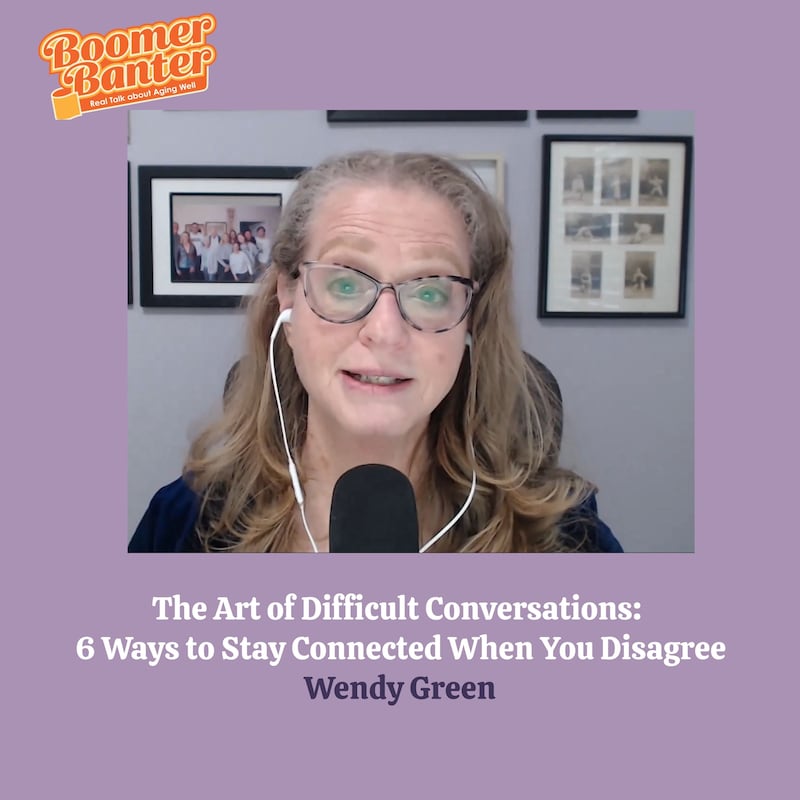
In this episode of Boomer Banter, we tackle something many of us are exhausted by but can't ignore ... difficult conversations. Not the surface-level small talk, but the real, uncomfortable ones with family members who see the world completely differently, with old friends across the political divide, and especially with ourselves.
Host Wendy Green shares a powerful story from the 1980s about finding common humanity with a coworker on opposite sides of the abortion debate, and offers practical strategies for navigating high-stakes conversations when the relationship matters deeply.
You'll learn:
- How to set the right intention before a difficult conversation begins
- Why paraphrasing is one of the most underrated conversation tools
- When silence might actually be the more loving choice
- How to have honest conversations with yourself about what you can actually do to make a difference
This isn't about changing minds—it's about choosing connection over avoidance, curiosity over contempt, and showing up with an open heart even when it's hard.
What difficult conversation are you ready to have?
Support Boomer Banter: buymeacoffee.com/heyboomer0413
Connect with Wendy: LinkedIn, Facebook & Instagram or at [email protected]
Resources to help with Difficult Conversations:
Difficult Conversations: How to Discuss What Matters Most by Douglas Stone, Bruce Patton & Sheila Heen
Crucial Conversations: Tools for Talking When Stakes Are High by Kerry Patterson, Joseph Grenny, Ron McMillan & Al Switzler
Braver Angels - organization bringing together people across political divides
Mentioned in this episode:
greenwoodcapital.com
Transcripts
Foreign.
Speaker A:Welcome to Boma Banter, where we have real talk about aging.
Speaker A:Well.
Speaker A:I am your host, Wendy Green, and every week we talk about the challenges, the changes and the possibilities that come with this season of life.
Speaker A:And before we dive in, I want to thank those of you who support Boomer Banter by buying me a cup of coffee.
Speaker A:It's not really a cup of coffee.
Speaker A:It's a way of showing your support for the work that we're doing here at Boomer Banter and that it means something to you and it matters to you.
Speaker A:So if you would go to buy me a coffee dot com.
Speaker A: Hey, boomer: Speaker A:You can buy one cup, two cups, however much you want.
Speaker A:Each one is $5.
Speaker A:But any support that you can give the show keeps us going and producing this kind of content that you enjoy.
Speaker A:So this is about difficult conversations.
Speaker A:And I wonder, what's the conversation that you've been putting off?
Speaker A:Maybe it's with a family member who sees the world completely differently than you do.
Speaker A:Maybe it's with a colleague or an old friend.
Speaker A:Or maybe this is the one we really avoid.
Speaker A:It's the one with yourself.
Speaker A:Today, we're going to talk about difficult conversations, the ones that matter, the ones that can change something.
Speaker A:Maybe not the world, but maybe you.
Speaker A:Or maybe your relationship with someone you love.
Speaker A:I'm so glad you're here.
Speaker A:So let's dig in.
Speaker A:I've been sitting with this topic for a while now, and honestly, I've been a little nervous to bring it to you.
Speaker A:Not because it's dangerous, but because it's personal.
Speaker A:And because I think a lot of us are exhausted.
Speaker A:We're exhausted by the noise, by the polarization, by the feeling that no matter what we say or do, nothing is going to change.
Speaker A:But here's what I've been noticing.
Speaker A:The exhaustion isn't just about the big abstract out there.
Speaker A:A lot of it lives closer to home, in our families, at our dinner tables, and in our own Heads at 2 in the morning.
Speaker A:So today I want to talk about something that we all are familiar with.
Speaker A:Difficult conversations and how they might make a difference.
Speaker A:I want to talk about them in two ways.
Speaker A:The conversations we have with other people and the conversations we have with ourselves.
Speaker A:Because both matter and both take courage.
Speaker A:So let's start with the obvious.
Speaker A:Many of us have people in our lives, relatives, neighbors, people we genuinely love who see our current world very differently than we do.
Speaker A:And I get it.
Speaker A:It's protective.
Speaker A:It feels safe.
Speaker A:Why open the door that might blow the whole house down?
Speaker A:If we open the conversation, that could be difficult.
Speaker A:So we keep things at a surface level and we save the deep stuff for the people that we know already are on our side.
Speaker A:But here's what I've been thinking about.
Speaker A:When we only ever talk to people who agree with us, something strange happens.
Speaker A:The other side stops being people.
Speaker A:They become a category, a type, an identity that we see as the other.
Speaker A:And that's where things get dangerous.
Speaker A:Not because disagreement is dangerous, but because dehumanization is.
Speaker A:So let me tell you a story.
Speaker A: Back in the: Speaker A:This was a topic I felt, and still feel very strongly about.
Speaker A:I had a co worker, smart guy, kind, genuinely respectful to everyone around him.
Speaker A:And he was deeply religious, which meant he was strongly opposed to abortion for any reason.
Speaker A:Now, on paper, this is the kind of person I was supposed to disagree with, fundamentally the kind of person I might have dismissed or avoided.
Speaker A:But I respected him and I was curious.
Speaker A:So we talked.
Speaker A:Not to debate, not to win.
Speaker A:We talked to try to understand.
Speaker A:He didn't see abortion as a health care choice.
Speaker A:He saw it as taking a life, full stop.
Speaker A:And while he could absolutely support women's health decisions in almost every other context, that was where his belief drew a line.
Speaker A:I listened.
Speaker A:And then I shared my own view that all decisions about a woman's health and body should belong to her and her doctor.
Speaker A:And he listened to that.
Speaker A:Did either of us change our minds?
Speaker A:No.
Speaker A:Did the conversation change anything in the world?
Speaker A:Not really.
Speaker A:But here's what it did.
Speaker A:It helped us both see each other as human beings with deeply held, carefully considered beliefs.
Speaker A:Not as enemies, not as caricatures, but as real people.
Speaker A:And that that shift in how we see each other, that matters more than we realize.
Speaker A:Now, I want to be real with you.
Speaker A:My co worker story had relatively low stakes.
Speaker A:If it had gone badly, it would have been awkward in the office, but that's manageable.
Speaker A:But what about when the other person is your mother or your brother or your oldest friend?
Speaker A:Someone whose opinion of you matters deeply?
Speaker A:The stakes do get higher and the emotions get closer to the surface.
Speaker A:History that you have with this other person complicates everything.
Speaker A:You're not just talking about an issue anymore.
Speaker A:You're navigating years of shared dinners and old wounds and unspoken fears.
Speaker A:So here's my honest take.
Speaker A:Not every difficult conversation is worth having.
Speaker A:You get to choose.
Speaker A:But if you decide to have it, if you genuinely want to understand and be understood, here's what I've found helps.
Speaker A:First, set your intention before you begin speaking.
Speaker A:Decide that success doesn't mean winning.
Speaker A:Success means walking away with the relationship intact and with a little more understanding than you had before.
Speaker A:Say this out loud to yourself before you begin.
Speaker A:Second, get agreement from the other person.
Speaker A:Before you start, say something like, I'm not going to try to change your mind.
Speaker A:I genuinely want to understand where you're coming from.
Speaker A:Can we try that?
Speaker A:That one sentence could possibly change the energy that follows if they agree.
Speaker A:Third, pause before you react.
Speaker A:When something they say makes your chest tighten, your belly go into knots.
Speaker A:Take a breath.
Speaker A:Ask yourself, why does this feel so threatening?
Speaker A:What is this touching in me?
Speaker A:That moment of pause can be the difference between a conversation and a confrontation.
Speaker A:Fourth, paraphrase.
Speaker A:This is underrated and incredibly powerful.
Speaker A:When they say something, reflect it back.
Speaker A:So what I hear you saying is, is that right?
Speaker A:It shows the other person they've been heard.
Speaker A:It slows the whole thing down.
Speaker A:And sometimes just hearing their own words in someone else's voice helps them hear themselves more clearly.
Speaker A:Or if you didn't understand, it helps them rephrase so that hopefully the next time you try something.
Speaker A:So, okay, so this is what I'm hearing now.
Speaker A:Is that right?
Speaker A:It helps you get to understanding.
Speaker A:You want them to also agree to paraphrase to you.
Speaker A:Fifth, ask questions.
Speaker A:Can you help me understand how you arrived at that?
Speaker A:Or what's the experience behind that belief?
Speaker A:Curiosity is disarming.
Speaker A:It's hard to stay defensive in the face of genuine interest.
Speaker A:Genuine interest.
Speaker A:And sixth, acknowledge when it gets hard.
Speaker A:It's okay to say, I can feel this is getting charged.
Speaker A:I care about us too much.
Speaker A:That then I feel like this could turn into a fight.
Speaker A:Maybe we should take a break.
Speaker A:That's not weakness, that's wisdom.
Speaker A:And none of this is easy.
Speaker A:But these conversations, when they go well, they're some of the most meaningful ones we ever have.
Speaker A:Okay, so let's shift now to the difficult conversations many of us are are having right now.
Speaker A:And they are not with the other person.
Speaker A:Those are the internal conversations.
Speaker A:It sounds something like this.
Speaker A:I'm angry.
Speaker A:I'm scared.
Speaker A:What can I do?
Speaker A:What should I do?
Speaker A:Is anything I do even going to matter if that sounds familiar?
Speaker A:You're not alone.
Speaker A:We all have conversations like that with ourselves regularly.
Speaker A:I used to March in the 80s and the 90s.
Speaker A:I went to demonstrations.
Speaker A:There was something so viscerally powerful about being in a crowd of people who believed in the same things you did.
Speaker A:The chants, the signs, the music.
Speaker A:There was always music.
Speaker A:It felt like something.
Speaker A:It felt like I was doing enough.
Speaker A:I'm older now and I engage differently.
Speaker A:I write letters.
Speaker A:I support postcard campaigns.
Speaker A:I make this podcast.
Speaker A:I try to create content that encourages people to believe they can make a difference, because I genuinely believe that.
Speaker A:But here's the thing.
Speaker A:I had to have a really honest conversation with myself to get here.
Speaker A:I had to ask, what do I actually believe I can do?
Speaker A:Not what I am supposed to do, not what would make me feel most righteous, but what am I actually going to do consistently with the time, energy, and gifts that I have?
Speaker A:And that's the question I invite you into today.
Speaker A:What's your version of making a difference?
Speaker A:For some of you, it may be showing up to city council meetings.
Speaker A:For some, it's having exactly the kind of uncomfortable conversations where you've been talking about.
Speaker A:For.
Speaker A:For some, it's beautifying a community garden or volunteering at a food bank or supporting local businesses that reflect your values.
Speaker A:And for some of you, and this counts, I promise it counts, it's choosing to listen to someone whose life is different from yours with genuine curiosity and an open heart.
Speaker A:Every single one of those things is a difficult conversation in its own way with yourself about what matters with your community, about what's possible with the future you want to build.
Speaker A:And I want to be honest with you about something.
Speaker A:I don't always do what I'm describing here.
Speaker A:There are relationships in my life where the risk feels too high, where I've looked at the situation and decided, for now, that silence is the more loving choice.
Speaker A:I'm still learning when to lean in and when to step back.
Speaker A:I don't have a formula to share with you, and I'm not sure anyone does.
Speaker A:But here's what I do know.
Speaker A:I want to be someone who chooses connection over avoidance whenever I can, who chooses curiosity over contempt whenever I can, and who believes that the person across from me, even if they see the world completely differently, has a story worth hearing.
Speaker A:Not easy.
Speaker A:I'm working on it.
Speaker A:And I think the fact that you're listening to this means that you are, too.
Speaker A:So here's where I want to land today.
Speaker A:Making a difference doesn't always mean changing someone's mind.
Speaker A:Sometimes it means truly listening.
Speaker A:Sometimes it means deciding what you can do, even if it feels small or even if it's invisible to the world, and then doing it.
Speaker A:Sometimes the most radical act is simply showing up to a hard conversation with an open heart and no agenda.
Speaker A:I'll leave you with the question that I've been sitting with.
Speaker A:What difficult conversation are you ready to have and what difference will it make?
Speaker A:I'd really love to know.
Speaker A:So reach out.
Speaker A:Share your story with me because your answer matters not just to me, but to this community of boomer banters that we are building together.
Speaker A:Thank you for being here, thank you for caring and thank you for being willing to have the hard conversations even when maybe especially when they're difficult.
Speaker A:And if today's episode resonated with you, I'd love it if you shared it with someone who might need to hear hear it a share or review or just a message telling me what this brought up for you.
Speaker A:It means more than you know.
Speaker A:You can find me at heyboomer biz on LinkedIn, Facebook, Instagram and I'll include some resources on having difficult conversations in the show notes.
Speaker A:A new episode drops every week, so I'll see you then.
Speaker A:Thanks.



