Shownotes
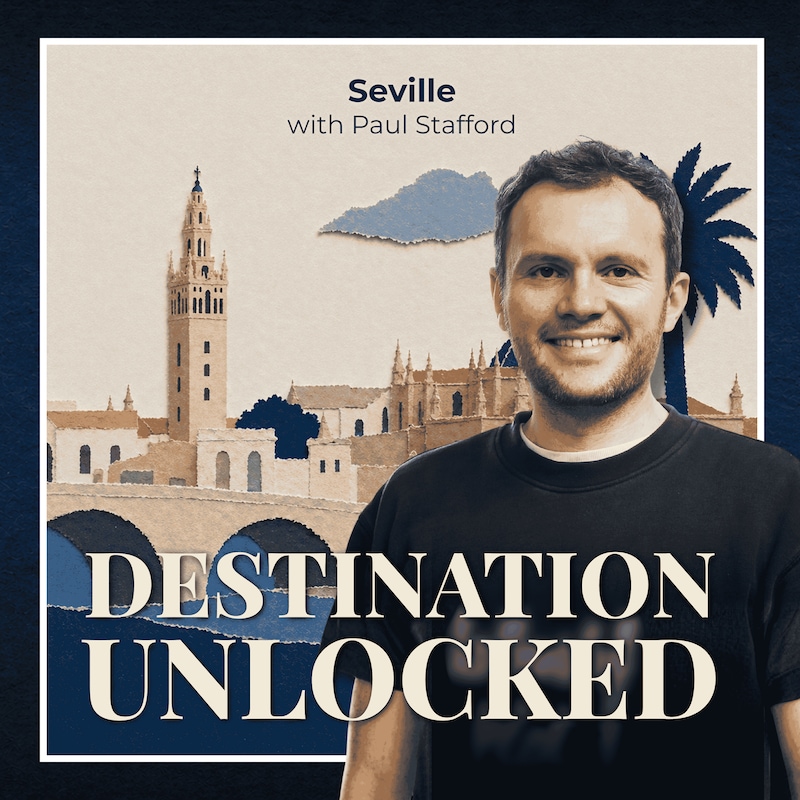
Who better to introduce Seville than the person who wrote the guidebook? Paul Stafford has been writing the Seville pages of the Lonely Planet Guide to Andalucia since 2021 and has so much top notch insight to share in this conversation.
He covers the must-see landmarks, areas that many visitors miss (but you shouldn't), top food tips, and regional highlights. This wide-ranging conversation draws together the multi-faceted cultural scene of Seville - home to flamenco, traditional Azulejos, and tapas.
Stay here: Eurostars Torre Sevilla ⭐⭐⭐⭐⭐
See this: Real Alcázar of Seville
Do this: Casa de la Memoria Flamenco Show
Eat this: Salmorejo
Buy this: Azulejos (traditional ceramic tiles)
Episode Credits
Host: Daniel Edward
Guest: Paul Stafford
Transcripts
This is Destination Unlocked with me, Daniel Edward.
2
:Well, welcome back to
Destination Unlocked.
3
:Great to have you here, and today
we are going to the South of Spain.
4
:It's an extremely hot part of
the world, but my goodness, it's
5
:a gorgeous place to visit and
with the most incredible history.
6
:I've been reading a lot about, and
Lucia in the South of Spain recently.
7
:Oh my goodness.
8
:It's fascinating.
9
:I think you're gonna really enjoy
this conversation, which is with
10
:the guidebook writer himself.
11
:I mean, you couldn't pick a better person
to introduce us to an area than the
12
:person who's written the guidebook for it.
13
:of The Lonely Planet Guide to Andalucia.
14
:Today we're joined by Paul Stafford,
who wrote the Seville chapters of
15
:the Lonely Planet Guide to Andalucia.
16
:Enjoy.
17
:So, Paul, where are you?
18
:I'm looking for us today.
19
:Paul Stafford: Today, Daniel, I
am unlocking the city of Seville.
20
:Daniel Edward: I think this is
the most intriguing part of Spain.
21
:It's a very hot part of Spain, and I do
avoid it at certain times a year because
22
:I would burn up like nobody's business.
23
:But the history and the culture
of this place is magnificent.
24
:Paul Stafford: You've
25
:Daniel Edward: just got back from a
research trip for an updated guidebook.
26
:What would you say are gonna
be the top highlights that
27
:are gonna go into that book?
28
:Paul Stafford: Well, you know, it's one
of those cities where the top highlights
29
:are the most popular highlights.
30
:It's one of those things where
you think, oh, the Cathedral, for
31
:example, is gonna be really busy.
32
:I'm gonna have to buy
my ticket in advance.
33
:There's gonna be lots of people
there and yet it's still a major
34
:highlight because of the size of it.
35
:It's the world's biggest
gothic structure for starters.
36
:And inside, you can just see this
incredible, vast space that was
37
:created purely with this fervour
The constructors, or this is at
38
:least the theory behind it, said
that people will think we were mad,
39
:when they see what we built here.
40
:And it really is just
an incredible structure.
41
:And then you have La Giralda,
which is the main tower , which
42
:you can climb to the top of.
43
:I think it's about 400 steps or
something like that, you're gonna
44
:really feel it, in that heat,
especially in the middle of summer.
45
:But it's incredible and that is a little
hint that Giralda of what it used to be.
46
:It used to be a mosque.
47
:That's why I think this structure's
amazing because it represents the
48
:fusion of the Spanish Catholic and
Islamic Moorish cultures that is
49
:on show throughout Andalusia, but
I don't think really anywhere more,
50
:impressively as it is in Seville.
51
:Daniel Edward: I think that's
the reason why I find it such an
52
:intriguing place, in the same way
that I find Istanbul very intriguing.
53
:'cause the Hagia Sofia in Istanbul has
a similar story, the opposite direction.
54
:There it used to be a
church, now it's a mosque
55
:Paul Stafford: Another magnificent,
huge, airy building as well.
56
:Daniel Edward: I don't believe
we build like this anymore.
57
:It's a shame in a way.
58
:We build tall glass towers
59
:and that's supposedly
impressive these days.
60
:But the grandeur, the splendour
it that they used to build and
61
:have survived for centuries and
still look just as magnificent as
62
:the day that they were designed.
63
:Paul Stafford: true.
64
:I don't know what upkeep actually
goes into them behind the scenes,
65
:but to think that that huge dome
has managed to stay in place with
66
:the original architectural features
that were designed to keep it there.
67
:And the cathedral in Seville is the same.
68
:It's just this magnificent
monument to faith.
69
:And the fact that it's in such
resplendent condition still is
70
:probably owes to the fact that.
71
:So many people visit it still,
and so they're making quite a
72
:bit of money, I suppose, off just
entry fees and things like that.
73
:Daniel Edward: But that's
a fairly modern phenomenon.
74
:the tourist drive to the south of
Spain for that cultural immersion.
75
:Paul Stafford: It started in the
late seventies because under Franco,
76
:Spain was locked down for many years.
77
:The package holiday phenomenon
is really what opened Spain up.
78
:And it was in the Costa del Sol,
mainly between Malaga and Marbella,
79
:that people started discovering Spain.
80
:And from the beaches that were the
main draw, they then started venturing
81
:in land and saw that Pueblo Blancos,
their little white towns and villages
82
:that are nestled in these mountains.
83
:And then they went a little further in
and they discovered cities like Seville
84
:and Cordoba, and Granada of course.
85
:You still see people are going
for package holidays, but the vast
86
:majority of visitors to Andalusia
are now going for those city breaks.
87
:Daniel Edward: Right.
88
:The city break has overtaken the beach
89
:Paul Stafford: Yeah, I'd, I'd, say so.
90
:Daniel Edward: It is not
all that close to the beach.
91
:For people who haven't
92
:been to the area or haven't looked
at it on a map, it, you're still a
93
:good hour and a half from the beach.
94
:Paul Stafford: Yeah.
95
:If you were to go to Matalascanas, which
I would say is probably the closest beach,
96
:you'd probably be looking at about a
50 minute drive on a good day, maybe a
97
:little bit longer, but it's not too bad.
98
:But Matalascanas for that
reason, is a little bit like a,
99
:Past its best resort, I would say.
100
:And it's primarily domestic
tourism that feeds Matalascanas.
101
:Not really a beach destination, Seville.
102
:And it's one of the reasons why it's so
hot, because it's kind of on the plains.
103
:But then north of that you've got the
Sierra Morena, which hems in the city.
104
:And Cordoba is even hotter.
105
:It's the hottest city in Europe.
106
:They just get these little nests of
heat that doesn't really dissipate.
107
:Daniel Edward: Oh my gosh.
108
:I call that prickly heat.
109
:'cause it, it,
110
:to actually hit you like pins.
111
:Paul Stafford: Yeah, you feel it.
112
:And one of the things about that part
of Spain as well is you'd expect the
113
:heat to be at its height at around 2:00
PM like it is in the UK or whatever.
114
:It just keeps getting hotter until
about five or 6:00 PM which is why
115
:people don't have dinner until eight.
116
:Restaurants don't even
open until about 8:00 PM
117
:Daniel Edward: oh my gosh.
118
:I'd be starving.
119
:Paul Stafford: The biggest
meal of the day is lunch.
120
:It's kind of almost expecting the
worst of the heat to be coming soon
121
:people will head to the restaurant at
maybe 2:00 PM and then that's the big
122
:meal that you take your time over.
123
:It's a long, slow meal.
124
:And then it's the little often tapas
type dining that you'll get in the
125
:evening where, you might tapear, which
is to go from one bar to another and
126
:have a little tapas in each place.
127
:Sadly, Seville isn't one of
the cities anymore that offers
128
:the free tapa with every drink.
129
:That's kind of a dying thing,
although you can still find it
130
:in places like Granada and Jaen.
131
:But in Seville you tend to buy
the tapas that you'll have.
132
:Daniel Edward: We are gonna get
more into food in a little bit.
133
:How can we not?
134
:But just to cover off some of the other
architectural highlights that you've
135
:really gotta see if you are visiting
Seville, a place which struck me the most,
136
:I just think it's the most incredibly
gorgeous scene, is the Plaza de Espana.
137
:Paul Stafford: Yes.
138
:Yeah.
139
:Yeah.
140
:So the Plaza de Espana is a more
modern construct, the style, I
141
:guess you would call it neo mudejar.
142
:Mudejar, is the fusion of Spanish
and Moorish architectural styles.
143
:It's a kind of a post reconquista,
style of architecture.
144
:So the Reconquista was when the Catholic
monarchs were retaking parts of Spain
145
:that were under Moorish control.
146
:So I think it was 1248 was
when Seville fell back into.
147
:Spanish hands.
148
:It wasn't until the late 1400s that
Granada was returned to Spanish control.
149
:But Seville fell fairly early.
150
:But instead of driving out all of
the Islamic artisans and things
151
:like that, they would employ
them to work on the now Catholic
152
:palaces that they wanted to build.
153
:And so you had this sensibility, this
geometric precision that a lot of the
154
:architects in the Moorish world had,
and they would be fused with that
155
:kind of fervent Catholic sensibility.
156
:And you'd have these Mudejar styles.
157
:So the Plaza de Espana was
actually built for the World
158
:Expo in like 1928 or 29, I think.
159
:Just before the.
160
:Wall Street crash.
161
:So it was a really
unfortunate time for them.
162
:But it was this beautiful bastion of
the modernist style that was going on
163
:and then this Mudejar sensibility and
it, it's just, it's vast, isn't it?
164
:It's this kind of C shaped building
165
:Daniel Edward: I love water that's
been integrated into the design too.
166
:Paul Stafford: is like a capital
D-shaped canal, if you will,
167
:almost a Venice like canal.
168
:And you can still hire a
little rowboat and go for a
169
:little paddle out on the water.
170
:I don't know if this was the case for
you when you visited Daniel, but, you'll
171
:often get flamenco performers, who will
just post up and do free shows for people,
172
:so that it is filled with this energy,
and it's right on the edge of Parque
173
:Maria Louisa, which is this beautiful
big green space that, especially in
174
:the summer when it's really hot, feels
so much cooler, like a good 10 degrees
175
:cooler when you walk into that area.
176
:It's a lovely place.
177
:I often go there in the afternoon
just to get away from the heat,
178
:but to be outside as well.
179
:I lived there through the summer, so a
great time to visit if you want quieter
180
:streets, because very few people go.
181
:The prices are very, very low.
182
:So as long as you set your day up,
you can avoid the hottest part.
183
:But inside the buildings, it
does feel very cloying if you
184
:don't have air conditioning.
185
:Daniel Edward: That's a really
interesting and almost intuitively
186
:backwards tip because everybody would
think, ah, summer will be peak season,
187
:so hot, it's gonna be crowded, get away.
188
:Paul Stafford: Yeah.
189
:Daniel Edward: And it's not that.
190
:Paul Stafford: That's when
everyone is actually at the beach.
191
:So it's the one time of the year where
you probably find more people at the
192
:beach than you would do in the cities.
193
:Daniel Edward: That's a genius tip.
194
:Oh, like
195
:Paul Stafford: And it's genuinely
significantly cheaper; places that
196
:you'd be paying maybe a hundred and
50 to 200 euros for in any other part
197
:of the year, you'll probably get for
maybe 50 to a hundred euros instead.
198
:Daniel Edward: That's a very good deal.
199
:Where else would you
suggest for highlight?
200
:Paul Stafford: If you don't
go to the cathedral, you
201
:must go to the Real Alcazar.
202
:It's right next to it.
203
:So they basically face one another.
204
:It's this sprawling set of palaces
essentially that, aside from the
205
:Alhambra in Granada, the pinnacle of
this Mudejar architecture, but also
206
:you've got the architecture that was
created during the Moorish rule as well.
207
:So it was originally created, as a home
really for the rulers of Moorish Spain.
208
:And, This set of palaces is really,
for me, an architectural history of
209
:many centuries of southern Spain.
210
:There's some rooms upstairs that
are used by the royal family still,
211
:and when they're not in residence,
you can visit those as well.
212
:Daniel Edward: The Spanish royal
family is an interesting one.
213
:Both for modern controversies
and also their history.
214
:They had a fascinating
relationship with the Pope.
215
:It's a very Catholic country with
the exception of the Moorish moments,
216
:Paul Stafford: Yes.
217
:Daniel Edward: it's been the most
fervently Catholic country outside
218
:of Italy, and they were given
special dispensation from the
219
:Pope to appoint their own bishops.
220
:Paul Stafford: Yeah, I imagine there is
still, a very special relationship there.
221
:Spain is probably one of the
most open-minded free countries
222
:that I've ever visited.
223
:But there's still this part of
society that is extraordinarily
224
:pious and traditional.
225
:And you're starting to see that kind of.
226
:Bubble up again at the moment.
227
:It's really interesting.
228
:Something like the Semana Santa
Seville has probably Spain's biggest
229
:Semana Santa, which is for the whole
Easter week, the centre of the city
230
:is locked down completely and it is
given over to parades and processions.
231
:And I was just there actually for
the most recent Semana Santa; a
232
:fascinating experience because you just
have tens of thousands of nazarenos,
233
:who are these people that wear these
pointed hats, like hoods that look
234
:slightly sinister if you're not from
that world , and these long robes.
235
:And la madruga, which happens on the
morning of Good Friday, it basically
236
:starts at midnight and runs all
the way through to 6:00 AM and it's
237
:this series of silent processions.
238
:So you have hundreds of thousands of
people in the centre of Seville, and
239
:the centre of Seville is wonderful.
240
:It's this romantic, beautiful old
city centre that just goes on and on
241
:and on, and it's all cobbled streets.
242
:There's not a straight street in sight.
243
:It's a wonderful place to get
lost, and you just have to
244
:find your way out of there.
245
:And that's part of the
beauty of exploring the city.
246
:But these streets are
absolutely packed with people.
247
:It is 2:00 AM you're exhausted.
248
:There's people everywhere.
249
:And then suddenly you'll hit the parade
route and it'll just be absolute silence.
250
:All of these people just lining the road
whilst all of the Nazarenos with their
251
:hoods are slowly walking with these big,
big candles, huge candles that are about
252
:five foot tall, and they're very thick
and they slowly burn, and you'll just
253
:get a saeta, which can either be a little
song or a prayer from a balcony that
254
:will pierce the silence of these shuffling
footsteps or maybe a clarinet or something
255
:like that, that will just do this brief
flourish for a moment, and then it's gone.
256
:And that almost underlines the silence.
257
:When that dies away again, the
silence feels more profound.
258
:Everybody is so locked in,
in that moment to this very
259
:historic, very traditional thing.
260
:You really feel the weight of
Catholicism and what it means to
261
:a lot of people still in Seville.
262
:Daniel Edward: It does sound very moving.
263
:Paul Stafford: Yeah, it really is.
264
:Daniel Edward: Are there other
festivals during the year that
265
:are a good one to put in the diary
that maybe don't exist elsewhere?
266
:Paul Stafford: Sticking with April,
two weeks after Easter Sunday, you
267
:have the Feria de Abril, which is this
big festival in Seville specifically.
268
:That always comes two weeks after Easter,
and for a week again, you have horse
269
:parades, you have people dressing up.
270
:It's a wonderful time to see the
traditional flamenco dresses they all
271
:go to this big ground to the south
of Seville where there's a big fair,
272
:and lots and lots of little tents.
273
:And each tent is usually
run by a brotherhood.
274
:Uh, They're called, Hermandades,
which are like these different
275
:religious brotherhoods.
276
:They're out in force and they have
different colours and everything
277
:in Semana Santa, and then they
have their own little place.
278
:each tent will have, drinking and
merriment and dancing and singing.
279
:A lot of dancing actually.
280
:especially if you're invited in
as an outsider, which can often
281
:happen if you just wander around.
282
:You could end up just being in
one tent rather than wandering
283
:around for the entire evening.
284
:And it can be a really great time.
285
:And then another one, is the uh, Bienal
de Flamenco, and that usually lasts for
286
:about a month, in September and October.
287
:usually, and it is this huge flamenco
festival that takes over the whole city.
288
:It's the biggest flamenco festival
that I know of in the world.
289
:And flamenco is such a wonderful art form.
290
:It's really complex.
291
:There's so many elements to it, from the
palmas, which is the rhythmic clapping
292
:to the dance, to the colourful dresses.
293
:The guitar.
294
:I would hazard a guess to say that
Andalucia has the world's highest
295
:concentration of accomplished guitarists
everybody seems to be a virtuoso
296
:whenever you go to an event and you just
hear that incredibly complex form of
297
:guitar; finger picked, often acoustic.
298
:It's just an incredible thing to
sit back and let it wash over you,
299
:Daniel Edward: I love the
sound of flamenco guitar.
300
:I want to get a closeup of their fingers
to see what they're really doing, but
301
:it's as they're doing everything twice.
302
:With two separate fingers.
303
:One finger is a quarter beat just behind.
304
:Paul Stafford: Yeah.
305
:And, they're also often hammering out a
beat with the palm of their hand, so you
306
:do have a raking motion, which will give
you that ing, but then also the finger
307
:picking is going on, on the side of that.
308
:it really can often sound like two
guitars being played at once, but
309
:also with percussion, and that's
just one very accomplished player
310
:doing all of that in one go.
311
:I've tried myself to learn
it and it's beyond me.
312
:I genuinely cannot get all
of that going in one go.
313
:Daniel Edward: It's a lot to do.
314
:How as a tourist do you know?
315
:Which show to try and get to.
316
:What's gonna be a ripoff
tourist option and what's gonna
317
:be something more authentic.
318
:Paul Stafford: Oh, that's
a really good question.
319
:I've been to a lot of different
flamenco performances over time, and
320
:one thing that I would say is pretty
true of all of them is that they're
321
:always really talented performers.
322
:So you will get a great show.
323
:I mean, I've cried a flamenco performance
before, they can be incredibly moving.
324
:Casa de la Memoria is one
where you sit and you watch.
325
:And you're just present and you're silent.
326
:You're not allowed to take
photos, you're not allowed to
327
:watch it through your phone.
328
:You're just there and you're present.
329
:And it just elevates the performances.
330
:So I'd say any place where phones are
prohibited, cameras are prohibited,
331
:and there's no food or drink involved,
those moments are always gonna
332
:be more impressive than the ones
where they're dinner and a show.
333
:And there's a lot of events
where it's a dinner and a show.
334
:I attended one just the other
week actually in Cordoba.
335
:And you spend half of the performance
just trying to see past waiters.
336
:They're rushing around trying to get
everybody their food, and there's
337
:like the sound of people eating and
no one's really paying attention.
338
:And, you know, then there's someone
leaning over your table trying to
339
:get a video, not paying any attention
to the fact that you're just trying
340
:to drink in this performance.
341
:me, those feel trashier in some way
than the ones that are just about that
342
:performance and you're just supposed to
be there in the moment experiencing it.
343
:Daniel Edward: Talking of food though,
what should people keep an eye out for?
344
:Is there still a Moorish influence
in the food as there is in the
345
:architecture, or the food quite
similar to the rest of Spain?
346
:Paul Stafford: I would say
the food traditions of Spain,
347
:vary wildly from area to area.
348
:Andalusia is traditionally the most
rural of the provinces of Spain.
349
:Bull fighting is also a big part of the
culture, especially in the south of Spain.
350
:Still holds on, greater
than it did anywhere else.
351
:And so some of the dishes that come
out of the region are born in that
352
:kind of era of like bull fighting
and then eating beef afterwards.
353
:So, one dish that you might come across
that is everywhere is Rabo de Toro,
354
:which is like a slow cooked oxtail stew,
355
:Wherever you stand on bull fighting,
and I'm personally against it as a
356
:pastime that should be left in the
past, but there's a lot of tavernas
357
:and tapas bars around the bull ring in
Seville that do that dish very well.
358
:So if you are a foodie and you can
separate the genesis of that dish from
359
:the actual tasting of it, then you
can enjoy the best Rabo de Toro in
360
:those tapas bars around the bull ring.
361
:And then you have solomillo al whisky,
which is pork medallions in a broth
362
:featuring, they say it's whiskey,
but it's more like a sherry brandy,
363
:and then you've got lemon and garlic.
364
:It's a really rich stew.
365
:If you're just wanting a light
breakfast in Andalusia, the main
366
:thing to have is just a simple pan
con tomate, you just get a mollete.
367
:Which is like a kind of special
type of bread that is cut in half.
368
:You toast it, you put on a load of tomato,
you drizzle it with the most amazing olive
369
:oil, a little bit of salt, and that's it.
370
:A really simple breakfast that
everybody has in Andalusia.
371
:My favourite thing, is boquerones.
372
:You can get 'em fried, but I prefer
them, in vinagre, which is like a kind
373
:of vinegary, oily thing that they're
just immersed in and they're delicious.
374
:And then salmorejo is probably the
big thing that I would recommend.
375
:It's a bit like gazpacho.
376
:Tomato and garlic.
377
:Like a soup, but a cold soup.
378
:And it's absolutely delicious.
379
:It's usually mixed with a
bit of olive oil as well.
380
:And it's usually topped
with boiled egg and jamon.
381
:You can ask for either or both of those
toppings to be taken away, and that's how
382
:you make it either vegetarian or vegan.
383
:It's an amazing thing to have for
lunch, sometimes alongside a tortilla
384
:de patatas or something like that.
385
:And that's the thing that I
probably eat the most when I'm
386
:in Spain 'cause I'm a vegetarian.
387
:I've had my life where I ate all of
those other dishes and I still have the
388
:memory of those, but these days I tend
to stick with , the less meat based
389
:Daniel Edward: Times have changed.
390
:Paul Stafford: It is hard being in
Spain, or France for that matter,
391
:and being vegetarian or vegan.
392
:It really is
393
:It's tricky.
394
:Daniel Edward: So how did you
first come to Seville and get
395
:to love Andalucia as an area?
396
:Paul Stafford: I was introduced
through a friend when I was growing up.
397
:His family were partly from
Andalucia, from Malaga.
398
:We grew up in a little town in
northern England called Clitheroe, but
399
:they would frequently visit Malaga.
400
:And one year they took me, and that
was my first experience of Spain.
401
:We flew into Madrid and then we went
all the way down through southern Spain
402
:and arrived through the mountains when
suddenly, Andalucia becomes green and
403
:the landscape is phenomenally beautiful.
404
:And then we arrived in Malaga and I
was a convert pretty much immediately.
405
:I ended up in Seville for the first time
when I did a TEFL course or a TSOL course,
406
:I guess is what you would call it now.
407
:Just after I finished university as
like a kind of backup if I wanted
408
:to travel and I wanted to make
some money, it was always this kind
409
:of thing that I had in my pocket.
410
:I could bring this qualification
out and I chose to do it in Seville.
411
:And I lived in the centre of the
city and it was a wonderful time.
412
:it was really good.
413
:And that's always been my go-to place now.
414
:Daniel Edward: And so how did you
then transition from going around
415
:travelling, teaching, to then travel
writing and, writing guidebooks to
416
:help other people explore the places?
417
:Paul Stafford: So I actually never got
to use that teaching qualification sadly.
418
:I ended up going to South Korea
randomly, 'cause I wanted to be an actor.
419
:That was my primary goal.
420
:And somehow, I kind of got into
acting in South Korea and just
421
:ended up doing that for three years.
422
:I came back to the UK and ended up
at a film school as a screenwriter.
423
:That was in London and it was
extraordinarily expensive to
424
:just be a poor student in London.
425
:so I started finding other ways
to make ends meet and all of that
426
:travel, all of that time overseas.
427
:It just lent itself to a different form
of writing, which was travel writing.
428
:And I submitted a few articles for
places and I ended up making money from
429
:that and as I realised, gradually and
painfully acting and, screenwriting
430
:weren't particularly lucrative,
especially somebody with only limited
431
:experience, I just got more and more
into the travel writing side of things.
432
:And then that just became a lifestyle.
433
:It started taking up all of my time and
I just realised, I think I'm a travel
434
:writer now and I'm not an actor anymore.
435
:Daniel Edward: organically
evolved, which the best things do.
436
:Paul Stafford: Yeah, absolutely.
437
:Daniel Edward: On your guidebook work,
you have covered a huge spread of places.
438
:Some writers will exclusively focus
on one area, some will pick a region,
439
:you've been able to travel the globe.
440
:It's amazing.
441
:Paul Stafford: Yeah, I guess the early
formative years of just travelling around,
442
:ended up living in a number of places.
443
:I lived in Mexico for a
year as part of my degree.
444
:I went to India for five months
after that, and then South
445
:Korea, for the acting as you do.
446
:so it just happened that I had
a bunch of different places
447
:that I knew really, really well.
448
:My uncle for a long time, was the
lead photographer for Visit Scotland.
449
:So I had links in Scotland as well.
450
:So I had all of these areas that I
knew pretty well and the best thing
451
:you can do usually is find a place that
no one else really knows very well.
452
:So I didn't write about
Spain for a long, long time.
453
:I didn't write about Scotland
for a long, long time.
454
:I've been doing it about 14 years now.
455
:But I started off writing about a
place like, South Korea that I knew
456
:really well but weren't well covered.
457
:Like England for example, the majority
of travel writers live in England.
458
:It's a very tough to get is writing
about England, because there's just so
459
:many people that have that experience
that are adept about it and wonderful
460
:writers and also have the links.
461
:But luckily in about 2021, I managed
to get my first guidebook in Andalusia.
462
:And it was again, based on the fact that I
knew Seville well and I guess nobody else
463
:that had applied knew Seville in that way.
464
:So I was really lucky to just get my foot
in the door and I've been back every year,
465
:for the last five years now, and spent
maybe a month a time it's been wonderful.
466
:Daniel Edward: For people who are
14 years behind you and thinking
467
:they love the sound of this,
they do go on travels themselves.
468
:Maybe they have lived abroad
already for six months or so.
469
:For people who are starting out,
should they be looking on job lists
470
:for people advertising that somebody
is looking for a guidebook writer in
471
:a traditional sort of job advert way?
472
:Or do they go about it in a different way?
473
:Paul Stafford: So I think the guidebooks
come a little bit later if you've got a
474
:bit of a body of work already built up.
475
:So, the best way to build a
portfolio, I think is to pitch
476
:ideas to editors about places that
fewer people have probably been to.
477
:Or if you have an amazing, unusual angle
on something that is well known, then you
478
:can go about it like that and just start
to kind of get one or two commissions here
479
:or there, because that'll really help sell
you as an authority figure on the area.
480
:And I don't actually like using that
term, because I'm not an authority at all.
481
:When I go out, I'm still
there as a student in a way.
482
:I still wanna learn everything I
can, and I never like to think that
483
:I have this authority over an area
or an expertise because there's
484
:always something out there, and
this is the beauty of travel for me.
485
:There's always something out there
that will confound you, that will
486
:surprise you that you haven't
experienced or explored yet.
487
:be fascinated in the world.
488
:seek out the human stories.
489
:I think with AI these days, AI is
incredibly adept at taking information
490
:that is factual and condensing it.
491
:So those types of articles, more
and more, you're seeing, they're
492
:probably not written by humans in
various outlets, well known outlets.
493
:And I think that trend
is only gonna continue.
494
:But what you can write is
your interest in the world.
495
:That's something that's
bespoke, it's unique.
496
:Start with something that you would do.
497
:That you would happily pay for.
498
:That's how I did it, what would I pay
for and how do I get paid to write
499
:about the thing I would happily pay for?
500
:And then find the human story behind
it because it's really the human
501
:stories that move us and are unique.
502
:Is there something on the fringes
of flamenco that is really unusual
503
:and is breaking from tradition?
504
:That kind of thing is always amazing.
505
:Or what's a, type of food or an ingredient
that is making its way slowly back
506
:onto people's tables and who is growing
that and why are they growing it?
507
:Is there a story behind that that
might be about climate change and
508
:now suddenly this ingredient that
wasn't able to be grown in the hills
509
:of the Alpujarras is now thriving.
510
:Little stories like that will
really help sell your articles.
511
:And then from there, you build up
this fascination and understanding of
512
:that world, and then you can write the
guidebooks because you've gone into
513
:that area with such depth and thought
about it in a way that not everybody
514
:ordinarily would think about it.
515
:I always say that I live in Birmingham,
but I'm probably one of the worst
516
:advocates for Birmingham in a
way because I've got my patterns.
517
:So I go to the restaurants that I
love, and I tend not to go beyond
518
:that because I love these places,
these five places, and I know that
519
:they're always going to be really good.
520
:That Barber Institute for Art over there?
521
:I could go today, but I'm gonna be here
tomorrow, so I'll just do it tomorrow.
522
:And now it's closed for
repairs, so I can't go.
523
:Daniel Edward: We don't appreciate
what we've got so close to us
524
:because it's so available to us we
become a little bit blind to it.
525
:The story comes to me so much
easier when I'm somewhere where
526
:I'm a little bit less familiar.
527
:It just jumps out at me.
528
:Oh, that's odd.
529
:Or that struck me.
530
:Oh, I wasn't expecting that.
531
:But when I'm walking
around at home, I'm blase.
532
:You don't realise that actually
there is still a story in that.
533
:Paul Stafford: Absolutely.
534
:you just have to find something
that triggers your wonder and
535
:heightens your senses because
it's something that's unfamiliar.
536
:Another reason I love to go, in April
to Seville is because you have the
537
:Azahar, which is the blossoming of the
orange trees, and there's this beautiful
538
:syrupy scent that fills the air for
about a month, of this orange blossom.
539
:it just adds this really rich, sensory
experience to the city that not every
540
:city will be able to provide you with.
541
:Daniel Edward: I love the
focus on different senses it's
542
:not just, what do you see?
543
:It's everything coming together and
yes, when you step away from home,
544
:all of your senses come alive again.
545
:It's a reinvigorating experience.
546
:Something that people may not know
about you, is that you're not just
547
:writing you also create music.
548
:Paul Stafford: Oh, that's true.
549
:Yeah.
550
:Yeah.
551
:Yeah.
552
:That's probably why I'm drawn to
flamenco the art form because of that.
553
:Just the beautiful sounds
that they managed to create.
554
:I myself am less finessed as a musician.
555
:I'm an alt rock musician,
with a band called Phwoar
556
:P-H-W-O-A-R, which is energy, basically
really good energy on the stage.
557
:Just having a great time.
558
:A little bit of post-punk
to the songs as well.
559
:That's another thing that I
thought, oh, I'll do that on the
560
:side 'cause that'll be interesting.
561
:And then I realised, oh, I just end up
travelling all the time because of it.
562
:So now I have two jobs essentially
that are effectively full-time and
563
:both of them involve a lot of travel.
564
:I should have done something where
I could stay at home a bit longer.
565
:Daniel Edward: Yes.
566
:At least you can sort of double
things up occasionally, do you try
567
:and arrange your tours for places that
you're interested to then write about?
568
:Paul Stafford: Absolutely.
569
:I'm actually doing a separate
guidebook right now, in England.
570
:And part of the reason was I've been
to Bristol because I really wanted
571
:to spend more time in Bristol.
572
:I'd been to Manchester, I'd been to
Liverpool as part of this, and now I'm
573
:gonna be writing about all of them.
574
:Experiencing it on a tour so much
different than experiencing it as a
575
:visitor who just is there to travel
because you more focused on the
576
:food and the music side of things
and it really narrows your focus,
577
:but in a really interesting way.
578
:And you get to kind of feel what is
that cultural touchstone of the city?
579
:It's really fascinating.
580
:Daniel Edward: I think having
a focus is very helpful.
581
:It connects into the discipline side of
the industry, which I think is overlooked
582
:by people who don't work in the industry.
583
:It's not just travelling
and going on holiday.
584
:It's travelling and going on holiday with
very set purpose, with some quite strict
585
:time restraints, definitely strict budget
restraints and knowing that you need
586
:to get something out of it at the end.
587
:Paul Stafford: absolutely.
588
:Daniel Edward: what do you find is
your best way of maintaining discipline
589
:on the road when it's just up to you?
590
:Paul Stafford: Well, the best way to do it
is just to get up early, not drink late.
591
:There is a part of me for a guidebook that
has to research the nightlife scene, but
592
:for the most part, I'm up at six, seven
in the morning and I'll not be back to
593
:the hotel room until 10 or 11 at night.
594
:Often I'm moving quite quickly between
towns and cities, so I'm having to
595
:find a way of moving my stuff around
as well, or storing my bag or whatever.
596
:So really discipline is
the name of the game.
597
:You are working for
15, 16 hours sometimes.
598
:Whereas most people who go to Seville
might go, oh, I'll check out this
599
:palace and then I'll go to the
cathedral and that's gonna be my day.
600
:I'll also have to see three other
churches and a museum and then try
601
:maybe a tapas at three different
restaurants as well in between.
602
:And try basically cramming
as much as you can.
603
:And it really is extraordinarily
hard work, but it's the kind
604
:of work where at the end of the
day, you feel more energised and
605
:invigorated by it than exhausted.
606
:One of the things that I love about
travel when I'm just a traveller is
607
:the openness, you know, you leave
your schedule open to be surprised
608
:by something that you discover there.
609
:As a travel writer, especially
as a guidebook researcher,
610
:I don't get that luxury.
611
:I have to do this at this time, this
at this time, this at this time, and
612
:it has to be done otherwise I'm not
gonna see everything and therefore
613
:I'm not able to write about it.
614
:Daniel Edward: If people want to find
your work, whether it's your writing or
615
:indeed your music, where can they find it?
616
:Paul Stafford: I would go to Paul R.
617
:Stafford, that's all one
word, dot com Paul R.
618
:Stafford.
619
:That's my kind of main source
of travel writing stuff.
620
:Or phwoar band.com,
621
:which is for the music side of things.
622
:And we're phwoar band on all the socials.
623
:And I'm Paul R Stafford
on all the socials.
624
:So whichever interests you, you can
follow me on, either both of those.
625
:Daniel Edward: Fantastic.
626
:Back to Andalucia, I am guessing given the
amount of time that you've spent there,
627
:you are now pretty proficient in Spanish.
628
:Paul Stafford: Funnily enough, I wasn't
very good the first time I was there.
629
:And then I went to Mexico and I
learned Spanish when I was in Mexico.
630
:So I just sound like I'm from
Latin America, via Britain.
631
:Of course,
632
:Daniel Edward: If you can't speak
Spanish, and you're visiting Seville
633
:are you gonna be able to get by?
634
:Paul Stafford: Yeah, it's quite
an international city these days.
635
:There's been tourists there for
many, many years and so it, there's
636
:definitely a good proficiency in English.
637
:For me, one of the most important things
whenever I visit anywhere, if I speak the
638
:language or not, is to learn a couple of
choice local phrases that help, not just
639
:as an icebreaker with locals, but it kind
of helps tune you into the local language.
640
:So I've got two really useful phrases
for you and for anybody visiting, not
641
:just Seville, but, Andalucia in general.
642
:So, an example, of maybe a
utilitarian phrase would be pon me.
643
:So there's lots of ways for
asking for something in a
644
:store or restaurant in Spain.
645
:You might typically learn damme, which
is give me, or if you are a little bit
646
:deeper into learning the language, you
might say me gustaria, which is I would
647
:like, but in Andalusia, it's pon Me,
which is literally translated to put me.
648
:But it really means give me, so, pon
me una cana por favor, uh, pon me una
649
:cana would be, give me a beer, please.
650
:and if you want to be a little bit
more colloquial, you can say Pofa.
651
:Instead of poor fa.
652
:So that's another way of saying please,
but in a more casual environment, and
653
:it's actually used much more widely.
654
:Like, I'll use por far
in Mexico, for example.
655
:And if you wanna get right into the
weeds of Andalusian slang, uh, it's
656
:ar favor, which is A-R-F-A-V-O.
657
:Uh, and that's kind of
like, do me a favour.
658
:I think it derives from
the phrase Avo, uh, AVO.
659
:So you could say, AVO.
660
:And that would be a really
andalusian way of saying, give
661
:me a beer, or I'd like a beer.
662
:it sounds almost like, give me
a beer is a bit direct, but it,
663
:that's how the Spanish works.
664
:It's not rude at all.
665
:It's just the usual way of using it.
666
:A really useful phrase that you could use
that's very Andalusian is esto flipando
667
:in colores it's a really popular saying at
the moment with young people especially.
668
:Flipar as a verb actually
means to freak out.
669
:It would be understood throughout Spain,
670
:literally translated means
I'm freaking out in colours.
671
:But it means, I'm blown away by something.
672
:So it's something I think would be
really useful for, tourists, because
673
:you are constantly encountering
things that will make you flip in
674
:Colores, because everything's amazing.
675
:Everything's wonderful.
676
:So, es in is, a wonderful phrase.
677
:Daniel Edward: Talking of
localisms, what about tipping?
678
:Is that a done thing?
679
:Paul Stafford: Not really.
680
:It's not customary to tip in
Andalusia or Spain in general.
681
:It's not expected.
682
:I always give about 10%.
683
:It's readily accepted when you do.
684
:Locals would tip for great
service or something like that.
685
:If you've ever been in
a Spanish tapas bar.
686
:At the busiest point of the day, around
3:00 PM or 9:00 PM you'll see people
687
:working with incredible efficiency.
688
:It's busy, it's crammed.
689
:There's so many things going on.
690
:Nobody writes anything
down, they just do it.
691
:Very rarely in my entire experience
in Spain has anyone forgotten
692
:anything that I've asked for.
693
:It's so incredible to watch
and I just always think that
694
:deserves, that deserves a tip, man.
695
:Then you add to the top of that, the
heat that they're doing that in as well.
696
:Genuinely, I would say that the
wait staff in Spain are like
697
:professional athletes in some way.
698
:The energy that they must put
into doing a shift is incredible.
699
:Whilst you can pay for everything on
card these days, a lot of the time
700
:they won't accept the tips on card.
701
:So it's useful to just have
a little cash handy as well.
702
:It's become increasingly hard to
find a free cash machine in Spain.
703
:UniCajar, UniCajar, they've
got a green and white logo.
704
:U-N-I-C-A-J-A, that bank still for
me is always a free money withdrawal.
705
:So look out for their cash machines,
then you should be able to get a
706
:little bit of cash out without having
to pay five euros for the, for the
707
:of doing
708
:Daniel Edward: All that hurts.
709
:Paul Stafford: Yeah, five to
10 euros is pretty customary
710
:now for most cash machines.
711
:Daniel Edward: Wow.
712
:Way to sting us.
713
:Paul Stafford: Especially if you only
wanna take out like 50 euros or something.
714
:It's like, that's
715
:10%,
716
:Daniel Edward: more.
717
:Paul Stafford: Yeah,
718
:Daniel Edward: There's somewhere else I
really want to talk about, you've name
719
:dropped it, but we've not yet gone there.
720
:If you're going to Seville, should you
take a bit of time to go over to Granada?
721
:Paul Stafford: Yes, you should.
722
:It's about three hours
on a bus or the train.
723
:It's one of those funny ones where the
bus and the train take about the same
724
:amount of time, because usually if you
go into Granada from Seville, you'll
725
:change over and Cordoba I'd say do
it as a two nights away type of trip.
726
:Just because Granada, like
Seville, demands time of you
727
:and you don't wanna rush it.
728
:You really wanna take your time to
explore the different neighbourhoods.
729
:You know, one area of Seville that I
haven't mentioned is Triana, which is the
730
:traditional kitano area, the Romani area
where they had this old ceramic tradition
731
:going on, but also a lot of flamenco.
732
:And you wouldn't even get
there if you were just there
733
:for a day or two in Seville.
734
:Same with Granada.
735
:You might head to the Alhambra, but
that takes a full day to do properly.
736
:You really need a full
day for the Alhambra.
737
:But it's a wonderful place.
738
:You wanna be in the Albaicin staying
there, because that's a hill that
739
:looks out across a little valley to the
Alhambra, which itself is on a hilltop.
740
:And, a sunset with a balcony terrace
with a nice glass of sangria I don't
741
:know, a white wine, an Albarino or
something from the north of Spain is
742
:one of the most romantic, relaxing,
thrilling evenings that you could
743
:possibly have in anywhere in Spain.
744
:So Granada is well worth it for that.
745
:Daniel Edward: Are there any other
regional highlights that you think
746
:people should consider as either a
day trip or a couple of nights if
747
:they're basing themselves in Seville?
748
:Paul Stafford: We probably
need a whole other podcast for
749
:me to go through all of them.
750
:I'll restrict it to
kind of day trip stuff.
751
:Just out to the west of Seville,
is the old Roman city of Italica.
752
:One of the four probably biggest
Roman cities in the Iberian peninsula.
753
:It was the birthplace of Trajan who was
one of the great emperors who expanded
754
:the Roman Empire to its greatest extent.
755
:He was born Seville and then his successor
Hadrian was also born in Italica.
756
:And obviously Hadrian is probably
better known to British audiences,
757
:especially 'cause he's got his famed
wall, that crosses the north of England.
758
:So Italica is a great one.
759
:today you go there 'cause it's
got these beautiful mosaic
760
:floors that are still in situ.
761
:And it's got a wonderful amphitheatre.
762
:At one time it could
hold up to 30,000 people.
763
:Wonderful place to visit.
764
:Also in Santa Ponte as well, they have
the Church of San Isador, which is a great
765
:old monastery where the first version
of the Bible in Spanish was translated.
766
:San Isidor is the fifth century
saint who was the first to translate
767
:the Bible into Latin from Hebrew.
768
:So there's a whole history there of
translations of the Bible to make
769
:them more accessible to more people.
770
:And then, if you go to the other
side of the city, you have Carmona
771
:and I like to think of Carmona as
like a Seville in miniature that is
772
:often overlooked by a lot of people.
773
:There's the necropolis there.
774
:So a really regal, or certainly
a wealthy family burial site
775
:on the edge of the city.
776
:And then you have beautiful
Moorish walls, lots of beautiful
777
:old churches, a great museum with
a lot of the old Roman artefacts.
778
:Some good restaurants there as well.
779
:Daniel Edward: what would you say is
the top thing to see or do in Seville?
780
:Paul Stafford: It is too obvious I guess,
but the Real Alcazar is incredible.
781
:And another place that you wanna
give at least half a day to.
782
:It really is the synthesis of all of the
greatness of Seville as a destination
783
:with the Mudejar architecture and history
that is behind it at the beautiful
784
:gardens as well are really amazing.
785
:I didn't even mention those before, but
they're filled with ponds and peacocks
786
:and all sorts of wonderful things.
787
:Daniel Edward: What is
a tourist trap to avoid?
788
:Paul Stafford: I would say get outside
of the Barrio Des Santa Cruz, which
789
:is the neighbourhood that immediately
surrounds the Real Alcazar and
790
:the Cathedral, because those are
really tourist trap streets now.
791
:and they're kind of famed because
they're like these higgledy
792
:piggeldy cobbled alleyways and
you just could get lost in them.
793
:But there's so much more of Seville
that is exactly the same as that.
794
:So just go north of the cathedral
instead or towards the river you'll
795
:have a similar experience and you can
do all of that without the crowds.
796
:Daniel Edward: What's your
favourite time of year to visit?
797
:Paul Stafford: April is a great
time because you've got the scent,
798
:you've got all of these big events.
799
:I guess you get the shoulder
season a lot as an answer to this
800
:because it's often traditionally
cheaper and there's fewer people.
801
:It really is flipped in Seville.
802
:They are really great times to visit,
don't get me wrong, but they're also
803
:incredibly busy and the prices are at
the highest, usually in the traditional
804
:shoulder seasons of spring and autumn.
805
:The best time for me if you want
to save money is summer because you
806
:get the streets at their quietest.
807
:It can be really hot.
808
:Yeah.
809
:But if you structure days around the
hottest part of the day, then you can
810
:have a really great time in Seville,
still, but without the crowds and with
811
:really drastically lowered prices.
812
:Daniel Edward: Do you have a book
recommendation about the area?
813
:Paul Stafford: I'm not gonna plug my
own guidebook, but it is out there,
814
:The Lonely Planet Guide to Andalucia.
815
:There's a book called, which
means the voice of the Elderly
816
:Woman by Elisa Victoria.
817
:It's a good book to read,
written by a local person.
818
:It's a coming of age tale.
819
:Set after the 1992 expo, which for me
is a really interesting time in the
820
:history of Seville, where it was a city
that had kind of relied on the currency
821
:of its ancient grandeur then decided
that it needed to have a more modern
822
:reason to be considered a great city.
823
:It had fallen a bit by the wayside,
and the expo was this attempt to bring
824
:the world's attention back to Seville.
825
:Daniel Edward: It sounds like a great
book, sort of melancholic and nostalgic,
826
:but also showcasing real places.
827
:And I love the English
translation as well.
828
:It's OldLadyVoice, all in one word,
OldLadyVoice by Elisa Victoria.
829
:What's a good food or drink
that we should try in Seville?
830
:Paul Stafford: I would say salmorejo.
831
:It's one that you can have
regardless of your dietary
832
:preferences, it's really delicious.
833
:It's just a simple dish, tomato,
garlic, olive oil, wonderful.
834
:Especially in the summer, it's really,
really nice to have pre it's served cold.
835
:Daniel Edward: And if you wanted to
take home an authentic souvenir from
836
:Seville, what would suggest we look for?
837
:Paul Stafford: Seville is still a
place known for its ceramic tiles.
838
:So I mentioned Triana before.
839
:This used to be.
840
:The kind of centre for all ceramic
tile production in all of Spain.
841
:They're known as kos, the tiles
themselves had more of a functional
842
:role in that they would line rooms and
patios to keep them cool in the summer.
843
:but at some point along the way,
primarily in the 18th century and the
844
:17th century, they became decorative.
845
:And so they're really
beautiful, ornate tiles.
846
:There's one store called Ceramica 1920,
which is right in the heart of Triana.
847
:It's right next to the ceramics museum
that fills an old ceramics factory.
848
:and that's a really good place
to get some locally made tiles.
849
:Daniel Edward: Paul Stafford, travel
writer, and sometime musician, thank you
850
:so much for unlocking Seville for us.
851
:Paul Stafford: Thanks so
much for having me on.
852
:It's been a pleasure.
853
:Daniel Edward: Wow, what a
fascinating part of Spain.
854
:Thanks again so much to Paul Stafford
there for sharing it with us.
855
:Your camera will be full of the most
amazing magazine quality pictures
856
:after a trip to Seville, and of course,
all of those day trips in the wider.
857
:And Lucia area.
858
:Hope you really enjoyed this episode.
859
:If you did, please share it on with
somebody else who you'd like to go
860
:travelling with and make sure you're
following the Destination Unlocked
861
:podcast wherever you're currently
listening, so that you can easily
862
:find us again next time you want to go
armchair travelling somewhere wonderful.
863
:I'll see you then.
864
:Bye-bye.




