Shownotes
HVAC systems are changing. The margin for error is shrinking.
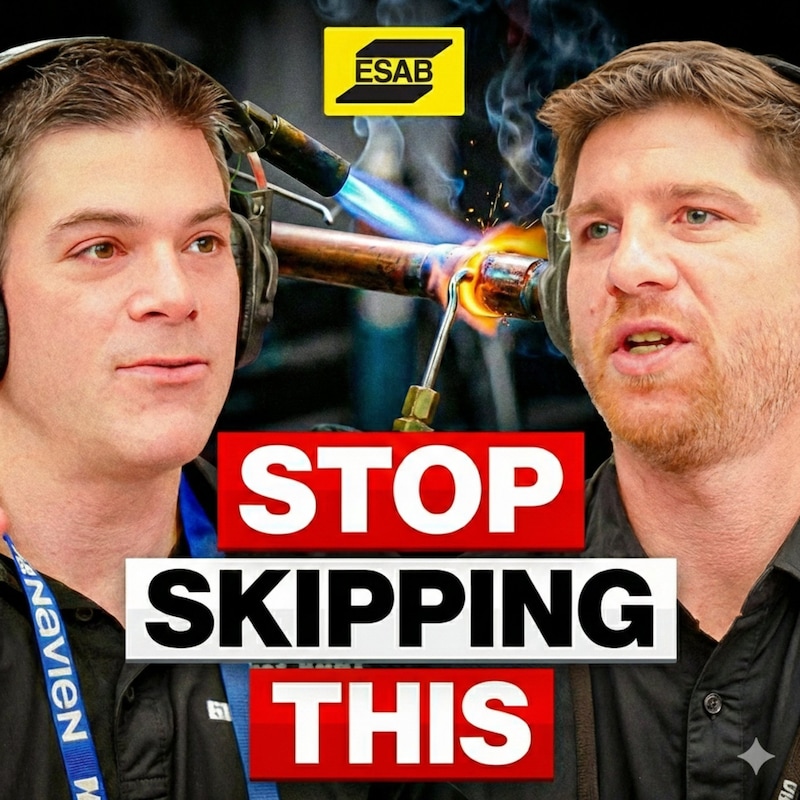
Host Andrew Brown sits down with Jay Henderek, Sales Director at ESAB, to examine why process discipline in the Skilled Trades matters more today than it did even a decade ago. As HVAC industry trends push systems to become smaller, more complex, and increasingly influenced by A2L refrigerant legislation, shortcuts that once caused minor issues can now create serious safety risks.
Jay explains why nitrogen purging for brazing is no longer a “best practice” but a baseline requirement. What some technicians still treat as optional directly impacts contamination control, joint integrity, and long-term system performance. Under modern refrigerant standards, HVAC technician safety is tied to every step of preparation and execution.
The conversation also explores contractor tool buying research and why disciplined professionals evaluate tools with the same care they apply to installation. In today’s environment, preparation separates respected contractors from reactive ones.
From HVAC to Plumbing, Electrical, and the broader Construction trades, this episode reinforces a clear reality: as systems evolve, standards must rise with them.
IN THIS EPISODE
(00:00) – Why Skipping Steps Carries Greater Risk Today: How modern HVAC industry trends increase system complexity and raise the stakes for HVAC technician safety.
(02:45) – Nitrogen Purging for Brazing: Protecting Joint Integrity - Why nitrogen purging for brazing prevents contamination and failure in sealed systems.
(04:40) – A2L Refrigerant Legislation and Flammability Considerations: How A2L refrigerant legislation shifts risk profiles and demands tighter execution standards.
(08:25) – Contractor Tool Buying Research: Discipline Before the Purchase: Why professional contractors evaluate tools deliberately instead of chasing features or price alone.
(12:05) – Long-Term Strength vs. Quick Fixes: Why proper brazing preparation outperforms temporary patches in durability and safety.
(16:45) – Reinforcing Standards Across the Skilled Trades: How manufacturers, educators, and contractors share responsibility in raising industry standards.
Key Takeaways
- Modern HVAC systems demand greater discipline because tighter tolerances and evolving refrigerant standards reduce the margin for error.
- Nitrogen purging for brazing protects system integrity by preventing oxidation and contamination inside sealed lines.
- A2L refrigerant legislation increases flammability considerations, making preparation and procedural adherence essential for HVAC technician safety.
- Contractor tool buying research reflects professionalism. The best contractors approach purchases with evaluation, peer insight, and long-term thinking.
- In the Skilled Trades, standards do not stay static. As technology evolves, responsibility must evolve with it.
About the Guest
Jay Henderek is Sales Director at ESAB, a global manufacturer of welding, brazing, and cutting technologies. Through brands such as TurboTorch, ESAB supports HVAC technicians, plumbers, electricians, millwrights, and contractors working in demanding field conditions.
Jay focuses on advancing HVAC technician safety, reinforcing nitrogen purging for brazing standards, and helping contractors navigate HVAC industry trends and A2L refrigerant legislation through disciplined processes and education.
Keywords
HVAC Industry Trends, Nitrogen Purging for Brazing, A2L Refrigerant Legislation, HVAC Technician Safety, Contractor Tool Buying Research, Skilled Trades, Trades Industry, HVAC, Plumbing, Electrical, Construction, Contractors, Craftsmanship, Andrew Brown, Jay Henderek, ESAB, Skilled Trades Advisory Council
RESOURCE LINKS
LinkedIn: https://www.linkedin.com/in/jay-henderek/
ESAB Website: https://esab.com/us/nam_en/
SUPPORT THE SHOW
If you’re getting value from these conversations and want to help keep the mics on, consider supporting the show here → https://andrewbrowntrades.kit.com/products/toolbox
Every contribution helps us continue bringing experience-backed insights from the trades—focused on safety, standards, and long-term performance.
Transcripts
(Transcribed by TurboScribe.ai. Go Unlimited to remove this message.) The consequences of skipping a step are more consequential than they've ever been.
Speaker:It could result in fires, it could result in explosions, it could result in, you know,
Speaker:things that have serious consequences.
Speaker:What's changing right now in HVAC?
Speaker:How I can be more efficient and more productive about doing my repairs.
Speaker:What do the best contractors do before they buy a new tool?
Speaker:There's half a million HVAC technicians that are out there.
Speaker:Say that number again.
Speaker:Hi, I'm Andrew Brown. You're listening to the Lost Star of the Skilled Trades podcast,
Speaker:a show that shines the spotlight on careers in the skilled trades that are high paying,
Speaker:honorable, rewarding and fulfilling.
Speaker:The trades are the backbone of the economy that keep us running.
Speaker:And without them, our world would cease to exist.
Speaker:Welcome back to the Lost Art of the Skilled Trades podcast.
Speaker:I'm your host, Andrew Brown. We're here live at AHR.
Speaker:It's good to be here. We have Jay Henderek, sales director at ESAB.
Speaker:Welcome to the show.
Speaker:Thank you. Thanks for having me on.
Speaker:Yeah. So if you're a contractor and you're walking the floor today, right?
Speaker:There's a lot to look at. You're looking left. You're looking right.
Speaker:And you sit right in the middle of those decisions with contractors.
Speaker:So I kind of want to zoom out for a quick second.
Speaker:What's changing right now in HVAC that's forcing contractors to be more disciplined
Speaker:than they used to be?
Speaker:I mean, so much has changed in the past two years with this industry.
Speaker:You look at the technologies and you see what they're doing.
Speaker:You see a very simplified example of how things are changing our access points, right?
Speaker:Things are getting smaller. You're packing more, piping more,
Speaker:like more stuff is happening in a smaller space.
Speaker:So to be a skilled contractor, to be a skilled technician, to be a skilled at this space,
Speaker:you need to be able to do what you did 10 years ago with 50% less space.
Speaker:And you need to do it quicker because there's more service work.
Speaker:There's more equipment. There's the product for the end user,
Speaker:for you and me, as we go home and we turn on our heat and our cooling,
Speaker:you're getting better performance and better output.
Speaker:But from a service provider, there is 10 times the amount of work to be done.
Speaker:So that's the challenge, right?
Speaker:If I'm a contractor, I'm trying to think about how I can be more efficient
Speaker:and more productive about doing my repairs and my jobs and such.
Speaker:And that's it. I mean, the industry is changing in many different aspects.
Speaker:Where do you feel, or what's the decision contractors are overthinking?
Speaker:And what's one thing they're underthinking when it comes to tools?
Speaker:Well, the underthinking is more resonant and apparent right now.
Speaker:There are certain things that you need to do in a job preparation of your work to prevent,
Speaker:you know, I'm talking specifically about nitrogen purging.
Speaker:This is something that it's very important when you're doing brazing
Speaker:to basically prep the lines that you're working on by using
Speaker:the proper equipment that TurboTorch produces,
Speaker:by using the nitrogen lines and running it through.
Speaker:And that prevents multiple issues in the past.
Speaker:And the reality is there are some skilled people that are certified,
Speaker:licensed that haven't been following those steps.
Speaker:And it's now even more important as they use more flammable refrigerant lines.
Speaker:You might be familiar with the A2L refrigerant legislation,
Speaker:how that has affected that stuff.
Speaker:The consequences of skipping a step are more consequential than they've ever been.
Speaker:So we really try to emphasize when we're here at events like this with end users
Speaker:to make sure that they're following the steps, that they're doing the right
Speaker:procedures and purging is absolutely one of them.
Speaker:So I'd say that's an underthink.
Speaker:And an overthink is like, you know, do I have the right tool?
Speaker:Do I have the right apparatus?
Speaker:And the reality is if you invest in the right kit,
Speaker:it's going to have every nozzle, every attachment that you need and have
Speaker:to get in and out of the access points that you need for your job.
Speaker:And the steps, like you said, if you miss a step, there's consequences to that.
Speaker:What have you seen examples out there in your travels
Speaker:or heard stories from organizations where maybe they missed a step?
Speaker:Is it more so because companies are trying to get things done in a quicker manner?
Speaker:Yeah, you hit it.
Speaker:We talked about it a little bit in the beginning, right?
Speaker:It's like there are more jobs that need to be done.
Speaker:There are more joints.
Speaker:There are more.
Speaker:And that's putting pressure on, you know, to cut corners and to do that stuff.
Speaker:And the consequences are you have equipment that doesn't get installed properly because
Speaker:it wasn't the surface preparation wasn't done that was needed.
Speaker:So that can lead to cracking or fatigue or other issues that will prevent the proper
Speaker:soldering of that joint or brazing of that joint and improper flow of the equipment.
Speaker:It could result in fires.
Speaker:It could result in explosions.
Speaker:It could result in, you know, things that have serious consequence when you're dealing
Speaker:with heat transfer, energy transfer, like you are in heating and cooling.
Speaker:Yeah.
Speaker:When it comes to that knowledge, it takes reps, right?
Speaker:To understand how to do this.
Speaker:And I assume that also comes just obviously from experience.
Speaker:It also comes from people who are doing the work, who are passing on that knowledge to
Speaker:the younger generation.
Speaker:Is that mainly what it is?
Speaker:Is it passing along that information?
Speaker:Passing the information, reinforcing the information is huge, right?
Speaker:Because it's like you'll learn something in your apprenticeship or you'll learn something
Speaker:in your school.
Speaker:But again, over time, you can get complacent.
Speaker:You can forget.
Speaker:You can so it's like it's good to just have multiple sets of eyes on work, reinforcing
Speaker:the standards like we do.
Speaker:I was talking to you a little bit earlier before about the training that we're involved.
Speaker:Some of the biggest takeaways are with seasoned professionals that have been doing what they've
Speaker:been doing for the last 20 years.
Speaker:But it's adding context from seeing if you're a contractor, you work within a narrower range
Speaker:of jobs, right?
Speaker:You pick and choose your job.
Speaker:So you get very comfortable with that range.
Speaker:But when you are involved in many different verticals, many different projects, you can
Speaker:kind of bring that knowledge in of like, well, this could create a bigger consequence than
Speaker:you understand because of something that we've seen happen in oil and gas space or
Speaker:something that we've seen happen in adjacent spaces.
Speaker:So that's the value of getting to them.
Speaker:But the challenge is getting to them, right?
Speaker:Because there's half a million HVAC technicians that are out there.
Speaker:Say that number again.
Speaker:There's half a million HVAC technicians in the US.
Speaker:So it's like, how do you get to them all, right?
Speaker:And we have distributors that have sales reps that call on them.
Speaker:And we have, I would say, TurboTorch products are probably stocked in about 10,000 different
Speaker:brick and mortar locations, distributors.
Speaker:And each of those 10,000 locations have a handful of reps that go out and cover.
Speaker:But it's not one-to-one coverage, right?
Speaker:We're out covered.
Speaker:So that's where we really try to get involved at the trade school level.
Speaker:We try to get involved at the apprenticeship level to hit them early, but then to reinforce
Speaker:that when they're employed, when they're at institutions, when they're out there on the
Speaker:job as contractors.
Speaker:And making sure they're safe as well.
Speaker:That's the most important.
Speaker:Yeah.
Speaker:Safety first, efficiency is a close second.
Speaker:Right.
Speaker:Exactly.
Speaker:Where do you feel the best contractors, or what do the best contractors do before they
Speaker:buy a new tool that others skip?
Speaker:The research, right?
Speaker:Like not just buying the newest and flashiest tool because it looks like it's, you know,
Speaker:really it takes, when you launch something, it takes six months to really see if it's a
Speaker:good launch, if it's a good fit.
Speaker:Cause there's, as a company that puts out new products, right?
Speaker:There's a little bit of a learning cycle, right?
Speaker:So like doing the actual research, getting peer validated feedback about how something
Speaker:is added, you know, just because a company says it's going to add value, look for those
Speaker:case studies, right?
Speaker:Like one of the things that TurboTorch does really well is when we launch something new,
Speaker:we put in the time to get feedback from real end users to show that there is a cost savings,
Speaker:that there's a time savings, that there's an efficiency savings.
Speaker:So it's look for, look for case studies, look for that to validate what manufacturers
Speaker:are saying when it comes to gains for new equipment.
Speaker:And the testing phase, obviously making sure that, you know, it's put through its paces,
Speaker:making sure that it's safe for everybody.
Speaker:And I like what you said about, you know, the shiny thing that people take a look,
Speaker:it's the newest, greatest thing, but is it the right thing for me and my job?
Speaker:That's a concern.
Speaker:Yeah.
Speaker:And that's what most people are at this show.
Speaker:They're looking for obviously things to either, one, save time or maybe save cost, be more
Speaker:efficient, but making sure you're picking the right set of tools or products.
Speaker:We're all about access here, right?
Speaker:So it's like, you think about the advantage of flame tools and these are not new, right?
Speaker:Look behind us, like these torches, they've been out for, in the marketplace for 40, 50,
Speaker:you know, years, but the benefit that they brought 40 years ago has only quadrupled,
Speaker:right?
Speaker:As at the start of our conversation, what is changing about the OEM equipment that they're
Speaker:working on?
Speaker:It's getting smaller, more compact.
Speaker:So that technology that we launched back in the 60s, 70s, that had that wraparound flame
Speaker:that basically heated a pipe 40% faster than a non-wrap, you know, technology, that's only
Speaker:become more important, more consequential.
Speaker:So that's one of the things that we stress is like, beyond just looking for the newest,
Speaker:shiniest thing, look at what's out there and look at how its value has changed as the
Speaker:equipment that it's working on has changed.
Speaker:I want to go back to what you were saying about the technology and how it's changed.
Speaker:How has it really changed since it's been around for a while?
Speaker:Can you just go a little bit more into the depth about really kind of what's changed?
Speaker:The actual equipment, as I said, has been pretty static and reliable when it comes to
Speaker:what it does and the value that it adds.
Speaker:The incremental change has been really more on the equipment that it's working on.
Speaker:So, you know, the main advantage of TurboTorch is efficiency when it comes to heating.
Speaker:It'll have you heat faster, access.
Speaker:It'll get you into places that you can't get with other types of, you know, tooling
Speaker:and equipment.
Speaker:So that's the main change has been the value that it's added as a result of what these
Speaker:contractors are working on with it.
Speaker:When it comes to raw power, right?
Speaker:So when does raw power stop mattering and mobility start saving time on the job?
Speaker:I'll change the raw power aspect of what you're saying and I'll translate it to, I
Speaker:think of like long-term fix versus short-term fix, right?
Speaker:So like, what's the strength of a soldered joint?
Speaker:What's the strength of a brazed joint?
Speaker:The strength of a brazed joint, you do brazing, you do soldering when you want a joint to
Speaker:last 50 years.
Speaker:When you want a joint to be resilient against vibration, heat, cooling, all these other
Speaker:effects.
Speaker:Now, if you're looking for a short-term fix, that's a quick in, quick out.
Speaker:There are other technologies that can get a patch or a crimp or a press or something
Speaker:that can get you in and out.
Speaker:But when you're really looking for strength as answered by longevity, that's where you
Speaker:look for a turbo torch tool.
Speaker:That's where you look for gas soldering and equipment.
Speaker:And I don't think it's relevancy ever ends.
Speaker:I think when you're doing this type of work, you want work that will last and that will
Speaker:hold up.
Speaker:And that's the advantage that flame tools bring.
Speaker:Right.
Speaker:It's just tried and true.
Speaker:And it's just, it's been out there for years and people know that it's holding up.
Speaker:As far as the technology, what are you seeing the technology changing in the past couple
Speaker:of years?
Speaker:Yeah.
Speaker:Other ways to do the job, right?
Speaker:There's other, beyond flame tools, beyond soldering and brazing, the advent of press
Speaker:tools, the way that you can get in and quickly do jobs, do quick repairs.
Speaker:You're working with different types of piping and materials.
Speaker:So you think about the U S right?
Speaker:Like 80% of the homes in the U S are set up with copper pipes.
Speaker:That is rapidly changing, right?
Speaker:When you think of new constructions, new housings in most markets, they're using packs, they're
Speaker:using some other type of material.
Speaker:So for flame tools, what that means is since the copper pipes are still in the majority
Speaker:of the existing houses and there are housing start shortages, there are different markets
Speaker:where there is more or less construction service versus repair.
Speaker:We play very heavily and we are very relevant in repair markets, service markets.
Speaker:And so that's our, that's kind of for flame tools and pipework and plumbing.
Speaker:That's our strength.
Speaker:But OEM equipment, brazing, when it comes to HVAC and systems, it's a, it's a, it's a
Speaker:big part of our business for the construction side as well.
Speaker:If someone was walking the floor here today, what should they pay attention to?
Speaker:And what can they safely ignore?
Speaker:Pay attention to, pay attention to technology that adds value across multiple segments.
Speaker:Like when you see technology that just adds value in a niche segment, that should be kind
Speaker:of a red flag because niche segments change a lot, right?
Speaker:Like an application that is very niche and adds value in this one specific way.
Speaker:And it's contingent upon one specific setup of an OEM component.
Speaker:Tomorrow that OEM component could change, right?
Speaker:So like look for, look for solutions that add value across a broad spectrum.
Speaker:That would be probably the best advice that I could give to someone that's looking at
Speaker:range of technologies and evaluating what to invest their time and resources into.
Speaker:I mean, that's a good way of looking at that because of the mix of products out there,
Speaker:just making sure again, that you get the right product for your application.
Speaker:Some again, want efficiency, some want to save costs and some, you know, it's a timing
Speaker:thing and that all works together.
Speaker:TurboTorch, we're part of ESAB, right?
Speaker:And ESAB plays well beyond, we're here today at an HVAC show, right?
Speaker:But ESAB plays well beyond the HVAC space, right?
Speaker:We're in the metal fabrication space, we're involved in aerospace and shipbuilding and
Speaker:oil and gas and all these other niche markets and verticals, right?
Speaker:And the advantage of tying that all together is there are technologies that we learn in
Speaker:these different spaces that we translate into adding value to every one of these segments,
Speaker:including the HVAC space, including the plumbing and HVAC space.
Speaker:So look for that as well.
Speaker:Look for companies that are involved in multiple verticals and can take that learning and bring
Speaker:it into their engineering to deliver real value.
Speaker:We were talking off camera and you were mentioning that some of the products by ESAB overseas
Speaker:that people don't know about, that some of these massive projects, can you share any
Speaker:of those projects that people maybe just don't even know?
Speaker:Yeah, sure.
Speaker:I mean, one of the, just because it's probably the most recent in my mind, I'm a big soccer
Speaker:fan and I'm very excited about the World Cup coming out here to the US and Canada and Mexico
Speaker:this summer.
Speaker:But if you watched the World Cup about four years ago, the finals was played in Lusail
Speaker:Stadium in Qatar.
Speaker:That stadium was fabricated using ESAB filler metals, ESAB equipment.
Speaker:It's a great way of just example of bringing the whole world together under the passion
Speaker:of sports and people speaking hundreds of different languages entering into that space,
Speaker:all focused on the passion of sport, right?
Speaker:And like another good example, just because it's timely and it's a project that will be
Speaker:completed, we're connecting two countries.
Speaker:We're connecting the nation of Denmark and the nation of Germany in the longest underwater
Speaker:tunnel that the world has ever seen.
Speaker:And that's a project being brought to fruition by ESAB equipment.
Speaker:And it's just so interesting to see in a world where we're all getting, the world's getting
Speaker:smaller, right?
Speaker:We're getting interconnected.
Speaker:It's great to be a part of projects that are bringing the world together.
Speaker:Yeah, it's pretty impressive stuff.
Speaker:Jay, if people want to find out more information about Turpletorch or ESAB, where do they go?
Speaker:I would say start at our website, ESAB.com.
Speaker:And there's a lot of different links to other brands that we have, to our many distribution
Speaker:partners and other nonprofits and organizations that we've partnered with to make sure that
Speaker:our technologies are well known of in the marketplace.
Speaker:Jay, it's been a blast having you on the show.
Speaker:Thanks so much for sharing more about Turpletorch and ESAB and the stories behind it.
Speaker:And enjoy the show.
Speaker:Thank you so much.
Speaker:Thanks for listening to The Lost Art of the Skilled Trades.
Speaker:Visit us at andrewbrown.net for more resources and tips.
Speaker:Join us next time for real stories and meaningful initiatives as we celebrate our men and women
Speaker:in the skilled trades and shape the future together.