Shownotes
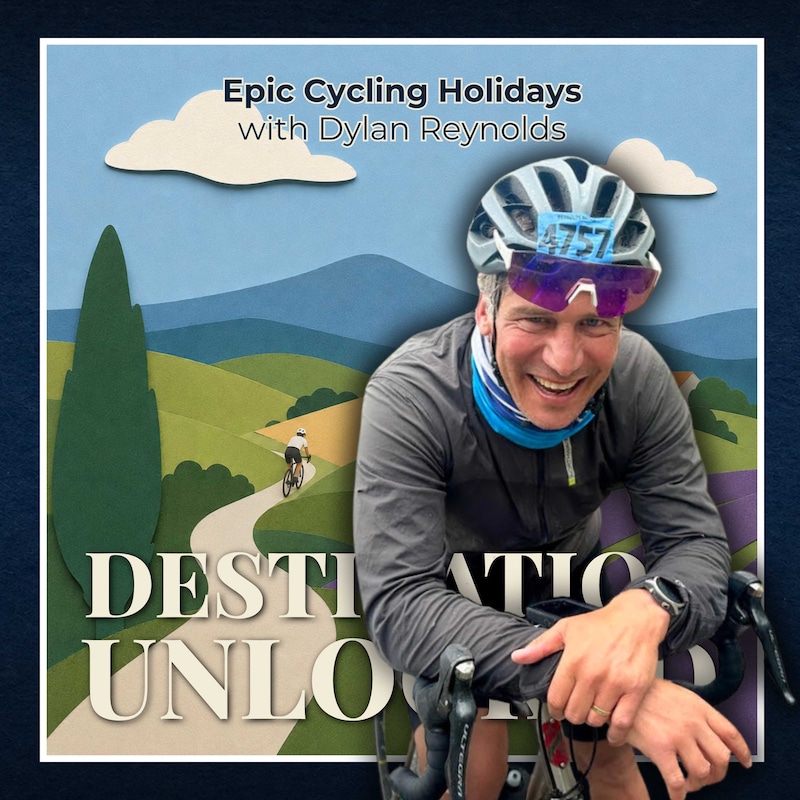
Dylan Reynolds, the founder of Ride & Seek, unlocks the secrets to epic cycling adventures that go beyond just riding from point A to B. In our chat, we delve into his journey from childhood cycling escapades to leading epic tours like the Napoleon Tour, which retraces the historic march of Napoleon's army across Europe. We explore the blend of cycling with cultural immersion, discussing the importance of local experiences, from the stunning landscapes to the delightful gastronomic offerings along the way. Dylan shares insights on how to prepare for such adventures and what to expect when you embark on a cycling holiday. So, get ready to pedal through history and discover the joy of exploration on two wheels!
Transcripts
This is Destination Unlocked with me, Daniel Elliott.
Speaker B:Just about ready to depart.
Speaker B:Please make sure your seat belt is.
Speaker C:Not fast and do make yourself comfortable.
Speaker A:Hi, welcome back to Destination Unlocked.
Speaker A:This episode is a bit of an adventure.
Speaker A:My goodness, it's a huge adventure to cycle across a continent.
Speaker A:But that is what Dylan Reynolds, the founder of Ride and See, does and enables you to do as well.
Speaker A:He's been cycling practically all of his life and has designed these amazing epic cycle tours that follow in the footsteps of some of the greatest military voyages of all time.
Speaker A:And today we're chatting about a few different trips and styles of cycling, but especially a trip known as the Napoleon Tour, which follows the journey of Napoleon's army from Paris right the way through to, well, Moscow.
Speaker A:Though right now the Tour ends somewhere slightly different, but I'll let him explain.
Speaker A:Enjoy.
Speaker C:So, Dylan, what are you unlocking for us today?
Speaker B:I am unlocking an epic cycling adventure which is more than riding from A to B.
Speaker B:There's so much more that can be discussed, discovered.
Speaker C:What got you into cycling?
Speaker B:I originally come from Cambridge in the UK and the bike, from the age of basically being a nipper, was my primary mode of transport.
Speaker B:And then I had a very adventurous father who used to take us on bike tours here, then everywhere.
Speaker B:And it was at the age of 12 that he dragged the whole family on a Lands End to John o' Groats Odyssey.
Speaker B:And I think that was actually what owed the seed for what Ride and Seek then became.
Speaker B:It was kind of using the bike to explore and find adventure and it's all gone from there, really.
Speaker C:That is a huge trip, especially as a 12 year old for people who don't know lands.
Speaker C:Enter John o'.
Speaker C:Groats.
Speaker C:That is the entire length of the United Kingdom.
Speaker B:Indeed.
Speaker B:Yeah.
Speaker B:I'm not sure any of us really knew what to expect and my mother most of all.
Speaker B:I reflect back on it with incredible admiration for what she put up with there.
Speaker B:So we have my dad pulling my youngest sister, who was 5, on a tag along, which have now become really popular.
Speaker B:But it was something, I mean, we're talking now the better part of 35, 40 years ago.
Speaker B:So we had this tag along for my youngest sister, which was engineered specifically for my dad to tow.
Speaker B:And then I had my younger sister, who was 10 at the time, who rode the whole thing on a regular bike.
Speaker B:I'm convinced that certainly at the time she was the youngest person to ever take that on.
Speaker B: iding it must have been about: Speaker B:It was big and I still to this day don't know why my mum signed up for it and how she managed to last the course at that point.
Speaker C:Was it exciting, tiring?
Speaker C:Did you get fed up midway?
Speaker C:Was it just the best thing ever?
Speaker B:It's the rose tinted spectacles analogy, isn't it?
Speaker B:I mean, on reflection, it was all amazing.
Speaker B:I think, to be honest, I think for us as kids, I don't have negative reflections on it.
Speaker B:It was just kind of your parents said, this is what we're doing, and, you know, he just got on with it.
Speaker B:And we also had some other friends that had accompanied us, so it wasn't just the five of us as a family.
Speaker B:So there was a lot of fun to be had at the end of the day and so on and so forth.
Speaker B:The one that actually, Daniel, that still amuses me though, is we.
Speaker B:We chose to do it as well, camping.
Speaker B:So we were fully panniered up.
Speaker B:Or think about it now.
Speaker B:I mean, it would have been so much more enjoyable if we'd have stayed in B and B along the way or whatever the case may be.
Speaker B:But it was very rustic.
Speaker B:But as kids, I think we just took it on, as you do.
Speaker B:That became our new normal.
Speaker C:And my gosh, the stories when you went back to school after doing that must have been amazing.
Speaker B:Yeah, no, indeed, indeed.
Speaker B:And then it just became a regular sort of summer thing.
Speaker B:We used to ride down to the south of France and then off the back of that, through college years, it just became the regular holiday.
Speaker B:I reflect on it now and think about it in the context of running a bike tour business and people will say, well, where did the inspiration come from?
Speaker B:And it came from all of those adventures that I had as a kid and through my formative years, almost an inevitability.
Speaker C:I haven't particularly cycled, funnily enough, since I was at Cambridge, which is a city where you can't escape the bikes.
Speaker C:I was at a college, which is in the centre, and I had some of my supervisions at Homerton, which would be a good hour's walk or so to get there.
Speaker C:So I went on a bike, but I gave my bike to someone when I left university.
Speaker C:So everybody just needs a bike in Cambridge, so I just passed it on to the next person and I haven't bought a bike since, which is such a shame because I really enjoy cycling.
Speaker C:It sounds like a really silly question, but do you need a bike to go on a cycling holiday?
Speaker B:You would assume that the person who chooses to Do a cycling holiday would have a bike.
Speaker B:There is no precedent for having someone call up and say, I don't have a bike, but I'd like to take on one of your epic adventures.
Speaker B:However, at least for the way we structure our tours, we have a bike fleet and we generally find 50% of the people that come on the tours will rent a bike office and then 50% will bring their own.
Speaker B:There's always a joy with being able to ride your own bike because you're familiar with that and you're comfortable with the geometry and the saddle and so on and so forth.
Speaker B:But from a convenience perspective, they were great, the bikes.
Speaker B:We have decent bikes for the purposes of what we need them for, and convenience wise, it's just quite nice to rock up and the bikes are all ready to go and off you go.
Speaker B:So on that basis, Daniel, yes, you could just come along and we'll.
Speaker B:We'll have a bike waiting for you.
Speaker C:I'm still in.
Speaker C:I've only hired bikes for day trips in the uk, great trips around Norfolk area.
Speaker C:Also in Cornwall, the Padstow area.
Speaker C:There's a lovely cycle ride there.
Speaker C:And historically, I mean, over the years I have found that the bike rentals have got better the quality of them, because I remember the chains falling off of some of those old things.
Speaker C:I mean, they were really just a metal piece of mess, but now they are much, much nicer to ride.
Speaker C:So I don't think that should put somebody off.
Speaker B:No, absolutely not.
Speaker B:That's an interesting observation on your part.
Speaker B:I think, certainly in the industry I work in, I've seen that across the board.
Speaker B:I mean, it's based on the demand or the expectations of the guests that come on the tours.
Speaker B:They want to have a bike which is similar, of a similar level to what they ride at home.
Speaker B:Anyone that's going to take on an epic adventure of these sorts is, generally speaking, going to be someone that, if not an avid rider, has got a certain level of fitness.
Speaker B:And so if they.
Speaker B:They choose to rent a bike off, as they've already got a bike at home, they're wanting a bike that fits a purpose and fulfills a certain spec in terms of the componentry and the materials it's made of.
Speaker B:Interestingly, the other one which we're finding, and this is across the board, is the interest in E bikes, the pedal assist bikes.
Speaker B:Just year on year, we get more and more demand for that.
Speaker B:We don't have those big heavy ones which you'll see on some of the city tours or whatever the case may be, but we provide now road bikes which ride of regular bikes that just give you that bit of assistance.
Speaker B:So it's quite interesting how that's improved and how many options there are.
Speaker C:Do you find there are bike purists on your tours who look at the people on the E bike with a slightly disparaging base.
Speaker B:That is such a good question.
Speaker B:I think it's changing.
Speaker B:It's probably been five years or so now that we've had the E bikes on the tour.
Speaker B:So I'd give you an example.
Speaker B:I mean we have 16 people on a tour.
Speaker B:It seems this year you'll have at least 2 or 3 of what we call E road bikes.
Speaker B:Now bear in mind, as I said before, they're not these big heavy things.
Speaker B:They look like a regular bike.
Speaker B:The technology has just moved so fast.
Speaker B:Previously it was like you gave someone effectively a moped and that really would drive people mad because basically they just pull the throttle back as soon as there was an incline and just shoot up.
Speaker B:And yeah, there was definitely pushback then.
Speaker B:What we're finding on our tools is the people that want the E bikes want to still get that workout, but they'll set the assistance in a way that gives them what they need to just have that helping hand.
Speaker B:So many people come back year after year to do the tours with us.
Speaker B:We get people that have got to a certain age that still love the concept of riding multi day tours of us, but just need that helping hand.
Speaker B:And what you'll find is that other riders will recognize that those people have done a lot of riding in the past.
Speaker B:So it's people that know how to ride a bike, choose to ride the bike with a little bit of assistance.
Speaker B:Where you get the pushback is when you get people that just basically want to ride it, like a motorbike that doesn't work.
Speaker B:And there's a number of companies out there that I'm aware of, they're having real challenges with that because whereas we'll have two or three E bikes per tool, you've got companies that are now sort of 80% E bikes and you've got that 20% on a regular bike who must just be going out of their minds because they're just killing themselves.
Speaker B:Whilst a lot of those people riding the E bikes who aren't regular riders are just like, put me in turbo and I'm going to get to my destination as quick as possible.
Speaker B:Doesn't work.
Speaker B:So how that dynamic sets out, basically.
Speaker C:They want to go on a motorbike tour.
Speaker B:Indeed.
Speaker C:Let's cover what to do before the tour starts.
Speaker C:And then I want to get into a tour and we'll use the Napoleon tour as the example because it just sounds like the most incredible trip.
Speaker C:What do I really need to sensibly train for before I get out there?
Speaker B:The tours we run are by definition epic adventures.
Speaker B:They're graded based on espresso cups.
Speaker B:So the more espresso cups, the harder the tour.
Speaker B:The tours themselves are for people that enjoy active vacations.
Speaker B:The what we would describe as being the easier tours are accessible to people who are just in reasonable fitness.
Speaker B:But in terms of preparing for a multi day tour, I mean the main thing I've, I would always say to people is just, well, the fitter you're going to be in the lead up to the tour, the more you're going to enjoy the tour.
Speaker B:Because most people with a decent level of fitness can jump on a bike and they could ride 40, 50 miles and away you go.
Speaker B:The challenge comes with backing that up and that is in particular with regards to the pressure on one's derriere because you do need to, it's not harden it up, but you do need to get used to being on a bike saddle if you are going to ride multiple days, one after the other.
Speaker B:So what I'll typically say to people is, yeah, ride as much as you can.
Speaker B:Go out and find your local hill, try and do some hill repetitions or whatever the case may be, but primarily just try and do over a series of weekends, try and ride two days in a row just so that you're familiarizing your body with doing more than just a one off ride.
Speaker C:Yeah, you don't get that rest day afterwards.
Speaker B:No, exactly.
Speaker B:I mean, the way the tours are structured, you're typically looking at riding five days and then there's a rest day and then you rinse and repeat.
Speaker B:So it's a case of, in terms of preparation, just being familiar with the fact that you're going to be riding every other day, not every day until you get the rest day.
Speaker C:And what do I need to pack because am I going to have this all on my back?
Speaker B:No.
Speaker B:Therein lies the joys of the guided tour experience.
Speaker B:The concept is you just rock up and we'll look after all of the details.
Speaker B:You're just needing to turn the pedals.
Speaker B:And so on a typical tour, there'll be two vans offering van support, one of which would be carrying the luggage from one hotel to the next.
Speaker B:And generally the other van is a multipurpose van, which is your Restaurant.
Speaker B:We do a lot of picnic lunches on the way.
Speaker B:It's also your mechanic, it's your SAG wagon.
Speaker B:I mean, the van is very much your friend.
Speaker B:So we've got the option to jump in the van if you want to take it easy between the two vans that are supporting the tour.
Speaker B:And then generally speaking, there's two bike guides who are actually riding alongside you.
Speaker B:Our role is to just chaperone you from A to B.
Speaker B:From when you meet us at the start of the tour to the end, you're in our hands and we're doing whatever we can to just allow you to just turn the pedals and enjoy the experience.
Speaker C:Ah, that's nice.
Speaker C:So let's get into an experience.
Speaker C:The Napoleon Tour is the one that grabbed my attention for a couple of reasons.
Speaker C:First of all, the idea of a 37 day cycle tour, 3,500 kilometers, just sounds incredible.
Speaker C:Epic is the word.
Speaker C:But the even bigger reason that this one jumped out to me is it retells a story.
Speaker C:It's not just about a really intense cycle ride.
Speaker C: that Napoleon's army took in: Speaker C:And that's a fascinating idea.
Speaker C:When you talk about journeys and adventures, I suppose the biggest adventures and the biggest journeys are those of those sort of armies that have made their way through Europe.
Speaker C:The idea of recreating that on a bike is just amazing.
Speaker C:Tell us about this trip.
Speaker B:Just to dial it back a year or so from when we first ran Napoleon.
Speaker B: So we ran Napoleon in: Speaker B:But we started with a tour called the Hannibal Tour, which again was of a similar ilk.
Speaker B:And it was Barcelona to Rome, following in the footsteps of the Carthaginian general Hannibal when he went over the Alps with the elephants.
Speaker B:It's just such an evocative story.
Speaker B:And the follow up to that was then Napoleon with this more than A to B concept.
Speaker B:To ride your bike, there is so much to embrace in terms of the historical context of where you are and cultural immersion.
Speaker B:And tying in this historical element just seemed like a great fit.
Speaker B:And the Napoleon one, very much so, because so many of us know at least the basics of what that tour involves.
Speaker B:Now, I will qualify this as in we're all about also finding the best routes.
Speaker B:So you'll find these various different parts along the route which correspond to where Napoleon was on any given time of his attempt to take Russia.
Speaker B:But we also, for example, at the end we go up through the three Baltic states as opposed to heading directly to Moscow.
Speaker B:So you kind of, you're meshing together the historical theme.
Speaker B:We're finding the best cycling as well.
Speaker C:And safety is important too.
Speaker C:Right now it just doesn't make sense to go to Moscow.
Speaker B: rst launched the Tour back in: Speaker B:It was Paris to Moscow via St Petersburg.
Speaker B:And so it was actually a 48 day tour.
Speaker B:We're really focusing on the accommodation and using the food and wine or food and drink we experience on the tours.
Speaker B:It's giving you a sense of where you are.
Speaker B:We found that riding between St Petersburg and Moscow, as amazing as that was from an adventurous perspective, to be able to say, like, tick that box, say, wow, I cycled through Russia.
Speaker B:The cycling itself was really dire.
Speaker B:The food situation was hilarious.
Speaker B:I mean, it was an amazing travel experience, but you'd rock up at a hotel or a restaurant.
Speaker B:I mean, we've already set the menus.
Speaker B:We're used to sort of having a three course menu and really sort of enjoying the experience.
Speaker B:And they'd bring everything out at the same time.
Speaker B:I think everyone did it and said the first two times we ran it and ended up in Moscow, I'm so glad I did that, but I don't think I'll ever want to ride a bike in Russia again.
Speaker B:So off the back of that we changed it.
Speaker B:We went Paris to St Petersburg and then obviously everything went to pot with the situation in the Ukraine.
Speaker B:And so the last two editions of the tour we've run have had us finishing in Estonia.
Speaker B:It's evolved, this tour.
Speaker B:I mean, what I love about it in so many ways, it's the extent to which it really feels like a celebration of Europe.
Speaker B:Actually.
Speaker B:It's a ride across Europe and obviously you've got the Napoleonic theme and our guides and the people we bring in to give presentations very much hone in on that.
Speaker B:But there's also so much linked to more recent history as we ride into the old Iron Curtain countries and you just see the way that they have, just the extent to which they've changed beyond all recognition as we head further east.
Speaker B:I think it's hard, like for so many people that come on the tour with us, it's.
Speaker B:They've got very different expectations to actually what they then experience and are very much taken with how good that travel experience is in terms of the food they eat, the places we go and stay in and the real sense of discovery.
Speaker C:I guess it does go to some of my favorite places in Europe and they are further east, funnily enough, in Our minds, we conceptualize them as Eastern Europe, but actually they're Central Europe in a way.
Speaker C:Poland and then up the Baltic.
Speaker C:Lithuania, one of my favorite places.
Speaker C:And you go through Vilnius, that's where sort of the second leg concludes in Vilnius, which I think is a fabulous city.
Speaker C:And they've got a lovely cycle path along the river there, which is an easy bit of riding.
Speaker C:I don't know if you're planning on just going along there for the fun of it, but I am wondering, given that you finish Finnish in Tallinn, whether you're finishing with a sprint up the hill to the center of the old town, because, my gosh, that's a burning finish.
Speaker B:Well, actually we finish in Tallinn, but unfortunately the roads running into Tallinn itself are really busy.
Speaker B:So the tour itself rides to a place called Narva, which is on the Estonian Russian border.
Speaker B:And there's a castle there, and we finish with a celebratory lunch there.
Speaker B:So the ride is Paris to Nava, and then we then shuttle from Narva to Tallinn.
Speaker B:So there's no riding into Tallinn.
Speaker B:Now you've mentioned that, though, Daniel, perhaps that could be a final challenge.
Speaker B:We pull the bikes out for one last element to the Tour.
Speaker C:It's hard enough to walk up that hill.
Speaker C:You've mentioned food a few times, and this is something which, funnily enough, it surprised me about the tour, but it surprised me in a nice way.
Speaker C:I don't know why, but I just assumed a cycling tour wouldn't make such a big deal of the food.
Speaker C:But a huge amount of your experience is the food and connecting in locally.
Speaker C:And it does sound like you really treat yourselves to some lovely local food.
Speaker C:Is there anywhere in particular on this route that's jumped out at you on previous trips?
Speaker B:We definitely do put a significant focus on the culinary elements of the tour.
Speaker B:I always draw parallels, actually, with people that go on skiing trips.
Speaker B:I mean, you've got a free pass to eat whatever you want.
Speaker B:You spend all day doing exercise, and then you get to the end of the day, day your body's crying out for sustenance to give you the energy for the next day, so you can eat whatever you want.
Speaker B:We go through, I think it's eight different countries on this tour, and each country has got its own gastronomy, which it always seems to me a no brainer that you would use that as part of your attempts to give people a cultural immersion or a sense of place.
Speaker B:The food and drink of wherever you visit is really indicative of what, what that country is about in many ways.
Speaker B:You know, one of the questions you often field from people is like, oh, I'm going to do stage one of this talk and I know the hotel is going to be great and I'll be like, well, you know, some of the best hotels we've got on the whole tour in Poland, for example, they, they are amazing, these star hotels we go to.
Speaker B:And similarly, actually there's, I mean there's something like, there's Bigos, which is this Polish huntsman dude, which at the end of a long day in the bike is just spot on.
Speaker B:I mean, the Polish cuisine, to be fair, is something I really raised.
Speaker B:It's interesting you mentioned Lithuania being one of your favorite travel destinations.
Speaker B:There's some world class restaurants there as well.
Speaker B:We're not looking to provide gourmet meals the whole way because people don't want to be sat at a table for three hours because they want to get their sleep.
Speaker B:So it's getting that balance.
Speaker B:But we'll always find at the end of a stage, for example, in Vilnius, we eat there in a Michelin starred restaurant.
Speaker B:And it is just a delight mixing that up as well in terms of the gourmet Polish huntsman stew on another night, I consider it to be such an integral part of the whole experience, really.
Speaker C:I love traveling with that blend of little luxuries to treat yourself because you are on your holiday, you're on your adventure, but also that quite humble, local, authentic experience wherever you happen to be, because people live there, they have their own traditions, they have their own recipes which have dated back centuries.
Speaker C:And I want to know what they taste like.
Speaker B:Absolutely.
Speaker C:How do you go about designing a tour like this?
Speaker B:It starts with a concept.
Speaker B:We started with Hannibal across the Alps and this was like, well, okay, what are the other great sort of journeys?
Speaker B:Early on in the piece it was kind of, well, let's focus on the military journeys of yesteryear.
Speaker B:And Napoleon was a natural fit.
Speaker B:So you look at the map you sell.
Speaker B:Let's try and do this.
Speaker B:And therein lies the start of a lot of work in terms of taking that from the conceptual to the reality.
Speaker B:So you start with creating it remotely.
Speaker B:In recent years, it's become a lot easier to do that with various different navigational programs that enable you to chart routes, that gives you an idea.
Speaker B:You then fit that in the context of the difficulty of the tour you think you need to present.
Speaker B:So the Napoleon tour is, whilst topographically not particularly challenging, albeit the first stage is where all the hills are as you ride across the Polish Lake District or Actually the Baltics, it's pretty flat, but the distances are not inconsequential.
Speaker B:So you're looking at that, you're trying to divide up to get a sort of average distance per day, join the dots between the towns along the way, towns and villages along the way that you consider to be interesting, that gets done remotely.
Speaker B:And then we send the guides off to actually drive and ride it, to actually put it all together.
Speaker B:And when they do that, they're then obviously looking to piece together all of the component parts of the tour.
Speaker B:It's a simple format, but there's obviously a lot of construct within that, which would be on any given day, if we said it's an 80 kilometer, 50 mile day, a third of the way through the day, we'll always stop for a coffee or a snack somewhere.
Speaker B:Ideally it's a coffee.
Speaker B:If we're doing it in Italy, easy, because every village has got a great coffee place.
Speaker B:As we travel through northern Germany and Poland, very different.
Speaker B:So we'll be looking to find a place where we can set up and provide snacks and coffee and we would provide that.
Speaker B:Then you've got your lunch, which might be a picnic or might be sort of a local fair, two thirds of the way through and then you ride on to the, to the hotel and rinse and repeat.
Speaker B:I think the hardest part for a lot of people is actually leaving the tour because you get so grooved into this format.
Speaker B:You go home and it's like, well, I'm ready for snack now.
Speaker B:Or you've got to be filling my water bottle.
Speaker C:You'll get hooked on the endorphins as well.
Speaker C:I mean, that amount of, of exercise pumping through your body, it's fantastic.
Speaker C:You're on a high.
Speaker B:I think the other thing, Daniel, is that it's then just reconditioning your body to not wanting to eat like the proverbial horse at the end of it because you're so used to fueling yourself to be able to do this every day, then you're riding your bike for the whole day, that it's.
Speaker B:Yeah, it's an interesting one.
Speaker B:Very difficult if you just do a five day tour because that's just a little, that comes and goes.
Speaker B:But when you sign up and do a, in this case a 37 day tour, you almost become institutionalized.
Speaker B:I think.
Speaker C:Yeah, you have conditioned yourself.
Speaker C:You mentioned the team, the team of guides.
Speaker C:I counted on your website, rideandseek.com 45guides listed there and these are locals who have true knowledge of the area and are able to get out there before you take a tour out there to make sure that everything is the very best it can be.
Speaker C:How do you find all these guides?
Speaker A:Is there a big community of sort.
Speaker C:Of passionate long distance cyclists?
Speaker B:What we call our trip specialists are typically those that work the most for us and they'll run multiple tours for us.
Speaker B:So they're not necessarily local to the specific countries on say Napoleon.
Speaker B:They will be the ones that will sort of manage the tour and then you're looking to incorporate within that guide to that local knowledge.
Speaker B:And they are fundamental in terms of helping us to structure the tour and set the tours up as well.
Speaker B:It's a very mixed bag.
Speaker B:There are a lot of guides out there and we're very fortunate that those same guides have been working for us for years now.
Speaker B:The more local guides offer obviously the guiding experience, but also are able to provide more of a sort of local insight to where you're going.
Speaker C:And you do have quite a good mixture.
Speaker C:I mean, I know we've spent most of the time chatting about this epic 37 day tour, but you could go out for a week as well somewhere.
Speaker B:Absolutely.
Speaker B:I mean, one of the tours, I think it was probably the third tour we ran off the back of Napoleon, which was called the the Three Islands tour, which is an island hopping tour where you go a week on Corsica, a week on Sardinia and then a week in Sicily.
Speaker B:So that's a three week tour.
Speaker B:And what we'll typically find on a tour like that is, you know, 50% of the group will do the whole tour and then the others will choose to just do single islands, which is great as well because I think it keeps the dynamic of the tour group fresh as well.
Speaker B:There's scope to chunk down the executive ventures as well as you alluded to with Napoleon, that's a three stage tour.
Speaker B:And that final stage from Vilnius up to Toy, it's just over a week.
Speaker B:So we'll get people that will come in and just jump between those three Baltic states.
Speaker B:They're so vibrant, aren't they?
Speaker B:It's an amazing place to travel and so many of us, if you haven't traveled there before, have.
Speaker B:I don't know what expectations we have.
Speaker B:I.
Speaker B:My expectation when we first set up the tour was it was going to be very Soviet esque and gray.
Speaker B:And then you get there and you're like, wow, this place is.
Speaker B:Yeah, it's remarkable.
Speaker C:The thing I love most about that whole region actually is you can see every era so blatantly it wears its scars and it's so fascinating to see these old wooden hut type houses which you get as you just get out of the city, not that far out of a city and you're already seeing these really old wooden buildings.
Speaker C:You go into the cities and often they've got these concrete Soviet blocks of flats and you get past that wall of Soviet brutalism and you get into this modern era.
Speaker C:But then you've got these little dashes of neoclassicalism where they had this heyday where a lot of money was coming in and this middle class was blossoming just before the Soviets came in and saw an end to that.
Speaker C:Every part of their story is still worn so visibly.
Speaker C:I think they're amazing to visit.
Speaker B:That's such a good take on it.
Speaker B:Absolutely.
Speaker B:It's living history, isn't it?
Speaker B:The other one which I'm always intrigued on with Napoleon is the when you move in, when you think about when the Berlin Wall came down and the reunification of Germany moment, when we cross into what was the old East Germany and it's seamless now, as I said earlier on in the piece, this idea that it's a celebration of Europe and how things have changed in the last 40 years, it's remarkable.
Speaker B:Poland, I always find an interesting one because like you originally from the uk, you walk into a hotel and you'll be like, do you speak English?
Speaker B:And you then discover that they worked in a hotel in Southampton for five years and just a number of them actually who seem to have now gone home because they can make more money back home than they can in the uk, which I find so interesting.
Speaker B:You kind of get like, oh, opponent, how am I going to get on here?
Speaker B:And the level of service, the level of English, you'll be fine.
Speaker B:And young, educated population through the Baltic States again, I find it very inspiring, very interesting to see.
Speaker C:It is incredible that the bulk of Europe now, Certainly the under 30s, probably even the under 40s, are bilingual.
Speaker C:And we are so blessed.
Speaker C:It's a shame in a way that it's so easy for us now because it does mean, and everybody says it, it does mean we make less effort.
Speaker C:But we are extremely fortunate that the vast majority of Europe is now bilingual with English as their second language.
Speaker B:Indeed.
Speaker B:And the level of English just blows me away.
Speaker B:I mean, a lot of people you come in contact with have spent time in English speaking countries, but at the same time, and I think it's an embarrassment really for from a personal perspective, I now live in France, would have spent five years studying French at high school, barely got anywhere beyond the asking where the tourist office is.
Speaker B:And then you'll meet someone who speaks damn near perfect English and you'll be like, well, how long did you spend?
Speaker B:How long have you lived in England?
Speaker B:Or how long did you spend in the us?
Speaker B:They're like, I've never been.
Speaker B:And you're like, well, how does, how, how can that be?
Speaker B:It's extraordinary.
Speaker C:The funniest fact that I've picked up on the go to do with that on my travels is the rate of English speaking ability in Denmark is higher than that of Scotland.
Speaker B:That's incredibly disconcerting.
Speaker B:Wow.
Speaker C:Talking of language that brings us onto locals.
Speaker C:It's not just food, it's people.
Speaker C:And that's something which I think is so important when you're traveling is to get that opportunity to connect a little bit with the locals, to chat with them, to sit around a table with them, to do activities with them.
Speaker C:How do you achieve that on an active tour such that you're not just cycling through an area, you are immersing yourself in it?
Speaker B:Yeah, that's a really good point.
Speaker B:I mean, one of the things which we facilitate is people being able to ride at their own pace.
Speaker B:So if we talk about a group of 16, which would be the average group size for one of these tours, they're not in the bubble where we're, We've got a van at the front, a van at the back and we're just corralling them to the end.
Speaker B:They're riding at their own pace.
Speaker B:And one of the things that we were very keen to say to people, look, you, this is about the immersion or the experience is so much about the people you're going to meet.
Speaker B:And we attract.
Speaker B:Because of the nature of the tours, you attract people of a curious mindset.
Speaker B:So they're riding at their own pace, albeit chaperoned by the fact there are vans and there are bike guides around them.
Speaker B:But we'll do a language lesson when we arrive in a certain country.
Speaker B:We'll facilitate pointing out these various different points along the way where we're really encouraging them to mix with those locals.
Speaker B:Really, you know, Daniel, I think it's a mindset thing really.
Speaker B:There are those that will just themselves in a bubble, will sign up to an organized tour just so they don't have to exit that bubble.
Speaker B:But I think what we find is the nature of active travel and these sorts of tours.
Speaker B:By definition, you're attracting someone that really wants to immerse themselves.
Speaker B:We know I'm hugely biased on this, but the bike as the mode of transport to immerse yourself with where you are because you're traveling at a speed where you experience those changes in real time.
Speaker B:You're not going so fast that it just flashes by.
Speaker B:The beauty of Europe in so many ways is just that diversity and how one day where we cycle through three different countries is to encourage our guests to interact as much as possible with the locals.
Speaker B:We'll bring in locals to do presentations or be on evenings and so on and so forth.
Speaker B:That's a structured way for our guests to actually ask more specific questions.
Speaker B:But I think it's a process of almost osmosis.
Speaker B:They are on their bikes, on their own or in their small little groups.
Speaker B:And whilst we'll say we're going to have a coffee here, well, we're definitely saying we'll grab another coffee there or whatever the case may be, which I.
Speaker C:Really like because it does highlight that this isn't some sort of older person's school trip.
Speaker C:This isn't, you know, teacher is going to take you from here to here and tell you what to do at 10 o' clock and then what to do at 11 o' clock and then they're going to hold your hand as you go to the top toilet at 12 o'.
Speaker C:Clock.
Speaker C:That's just not how it runs.
Speaker C:You are an adult who is signing up for a great itinerary, facilitated but not so much instructed.
Speaker B:That's absolutely spot on.
Speaker B:And in fact one of the most enjoyable elements of any tour day is we'll generally say, oh, at such and such a time, pre dinner, we'll have a, we'll have a pre dinner drink and everyone comes together and that's the opportunity we have where the guides or local guides will come in and do a short presentation about whatever may be the case, whether it be Napoleonic history or just a presentation about a specific dish that they might be eating that evening or whatever.
Speaker B:And then you just get chatting and then the stories that come out of what's happened on any given day.
Speaker B:Oh, I met this guy, this farmer, he invited me into his house and I ended up having this local mead or whatever the case may be.
Speaker B:We're providing that safety net.
Speaker B:It's a guided tour but what we find is most of the people that do these tours are doing these tours because they want to experience these places which they've always wanted to go to or had no expectations of previously.
Speaker C:The wrap up round up Quick Fire finish is now ready for boarding.
Speaker C:What would you say is the top thing to see or do when you're out on an epic cycling tour.
Speaker B:Specifically on a cycling tour.
Speaker B:I'm going to go back to this idea of just enjoying the bike as the perfect vehicle to take in all of your surroundings and experience life in real time.
Speaker B:We live in busy times, don't we, in terms of all of those distractions?
Speaker B:And as an antidote to that, I think just riding your bike on an epic adventure, it's great medicine.
Speaker C:What's a tourist trap to avoid on one of these big trips?
Speaker B:I think people get a bit too carried away where I have to tick these things off.
Speaker B:I remember years ago when I was doing my backpacking adventures and you'd look in the Lonely Planet and you'd always look up which was the most recommended place and you'd go to that place.
Speaker B:I feel as if that's becoming the case now with the various different review sites.
Speaker B:If you'd be like, right, I want a great meal and it's all about, well, I'm going to go on Google Reviews.
Speaker B:If it's got less than this number, then I'm not going to go there.
Speaker B:I say, we'll get down those back streets and turn off your phone and just have a punt.
Speaker B:If a restaurant looks full and you walk in, it's got a good vibe, actually try and discipline yourself not to look at the review site.
Speaker B:So it's something I'm trying to discipline myself to do.
Speaker B:Try something new, take a plunge.
Speaker C:And that's a great tip.
Speaker C:I always try and pick my restaurants by the smell.
Speaker C:If I can't smell cooking, then that's not the one to go to.
Speaker C:What's your favorite time of year to get out on the bike?
Speaker B:Depends on where we're obviously running the tour.
Speaker B:We're riding in 38 different countries, from kind of Japan through to New Zealand to multiple tours across Europe.
Speaker B:So it's not as if there's a specific month.
Speaker B:You're looking for what we call the Goldilocks period.
Speaker B:Though if I'm looking at Southern Europe, I'd say May and early June, I think, when everything's in bloom and everything is so green.
Speaker B:May's a lovely time and you're avoiding the heat of the day.
Speaker B:It depends from tour to tour.
Speaker C:What is a good book recommendation for somebody interested in the sort of travel that you do?
Speaker B:Stephen Fay, Signs of Life.
Speaker B:She was on the road for five years, rode across six continents.
Speaker B:We became good friends, actually, because I. I met up with him when he was on his Australia leg of the tour.
Speaker B:He's now a medic back in London.
Speaker B:But he set off for six years and wrote this book, writes brilliantly.
Speaker B:Signs of Life by Stephen Fabes.
Speaker B:I think that's a great book.
Speaker C:That does sound good.
Speaker C:I love it when I get to read these people's adventures because it's inspiring to then sometimes copy them, but sometimes, you know you're not going to do a certain trip, but you still want to experience it.
Speaker C:They gift you that.
Speaker C:What would you say has been your top food or drink experience?
Speaker C:What should somebody keep an eye out for?
Speaker B:There's.
Speaker B:There's definitely a correlation, Daniel, between great cycling countries and wine regions.
Speaker B:On any number of our tours, we seem to correspond, riding through great wine country, so that's great.
Speaker B:Napoleon's got champagne, which is always a win.
Speaker B:We run a lot of tours in Japan now, actually pretty much covering the whole country.
Speaker B:And the food in Japan, the kaiseki meals.
Speaker B:Oh, there.
Speaker B:There you go.
Speaker B:If I can design the perfect tour, and this is very much a personal thing, but the perfect tour is for me is in Japan, because you ride your bike all day, you get to the ryokan, the traditional accommodation, you get changed into your yakuta, and then that's you're ready to go.
Speaker B:You go into the onsen, so you have a hot spring bath to rest your weary limbs.
Speaker B:You come out, there's a vending machine selling you a cold beer, which works perfectly, and then you go in and have one of these kaiseki Japanese buffet meals.
Speaker B:Therein lies the perfect bike tool format.
Speaker B:You should definitely ride in Japan.
Speaker B:But the one caveat is, do you like Japanese food?
Speaker B:Because as you all know, the rigidity of the culture in Japan is part of the appeal.
Speaker B:You're not going to go in there and say, well, I want a. I want to.
Speaker B:I want a bottle of Chardonnay.
Speaker B:It's kind of.
Speaker B:No, you've got to embrace Sasaki.
Speaker B:But yeah, kaiseki meals in Japan, when.
Speaker C:In Rome, do as the Romans do.
Speaker C:And final question, if you're looking to pick up something authentic, a nice souvenir of your time on an epic bike ride, maybe you're going on many and you want to make it an annual thing and you want to start a collection of something.
Speaker C:I don't know, what sort of souvenirs do you keep an eye out for when you're out cycling?
Speaker B:My1 ceramics, interestingly enough, it just seems to be, where do we go?
Speaker B:That's a lovely thing to take back.
Speaker B:And I've got into the habit of doing that wherever we are.
Speaker B:But even like a small piece of.
Speaker B:I mean it depends and you can get very carried away, but wherever you go, that, that, that's a sort of a bit of a left field one in terms of a keepsake you can then use when you get home as well.
Speaker B:But it's also representative of where you've been.
Speaker C:Dylan Reynolds, founder of Ride and Seek, taking us on these epic cycle adventures.
Speaker C:Thank you so much for unlocking these big trips for us.
Speaker B:Thanks Daniel.
Speaker B:Enjoyed the chat.
Speaker C:Thanks very much again to Dylan Reynolds,.
Speaker A:The founder of Ride and Seek.
Speaker C:If you're looking to get out on.
Speaker A:An epic cycle ride all over the.
Speaker C:Planet, then definitely check out their website.
Speaker A:Thanks again for listening to this episode of the Destination Unlocked podcast.
Speaker A:Do make sure you are following the podcast before you head on off.
Speaker A:So the next time you want to go armchair traveling somewhere nice or pick up some good tips for your next trip, you'll know how to find us.
Speaker C:I'll see you then.
Speaker C:Bye Bye.




