Shownotes
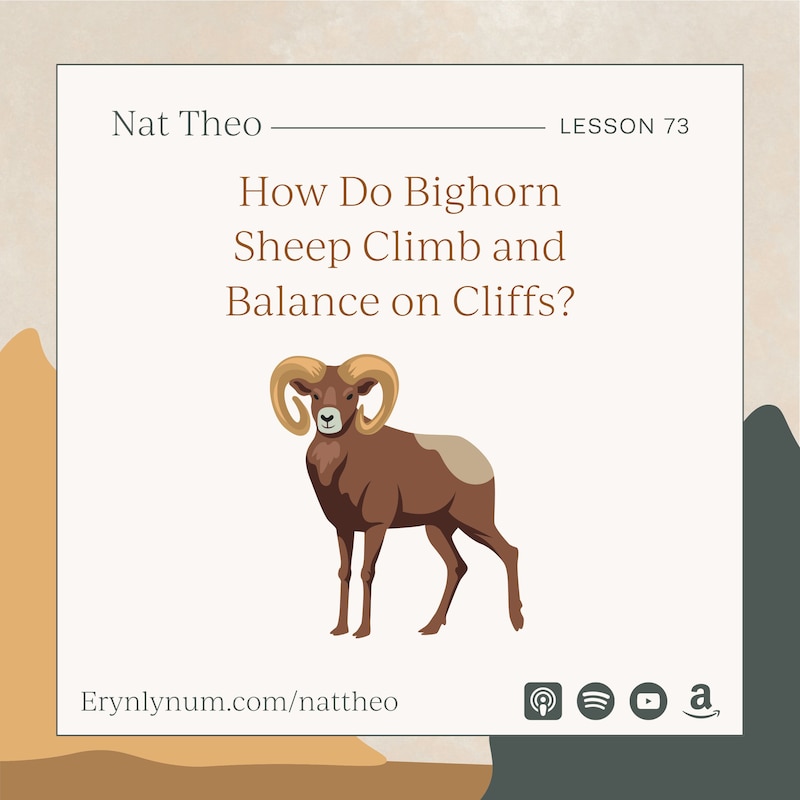
Meet the master parkour animal of the mountains: the bighorn sheep! Discover how bighorns run up steep mountains, balance on cliffs only a couple of inches wide, and find their way to safe resting places.
Here’s our trail map:
- What Is a Bighorn Sheep?
- Why Do Bighorn Sheep Ram Each Other?
- Why and How Do Bighorn Sheep Balance on Cliffs?
- How Did God Design Bighorns to Live Well Through Rest?
- How Can We Follow God’s Lead When the Way Gets Tough?
Episode Links:
Scriptures Referenced in This Episode:
“The LORD is my shepherd;
I have everything I need.
He lets me rest in green pastures.
He leads me to calm water.” Psalm 23:1-2 (NCV)
“‘Go up to a fertile land. But I will not go with you, because I might destroy you on the way, since you are such a stubborn people.’ When the people heard this bad news, they became very sad…” Exodus 33:3-4 (NCV)
“The LORD replied, ‘My Presence will go with you, and I will give you rest.’” Exodus 33:14 (NIV)
Terms Learned in This Episode:
- Ewe Bighorn: Female bighorn sheep with short horns that grow to a simple curved point above their heads.
- Ram Bighorn: Male bighorn sheep with large, thick horns curling around their face.
- Horn: A permanent part of the bighorn’s body. It has two main parts: a core made of bone, which we cannot see. Then, over that bone, there is a large sheath, or covering, made of a material called keratin. That is the part of the horn we see.
- Keratin: A type of protein that covers bighorn sheep’s horns and makes other things in nature including hair, nails, claws, scales, feathers, horns, hooves, and even the outermost layer of our skin.
- Versatile: Something that can be used for many different things.
- Cortical Bone: A very hard and strong outer layer of bone. Also called dense bone.
- Trabecular Bone: Spongy bone that is very porous.
This podcast episode contains paid advertisements.