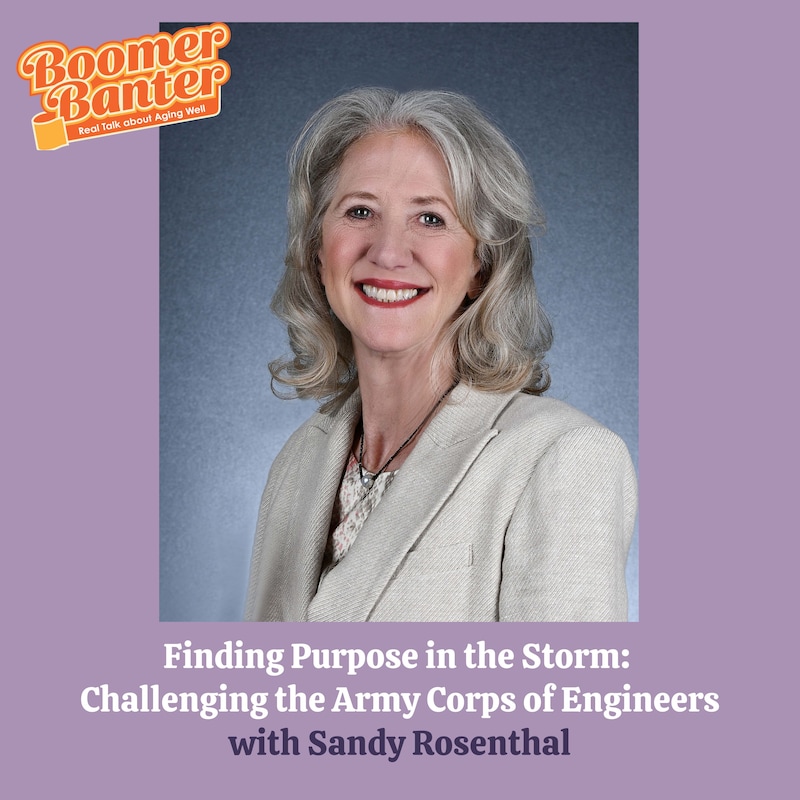
Shownotes
In this powerful episode, Sandy Rosenthal shares her remarkable story of resilience and determination in the wake of Hurricane Katrina. With no background in engineering or law, Sandy took on the U.S. Army Corps of Engineers after uncovering a devastating truth: the levee failures that flooded New Orleans weren’t just an act of nature—they were preventable mistakes. Her journey reminds us how vital it is to hold institutions accountable, especially in times of crisis.
Sandy opens up about the emotional toll and uphill battle she faced while pushing back against powerful forces trying to shift the blame onto local communities. Her advocacy wasn’t easy, but she refused to back down. This conversation brings to light the complex web of power, responsibility, and the courage it takes to speak truth to that power, all of which is covered in her book, "Words Whispered in Water: Why the Levees Broke in Hurricane Katrina."
Her story is more than just a tale of disaster—it’s a call to action. It’s about purpose. About using your voice. And about realizing that even without credentials or a platform, each of us can still make a real impact.
This episode is an inspiring reminder that it’s never too late to stand up, speak out, and bring about change—whether in your neighborhood or on a larger scale.
Links referenced in this episode:
- The grassroots organization that started it all: levees.org
- To get information about Sandy's book, what she is doing now, and her podcasts, go to sandyrosenthal.net
- Check out Older Women and Friends, hosted by Jane Leder.
- Try out the Boomer Banter Membership, free for a month. Email me at [email protected] to get access to the virtual gatherings.
- Support our sponsor, Greenwood Capital
Learn more about Greenwood Capital or find resources at www.GreenwoodCapital.com. Boomer Banter is sponsored in part by Greenwood Capital Associates, LLC. Greenwood Capital Associates, LLC is an SEC Registered Investment Advisory firm with offices in Greenville and Greenwood, SC. As a fiduciary firm, Greenwood Capital is obligated to disclose any potential conflicts of interest with this arrangement. The host of “Boomer Banter”, Wendy Green, is a client of Greenwood Capital, and her show “Boomer Banter” has been compensated for her testimonial through Greenwood Capital’s sponsorship. Greenwood Capital is a Legacy sponsor at the stated rate of $2,600 for the 2025 calendar year.
This podcast uses the following third-party services for analysis:
OP3 - https://op3.dev/privacy
Transcripts
So what would you do if you discovered that one of the worst disasters in U.S. history wasn't just an act of nature, but a preventable failure? And what if the people responsible were working hard to cover it up?
Many of us would feel powerless, Frustrated, Powerless. But Sandy Rosenthal did something extraordinary.
With no background in engineering, law, or politics, Sandy took on the Army Corps of Engineers, exposed the truth behind the levee failures after Hurricane Katrina, and changed the national conversation about disaster accountability. Her journey is a masterclass in resilience, purpose, and the power of speaking up, even when the odds are stacked against you.
In this episode, Sandy will share how she uncovered the truth, the personal risks she faced, and why finding your purpose can make all the difference. There is so much that we can do at this stage of our lives. And if you are wondering if it is possible to make a difference, stay tuned.
You will not want to miss this conversation with Sandy Rosenthal. Welcome to Boomer Banter, the podcast where we have real talk about aging. Well, my name is Wendy Greene and I am your host.
Have you ever felt that something's just off? Like life is full but not fulfilling the way it used to be?
Well, after our seasons of careers and maybe caregiving, we often find ourselves missing a sense of connection. Those regular chats shared laughs and friendship with people who truly get us.
And that's why I started the Boomer Banter membership, a warm and welcoming space for adults 60 + who crave real conversations, meaningful friendships, and something to genuinely look forward to. We meet twice a month for live, engaging discussions that feel more like catching up with good friends and opportunities to learn from each other.
And your first month is totally free. No pressure, no connections required. Just email me at wendyeyboomer Biz and I'll personally get you signed up.
And if you don't like it, if it's not for you, no problem. We'll just stop the the membership at that point. No cost involved. So come join us. We'd love to have you.
And remember that spots are limited, so grab your free month today. Now I want to take just a moment more to tell you a little bit more about Sandy Rosenthal, our guest for today.
Sandy was an ordinary citizen who uncovered an extraordinary scandal after Hurricane Katrina. She discovered the catastrophe was caused not by nature, but by the Army Corps of Engineers defective flood walls.
And then she exposed their massive cover up. Her David and Goliath fight earned her comparisons to Erin Brockovich. In fact, they've even met.
In:Today, Sandy continues to empower others through her podcast, Beat the Big Guys, inspiring everyday people to stand up to powerful institutions. And she's also the co host of the Slingshot, where she shares more stories of courage, activism and community impact.
I am so happy to welcome Sandy to Boomer Banter today. Hey Sandy.
Sandy Rosenthal:Hello Wendy. It's great to see you.
Wendy Green:Thank you for joining us today. Excited about this conversation. So you weren't an engineer or a journalist or an activist before Hurricane Katrina.
What made you decide to take on this fight?
Sandy Rosenthal:You know, if you look at other people who have pulled back the curtain on corruption and exposed something, often it was people outside of that discipline.
Because if it's within your discipline, you risk being shunned by your community, being called a whack job, you risk losing your job, you risk losing your clients. So it's actually not that unusual that I, a non engineer, actually exposed a cover up in the engineering community.
And we'll talk lots more about how I did that, but it's not terribly unusual.
Wendy Green:So what, what was your motivation to get involved in the first place?
Sandy Rosenthal:Well, it. Something didn't feel right or sound right. In the months after.
Excuse me, in the weeks after the flooding, I kept hearing about local individuals and local people being held responsible. It didn't make any sense to me. These are huge levies. How could any local people be possibly be responsible for these?
And I just started asking questions. I started reading and watching the News. This is 20 years ago. So we didn't have the same ways of getting on news as we did today.
And again, it wasn't making sense. So I just started digging a little bit deeper and that's when I got this hunch, something's wrong. But it would take a while for me to figure it out.
Wendy Green:So it was interesting, Sandy. In your book you tell the story of a couple that were seriously impacted. They lost their home, they were on the rooftop for a while.
Your home was not damaged. And so some people might say, well, you weren't hurt, so why, why make such a big stink about it?
Sandy Rosenthal:Well, it's two things about that. One is you, right? I didn't flood my house, my son's school, you know, the, the family business. None of those flooded. Certainly not seriously.
So what that did is I had the luxury of. I didn't have to deal with a contractor or FEMA or my insurance Company, which was all consuming at that time.
This was a major catastrophe, the worst in America, certainly, in terms of engineering failure. So I had, if you want to call that luxury, I had a little bit more time than other people. And. And also. So that's because I didn't flood.
And also I was in a position where my husband is an insurance agent, and he told me. Yeah, so he told me, pack for three weeks. We're not going to be able to get back home for three weeks.
And I really think I was the only person that packed for three weeks. I've interviewed lots of people since then, and everyone thought we would be gone for a couple of days.
And no one dreamed that a catastrophe like this could happen. Nobody. There was no warning that this could happen. And so. So that's what. That's why I was in this kind of a peculiar position.
Oh, and then, last but not least, even though I didn't flood, everyone I know was affected.
And even if you didn't get water in your house or your business, you might have lost your job because your business flood, the company you worked for flooded. You work at a restaurant that flooded. So everybody was affected, even people as far away as Bat. Baton Rouge and Alexandria and Lafayette. I was away.
Everybody, the whole state was affected by this disaster.
Wendy Green:Yeah. And we watched it on the news. You know, we saw all of the horrible damage that. That people endured, and some didn't survive.
But you had a lot of pushback from some very powerful organizations as you were uncovering this. I don't know, maybe you want to first start to talk about how you uncovered it before we talk about the pushback. What do you think?
Sandy Rosenthal:Yes, let's start with how I figured out.
Wendy Green:Yeah, let's start with that.
Sandy Rosenthal:And this is key. Four weeks after the catastrophe, which isn't very long, I was reading and doing my usual research, which was sort of my. My way of dealing with the.
With the stress, you know, to be reading and reading and reading. So I got my little hands on an article.
It seems that the Government Accountability Office had done a report for Congress and, And talked about the flooding.
It was one of the very first reports after the catastrophe, and it stated very clearly on page four that the Army Corps of Engineers is responsible to design and construct the levees, and local people do the maintenance. Well, how is it. How could this possibly have been a maintenance issue? And in my mind, it had to be a design or a construction issue. Not.
Not a maintenance issue. A lot of our levees are brand new, so that's When. That's when I began to go, wait a minute, that this doesn't make sense.
And so I started asking questions. And that is when I got the pushback, when I started asking questions, because, again, I wasn't a lawyer, I wasn't an engineer, I wasn't a politician.
Why is little Sandy getting so much pushback for asking questions? And that made me feel I must be on the right track. And he know all the answers yet. And that. That's something to know.
You don't have to know all the answers. Just keep asking the question.
Wendy Green:Keep asking the question. So who are you talking to? Who are you asking these questions of?
Sandy Rosenthal:I would ask these questions of leaders at that time who were pointing fingers at local officials and saying they should have been protecting us from flooding. I would just ask my little question. Well, excuse me, the Army Corps of Engineers is responsible for building these things.
My answer would be something like. Or. The answer that I would receive would be something along the lines of, what's wrong with you? You want corruption, changing the subject? Or. Or.
Or just belittling me for not being an engineer. And so that's when I. When I got pushback like that. I says, you know what? I've got. I've got to keep.
I've got to keep asking these questions until I get. Until I get an answer I'm satisfied with. And it. It would be a long time before that happened.
Wendy Green:Yes, it would be. I'm reading your book. So you and your son really kind of took this on and started trying to organize. Tell me about that.
Sandy Rosenthal:Well, I'm agonizing. Go. How do I, you know, get the word out? You know, it's just me and I. Meanwhile, at this time, I wasn't even living in New Orleans. I had.
My son's school had to close because there were no teachers. All the teachers had flooded. And you can't have a school without teachers. So the school was closed for three months.
And so we evacuated to a town outside of New Orleans so that my son could go to school. And so we found a school for him just south of the city of Lafayette.
And during the day, as I've already mentioned, I did my reading and listening to the radio. That's how I got information back then. The radio. Real news stories, too. I'm not talking about podcasts.
Not that there's anything wrong with the podcast. We didn't have them back then. It's the news on the radio. And.
And I was getting my information, and that's when I realized my gosh this is the Army Corps of Engineers. They're at fault and we have to get the word out.
So my son had barely turned 15 years old, a freshman in high school at a school that is just meeting all these new people in Lafayette. He said to me, mom, if you will do, write up a mission statement and do that part, I'll do the website and I'll build a website for you. 20 years ago.
Wendy Green:20 years ago, years ago.
Sandy Rosenthal: website in early December of:But then I realized, wait a minute, we need more than a website.
Wendy Green:That's right. You need the people.
Sandy Rosenthal:We need the people. So very good. So I thought, I know, I said, will create a membership of people. Well, how do we do that? I know.
President Bush had just visited New Orleans just a week before and had promised to bring New Orleans back. No, President Bush had promised to build the levees back bigger and stronger.
I put a petition up on the levy.org website and asked people to sign the petition to President Bush asking him to keep his promise. And overnight we got 200 members and now we're on the map.
Keep in mind this is 20 years ago when getting 200 people overnight, before social media was actually quite an undertaking. But there was a vacuum of leadership in New Orleans at that time.
And a lot of very confused, scared people at that time, really just craving information, craving it and would do anything to get it. And that helped get that 200 people overnight, which eventually turned into 25,000.
Wendy Green:25,000. That's incredible. Sandy. So this obviously became your purpose during that time.
zed this was your purpose for: Sandy Rosenthal:I realized it became a defining purpose when I quit my two paying jobs to devote my time, full time to the work of levies.org I was a part time marketing copywriter for an insurance company. And keep in mind, I was, you know, at this time I, I only had one child, a teenager and I was working part time.
And I also was a part time fitness instructor.
Wendy Green:Oh, okay.
Sandy Rosenthal:That's where I got my skills of being out in front of a crowd of people and leading them, you know, leading them in fitness. But I quit both of those paying part time jobs for the full time job of a not non paying job running a non profit.
Levy.org and that's when I realized, yep, this is my new defining thing in my life.
Wendy Green:Wow. Wow. So do you think that a purpose is Something that we find, or do you think it's something that kind of finds us?
Sandy Rosenthal:I think we find it because you have to build it. You have to build, like for example, levies.org and I had to build the attention, you know, to the problem.
I need to draw the attention of the American people to this issue, which was so misunderstood. I mean, the American people thought, oh, Katrina was a huge storm and those local people shouldn't have been living in a. In a place that floods.
That was the logic in:Something didn't work, I had to try something else. If something did work, I put more energy into it.
If for some reason no one was listening to us, I would have to invent a way to get people to listen to us. And, and still doing that to this very day.
Right now, Governor is, has made up his mind that he wants to control the people in charge of the levy protection. He's decided he wants to control it. And lo and behold, that gives my organization another opportunity to get its message out into the general public.
And the timing could not be better. We are now at 20 years after that catastrophe and not a disaster. It was a catastrophe. 135,000 houses destroyed.
The financial is $190 billion, adjusted for inflation. And it was also the most expensive, costly hurricane in our nation's history, in the entire history. So it wasn't a disaster. It was a catastrophe.
Wendy Green:It was a catastrophe. And it was interesting to hear you say that. You needed to get the word out for the American people.
This wasn't your mission, wasn't just so that New Orleans would understand what happened. You wanted to make a difference.
Sandy Rosenthal:Nationwide, 62%, 2/3, almost 2/3 of the American population lives in counties protected by levees. And it's the Army Corps of Engineers that designs and build those levees. So this isn't just a New Orleans thing.
We saw terrible flooding in the mountains of North Carolina recently during Hurricane Helene. And there lots of other examples, none of them quite so severe as what happened in New Orleans and in North Carolina.
But there's flooding going on everywhere, even in the mountains.
Wendy Green:Oh, for sure, yeah, that was a catastrophe also. So, Sandy, what were some of the biggest obstacles in getting people, both public and the policymakers, to believe the truth about the levy failures?
Sandy Rosenthal:In the beginning, I had the strangest pushback. That took me a while to figure out. In the beginning, I would be trying to educate it needed to begin locally.
Now, before you go national with something, you need to start locally and get everybody on board locally. Well, I thought that was going to be easy.
Well, it turns up that there were a lot of people that just wouldn't listen, wouldn't listen to the facts I was trying to give them. And they would say ridiculous things like, well, the Army Corps of Agent Engineers gave the money for the levy protection to the locals.
Well, that's nonsense. The feds don't give money to the locals to build the core. I mean, the Corps doesn't give money to local people to build the flood protection.
And they kept saying, oh, I read that, I heard that. I said, will you show me? Well, I can't find it now. When they know it was political. It was.
We were a Democratic governor and a Democratic mayor and this was a region of New Orleans that were all Republican. And it took me a while to figure that out. And you still see that today.
If you've got your mind made up on a particular ideology or partisan, you're not going to believe anything you hear. And that's still, unfortunately that's still going on today. But I think it's always been going on.
And that's one of the first things that confused me in the beginning, the pushback. And then the other pushback was from the Army Corps of Engineers itself, which disguised its identity and.
Yeah, well, yeah, I'll be happy to talk to you about that whenever you're ready.
Wendy Green:Yeah, go ahead, tell us.
Sandy Rosenthal:Sure.
So that was probably the biggest eye opening and most attention getting thing that happened during my leadership of levies.org I know all of your listeners are familiar with a caller id.
Wendy Green:Right.
Sandy Rosenthal:Even if a person's number isn't in your address book, you look at your phone, you see the number, you recognize the number, that's caller id. Well, every single laptop desktop has something called an IP address. It's a caller id.
Well, using back end tools available to any amateur and using free software, I was able to figure out that the pushback and the vicious comments and the ugly things being hurled at me were coming from none other than Army Corps of Engineers headquarters in New Orleans. And it was thousands, thousands of comments coming to me in New Orleans. So I was able to figure this out and I picked up the phone.
Back then we used phones and I called TV station and they promptly accepted the story as an exclusive, did a big story about it and it was all exposed. It was the Army Corps of Engineers sitting at their desks. And these are people who are tasked by Congress to protect us.
We're using their equipment to attack me Again, a nobody. A little Sandy on, you know, Sonia Street.
Wendy Green:So that must have been. Must have been scary, though. Were there times that you felt really scared for your safety?
Sandy Rosenthal:Absolutely. In the earliest. In the earliest months. And it was.
New Orleans was a little scary in the early months after the flooding because more than 50% of the city was evacuated and probably two thirds of the city wasn't even here. It was quiet. It was so quiet at night. No bugs, no birds.
And it was during this time that I was organizing the campaign to expose the truth about the core. And so one day I came out and my. My SUV folded. The roof with yard signs was keyed. Every single panel of the car was keyed.
Keep in mind, nobody was even living in New Orleans at this time. So that was frightening.
Wendy Green:That was scary.
Sandy Rosenthal:That was. That was scary. And I, of course, my whole family saw that. And then also, a few days later, I got home and there was a dead bird at my back door.
And this wasn't a dead bird that a cat had found. I grew up in a rural area, and I'm used to dead birds that the cat brought home. This was no dead bird the cat bought home.
This pigeon head had been chopped off with a cleaver with a sharp is at my back door. So obviously, it was unsettling. And I got a dustpan, picked up the bird, put it in my trash can, shut the lid, and shut a door in my brain.
Because if I focused on that, it would have gotten in the way of my work. And if I told my family about it, they might have told me. It might have encouraged me to stop doing this work. This was early.
And so, you know, I didn't think about it for years until my book that I. That I started talking about the dead bird. But you know what? My. My thought is, even at the time, it's going to take more than a dead bird to stop me.
Wendy Green:Golly, that's. That's very, very brave, Sandy. And that you didn't share it with your family is pretty phenomenal, because that would have been very scary. I.
I need to take one. That was their goal.
Sandy Rosenthal:Absolutely.
Wendy Green:To shut you up.
Sandy Rosenthal:That was their goal. And there's lots of ways that the big guys use to shut people up. One of them is the something called if you don't, I'm gonna.
It has a fancy name, but it's basically, if you don't stop talking, I'll sue you. And that's Enough to get a lot of people to be quiet.
Wendy Green:Absolutely.
Sandy Rosenthal:They tried it with levy.org they tried it with me. And, and that's, that's. We go into all the details in the book, but we basically said, fine, sue us. And they backed off. And they backed off.
They knew it was illegal what they were doing. In, in this great country of America, it is illegal to shut people up with the threat of lawsuit. Thank goodness.
Wendy Green:Yeah, thank goodness. It's, it's so interesting how when you stand up for what you think is right and don't back down, it kind of shuts them or pushes them back anyway.
Sandy Rosenthal:Yeah, the little, the little things that usually work, you know, didn't work on me. Yeah, not that little, you know, dead birds and, and threatening.
Wendy Green:Yeah, yeah, right.
Sandy Rosenthal:Pretty big.
But fortunately, obviously, and I'm sure your listeners know, nothing great gets done alone, you know, obviously, I had lots and lots of advisors who offered their advice pro bono. And one of these people advising me was an attorney. An attorney advised me, don't back down. Don't let the Army Corps of Engineers make you back down.
Stand up. And he offered to. He offered to represent me pro bono.
Wendy Green:Oh, that's awesome.
Sandy Rosenthal:And to your listeners thinking of stepping up and riding along, lots of good people with great skills will come forward and offer their skills pro bono. And all I want in return is for them to use their advice. Just to use. They don't need any more thanks than that.
Wendy Green:That's an excellent point.
I need to break for 1 second, 1 minute to talk about my sponsor, who is Greenwood Capital, and my advisor, Melissa Bain, who works with me to make sure that my financial portfolio matches my preferences and my desires. And, you know, all of that. And so as an independent registered advisory firm, Greenwood Capital is a fiduciary.
They must place your interests above their own. And I need to share that as a sponsor. Greenwood Capital has compensated my business for this testimonial.
So for more information about how they can help you with the financial plan, go to greenwoodcapital.com so let's get back to Sandy. This is such a great conversation.
So many people will see an injustice or a wrong, and we have plenty of things that we can take action on now, but they also are afraid and they don't act on it. So why do you think you felt differently? What gave you the courage to step forward?
Sandy Rosenthal:That's such a great question. If this was a video, I would hold up a coin for everybody because everyone knows a coin has two sides. And I think what, what makes People hesitate.
Is this, this coin. And what this coin is, is people feel if they, if they have to stand up for a cause, whatever it is. I mean, I'm trying to pick something.
Getting recycling in a neighborhood. Okay, okay. It doesn't happen. Let's just pick one. In order to fight for something, you almost always have to criticize or call out people. Okay.
And, and, and most people, most people don't like to criticize other people. Okay, Right.
Wendy Green:Because then you're going to think nobody's going to like me and they're all going to, you know, make fun of me or whatever.
Sandy Rosenthal:Right, right. It's, it's, it's a very human thing to not want to criticize other people. And, and so what? And my advice is it's not the person you're criticizing.
It's what they're saying. It's what they're saying. It's what they're representing, not the individual. Because if it weren't that individual, it'd be somebody else.
It'd be somebody else. So once you've accepted that. Oh, and it took me a while to figure that out too. Oh, it's not Marie or Anne. It's, it's this issue. Okay.
And it just so happened that the Marie of Ann is the one behind that issue, but that's irrelevant. And then the other side of the coin is you personally. And none of us likes to be disparaged or ridiculed or made fun of or. Nobody likes that.
Criticized. No, nobody likes it. And so if you get past, it's the same thing. They're not criticizing me. They don't like what I'm saying.
My own brother in law, bless, you know, rest in peace. He's not with us anymore.
ime was believed to be almost: Keep in mind,: Wendy Green:So, so, so as you're telling this story you're talking about, over time you realize it's not the person you're Criticizing. It's the issue. It's not me they're criticizing. It's what I'm saying.
But initially, Sandy, you had to have the courage to stand up and say these things that didn't feel comfortable. I mean, have you always seen yourself as a fighter, somebody who has a cause?
Sandy Rosenthal:That's a great question. It would take a little while for me to figure out that coin. And it was very uplifting and helped me do more and bigger things, for sure.
But you're talking about right in the very beginning, in the very beginning, why did I. What made me. Maybe I was a little bit crazy.
Wendy Green:All of the trauma.
Sandy Rosenthal:I definitely felt that if they're going after me, I'm on the right track, or I'm either right on the right track, as is when I got the criticism. And that fueled me, that. That gave me confidence to keep going.
Wendy Green:Yeah.
Sandy Rosenthal:Me.
Wendy Green:Yeah. So. And you knew. I mean, you also felt that they were criticizing people, the victims, like you said, and you advocated for them.
Sandy Rosenthal:I couldn't bear it. I say, I think, you know, I think you've helped me. This has been a long time since I've thought about these things. I think you helped me remember.
I think that was where I just lost it. And I've got to do something. Victims are being blamed for something that is no fault of theirs. It actually arose out of an argument.
I was having this conversation by now. This conversation happened in late October, right around Halloween, and I was talking to a gentleman from Alexandria, Louisiana.
It's about two and a half hours from New Orleans. Explaining him what your listeners all now know. It wasn't the storm. It was the federal. Federal government's design mistakes.
And he shut me down, or tried to. I said, oh, no, no, there's nothing wrong with those levies. Katrina was a huge storm. A huge storm. And people like you don't deserve any help.
Well, when I say I lost it, I lost it. And I didn't lose it physically in front of him, but mentally. I went, something's got to be done.
And I went home that night and said to my husband, I've got to do something. I've got to tell the world, or at least start with America what happened. I didn't know how, I didn't know how, but I knew something had to be done.
And I think that was that defining moment.
Wendy Green:Yeah.
Sandy Rosenthal:And I spent the next week or two, not more than two weeks, trying to find someone else who was already trying to get the word out that I had figured out myself. I figured if I could figure this out. Other people must have figured it out.
And I spent two weeks looking for somebody, and every person I asked, no, they were. They were stuck on locals, that local responsibility. Somehow the locals should have.
I don't know what we were supposed to do, but it was believed that the locals were responsible at that time. So the proverbial you want something done, you gotta do it yourself.
Wendy Green:Do it. And you sure took it on. You were amazing the way you did that.
So tell us about the impact that all of this work has had on levees and society in general.
Sandy Rosenthal:Well, yes, the Army Corps of Engineers no longer build levees like the ones that they built here in New Orleans. But as far as the work that my organization can definitely say is because of us, I think there are many, many things.
But I think the most important accomplishment of levies.org is we approach the Associated Press. The Associated Press is a worldwide news organization that has something called a style book.
And for your listeners that don't know what that is, it's. It's a book of how you reference anything, be it 9, 11, be it hurricane Katrina, be it the way.
The way you describe, you know, the chemical explosions and you name it. It's. If you refer to something, it's always the same way. And if you think about it, journalists always refer to the 911 disaster with the same words.
Okay.
my Corps of engineers. And in: In: Wendy Green:Wow. And it. It only took you like 17, 18 years.
Sandy Rosenthal:17 years. Keep in mind, we're a little nonprofit.
Wendy Green:Oh, my gosh, no.
Sandy Rosenthal:Dedicated income stream. And we pulled off something that big PR companies could not have pulled off.
Wendy Green:Wow, that is so impressive, Sandy. Good for you. I think there's one other thing, though, that you've made a change with engineering students. Right. And how they study.
Sandy Rosenthal:Thank you. That campaign is ongoing. We haven't been able to open our Champagne quite just yet on that.
Wendy Green:Okay.
Sandy Rosenthal:What we're trying to do is change the way engineering is taught in some 200 different engineering schools all across the nation right now. It is not required that engineering students receive instruction on disasters and the lessons learned. We think that needs to change.
that needs to change. In the:You know, you need to teach the kids about disasters and the lessons learned. Like the recent one in Baltimore.
Wendy Green:Right. The bridge. Yeah.
Sandy Rosenthal:So the engineers failed for several reasons. The main one being they tried to go directly to the schools and get them to change their ways. Our organization is doing it different, differently.
We're going to work with the accrediting body that accredits all those 200 schools, and we're going straight to them, and we're going to get a coalition of deans of the engineering schools urging Abbott to make this change. And it's. This is not something done overnight. This. This is more of a marathon than a sprint.
But it was begun two years ago, almost one and a half years ago. And each day we're getting closer. And I hope to be able to, in maybe two years, be able to announce that this campaign's been successful.
Wendy Green:And it seems so logical. I can't imagine that there would be much pushback on that. I mean, they design the bridges and the buildings and everything.
Sandy Rosenthal:Nobody pushes back on this one, which I gotta tell you, is a bit refreshing.
Wendy Green:Yeah, I bet.
Sandy Rosenthal:To actually be working on something that nobody disagrees with, that is kind of.
Wendy Green:A new thing for you. Yeah. So.
Sandy Rosenthal:Yeah.
Wendy Green:Yeah. About time, right? So you built an incredible second act of life, Sandy, and you're still going strong.
So what advice would you have for people at this stage of life? To feel like they have the power, we have the power to create change where we see it needed.
Sandy Rosenthal:I should. I want to share something with your listeners that hopefully will be empowering. I was born profoundly deaf in my right ear and severely in my left.
I'm wearing hearing aids right now. The. And so because of this, I learned. You know, I was born 68 years ago, and I was. Learned to speak the way I heard.
Well, obviously, I was unintelligible and I had to take speech therapy. I'll give you an example. The chicken. I hear chicken. And that's just one example.
That's just one among millions of examples of the words and I've overcome and the technology to correct my Hearing disability came out in the 21st century, so I've been hearing aid wearer for a couple of years. It really helped. There's a lot of sounds in there I've never heard before, and I think.
Wendy Green:That amazing, but I gotta tell you.
Sandy Rosenthal:Both of them are annoying.
Wendy Green:My mother would say the same thing.
Sandy Rosenthal:Oh, my gosh.
Wendy Green:I hadn't.
Sandy Rosenthal:I didn't know. My dishwasher made a high pitched beeping sound when I opened it, and I did. So in some ways it's not as peaceful a life.
But my point is, you know, with my severe speech problems and the hearing problems, and here I am today with my own podcast, you know, about to End One and about, and having started a new one that if I can pull this stuff off, there's nothing stopping anyone out there from doing whatever it is. They just have to make up their mind. Abraham Lincoln has a great comment. Whatever it is you want to do, it's already half done.
By the time you make your decision to do it, it's already.
Wendy Green:Oh, I love that.
Sandy Rosenthal:I love it.
Wendy Green:Heard that one. That's a great one. And that is a very empowering story. Thank you for sharing that.
Because that could be something that, you know, people want to keep hidden, but you, you put it in the book too. You know, like, I got to learn to talk if I'm going to be able to be the spokesperson of this organization. Yeah, that's awesome.
Sandy Rosenthal:I mean, most people are afraid of a very common fear of speaking before an audience, speaking in front of a news camera. Very, very common. And some of the most accomplished people in the world, Greatest evers. Are scared to death of having to speak before an audience.
And imagine me, I couldn't speak.
Wendy Green:Amazing.
Sandy Rosenthal:Not very intelligibly. So by the time my speech therapy ended, they couldn't do anything about the Boston accent.
And they reassured me it's okay as long as you're understood and you are understood.
Wendy Green:You are beautifully understood and very eloquent with your descriptions. Thank you. So tell people how they can get in touch with you and briefly tell us about your podcasts.
Sandy Rosenthal:Certainly. Well, let me start with the podcast.
uys, was launched in June, in:So I started this podcast and had a weekly guest each week to talk about different things they need to know, like what to do when you've. You've just been received an award Most people would be embarrassed. Okay. No, you use, you use that word reward.
You use that award to get more followers and more supporters or how to raise money. You know, among lots and lots. We recorded 122 episodes. And not wanting to go out with a wimpo, we're going to go out with a bang.
My final, my final guest will be the person that urged me to start my own podcast.
Wendy Green:Oh, yeah, that's great.
Sandy Rosenthal:I thought that would be appropriate. His name is Mr. Ken McCarthy and that will be next month.
Wendy Green:So it's Beat the Big Guys. Look for that one.
Sandy Rosenthal:The Big guys, yes. And of course, the podcast will stay up, you know.
Wendy Green:Right, right.
Sandy Rosenthal:So it's going to take a while to go through all those. Each one's about a half an hour. And I've also well into a second podcast, myself and two guests, Moody Vorkapek and Stuart Loeb.
And we talk about current events that are important to our listeners. And it. And we're not all on agreement on the same page. So we, we have some pretty rollicking discussions on that show, which makes it much better.
I think so.
Wendy Green:And that one is called the Slingshot.
Sandy Rosenthal:Right, the slingshot from levies.org and as for getting in touch, as for learning more about my work and me and everything. So there's the podcast, there's the book, there's levies.org and. And if you want to know about any of those, it's all at your a one stop shop.
It's my name.
Wendy Green:Sandyrosenthal.net sandyrosenthal.net thank you so much, Sandy. This is absolutely.
I'm excited just listening to you tell this story and I'm so, I don't know, is it okay to say I'm proud of you, I'm proud to know you. Thank you. And, and listeners, I know that you're enjoying these stories and inspiration each week on Boomer Banter.
And it would be so helpful if you would go out and rate and review and let people know, let your friends know about what we talked about. I also want to recommend a podcast. It's called Older Women and Friends. It's by my friend Jane Leder, L E D E R.
And you can find out about [email protected] she has a wonderful array of guests and they work to dispel the myths of getting older and explore the many contributions that older women make and the wisdom they have learned. So check out older women and friends and wherever you are, I want to tell you about next week's guest and his name is Mike Waters.
And we're going to talk about the impact of music and the arts and your environment on your brain. Mike has had a 45 year career in adult fitness, wellness and health promotion.
And I think we're going to have a lot of fun, a lot of insights and a nice change from, you know, just you have to exercise and eat right and stuff. There are also things we can do for our brain that are enjoyable, like music and art.
So, Sandy, thank you so much for being on the show today and thank all of you. So keep coming back and share with your friends. See you next week.



