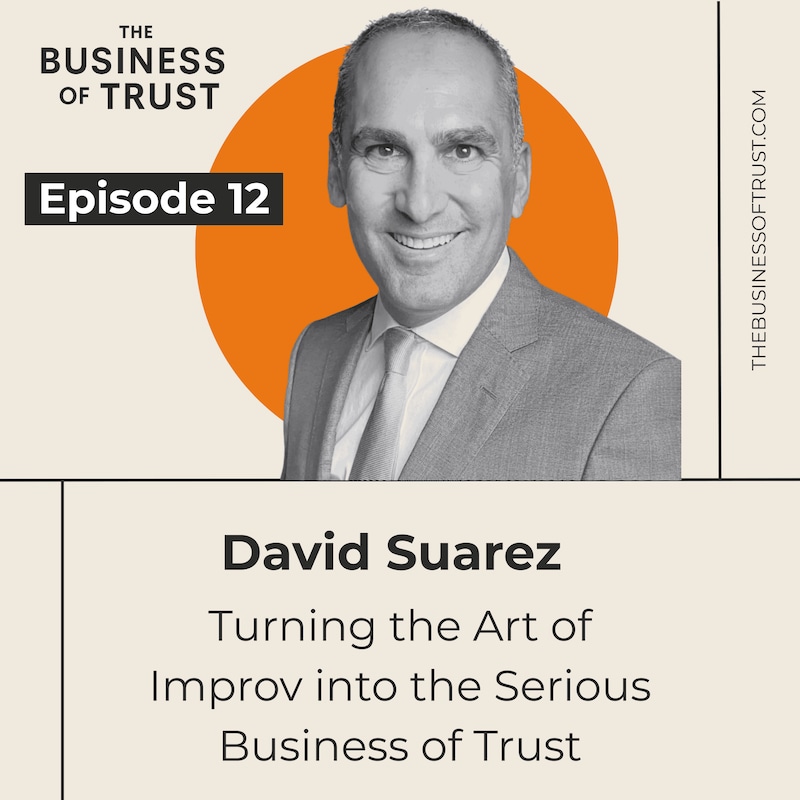
Shownotes
Watch Video Version:
https://www.youtube.com/watch?v=EIUFzYS3dB8
Show Notes
In today’s episode, I sit down with David Suarez, founder of Interactive Training Solutions… this conversation is a masterclass on what real networking actually looks like.
I met David at a DisruptHR event here in Miami. He was the MC, the organizer, and the final speaker—and he completely owned the room. Funny, sharp, relaxed, and deeply human. After watching him, I knew I had to bring him on the podcast.
David has built a highly successful corporate training and executive coaching firm using improvisation as a core tool—but what really stood out to me wasn’t improv. It was his mindset around trust, relationships, and human connection.
What You’ll Learn:
- How a business plan that started as an MBA assignment became the business of his life
- How talking to one intern (while ignoring all the “important people”) led to his most successful client
- What it really means to treat your network as sacred
- How to build trust without pitching, forcing, or “working the room”
Connect with David:
- Website:interactivetrainingsolutions.com
- LinkedIn:David Suarez, MBA
Transcripts
an event called Disrupt HR here in Miami. There were many amazing presentations, but it was the MC who really caught my eye. He was hilarious. He made us all laugh in our chairs and lay back and relax. His energy and his communication skills were so on point that I was having so much fun.
and actually waiting for his intervention in between presentations. It turns out that he was also the organizer of the event and the last presentation of the night. He was brilliant. So went to him and I knew I had to have him in the podcast. He said, yes, the guest today is David Suarez. David is the founder and lead facilitator for interactive training solutions. They do corporate training, team building and executive coaching, but
that has been going on since:to follow his passion. Also, have a conversation with his daughter who was six years old at the time turns out to be the turning point for him to decide to go full in with this new business venture. We talk about how he gets clients, how to network effectively, and the power of relationships. So I welcome you to my conversation with David Suarez.
Hugo Sanchez (:Hello David, welcome to the Business of Trust Podcast.
David Suarez, MBA (:Hi Hugo, thank you so much for having me here. I'm really excited about our time together.
Hugo Sanchez (:I'm super excited about it too, especially because of what you do. You have combined like what seems to be your passion and improv with a vocation in executive coaching and leadership development. And I'm super curious about how did you end up in this line of business? Did you think when you were like trying improv that this was going to become a vocation? How did that happen?
David Suarez, MBA (:Yeah, it really found me and it all happened almost by accident. a long time ago, back in the early 2000s, I was an owner and running an improv theater in addition to working in film and television. And little by little, there would be these calls or emails that would come in to the improv theater and they would ask, hey, do you do team building? And we would...
try to entertain these requests and little by little we started doing them. And over time, people kept saying, David, you're the one who's getting an MBA. You're the one who has some business background. You can probably do a better job with this than the rest of us, at least take the lead on it. And that's exactly what I did. And then little by little, what ended up happening was,
the requests started to become more about the business skills than the improv pieces. And with that, that's when in my MBA program, I just happened to take a class that was being offered for the first time. And I went to Florida International University. it's a, I'm proud of that and was in their MBA program and they had a business class development.
⁓ business, excuse me, business plan development class. And that was my turning point because we were charged with doing one of two things, either take an existing businesses, business plan and revamp it, recraft it, redefine it based off of where that business was in its lifespan or to build a business plan on a brand new business, a business you wanted to start yourself. And I wasn't thinking about starting a business and I wasn't really in
interested in recrafting somebody else's business, it felt like, all right, that's just an assignment. So I started to gravitate back towards, well, I'll just do this for fun. And the for fun piece became Interactive Training Solutions, which is my company and the company that I've been a part of now for the last 18 years. I built that business plan within that.
program and utilize my skills from improv comedy, which I adore and love and very, very much passionate about. And then also from my time as a
⁓ film producer and TV producer and taking those pieces where I worked with on-air talent and how to craft all of that. So as I was kind of cooking up that soup, I realized, all right, advanced communication and listening skills, check. I've got that from improv.
getting people to be their best selves in front of other people, check I've got that from film and television. And now I've got this business acumen that's coming from not only my time in the MBA program, but I was also working in management at the time. And that allowed me to bring three unique skill sets together. So having the ability to really understand leadership and management.
the ability to deal with people and how to get them to be their best selves in front of other people. And then finally how to take that advanced communication that we do in improv comedy and put all of that together. And that's exactly what in interactive training solutions became. And I'm really proud of that business plan because at the end, and this was well before the show ever came out, we had a shark tank style competition where we had angel investors, VCs, professors, and
the business professionals from across the landscape here in South Florida come in and judge the business plans and we had to pitch them. And after I pitched mine, I ended up being one of the finalists and I was told afterwards when the winners were announced, you need to start this business. You need to do this. And I did something that a lot of people do, which was nothing. I didn't do it.
I was too scared to do it. I had a cushy management job that allowed me to get through my MBA program, which was exactly why I was working in that position was so I could be able to go to night school and get it done back then. You couldn't do it online. You had to actually show up and go to the school. So I needed that flexibility, but it became comfortability. And
It took a conversation with my then six-year-old daughter who's now much older. She's 25. But back then we had this conversation and the conversation was the typical conversation that parents have with their kids, which is what do you want to do when you grow up? What do you dream about? What are you passionate about? And we talked about these things. And during that conversation, I realized, wait a minute, I'm not doing the thing that I'm passionate about. I need to change that.
And that's exactly when interactive training solutions went from being a plan to being a reality. And that was 18 years ago. And we've been here weathering a financial crisis and a pandemic, and we've come out of both stronger than ever. So I couldn't be more proud.
Hugo Sanchez (:That's a fascinating story because I interview many people in the podcast who have created successful firms and a lot of them had an idea, a sense of what they wanted to do and then went and tap into relationships. Some of them like just, it just happened, but you had a business plan and that's like very, like, mean, based on the people that I've talked to, it's kind of unusual to my surprise, but what were elements of having a business plan that you felt that ⁓ were
David Suarez, MBA (:Mm-hmm.
Hugo Sanchez (:you know, 18 years ⁓ later that you feel like really ⁓ moved the needle for you.
David Suarez, MBA (:Mm.
Yeah. And this is interesting. And I've, I've talked a lot about this with, I do a lot of pro bono work, ⁓ where I I'll go into classrooms and talk to students specifically in business programs. One of the things I often talk with them about is this story. How did you get started? I tell them the story I just told you, and then people will
naturally assume that that's just the way that it works. And there are some really interesting things. One of the things I tell people all the time is that your business plan is going to help you have definition and shape of that great idea that you think can work. And then it will actually challenge you to really have to develop it in a way where you have to deal with all of the pragmatic pieces that will come into play when reality actually happens. Now, while that is said,
The interesting thing about a business plan is whatever you write up from day zero will look completely different by day 365. So within one year, whatever you think your business is going to be, it's not going to be that. And you have to be flexible and willing to adapt. And I think that's one of the hardest things that we do. So when I then talk to...
people who say, David, I love what you've done with Interactive. It's a really great firm. How can I do something like that too? The first thing I tell them is to write a business plan. So many people get into this line of work where they don't have a plan, but they have a really great idea, where they have a really strong passion. But without a plan, what ends up happening is you'll be aimless for a long time. You'll waste a lot of time. You'll make a lot of mistakes, things that could be learning experiences, but they
really aren't because you're navigating blind. So what ends up onboarding are things that you don't necessarily need and in some cases things that you can avoid. But that business plan gives you this idea that is a lot more fleshed out into something that.
you know will change over time, but you can reference it and say, okay, this is what I wanted the business to be. Here's what's working, what's not working. Now these are teachable moments. How do we adapt and evolve to make the business viable? Which is exactly what we had to do with interactive training solutions.
Hugo Sanchez (:Brilliant. And David, because this is called the business of trust, I always talk about trust in different layers. is like the general, I see like as a general trust we have in life, in like the goodness of life. And there is the trust that we have in our skills and the trust, interpersonal trust, the trust that we have with people. You at this point, we're kind of like set in a comfortable career. You had a six year old daughter, I'm assuming at, you know, like a larger family, like a partner or so, but
David Suarez, MBA (:Mm-hmm.
Mm-hmm.
Mm-hmm.
Hugo Sanchez (:It requires a lot of trust to let go of something to pursue your passion, especially when you have mouth to feet. was there ⁓ a moment of conflict for you, a negotiation where you had to say like, I, okay, I have to do this and I trust, I'm putting trust in my skills on myself and I trust life and pray, pray and look at the business plan. But like, was there, how do you dwell with that conflict?
David Suarez, MBA (:That's a great question. And I think any entrepreneur, any person who believes in themselves at some point, they will be tested. And in my case, it's been multiple times. So as I mentioned before, we started interactive training solutions back in 2007.
ould start a business. And in:nil next to nothing. So how do you evolve? How do you do this? And part of our story was being able to have the trust within ourselves to figure it out. That's number one. Number two was, and this is an important one for, it was important for us. It will be important for hopefully those listening that when you embark on this,
you have to be able to weather the storm. You have to be able to figure it out. Now for some people that might mean, all right, maybe I do have to take on a day job in order to bridge over a rough patch financially, or maybe I need to bring on a partner who has additional skill sets to be able to allow us to have an opportunity to flourish and grow. In our case, luckily,
that none of those things really had to happen. So what was wonderful about that was this, is that I was able to get through the financial crisis by shifting and creating open to the public. So...
We knew that we could not go and do what we originally planned, which was reach out to major organizations, companies, corporations based here in South Florida where we're based and go after them the way that we started to in the very beginning and more successful at once this financial crisis hit, we needed to figure out how do we go directly to the consumer? We went from B to B to B to C and, and these are really old terms now, but nobody uses them that much anymore.
C model looked like this. had open enrollment workshops where we had to directly market to people and that bridged us that got us through that time not easily. And it definitely took savings to stay alive personally financially, but it got us to that other side. And why that was important was, is because that adaptation built a ton of content, which then turned into public speaking opportunities on the other end.
And we also had
a brand new set of workshops that could be easily recrafted to go from a direct to consumer model to back to a business model where it could go business to business. And that when we got out of the financial crisis gave us so many opportunities, things like, for example, being able to go back to trusted clients that now did survive the financial crisis and say, we have all of these new offerings for you. We can work with you on X, Y, and Z. So for example,
advanced relationship sales skills or networking skills or public speaking skills or internal networking skills. How to get your people onboarded but also connected with people within the organization so that way they are not a wallflower but they're actually a social butterfly within the organization and can leverage those relationships to be more effective for what they do within your organization. So all of this was now at our fingertips and it allowed us to flourish and
Hugo Sanchez (:Mm-hmm.
David Suarez, MBA (:row.
Hugo Sanchez (:Hey there, I'm your host Hugo Sanchez, founder of MoonDesk Media, the sponsor of this podcast. I created this podcast because I wanted to put into evidence what really works when it comes to growing a successful professional service firm. It is not cheap tactics that you get advertised on social media. It is the hard work of relationships, referrals, and reputation. If you're curious to see how my agency can help you take your business to a whole new level, don't hesitate to go to
mundesmedia.com and check out our work. I look forward to hearing from you. Let's go back to our conversation.
Hugo Sanchez (:And David, was there a moment during this financial crisis where you like said, that's it. I need to close this and like go find something else to do. This didn't work. And you had to say, no, I'm going to stick route. I'm going to stick some course and, continue and trust the business plan adapt and go like, did you have like that, like say dark night of the soul.
David Suarez, MBA (:Yeah.
And this goes back to something I'll answer that and bring us back to that business plan piece ⁓ from before. The business plan was out the window. The original one was gone. And all the beauty of that initial idea is really when you write a business plan for your initial concept, you don't know what the reality actually is. So that's why it's going to change.
well within those first 365 days that you've got in front of you when you actually start the business. And there's so much to it. But going back to the question that you just asked, never thought of throwing in the towel. And the reason why is because one, I did two things that really held me accountable. One, the first one was making a declaration to those that I cared about and loved as well as
my entire network and universe, which was I'm starting this thing. And this is my passion. I'm all in on this. And by doing that, there's an accountability factor that if you give up on it, that's a reflection of your character and who you are. So I would go down with that ship, but I would not give up on that ship. And that's a key piece.
And being all in like that, you know, and I talk about something that doesn't hold up over time, but I'll bring it up here, which is the conquistador Cortez. And the famous story is he told his men as they were trying to go and invade Mexico and plunder all of its golden resources, ⁓ that they needed to burn their ships. And the men burned the ships and they said, why did we need to burn the ships? And Cortez told them, now I know that you'll fight to the death. And that's exactly.
Hugo Sanchez (:Mm.
David Suarez, MBA (:the way that I looked at interactive. I will fight to the death for this business. So having that accountability piece helped me out. The second piece in that was really about a core belief. If you know that your skill set, who you are as a person, if you are in a business like I am, where your personal identity is attached to your professional identity, that's really hard to give up on.
If you believe in yourself, if you believe that who you are has a connection with what you do for a living, it's really hard to give up on that.
and not lose in the process, lose something, whether it's your soul or whether it's your passion or whether it's just your overall impetus. And I've seen people who've gone through this and they come out the other side and you see what it takes out of them. I didn't want that for myself. So for me, it was really about, all right, I'm all in. I'm not only all in because I said I was all in, but I'm all in because I believe in everything that I'm doing.
And that was that that was the big piece for me. I know that this sounds like a vanity thing and I don't like that, but I'll reposition this in one other way that for the listeners out there, I hope resonates with them. If what you are doing benefits or helps people or provides value to people, then you need to stick with it.
Hugo Sanchez (:Wonderful.
David Suarez, MBA (:If it's about you, if it's about a paycheck, if it's about just having a flexibility and freedom in your lifestyle, this isn't for you. You've got to truly believe in the fact that what you do benefits somebody else. And if that happens, the benevolency of that is going to be an easy fuel to keep you going forward. And I'll leave it there. could go on and on about that.
Hugo Sanchez (:beautifully said, it's about becoming a go-giver, like the impact that you create in other people. It's what really creates success. So David, your daughter inspires you to follow your dream and you're like, okay, let's go. Did you quit your corporate job or did you close the improv theater and went full in into this? How do you go about, okay, here's a business plan. I'm gonna take action. How do you go? Can you tell us?
what happened in those first few, I don't know, weeks or months between making the decision and getting your first account.
David Suarez, MBA (:Yeah, absolutely. So first things first, yes, I did leave the management career. That was coming to an end one way the other. I had zero passion for that. And not only that, it was a means to an end. It was just to get the MBA. And once that was achieved, I stuck around well past my expiration date and...
for both sides, I think we were both in that space of like, I wanted to go, they were like, we've got somebody who's pretty much ready to go. you know, it was not difficult for me to leave. And that's, you know, unfortunate, but at the same time, that's the way life works. The second thing was that you mentioned was about the improv theater. And this is something I'm extremely proud of.
r with eight other friends in:I had the good fortune of being able to sell the business. And so to answer that part of the question, no, I did not leave. As a matter of fact, I was working days at Interactive, nights at the Improv Theater, and they both were symbiotic in that my blade was always sharp because I was teaching and performing at night.
And then during the day, I was facilitating coaching and leading an organization that was specific to working on specific skill sets. And one thing I do want to really highlight as well, would be really easy to say that what interactive training solutions does is all improv meets business. But the reality of it is, that about 80%, if not more of what we do really goes well beyond improv comedy. The improv comedy is.
a tool that we use and informs and provides a backbone for communication, which we employ in everything that we do. But it's not a, we're a bunch of improvisers coming in to just do improv for you. We actually don't do that at all. What we do is we used techniques from improv comedy and a lot of those great.
on air as I mentioned before pieces from my production career along with some other key pieces from the world of business and put all of that together to make a very special and unique service offering.
Hugo Sanchez (:Beautiful. So when you ⁓ decide to go on with this, like how did you go about landing your first account?
David Suarez, MBA (:Yeah, first to count. So back in the day, organic search was a lot more accessible towards just about anybody. If you wanted to rank highly on a search engine, you just needed to read up on the internet how to do it.
and basically get out there, get your metadata right, make sure you have your keywords, make sure all of your content had all of that key data points that you needed in there to be able to be searched and get that organic search. And we were very successful at that. So we were very lucky in the beginning in that we could get into the game for free and be top listed in a number of key areas. Team building.
corporate training, executive coaching, we owned those three for our market. Can't do that these days at all unless you pay big bucks for that and we're no longer top listed for that. But we were lucky enough in the beginning to get that. So that was a big part of how we were able to get traction originally. But one of the things that we did is we built out a wish list of all the different headquarters that were based in South Florida and
We targeted them and targeted how to get access to the people organically. And that's a big one, not cold calling them, but organically have the ability to be in the room with them and have those conversations. So networking became our best friend. And I tell a story all the time about this. Had a night of networking, an unbelievable night of networking where I went out to an event in downtown Miami.
on one side of the city, I have two networking events. I go to the first one. It's amazing. It's at four o'clock late in the afternoon. Just, I mean, meeting so many people handing out cards like I'm a Vegas dealer.
in a casino. Get to the second event. Same thing happens. This one's at around five. So I literally walk a couple blocks over, go to the second event. I'm meeting all of these great people. Everything's wonderful. Blah, blah, blah, blah, blah, blah, blah. I am just repeating this cycle. Probably have given out at this point 75 business cards feeling like, wow, I am so accomplished. I had a third event and I never would have gone to it if I didn't already pay for it.
Hugo Sanchez (:There.
David Suarez, MBA (:and it was sold out and I figured, all right, I should go. So all the way across town.
in an area called Doral, there was the third event. Now, if you know anything about Miami, Florida, driving anywhere from downtown out west, much less Doral, that is the worst traffic you will find anywhere in the United States and most places on the planet. So there I was stuck in traffic, getting my way out there, of course, getting there late. But I felt so accomplished from the two earlier networking events that, all right, great, I'm winning the game. I've already won the game. Let me just go and do this.
I get to this event in Doral
I walk in, I am the last person to arrive. The room is completely sold out. There is one chair left open. It is in the table in the very back of the room. There is a speaker speaking that they brought in to speak to the entire group and all of these people that were there were HR leaders. So I sit at this table. I start to get caught up on my meal. I say hello to everybody. I am sitting at a tent top, meaning that there are nine other people at this table.
As I sit with them, I realize that the person to my left and so on and so on is either a director, vice president, or some sort of chief, either people officer, human resources officer, somebody big in their organization for human resources. I go all the way around. Eight people go by. Person number nine, the person to my right, introduces herself.
as an intern. Like, okay, great, met everybody. Go back to eating, because I, you know, want to catch up. I see the waitstaffs trying to clear my plate. They've already cleared everybody else's. And I realized something during that time.
These eight other people are all chatting with each other and being chummy, but nobody's talking to the intern. And I thought, David, you know what? You've already done so well tonight with networking. Go ahead and do some charity, talk to this person. And that's what I did for the rest of the night. So the speaker finishes. We get to networking time. I just literally sit there and ask a million questions to the person on my right. For the sake of protecting the innocent, I will change names here.
and next to me is named Jane and Jane has spiky hair, a very distinguishing feature. We get to talking and as I talk with Jane, I find out that Jane's really into HR, is an intern, is going to get her master's, wants to get a PhD in organizational psychology, which is basically the mountain top for HR and has a passion for this profession. In addition to that, we talked about the spiky hair, which she brought up, which I thought was great. ⁓
and then talked about like things that she loved to do on the weekends, DJing, all sorts of different things. And we got into that. By this point, the night is pretty much almost over. People are clearing out of the room. You can tell that the wait staff now wants everybody to leave. It's kind of like last call, get out of here. And that's when Jane says something to me. Jane says, David, you know everything about me. I know nothing about you. Tell me something about you. I said, don't worry about it. It's all right. I just wanted to get to know you.
and she insisted. So I told her, okay, my name is David Suarez. I'm with Interactive Training Solutions. I'm a facilitator and coach and everything we do is based on improv comedy. And that's our fun elevator pitch.
And she's like, wow, that's really interesting. Tell me more about that. So I did. Then she asked, do you have any open to the public workshops? And remember I was talking about that. We had started developing that before the whole financial crisis. It was a very small part of our business, soon to become a very large part of our business. But she asked about that. And I told her about it. She said, do you have anything coming up? I said, yeah, we have one coming up in two weeks. It's an all day workshop. And she said, I'm going to come to that workshop.
Hugo Sanchez (:Mm-hmm
David Suarez, MBA (:And if you know anything about Miami, people say things like that all the time and then nothing ever happens. And that's exactly what I thought. Well, two weeks later in walks Jane, not alone. Jane comes with her boss, her supervisor, both of them take the all day workshop at the end. Jane comes up to me. She's like, my supervisor loves this.
And her supervisor then walks up and says, I want you to come and do one of these for our people back at our company. And I'm thinking again, this is the Miami, you know, David that, lives within. This is never going to happen. A month later, there I am doing this, this workshop for 30 people at this organization. And we finished that workshop. And that's when Jane's boss comes up to me and says,
You know, my supervisor was actually taking this workshop and didn't say anything in regards to who they were. They loved it. We want you and your team to come in here and now work with our entire staff. And that just blew my mind. I could not believe it. And Hugo, here's the interesting thing. All of that happened from talking to an intern, just one person.
And that one person happened to work for the company that was number one on our wishlist. Never would have happened. Those 75 other cards, never heard from any of those people again. That huge account came from talking to one person, an intern, not talking to any of those other big wigs at that table. And that turned out to be what pretty much put us on the map. So.
Hugo Sanchez (:Wow.
David Suarez, MBA (:I can't express enough how important it is to have honest conversations with people. This is actually what we teach in our networking sessions that we do, whether it's training or coaching, or even some of our online work that we've or even some of the public speaking pieces that we've done on the subject. We talk about that story and how important it is to have legitimate, honest, genuine conversations with people, because that's truly what will build trust, which is what we're talking about today, which brings us business.
Hugo Sanchez (:Wonderful. It's like never, never dismiss a person because of their position and because they don't have access to resources at that moment. You know, at one point in their career, they will have access to resources or to someone who has resources. But the beautiful part about this is that you like let go of the agendas and just connect it with this person right next to you on a very human level, which is a beautiful story.
David Suarez, MBA (:Yeah.
Yeah, and it's a testament to the fact that you really can't pre-qualify anyone. You really need to dig deep and get to learn about people. And sometimes it's really interesting. We'll go to conventions and we do a specific piece on networking at conventions and conferences. And when we're at these conferences or conventions,
One of the things that we talk about is you're going to meet people that you think can do absolutely nothing for you. Whether it's because of their position or because you may view them as a competitor or you may see them as redundant or they may be in a profession that you feel does not serve you and do not discount the quality of having
an incredible network. And you can only build that by having genuine, honest conversations that turn into genuine, honest relationships. Why? Because if we are in service of helping each other and paying it forward, which happens when we have real relationships, we care about the people that we know, and we want to see them succeed. And if that's the case, then they'll want to do that for us as well.
If we know enough about each other, we're gonna look out for each other. And I cannot tell you how many times one of those great conversations that you would assume would go nowhere will take you to some of the most wildest and most wonderful places. So do not discount the value of a great conversation.
Hugo Sanchez (:Thank you, David. Thank you. That's excellent advice. And I was going through your company's website and I went to the client profile and I was scrolling for like a solid minute through all the list of clients that you guys have. It's very impressive ⁓ because it seems like you're very, a very relational person. ⁓ What have you learned about business development through relationships in this, you know, the last 18 years doing business?
interactive.
David Suarez, MBA (:Yeah, relationships are everything. I cannot express this enough. even in our digital age that we have now, and let's talk about the pandemic where we learned how to basically disconnect.
figure out a new way of doing things. A lot of that happened within a box like we are talking right now and stopped happening in person. And now we're getting back to being in person more and more. But we still rely on this wonderful technology here. This is great for me. I came from this world in film and television. I understand the power of 16 by nine or four by three, depending on, you know, the technology of the day. But this is not what it's...
about ⁓ what it's about is really being able to connect with people on a deep level. Those relationships are everything. I stress to people whether they are just starting out in their career or if they think they know everything and especially this unique generation that has been brought up on technology. So I've done this with both of my kids. I have two daughters and with both of them, I have been very much ⁓ a champion of
connect with people on a human level, and then you expand your network. It's one thing to know of people, it's another thing to actually have a relationship with them. And like I mentioned before, that relationship is your network and your network needs to be held sacred. And I hold mine sacred. So for example, I do not spam people. I do not inundate them with my thoughts or ideas on subjects. I do not go to my network and try to solicit them.
My network is sacred when I reach out to you. It's because I truly care about you want to find out how you're doing what's going on with you. So I cannot express enough to really value and treasure your network. And if you do that in a genuine way, then it will come back to you tenfold. If you treat your network is just this channel to be able to advertise or market yourself. You're going to get what you deserve, which is
a network that turns off on you. We get enough of that already. All of the messaging that we get. If you think you're unique with whatever it is that you're marketing or advertising to your network, you're not. A million other people are doing this. And so how do you differentiate? You differentiate by actually valuing your network and taking the time to foster and then cultivate those relationships and make sure that you're doing all the right things.
to maintain those relationships, reconnecting with people. I cannot tell you how valuable that is. I do that as many times as I can. And I'll give you one of my, two of my tips. Work anniversaries, birthdays on LinkedIn. They're your best friends, use them. It's a great opportunity to say, happy birthday, how you doing? Or congratulations on 10 years at whatever you've been doing or wherever you've been doing it at.
And it's a great opportunity just to say hello at the very least, or just to congratulate or celebrate somebody. And then sometimes those conversations turn into, what are you up to now? Tell me a little bit more about how life has been going. And that's what keeps us human.
Hugo Sanchez (:Beautiful. David, I mean, as I hear you, it's just clear to me how your success was inevitable because you had not just a business plan, you had to adapt, you ⁓ had a very deeply ⁓ relational mindset. You really care about the people that you were working with and you had a very sexy branding. Now, my last question for you, because you've been so generous already, is what's in store?
for you now that things are changing. Like it seems like the ground is shaping among us and people are talking about another bubble with the AI. I mean, AI is commodity sizing knowledge, which is more accessible than ever. ⁓ And a lot of people in the coaching industry might feel displaced or they could be displaced, not just coaching, but in any part of like the knowledge industry. ⁓ What do you see emerging for you as an entrepreneur and interactive?
David Suarez, MBA (:Mm-hmm.
Yeah, absolutely. So for interactive, a big part of what we do is so based off of actually not a big part, everything that we do, even when we do it in a virtual environment is so based on the human connection. So I'm not going to say that we're AI proof. I don't think anything necessarily is. I'm sure that there will be some pieces that will be affected in regards to our entire industry of coaching, training and facilitation where
AI can come in and do some of those pieces. But one thing that has been at the core of everything that we've done from day zero is we're going to provide an experience that does three things. Number one, addresses applied learning.
that's learning by doing any concept or skill that we are going to introduce, you are going to be doing while you are with us. So you actually get to practice what we are teaching. That's huge for us in regards to having that tactile experience with the people that we serve. The other thing is that everything that we do is going to be incredibly applied where, you know, we're going to get people up and on their feet. We're going to give them an experience that allows them to actually do.
When you do that, that is a lot more AI proof. AI is not going to get you to do that. And AI is not going to be able to, until the robots come, I guess, is not going to be able to have the kind of feedback that humans desire in order to improve in their learning. Second piece is experiential learning. And this one is AI proof. Experiential learning means learning through sharing, sharing of ideas, sharing of knowledge, sharing of experiences, sharing of thoughts.
Hugo Sanchez (:Mm-hmm.
David Suarez, MBA (:creativity, whatever you want to put out there as a human being, we're sharing it with other human beings. And while human beings are in the workplace and still matter in the workplace, experiential learning is a huge tool to be leveraged in order to provide a vehicle for onboarding new skills or new ways of doing things or processes or just a paradigm shift, getting people to think differently.
And to do that when you have experiential learning and applied learning, that's really strong. Now, what we do to take it up another level is improv comedy. And remember, as I mentioned before, we're not the people that come in and, you know, we're here to do all of the improv comedy for you. We use pieces from improv comedy to teach you how to be a better leader, be a better supervisor, be a better employee, better organization.
better team or department. We're going to do all of those things with that focus. Now, improv comedy comes into play because we can teach you about advanced active listening skills. We can give you further tools to apply things because we know how to use improv and things like role play or improv and pieces like how to teach you specific skill sets and the way that you message what you message. And then finally, we know how to make it fun.
Improvisers by nature, especially if you're comfortable in your own skin, what I mean by that is you're confident enough to walk into a room, and this is something that we learned very early on. It's one thing to be a great improviser, but are you a great improviser that knows the language of business and can confidently operate in that environment?
And facilitators who are great improvisers only can only do improv, but great improvisers that can do great improv and know business and speak business at a high level can now do something really special. They can make something enriching, rich, knowledgeable, and
life-changing, but also make it fun in the process. So when you take that applied piece of learning by doing, the experiential piece of learning through sharing, and then the improv comedy piece, rich in communications, but high on fun, and put all of that together, people start to learn in a much more human way, which is, I'm gonna have fun, that's like, I've got some good medicine here, but I've got to make it taste good. And then,
Hugo Sanchez (:Yeah.
David Suarez, MBA (:active listening, I'm sorry, applied learning, which is that piece of, right, we're going to learn by doing, wait a minute, I'm having fun and I'm doing stuff. And then we, we add in the experiential learning and I'm sharing things with the people that I know. And I'm learning even more because I'm bringing in all of the experience of the organization and our institutional knowledge along with these are the people that I work with every day. And I'm now hearing from them.
Hugo Sanchez (:soon.
David Suarez, MBA (:and we're all working on this concept, skill or path together. That's our secret sauce. That's what we do. So what I'm excited about for the future is the fact to give you a very long winded roundabout answer here is that things are going to be much more valued for having the thing that we took for granted for so long, which is a human experience.
We took it for granted before the pandemic. After the pandemic, we realized, wait a minute, that's the thing that we lost when we were all locked inside and couldn't go anywhere and we could only exist on these screens. We wanted this human experience again. And now with AI, it's nipping at the heels. And we're saying, wait a minute, our existence because of this tool, which could be an existential threat, is how to have this human experience. And that's where we are.
are perched in terms of where we're at. One other thing I will share about the pandemic that was really interesting that we're seeing as not just a trend, as really something we always knew was there, but now everybody else is figuring it out. And then when I say everybody else, mean, the people that we serve, our clients is this, is that pre-pandemic people looked at coaching in a different way. was almost as if coaching was either punitive or it was something that had a level of shame or stigma attached to it. Something was wrong with you.
if you were getting coaching from a coach. And then during the pandemic, people had a lot of time on their hands. They needed to either upskill or they needed to transition into a new area, whether it was a new industry or a new role or whatever that might be. so coaching was now something that you actively sought out. And we come out of the pandemic now and people look at coaching like, wow, you're getting coaching? I want that too.
Hugo Sanchez (:Hmm.
David Suarez, MBA (:I want to improve in who I am as a professional. And so what we've seen is that coaching, in addition to having a very human interactive experience, those two pieces are what's going to be, at least for interactive training solutions, are driving pieces we move forward.
Hugo Sanchez (:Beautifully said. David, thank you so much for the generosity of advice that you shared today. I am so honored that you spent time with us. For people who want to learn more about you and connect with you and the work you do, where would you like to send them?
David Suarez, MBA (:Yeah, great question. The easiest place is to our website at interactive training solutions.com. You can also find us on LinkedIn at interactive training solutions. If you want to connect with me on a professional level, you can find me at David Suarez MBA. ⁓
on LinkedIn and also on Instagram. Both handles are the same. ⁓ David Suarez, MBA at Instagram as well. I'm happy to answer any questions you might have. If you want to reach out, I'm always up for a great conversation. And then like you mentioned, Hugo, our website is there with everything that we do and also our incredible client list, all the wonderful people we have had the privilege to serve.
Hugo Sanchez (:Thank you, David. Have a great day and thank you for your time.
David Suarez, MBA (:Thank you, Hugo. Thanks for having me on.
Hugo Sanchez (:Well, that's all for today. I hope that you enjoyed my conversation with David Suarez and that you got a lot of actionable insights from it. Make sure to rate us and subscribing whatever platform you're listening from. If you go to thebusinessoftrust.com, you will be able to subscribe and receive new episodes into your inbox every Friday. Also, if you're curious to see how my firm, mundesmedia.com can help you grow your business, go to mundesmedia.com.
I'm your host, Hugo Sanchez, and I'll see you in our next episode. Bye for now.



