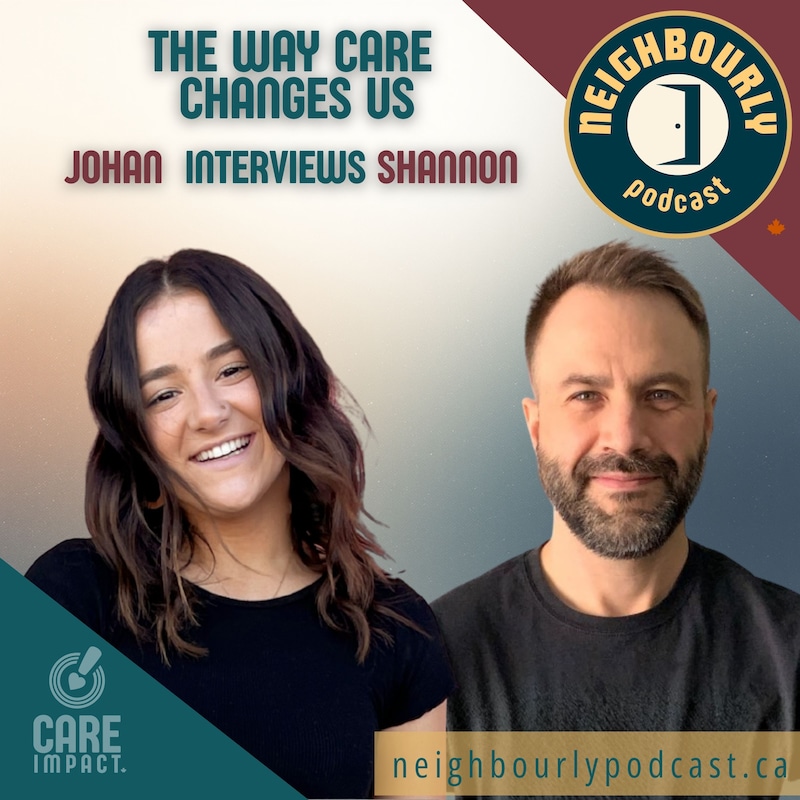
Shownotes
Partner with work of CareImpact and Neighbourly!
Description
How do you respond when your offer of care goes unreturned, and you’re left waiting with more questions than answers?
This story invites us to consider what’s happening beneath the surface—both in ourselves and in those we hope to help. Through honest moments and unexpected pauses, a simple act of care reveals how seeing one another can change us, even when things don’t go as planned.
Time Stamps
05:48 Made for connection and community
08:56 Dropping off car seat and stroller
11:26 Learning compassion through perspective
15:31 Connecting a dad with neighbours
17:54 Building cross-sector partnerships
22:35 Building relationships through consistent care
24:33 Helping a mom in need
28:21 Encouraging churches to care locally
Other Links
Join The CareImpact Podcast Group on Facebook: https://www.facebook.com/share/g/1PgzJWfkq9/
Reach out to us! https://neighbourlypodcast.ca
Email: podcast@careimpact.ca
About the CarePortal: careimpact.ca/careportal
DONATE! Help connect and equip more churches across Canada to effectively journey well in community with the most vulnerable: careimpact.ca/donate
Transcripts
And after a few minutes, she still didn't come back. I was confused.
Speaker:And if I'm really being honest, I think I was a little frustrated. You know,
Speaker:you schedule a time to meet with somebody, whatever the occasion is. But
Speaker:in that moment, kind of had a nudge, like, what's going on in her
Speaker:world? She's really pregnant. Maybe what
Speaker:she went to get for food was the only thing that she'd be able to
Speaker:tolerate that day. And, like, that's what she needed maybe.
Speaker:There's so much that people are carrying and people are walking through
Speaker:that we don't see.
Speaker:Not every act of care feels natural. Sometimes it's
Speaker:uncomfortable, sometimes it's inconvenient, and
Speaker:sometimes it doesn't go the way you expected at all. I'm
Speaker:Johan, producer of Neighbourly. Today, the roles are
Speaker:flipped. Shannon, who usually sits across the table
Speaker:listening to others asking the questions, steps into the
Speaker:story herself. And what she shares isn't just about
Speaker:meeting needs. It's what happens inside us when we begin
Speaker:to truly see people. Because care isn't just about
Speaker:delivering something. It's about learning to notice,
Speaker:to listen, to stay curious instead of jumping to
Speaker:conclusions. And along the way, Shannon invites us into
Speaker:real moments, real stories, stories that reveal
Speaker:how easy it is to lead with expectation and how powerful it is when
Speaker:we choose compassion. Instead, this conversation might
Speaker:just change the way you see people right in front of you. So let's
Speaker:join Shannon at the table. Shannon,
Speaker:welcome here. I'm looking forward to this conversation because,
Speaker:well, usually you're starting this conversation and I'm kind of behind the scenes making you
Speaker:sound good, but here I am. I get to ask you some questions. So
Speaker:how you doing? I'm good. I'm a little
Speaker:more nervous for this conversation, I guess, because usually I just get
Speaker:to hear other people share. But I'm excited.
Speaker:I'm looking forward to this one. I mean, for listeners who don't
Speaker:know, you're the regional manager for a CarePortal. So we talk a lot
Speaker:about CarePortal on this podcast and we share some of these
Speaker:stories, and this is an opportunity for you to share some of the
Speaker:stories because, well, you're always asking the questions, but
Speaker:you're kind of seeing it from a broader perspective all over the
Speaker:place. So this is great that you can share some careportal stories
Speaker:and not just meeting the needs, but also seeing the transformation
Speaker:in people and seeing the people that get to fulfill these needs and
Speaker:the brightness that comes into their eyes when they get to do that,
Speaker:that's probably a gift that you get to see. Oh, it's my favorite
Speaker:thing when I tell people about my job or they ask like, what do you
Speaker:do? I get so excited every time I talk about it because it
Speaker:really is such a unique point of view. I get to
Speaker:see needs come in from agencies that we're working
Speaker:with and see them share about the family who needs
Speaker:X, Y or Z so that they can be supported and stable and successful.
Speaker:And then have this network of churches that I'm in
Speaker:conversations with and in relationship with and helping
Speaker:empower them to respond to those needs and
Speaker:addressing some of those barriers with them, some of the fears they have.
Speaker:Oh, it's so cool. It's so cool to be at this point of getting to
Speaker:see both perspectives and the requests coming
Speaker:in and then the stories afterward, which are
Speaker:the best part, getting just to hear these connections that happen.
Speaker:It's a gift. It's really a gift that I get to do this.
Speaker:Do you want to go into a little bit more what you do with CarePortal
Speaker:just to explain it for those once again, like you can never
Speaker:over communicate is one of those things that I've hear in the
Speaker:church world. What exactly is CarePortal and what's your role
Speaker:there? Yeah, so CarePortal, it's a connecting
Speaker:technology. It is not a ministry in and of itself. It's
Speaker:a tool that can be used. In a nutshell, it's a request
Speaker:and response loop. So a child serving, family serving
Speaker:agency, organization, nonprofit of some kind,
Speaker:that's working with families on the ground, they can
Speaker:submit real needs for a specific family into this
Speaker:system, into this portal. And it's app based, so you
Speaker:can go on your phone and you can see these needs that are
Speaker:getting entered. And it's based on geography. So when
Speaker:a request is submitted, there's a little pinpoint on a
Speaker:map of the general area of where that family lives.
Speaker:Not the specifics, of course, for privacy and safety, but then
Speaker:churches that are nearby to that family that I've connected with, that
Speaker:I've trained and shown them how to use the portal,
Speaker:they then have the opportunity to go and meet that family
Speaker:and not only do they get to provide maybe the tangible
Speaker:items that that family needs, but more importantly, it's about that
Speaker:relational connection that they get to have with somebody that
Speaker:is potentially right in their neighborhood, really hidden in
Speaker:plain sight. And now they know about that family, now they can
Speaker:go help meet a practical need, but also build
Speaker:a meaningful connection with that family. Now this is mostly an
Speaker:audio only podcast, but I don't know if this is going to be a clip
Speaker:or not, but you guys should see how Shannon's face lights up when she
Speaker:talks about this stuff. She's honestly very excited. So for those
Speaker:churches or leaders that are listening and don't have CarePortal, you
Speaker:really should get Shannon in front of you and see that face light up. So
Speaker:that being said, like, as you've gone through this process, as you've
Speaker:seen people fulfill needs, you've probably fulfilled some needs
Speaker:yourself and delivered stuff. What has changed in how you actually see
Speaker:people? Oh, everything.
Speaker:There's so much. I think what it really
Speaker:comes down to, and we've talked about this, I feel like on every
Speaker:episode this season, which just shows how important it is,
Speaker:is that people have a desire to be seen.
Speaker:And at the core, I think that really
Speaker:points to our creator, our heavenly Father, that we're
Speaker:made in the image of God. And so we're made for connection, we're
Speaker:made for relationship. That's how we're wired. And
Speaker:so when I see churches responding
Speaker:to these practical needs or when I've been able to do that myself,
Speaker:yes, that makes a difference. The practical needs matter because
Speaker:sometimes that means it's preventing
Speaker:separation from their family or just helping gain
Speaker:stability and that's impactful. But
Speaker:when a family, when a person feels seen
Speaker:and feels like there's somebody that's in their corner,
Speaker:that can really change everything. It's
Speaker:shown me how we're just people. Like, it's this human to
Speaker:human connection. That person might have a need, but
Speaker:I can think back in my own life where I had needs that might
Speaker:look similar or might look different. And yet at the end of the day, I
Speaker:was needing to feel seen and loved and cared for and like there were
Speaker:people in my corner. And so as I've gotten to experience
Speaker:that firsthand, what I'm trying to communicate,
Speaker:Johan, is that like how we're all just human
Speaker:and I don't know how to communicate that any other way but that we're
Speaker:not that different from each other. We're really not. And it's so easy in this
Speaker:world to get caught up in that. And you
Speaker:spend any time scrolling on social media and you're inundated with just like
Speaker:all this trauma and all this news and so, and
Speaker:so and, and da, da, da, da. And yet at the end of the day,
Speaker:when a mom needs a car seat for her baby and she gets that and
Speaker:she feels like, oh, there's this nearby church that's like here for
Speaker:me, oh, I think about when I'm gonna have a
Speaker:baby and I'm gonna need a car seat. And I know that I have family
Speaker:and people in my corner. It just changes the way
Speaker:you think. So when you're explaining that, like this
Speaker:podcast is all about stories, telling stories about good
Speaker:neighbors, there's probably a story behind you, even explaining that
Speaker:when you're trying to explain what Careportal means to you and how it's
Speaker:transformed you. Let's go there a little bit. Is there a story
Speaker:behind what you were saying there? Something specific?
Speaker:Yeah, there's one that really comes to mind. It was about a year
Speaker:ago or so, a request came through for a mom who was pregnant and
Speaker:pretty close to the end of her pregnancy. And so she was needing a
Speaker:stroller and a car seat pretty soon. This was actually a request
Speaker:that I got to bring my parents on. And they hadn't experienced
Speaker:CarePortal yet. They live somewhere else. And I got to kind of
Speaker:show them here's how it works. And so it was beautiful to get to
Speaker:experience that together. So I had connected
Speaker:with the mom over text, I think, and arranged
Speaker:a time to bring the car seat and the stroller.
Speaker:I'd given her about, I don't know, 15 minute heads up when we were on
Speaker:our way. And while we were on our way there, I think
Speaker:we'd almost gotten to her home. She calls me and
Speaker:says something along the lines of, you know, I had to step out for a
Speaker:minute, I needed to go get something to eat, but
Speaker:my niece will be able to let you in, I'm on my way back, that
Speaker:sort of thing. And I was like, okay, you know, all right, sounds
Speaker:good. So we got to her home and we were parked on the street,
Speaker:and I wanted to wait a few minutes. Cause I was really hoping that I'd
Speaker:be able to connect with her once she got there. So we waited a few
Speaker:minutes. She hadn't come back yet. And so I thought, okay,
Speaker:let's just go knock on the door and bring it in. So we do, and
Speaker:her niece answers the door and we bring in this big box because it was
Speaker:a stroller car seat combo. You know, we said, hey, do you. Do
Speaker:you guys need any help putting this together? There might have been another adult
Speaker:somewhere in the home, but didn't really know who that was. And
Speaker:they said, no, like, we've got it all good. And we're like, okay,
Speaker:sounds good. So we go back to the car. I thought, well,
Speaker:let's just wait a few more minutes just to have the opportunity to meet this
Speaker:mom. Because I really wanted to meet her and know that we see
Speaker:her and that we're here for her. And after a few minutes, she still
Speaker:didn't come back. And so eventually we decided, okay,
Speaker:let's go on with the day. To be honest, when I think back to how
Speaker:I felt in that moment, I was confused and.
Speaker:And if I'm really being honest, I think I was a little frustrated. I
Speaker:think those are some normal feelings to maybe experience.
Speaker:I think with anybody. You know, you schedule a time to meet with somebody, whatever
Speaker:the occasion is, and they don't come and you're like, oh.
Speaker:But I think especially as believers,
Speaker:we are called to go a little bit beyond the surface level.
Speaker:And in that moment kind of had a nudge,
Speaker:like, what's going on in her world? She's really pregnant.
Speaker:Maybe what she went to get for food was the only thing that she'd be
Speaker:able to tolerate that day. And like, that's what she needed. Maybe.
Speaker:Or, you know, maybe she was overwhelmed and needed to just step out
Speaker:of the house for a second. Maybe, or
Speaker:maybe she didn't know how to receive help yet and
Speaker:it was hard for her to process, like receiving this item. I don't know.
Speaker:And frankly, that doesn't really matter. It doesn't
Speaker:matter what the reason was, but it was a
Speaker:moment of acknowledging there's so much that
Speaker:people are carrying and people are walking through that we don't
Speaker:see. And moments like that,
Speaker:that moment specifically helped me to pause
Speaker:and really realize so much of life. I interpret through
Speaker:my own expectations and instead of compassion
Speaker:or my own expectations come first and compassion comes later.
Speaker:And I think if we can get to a point through
Speaker:experiences like this and really putting love into action,
Speaker:we start to kind of flip that and start with compassion
Speaker:and say, yeah, maybe it was an inconvenience to me that that person was
Speaker:late to something or, or, you know, I had to go out of my way
Speaker:to, to bring a mom a meal who had just had a baby or whatever
Speaker:the thing might be when we can step outside of ourselves
Speaker:and put ourselves into someone's shoes, I
Speaker:think that leads us to be a lot more like Christ.
Speaker:I find it interesting, like there's a lot of good ministries and good
Speaker:organizations doing good things by doing similar type deliveries,
Speaker:hampers, all this sort of thing. But the story you just told, it felt
Speaker:like it really wasn't about the physical item and getting it to them,
Speaker:but you were really wanting to get that, that connection piece to
Speaker:that mom. Like you really wanted to connect with her and that's where
Speaker:it bothered you a little bit. Right? It's like, I really want
Speaker:connection. So what makes CarePortal a little bit different there? I
Speaker:hear those types of stories all the time when we talk about
Speaker:CarePortal is people wanting to make that meaningful connection
Speaker:rather than just delivering the item. Yeah,
Speaker:that's really the core of this, is that connection with
Speaker:somebody. And there's so many amazing ways that churches are
Speaker:getting creative with engaging in their communities. It can be
Speaker:really beautiful to see, you know, different activities and
Speaker:different programs. And those are not inherently bad. But what
Speaker:can be a danger, I think at times is when we forget the point of
Speaker:what those activities and programs are trying to get us to in
Speaker:connecting with community. If we get too caught up in the details
Speaker:in the system, in the. The shopping list and the to dos to get ready
Speaker:for that event and then maybe forget, oh, what is this event? Even
Speaker:for in the first place? That's what I love so much about
Speaker:CarePortal, is it? It just brings it down to that one on one
Speaker:connection with a family right there. Okay, so you
Speaker:shared a personal story. What about when a church responded?
Speaker:Do you have any moments or stories where you saw a church or community
Speaker:show up? Yeah, there's a
Speaker:story that I often share when I'm meeting with churches for the first time because
Speaker:it. There's. There's so many stories, but this one really gets to the
Speaker:heart of what we're even trying to do here. A while
Speaker:back, there was a dad who was a single
Speaker:dad, and I believe he had been experiencing homelessness and was
Speaker:now in housing. And it was beautiful. And so he was working on
Speaker:reunification with his daughters. I think he had two. Two
Speaker:young girls. And the request came through that
Speaker:he needed some simple furniture. I think it was maybe a
Speaker:dresser, maybe a kitchen table and a microwave. Just some
Speaker:basic household things. And the request
Speaker:said that this would help him be able to start having visits with his daughters
Speaker:again if he could get these items in his home. So a church
Speaker:who was, I think, blocks from the family or a church
Speaker:responder who lived, you know, just a few blocks away from this dad
Speaker:responded, and pretty sure in partnership with some other
Speaker:churches, they were able to get those items. And they go and connect.
Speaker:Not only did they just bring the items, but they stayed and
Speaker:they chatted with the dad, and they ended up watching the jets game
Speaker:together and just sitting down and being together for a
Speaker:little while as. As neighbors. And later we
Speaker:heard that when his daughters did get to come visit, they
Speaker:ran into their room they were so excited to see their space all set
Speaker:up for them. And I think what I always am
Speaker:so just amazed by with this story is the
Speaker:proximity that there was a dad this close
Speaker:to someone from a local church. They were
Speaker:hidden in plain sight. They were right there. And all that was
Speaker:needed was a way to connect, a way
Speaker:for this need to be brought forward in some
Speaker:way and this neighbor to say, yeah, I'd
Speaker:love to go connect with this dad. They just needed a way
Speaker:to know about each other. And that's what
Speaker:happened. A need was shared through the, the
Speaker:caseworker, the social worker for this dad and someone
Speaker:who was in the neighborhood said, yeah, I'd love to meet him.
Speaker:That's just beautiful to me. And that's one of the things that you
Speaker:mentioned with fulfilling these needs. Like, it's not
Speaker:just about that one on one connection. Like, we're really trying
Speaker:to bring networks of people to surround people.
Speaker:Like, we're bringing different organizations together to fulfill these needs
Speaker:to make connections with people. So it's not just that one on
Speaker:one connection, but we're really trying to bring organizations together. What have
Speaker:you seen with like the networking of, of different groups of people
Speaker:coming together to support these families?
Speaker:Yeah, the connections with families are so
Speaker:powerful and impactful. But the whole
Speaker:networking and cross collaboration that happens
Speaker:is, in my opinion, just as meaningful.
Speaker:Because in communities you have, yes, you have
Speaker:churches that are pillars and sometimes long
Speaker:established places. You also have government
Speaker:agencies working. You have social workers who are there
Speaker:trying to support families. I think of mental health counselors
Speaker:and all of these different supports that are out there. But
Speaker:so often what happens in today's world is everyone
Speaker:is operating in silos. I don't think it's a lack of
Speaker:desire to coordinate and
Speaker:collaborate, but I think how to do that in practice can
Speaker:get hard. And that's. That can be where it's just like, how do we
Speaker:come together in a way that's efficient and really meaningful?
Speaker:And so what we've gotten to see through this
Speaker:network is churches coordinating with
Speaker:social workers and nonprofit organizations,
Speaker:partnering with, you know, these church responders. And sometimes
Speaker:we even are able to have local businesses like Kildonan,
Speaker:mcc thrift, they're a part of this as well. And so all these
Speaker:intersecting spaces and entities
Speaker:working together in a way that's actually quite simple and
Speaker:doesn't take a whole lot of.
Speaker:Relatively speaking, there is some effort that has to go into, you know, these
Speaker:partnerships, but there's an element of
Speaker:cross sector collaboration or what we'd maybe call collective impact.
Speaker:That is hard because partnerships can
Speaker:be messy. But when we embrace that messiness
Speaker:sometimes and are able to use a tool like this
Speaker:to streamline sharing needs and
Speaker:needs being met, and churches and agencies
Speaker:and government working together, the impact
Speaker:goes far beyond what we could each do in our own lane.
Speaker:And the church working alongside these government
Speaker:organizations and community organizations is really cool, too.
Speaker:Like, that's not something that is typical historically throughout the church,
Speaker:where the church can work really well with community organizations.
Speaker:Exactly. And more and more every day,
Speaker:I am convicted again and again
Speaker:of how the church is called to show up in this space.
Speaker:I have immense gratitude for social workers.
Speaker:I have friends that are social workers. We have people on our team that
Speaker:are. And what they are carrying
Speaker:day in and day out is unbelievable.
Speaker:And the mental health counselors in our cities,
Speaker:what they're walking with people through and the
Speaker:government agencies and supports and benefits that are out there,
Speaker:you know, all of these are in an effort to support people,
Speaker:but they can't carry that alone. And the church is
Speaker:called to do this as well. I love the church. I
Speaker:was raised in a local church. I'd call myself Church Girl.
Speaker:And I believe in God's plan to use the church to reach
Speaker:people with hope. Because we. We know where the hope is.
Speaker:It's in Jesus. And so should
Speaker:the church be involved in caring for the widow and the orphan?
Speaker:Scripture's pretty clear about that. And we got churches on
Speaker:every corner. We are in the communities. Like, what an
Speaker:opportunity. That's right. There's churches all over
Speaker:the place. And I can understand that
Speaker:sometimes it's not that churches don't want to help, but sometimes
Speaker:it's just like, where do we start? Especially if they're in a community with a
Speaker:lot of needs, or maybe they're more in a more
Speaker:affluent or less impoverished area and they want to help, but they're
Speaker:like, how do we access those needs and how do we support?
Speaker:And so that's what I love about my job, is I get to help
Speaker:churches identify the barriers for them in
Speaker:engaging in community and then help remove those barriers. Because
Speaker:when we put our love into action and we rally around people who don't have
Speaker:a community of support, and we as the church get
Speaker:to show them what that looks like, that is
Speaker:really embodying, I think, what the church is supposed
Speaker:to be. And like you mentioned earlier, it's very
Speaker:geographical. Right. So there's an opportunity there for
Speaker:churches being on every corner to check in again after, to follow
Speaker:up, to be that continuous connection. Because
Speaker:that's really what people need and are longing for, is that continuing
Speaker:connection. Yeah, 1,000%. I remember hearing
Speaker:about a family who was asked to write down their
Speaker:circle of support. And I think this was they were in a caseworker
Speaker:meeting of some kind of. And every name that
Speaker:they wrote down was someone who was a paid professional.
Speaker:So whether it was their social worker, their counselor, whatnot.
Speaker:And ever since I heard that story, it has stuck with me
Speaker:because I think about if I were asked to do that, I'd start with my
Speaker:parents, I'd start with our pastors. I have
Speaker:mentors in multiple countries
Speaker:now and regions. And that is such a blessing.
Speaker:And I'm so rich because of that. My husband and I are so
Speaker:rich with relationships that
Speaker:there'd be so many people I could share. And to
Speaker:imagine that there are some, actually a lot of people
Speaker:that aren't able to do that,
Speaker:yes, it breaks my heart. But then it fires me up because I
Speaker:know there's churches on every corner that are called to be that.
Speaker:And that's where they can really step in in a meaningful way through
Speaker:relational, consistent care. Not just showing
Speaker:up once, but actually remembering someone's name, sending
Speaker:a text a week later after they dropped off that car seat and
Speaker:saying, hey, mom, how are you doing? You know, do you need anything this week?
Speaker:Can I bring, you know, a meal over or, you know,
Speaker:are you getting ready to go into labor? Whatever. The thing is,
Speaker:it's relational, it's consistent, and
Speaker:being present shows people that they're not alone.
Speaker:You mentioned remembering someone's name. Just that recognition and
Speaker:that continuous connection. Is there a face or name or
Speaker:moment that you still carry with you every day?
Speaker:Yeah, there's definitely a face and a moment
Speaker:that sticks with me. Last summer a
Speaker:request came through for a mom who was due with
Speaker:a baby. She's a first time mom and was feeling pretty
Speaker:anxious and needed pretty much everything.
Speaker:She didn't really have anything. And so there were a few key
Speaker:things that she was going to need to begin with, but also just some of
Speaker:the other basics for a new baby beyond that. And there was
Speaker:somebody from my own church actually who had
Speaker:adopted, fostered and adopted and had just told me, you know, if
Speaker:you ever need baby items, I've got so much. And
Speaker:so I contacted her, I said, hey, now's the time. We're ready for those things.
Speaker:So I picked them up from her. And this mom was
Speaker:in a much different part of the city, so I was able to connect with
Speaker:a church who was closer to where she is. And
Speaker:one of the young ladies there came along with me, and
Speaker:we had our car packed full of things. And when we
Speaker:got there and got to meet her,
Speaker:she was overwhelmed. She was overwhelmed in the best way.
Speaker:She cried, and I cried
Speaker:because I was so challenged and
Speaker:convicted by her courage, the strength it
Speaker:takes to say, I don't have all the things I
Speaker:need, but I'm willing to receive them. Hearing
Speaker:a little bit about her story and some of the circumstances
Speaker:leading up to this beautiful baby that was gonna be born,
Speaker:I just felt like such an honor, such a gift
Speaker:to get to go and connect with this mom that I wouldn't have known about
Speaker:otherwise and show her that there are people that
Speaker:see her and that are here for her. That's really a
Speaker:moment that I won't ever forget. I would
Speaker:say doing some CarePortal requests myself. I wish we all
Speaker:had those stories and those people that we can go back and
Speaker:remember and keep us compassionate and keep us wanting to
Speaker:see more people find those connections. And I think
Speaker:there's opportunity for the church to grow in this.
Speaker:Obviously, like, this is. It's not always easy for
Speaker:churches to know how to do this and access ways to get into
Speaker:their community, but CarePortal, I mean, we don't want to
Speaker:sound like an infomercial here, but Careportal really is a
Speaker:good way of doing that. Yeah. So let's go back
Speaker:to your job as the regional manager a little bit.
Speaker:We're going to close up here right away. But what are some things that you've
Speaker:learned through some of these moments of connection, through
Speaker:seeing churches fulfill needs? Maybe just share some of those learning
Speaker:moments. Yeah, there's a bunch. And I think one
Speaker:thing to address, too, something that I always communicate
Speaker:when I sit down with a church for the first time and share about this
Speaker:opportunity. I shared this in the beginning of the episode
Speaker:here that, yes, we're talking lots about
Speaker:CarePortal, and we don't want it just to feel like an infomercial. But that's the
Speaker:thing. It is just a tool. And so this
Speaker:is a great tool, but in the hands of a church who's
Speaker:able to use it and make it part of their ministry and integrate
Speaker:it into their ministry as an outreach tool, that's where things
Speaker:can change, and that's where impact can happen. And what I've
Speaker:learned through that is so often,
Speaker:I think people overcomplicate what it means to care.
Speaker:We think we need to have a bunch of time in our
Speaker:schedule. Sometimes we feel like we need to have it all Together
Speaker:ourselves or, you know, have a degree of some kind
Speaker:to do this. And that's not it at all. I
Speaker:think what people want the most is for someone just
Speaker:to listen. Think back to an episode that we did with
Speaker:Pastor Steve Griffin from Calgary, and he
Speaker:talked about this exact thing that he's experienced when
Speaker:working with people experiencing homelessness. More often than not, people
Speaker:just want someone to listen to them beyond the stuff themselves.
Speaker:So slowing down really matters. And I think the beauty of
Speaker:a tool like this is that you don't have to find the
Speaker:needs yourselves. We're already partnered with
Speaker:trusted agencies and trusted organizations in the city that are
Speaker:already doing this in a very dedicated, boots on the
Speaker:ground kind of way. They know where the needs are. They have people coming to
Speaker:their doors already. This is an invitation for
Speaker:churches to show up as neighbors, not as experts,
Speaker:not as child welfare professionals, just as
Speaker:friends, as neighbors. And so there's just such
Speaker:an easy, practical way to step into that kind of care.
Speaker:You're not supposed to be a savior who, who has all the answers,
Speaker:who has all these kinds of training. We equip you with some tools
Speaker:for sure, and that's helpful, but you get to just be somebody who
Speaker:cares and you get to help your church lean into this posture
Speaker:of caring for those right outside your door.
Speaker:With care, it doesn't mean you have to have the right answer for somebody
Speaker:right away, but you're willing to step out of your comfort zone.
Speaker:You're willing to be the kind of person that
Speaker:in times of loneliness or isolation, yourself you've
Speaker:wanted. You just notice, you, you
Speaker:listen and you're willing to show up for others.
Speaker:And so I think this week, as you are
Speaker:going about your day to day and your world and things don't go
Speaker:the way that you expect, or someone doesn't respond the way that you thought
Speaker:they would. Ask yourself a simple question of
Speaker:what might be going on in their world. Because more often than not,
Speaker:there's always more to the story.
Speaker:Yeah. So let's go get those stories that are going to sit with us.
Speaker:Like the stories Shannon shared that are going to transform us
Speaker:and keep us compassionate people. That's really beautiful.
Speaker:So, Shannon, what might be keeping people from actually
Speaker:jumping into this and getting those stories that stick with them, the ones that
Speaker:some of those stories that you have that stick with you and keep you compassionate.
Speaker:What do you think is holding us back? Yeah, I think
Speaker:a lot of it is fear. And that's not always something that I
Speaker:hear people name specifically, but
Speaker:is one of the barriers that's going on internally,
Speaker:whether it's insecurity of whether they
Speaker:feel equipped or feel like they have the ability to
Speaker:go in and do this and meet a need like this,
Speaker:or they're just uncertain of, you know, what.
Speaker:What is this family walking through? There's. There's so many,
Speaker:I think, limitations that we place on ourselves,
Speaker:but also on God that we think we're
Speaker:going out into the world on our own. And
Speaker:he quite literally sent an advocate and a helper. He sent
Speaker:the Holy Spirit to walk with us. And so when
Speaker:we change our posture to one of,
Speaker:wow, I get to engage with a family in my community, and I'm not doing
Speaker:it alone. I'm helping them feel not alone.
Speaker:That changes everything. And that would be my
Speaker:encouragement to any of our listeners, is that you
Speaker:look internally and you reflect on
Speaker:when that resistance comes up or when those feelings of
Speaker:holding back come up, that you'd actually challenge
Speaker:yourself to press in and to stay to engage in the
Speaker:opportunity when it comes up, because that's
Speaker:where real change can happen. And stretching ourselves
Speaker:beyond fear is a great way to grow. That's right. Thanks so much, Shannon.
Speaker:Thanks, Johan. The stories we share here
Speaker:remind us that CARE does not have to be perfect to be powerful. It
Speaker:just has to be present. Neighbourly is an initiative of
Speaker:CareImpact, a Canadian charity equipping churches, agencies
Speaker:and communities with technology and training to care better
Speaker:together. This episode was produced by CARE Creatives Co, a
Speaker:social enterprise of CareImpact. If you're building a podcast
Speaker:and want help with strategy, editing, or full production, visit
Speaker:CareCreativesCo.ca to connect with us. I'm Johan. Thanks for
Speaker:listening and keep being the kind of neighbor someone will never
Speaker:forget. In a good way.
Speaker:When I see you in a stranger I'm no
Speaker:longer a slave Turning
Speaker:over.






