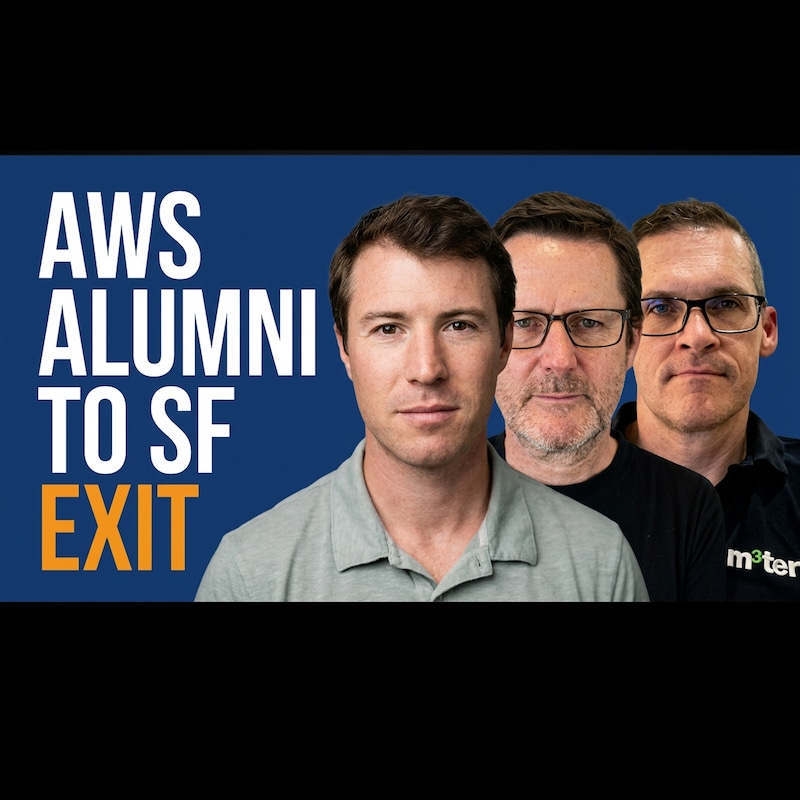
Shownotes
➡️ Summary ➡️
Griff Parry, co-founder and CEO of m3ter, and Marek Rubasinski, Head of EMEA and VP of Partnerships, join just days after closing their acquisition by Salesforce to tell the story of how they got there. m3ter is the data infrastructure that lets big enterprises move from subscription to usage-based pricing — metering usage, rating it against complex pricing logic, and automating data flows across the quote-to-cash stack. Griff and Marek trace the journey from their GameSparks and AWS roots, through a rapid $17.5M raise in a founder-friendly market, to the deliberate bet on an enterprise ICP and an integration-first, partnership-first strategy. They dig into the connector and native Salesforce managed package they built while competitors just shipped an API, the hustle that turned a thin network thread into a Salesforce relationship, and the honest failures along the way — a bad-fit partnership, underpricing by 10-20x, and trying to do too much at once. The conversation closes on why AI has made usage-based pricing obvious, why pricing is 50% strategy and 50% operations, and what m3ter inside Salesforce could unlock for ISVs.
➡️ Guests ➡️
Griff Parry https://www.linkedin.com/in/griffinparry/
Marek Rubasinski https://www.linkedin.com/in/marekrubasinski/
m3ter https://www.m3ter.com/
➡️ Takeaways ➡️
m3ter is data infrastructure for enterprises shifting from subscription to usage-based pricing — it does three things: meter usage, rate it against complex pricing logic, and automate data flows across the quote-to-cash stack
The founding team had felt the usage-pricing pain firsthand twice — at GameSparks (acquired by AWS) and inside AWS itself — so they knew the problem cold before writing a line of code
m3ter raised $17.5M in three quick steps by the end of 2021 — a ~$2.5M seed, then $10M, then $5M from Insight Partners — riding a uniquely founder-friendly, post-COVID SaaS funding market
Early design partners came from deliberate discovery conversations through the founders' network, framed as discovery rather than sales — good discovery naturally led to design-partner relationships
Letting enterprise customers, not early-stage engineering teams, shape the ICP made m3ter distinctive versus competitors like Metronome and Orb — luck with judgment led them in the right direction
Integration-first, partnership-first: the product simply doesn't function unless it plugs into a sales front end (Salesforce) and a finance back end (NetSuite), so know exactly where you sit in the ecosystem
They bet an entire engineering team on a complex, enterprise-grade native Salesforce managed package and security review while competitors just handed customers an API — that became a durable differentiator hard to catch up to
The Salesforce relationship started from a tiny network thread — a VC intro and an ex-Zuora colleague's connection — plus relentless hustle; the founders insist they had no special advantages
Salesforce ultimately pulled m3ter in: they saw the usage-pricing trend, wanted a trusted partner to introduce customers to, then partnered, invested (March 2026), and acquired
Honest failures: a strategic partnership with the wrong ICP fit wasted time and money, and like most startups they priced far too low early — now charging 10-20x for comparable deals
Winning the customer isn't the finish line — getting them activated and live in production is, which in the early days meant heavy support before building an SI/consulting partner ecosystem to scale it
They tried to do too much in parallel — core metering/rating plus a "decisioning" analytics product — when they should have won in series; the lesson: stick to the knitting and earn the right to expand
For founders without a network: lead with genuine discovery instead of selling, ask ex-founders for their time, and remember The Mom Test — listen far more than you talk
On the acquisition: don't overthink it — be the best possible partner, and acquisition conversations flow naturally from there
AI made the pitch obvious — usage pricing used to need explaining, but now customers open calls with "we're launching an AI product and need to sort out billing"; pricing is 50% strategy and 50% operations
➡️ Youtube ➡️
Watch this episode on our Youtube channel
➡️ Keywords ➡️
m3ter, usage-based pricing, metering, rating, quote-to-cash, billing, Salesforce acquisition, Salesforce Ventures, ISV, NetSuite, managed package, AppExchange, product strategy, partnerships, Griff Parry, Marek Rubasinski
➡️ Hashtags ➡️
#AppsemblyLine #Salesforce #ISV #UsageBasedPricing #QuoteToCash #Billing #AI #m3ter
Mentioned in this episode:
Simplify Your Salesforce Security Review
Get clear explanations, actionable insights, and step-by-step guidance to pass your review and get to market faster.
ISV Forge
Accelerate Your AppExchange Success!
Permissions Assistant by Tython
Simplify security and permissions for Salesforce admins & consultants. Secure your data using head-to-head user comparisons, AI summaries, org-wide integration audits, and analyses that can span across time or even between separate orgs. Gain Powers & Save Hours. Visit Permissions Assistant on the AppExchange to start your free trial today.
Sponsorships
Advertise on AppsemblyLine to elevate your brand and connect with a passionate community of leaders!
Transcripts
Today on Appsembly Line, I am joined by Griff Parry and Marek Rubasinski of m3ter Welcome to Appsembly Line, you both.
Griff Parry (:Welcome, hello, thank you, very nice to meet you.
Marek Rubasinski (:Welcome.
Scott Covert (:I'm really excited to get into your story, learn more about the journey of of meter. but first before you even dive in there, I want to say congratulations. I know you all recently signed an agreement to be acquired by Salesforce, which just officially went through. So congrats to you and the and the team.
Griff Parry (:Thank you very much. Yeah, it's still within a week. We only closed last Wednesday.
Marek Rubasinski (:Thank you.
Scott Covert (:Well, I'm sure a lot of listeners are gonna be really interested to hear how that that initial partnership came about and how it led to the ultimate acquisition. So so yeah, let's just get right into it. maybe before we we talk about the the the journey that you want town, Griff, you could share a little bit of information for listeners and viewers about what meter is, what problems it solves and and who it was built for.
Griff Parry (:So, Meta basically solves problems for big enterprises who are moving from simple subscription-based pricing to usage pricing. And the way to think about what Meta is, it's really data infrastructure. So if you move to usage pricing, you need to be able to capture and process usage data, and you need to bring it together with pricing data to work out what goes on the bill.
And our customers generally successful companies, have entrenched quote cash tooling so that they'll use Salesforce on one side. They might use something like NetSuite on the other. But they don't have a capability to do what I just described that data infrastructure to capture the usage data and process it. So meter is a way of basically upgrading your monetization stack for usage pricing in the most painless and quickest way possible.
Scott Covert (:Very cool.
with John Griffin in October: Marek Rubasinski (:Mm-hmm.
Griff Parry (:That's right.
That's right. So meter's got a lot of people who've known each other for a long time. I mean, I've Marek for over 20 years. Ages this. But where meter came from is where I know Marek from is Sky. And sort of I was really involved in, which is a big pay TV operator, sorry, in the UK.
Marek Rubasinski (:Yeah.
Scott Covert (:Yes.
Griff Parry (:and
Marek and I were both really involved in that company's response to digital generally.
So which create a lot of opportunities, a lot of threats. And one of the things that we ended up doing was building the online TV capability of the business. So it's a satellite business, but we realized quite early on that television via the internet will be a thing, but we didn't have the technology internally. We knew satellite or broadcast technology. we, we appointed a
a specialist third party and I know my co-founder John Griffin because he was the main salesperson for that company and then one thing led to another and then we founded a company called GameSparks which was essentially a back-end as a service business focused on the video game space. It made sense, both of us were sort of exploring certain opportunities in that area and we sort of spotted an opportunity and the knowledge that we had from doing online TV was directly applicable.
Scott Covert (:Mm-hmm.
Griff Parry (:we ran that business and it was pretty successful. then we sold it to, you it was basically a layer on top of AWS and we were eventually acquired by AWS. And...
And the day we signed the deal, we knew we wanted to do another startup. There was a sense of unfinished business. We wanted to go again. And the problem that we were solving in Meta was a problem that we'd had at our old business, GameSparks, and also at AWS when we worked in there in our own app. So what both those businesses had in common is that they had usage-based pricing.
And we had a bunch of operational go-to-market pain associated with that pricing model, which at the time we didn't really understand, but we were very aware of the pain. And when we got to AWS, we saw that they price in a similar way.
because they're a similar business, they're on a hugely different scale, but they've got the same problems. And so that's when we started thinking, all right, okay, so if you're going to be doing usage pricing like that, you need to capture the usage data, you need to process it, you need to be able to apply complex rating rules to it and deliver the outputs. And that solves a bunch of problems, not just billing, but also customer experience and sort of pricing agility, et cetera. And so we knew there was a problem because we had experienced it firsthand twice, essentially. And so we founded Meta.
Scott Covert (:Mm-hmm.
Griff Parry (:end of 2020 to focus on an executive problem.
Scott Covert (:Mm-hmm.
so companies founded October: Marek Rubasinski (:Yep. Yep.
Griff Parry (:No.
Scott Covert (:fundraising
and a half million in in: Griff Parry (:So I'll tell you what happened because there were actually multiple steps which are reported as one but there were several steps in short succession. So we left AWS, we knew we wanted to found another business, we had a good idea about what it was and it was rooted in our own experiences so we were pretty persuasive that there was a problem we knew how to solve it.
Scott Covert (:okay.
Griff Parry (:We raised an initial seed round of about $2.5 million very quickly. It was like, oh, right, basically based on found history. But we then raised more money very quickly.
remembering that this was an incredibly favorable time for raising money for SaaS businesses, particularly infrastructure-based SaaS businesses. So this was all sort of after COVID, all the SaaS valuations had rocketed, money was very easy to come by. So we raised $2.5 million in February 21, but we then raised another $10 million about six or seven months later. that was, the reason that happened is one of our early customers raved about what we were doing to his VCs.
Scott Covert (:Mm.
Griff Parry (:they stepped forward and said, hey, listen, we'd love to invest based on what our portfolio company is saying. And we said, well, that sounds fantastic. And then we raised another five million about four or five months later from Insight Partners, a really big multi-stage firm. And the reason that happened is that we came across the person on their platform team who ran their pricing team basically. And he was really excited by what we were doing because he could see how relevant it was to a really significant proportion.
in three steps by the end of: Scott Covert (:Okay, that make that does make sense now that to hear those numbers
because th that this the initial true seed I guess was was a smaller initial investment. But then you saw the opportunity for you know it's a good time to raise and you had those conversations, so it makes sense that you'd strike while the iron's hot.
Griff Parry (:Yeah.
Yeah,
exactly. also, there's a couple of things to add is our experience at Gamesbox was different. It wasn't completely bootstrapped, but there was much more emphasis on generating revenues as quickly as possible and self-funding through a significant part of the journey. so people wanted, I wanted a different experience, John wanted a different experience. It's like, right, if we can raise money from great VCs, let's do it because it's sort of an exciting journey. So there was definitely that element to it.
But another thing is we knew we were building critical infrastructure and we were focusing on enterprise customers. That was our ICP and we understood that pretty early. And you have to build quite a lot of product to be able to deliver a decent MVP for critical infrastructure for a big buyer like that. So it made sense that we raised a lot of money because we had a lot of building to do.
Scott Covert (:Mm. Mm-hmm. That that does make sense. So I had also read y a little bit about how V C introductions, like you mentioned, were a core part of your your go to market early on. And that John had mentioned before some some early day struggles from
trying to be too much to to everyone and get and getting yourself spread a little thin. so maybe since since those VC introductions were so key, I'm wondering if you could maybe share how that came about. I mean did you intentionally reach out to these VCs or was it a little bit of luck or maybe both that you you had that customer rave rave to their parent VC?
Griff Parry (:Yeah.
Do you mean about how we raised
funding or how we acquired early design partner customers?
Scott Covert (:Both, both I think. but I'm I specifically I think the the latter.
Griff Parry (:It wasn't all VCs, so we basically used our network. it was useful that we had some, we had an interesting background. We were an interesting founder team with interesting background.
We're also relatively long in the tooth, so we knew quite lot of people. And so we were very deliberate about doing a lot of discovery. So although we raised, you know, really quite a big chunk of money within a year of getting going, we were holding back on writing code until we fully understood what we wanted to build. And so we did a lot of discovery conversations and they were pitched as discovery conversations, not a sale conversation.
contributed to us finding people to talk to because you know we'd always say hey listen is there anybody in your portfolio who's got this problem would you introduce us we'd love to do some discovery work with them but good discovery conversations often lead to good conversations about
potentially being a design partner. It's like, oh, if you're really interested in what we're doing, why don't you be one of our early customers? You'd have a lot of influence over the product that we're building. So that's how we acquired that first group of five or six customers. And that's just the nature of it. You have to find a way of getting started. You need those initial customers. mean, firstly, for validation so that you can go on and sell to others or raise further funding. But you also need the customer to help you design a great product that will work.
in practice, know, there's a lot of iteration and learning work to do there, however well you know the problem space. So that's how we did it.
Scott Covert (:Mm-hmm.
Sure. Yeah. It helps to have that that network for sure. And and those early customers can end up being cheerleaders for you to lead to to more customers, right?
Griff Parry (:It's really, I mean, the other thing to add is that there's an element of sort of luck or good fortune because your early customers are then really influential over the product that you build. So it really helps if you find the right customer who will help you build the right product for the future.
we could have gone quite different directions in that early phase. If our early customer cohort had been dominated by more engineering or teams in earlier stage companies, we might have built something that looked a little bit more like Metronome or Orb, who were major competitors in the area.
The balance of our early customers were the enterprise businesses that I talked about before. So that became our ICP and it meant that we built something distinctive. I mean, look, these products are all, they all have their similarities, but what Meteor is particularly well designed for is that enterprise customer with enterprise capabilities. So they are very influential and luck with judgment, we had good ICP customers that led us in the right direction, helped us build a good product.
Scott Covert (:Mm-hmm.
Gotcha. Makes sense. So while Griff, while you and John are focused on talking to your ICP and and these early advisory customers, I I know
meter is is one piece of the the puzzle, but there's also kind of the revenue engine, the sales forces, the the net suites. So Marek, I'm assuming while they're focusing on talking to the customers, you're busy trying to reach out to the sales forces, the the net suites to get these partnerships going, right? Because probably a lot of people are right away going to ask for can this integrate with my existing s tool set?
Marek Rubasinski (:Yeah, no, 100%. Although for the last four years, I've been at Meads for almost five, I've been wearing two hats. I've been selling as well, but I've been doing the partnerships. know, Griffin John caught me just at the point where they had to start papering those first one, two, three deals. And so it was a bit of a baptism of fire to come in and do all that. But you're absolutely right. There was a realization super early.
just scratching things out on whiteboards and Mirabords going, hang on, this is great. We love what we're doing here and customers responding really well to the underlying capability and what it's solving for. But really this product has, it doesn't function if it's not plugged into some sort of sales front end, you know, at beginning.
and some sort of finance stack at the end. And there's a kind of third axis there. We typically integrate bi-directionally with our customers, other data infrastructure, their data warehouses or wherever those things are. So with that in mind, two things really then drove the overarching product strategy. And I don't mean from a featuring capability point of view, but kind of big picture, kind of where do we fit in the stack, which
I would urge everyone who is maybe more in the B2B space to have that visibility or view of their own business or whether they want their business to be. Because I think it's incredibly rare that in Cernian software, actually to be honest, any technology that you're not part of an ecosystem. And so we did that kind of analysis, although that's maybe a big word for just
constant thinking and iteration about this and having those conversations and very quickly boiled down the world to, okay, there aren't that many big kind of sales front ends. and there aren't that many big ERPs or, or sort of, finance systems at the back end and triangulating between where, where we're strong and where our customers are. And also to, to Chris point, those early customers were pretty much all Salesforce and NetSuite customers.
So it doesn't take a whole lot of thinking to go, okay, well that's one, two, three, four, and they're all asking or rather telling, we need to integrate with Salesforce. Have you got a managed package? No, but we're gonna need one. Have you got a native integration with NetSuite? No, but we're gonna need one. And so to very, I think to Chris point about the competition, very early on a couple of distinctive ingredients in the
overall product strategy, one of which is integrations and being almost integrations first, because you know, it meets us in the middle, it solves for the messy middle. But really, it's, it's, it's not trying to take over from other systems. So we had to think about, think about the ecosystem. And I think that's good advice for any founder or any, anyone working with founders or early stage businesses is think about how they
sit in amongst the ecosystem and what they have to talk to. And then on the Salesforce thing specifically, I people were saying, well, I take this, but really need to know more about how you're going to integrate with Salesforce. And so there was a very rapid learning and upskilling of, you know, you can, obviously you can go online and sign up and you get your login and your dev org.
And then the partner account manager reaches out to you and you start that conversation, but it had to ramp really quickly because it, know, building, building a good Salesforce integration managed package, it's now gone headless, obviously. So, you know, there's even more opportunities to work with, with the Salesforce platform. It takes time. You need to have the commercial discussions, you need to have the engineering and product discussions and you've got to get good.
you you kind of really iterate those things. So yeah, absolutely, absolutely. Very early on, realized that we needed to be integration first, partnership first in our approach.
Scott Covert (:And did did you or anyone else on the meter team already have connections or a network with Salesforce that helped with those that early those early days of the partnership?
Marek Rubasinski (:just a tiny thread to pull on. a couple of connects, I think if I remember rightly, it was via one of our VCs. think we had, we had a, just a, at least a, just a tiny bit of a thread to pull on where we, we, it wasn't just filling in an online form. You know, you could, you could reach out and have a sidebar conversation. And actually one of our other very early colleagues.
Griff Parry (:Yeah.
Marek Rubasinski (:who was ex Zora and ex I think Oracle and other kind of similar businesses. He knew someone who was now in a relevant team at Salesforce for whom this would be interesting. We'd be solving a gap for them on that platform. And it was really those two things that helped us, you know, kind of help accelerate that, which is sort of
terrible advice because it's basically saying get lucky and have a connection, is not great advice. yeah, absolutely. yeah, yeah. mean, Now, as I was going to say to hustle, would be the advice. Even if it's a third connection twice removed on LinkedIn. And we were doing a lot of that. We were doing, hey,
Griff Parry (:Yeah, I was going to emphasize we didn't have any special advantages. We were hustling and we found ways of getting in.
Scott Covert (:But it's true.
Yeah, smart. Well I go ahead, I'm sorry.
Marek Rubasinski (:Turns out that you once played netball with my friend John. Do you want to talk about billing and Salesforce? Yeah, we were doing a lot of
Scott Covert (:I I did also notice and and perhaps this is quin coincidental given Salesforce's size, I did notice a few members of the current and and and prior marketing team at meter seemed to be some folks that came from Salesforce. And I saw that and I wondered, well, was this is this strategic? Were you all playing 4D chess while some of us are just playing checkers here?
Griff Parry (:yeah, but...
Marek Rubasinski (:Thank
Griff Parry (:Are we honest here? Yeah, of course we were paying five dimensional checks. No, that was a complete coincidence. So yes, our two, I guess our two key marketing people were both from Salesforce, but it was more...
Scott Covert (:Ha ha ha.
Griff Parry (:So Kelly Sing Sank was our head of marketing or a marketing leader and she joined the business quite early and she was talked about in the VC networks as being someone who's really good, wants to get back into sort of like smaller companies to build things up. And I mean, what impressed us most about her is that she's really good and really nice, but it was a nice additional benefit that she understood the Salesforce ecosystem, which we knew was going to be important to us. So.
Scott Covert (:Mm-hmm. Mm-hmm.
Griff Parry (:It did make a difference on the margin for sure, but I wasn't, we weren't really playing through the chess.
Scott Covert (:Okay, so so the the app exchange listing, the the Salesforce connector, I noted went through that the security review, the dreaded security review that everyone fears, late 2023, I believe October twenty-three, and then the listing went live later in twenty twenty-four.
Things seem to accelerate very very quickly from there. At least in hindsight, it it always seems that way. because I noticed that in March of this year, so not even two years later, you meter had an expanded integration to better support revenue cloud, aka aka agent force revenue management.
Griff Parry (:Yeah, that's right. I mean, things did move pretty quickly. mean, as Marek said, we knew that embedding ourselves in the partner ecosystem was key and Salesforce were absolutely at the top of list of people we needed to find a way of working with. And what it meant is that we were present and front of mind.
Marek Rubasinski (:Mm.
Mm-hmm.
Griff Parry (:And, but the, the pull for the partnership was actually from them rather than us, because they could see that, that there were trends in the way software pricing and high tech pricing or generally was going where there was more and more usage. And, there was something that their customers needed to make it, make it work. And so, they wanted to find.
a partner or trusted partners that they could introduce the customers to. So there was a pull. So we were around and they were front of mind because of the work that we'd done and the time we'd invested in the partnership. But then they pulled us in and that's one thing led to another. eventually they acquired us and along the way they formally partnered with us and they invested in us. So yeah.
It was the result we were hoping and planning for.
Scott Covert (:That's
what I was gonna ask if this was all part of the the the hope was a eventual acquisition, specifically a Salesforce acquisition, because there was that strategic investment March of this year, just three months later, in in June, they've they you signed a definitive agreement to be acquired, right?
Griff Parry (:Yes, yeah. So I would say it wasn't necessarily specifically Salesforce, but we knew that the ecosystem, we played a certain role and our customers had tooling that they were absolutely committed to, they needed to make work with Meta. So our likely exits were with those.
with those tooling on either side. So it could have been Salesforce, it could have been another sales CRM, it could have been an ERP on the other side. But it was those ecosystem players that we'd spent a lot of time building integrations for. it's, can I just flag one other thing, which sort of explains what our connector was for and why the integrations matter.
I talked about meter doing two things. We really do three. So the two that we obviously do is that we meter and we rate. So the metering is capturing processing usage data. Rating is the application of complex pricing and billing logic to that usage data to work out what goes on the bill. But the third thing we do is that we automate data flows across the quote cash stack. we make it much
easier for people to do things with much less manual intervention and manual based processes. And the reason that the connector was important to us is that if there is pricing logic captured in the CRM, you want that to be automatically moved into the bill calculation mechanism provided by Meta. And then once Meta calculates what's on the bill, it'll deliver that downstream to the invoicing system. But it'll also want
to your customers also want that information delivered back into Salesforce. So account managers can see, you know, what the billing of a particular customer is, what the usage of a particular customer is. And the, and the connector was designed to, to automate those flows. It's pricing data in and usage summaries and billing data back into Salesforce. So that, that's, that's what its role was.
Marek Rubasinski (:Yeah, but Scott, to your point about the what was it always the plan? Like, Gross said, no, but we did specifically identify and move into white space with this. So if you if you at the time when we were making the decisions and placing the bets, you know, you've got limited resources. What do you put an entire kind of two plus one engineering team on to to develop, you know?
Scott Covert (:Very cool.
Marek Rubasinski (:Standard wisdom would suggest, this is not the time to invest in a really complex enterprise grade native connector to your point that has to pass through a stringent security review, which can sometimes be a little bit opaque and difficult to navigate. And you have to learn a whole new language and a whole new kind of engineering framework to do that. But we place that bet because when we looked around our company,
zag when other people zigged. The competition was not doing that. They were saying, just sort yourself out. We got an API. You can integrate that. But that, became a differentiator for us. And once we were, to your point, the time that we spent developing it and launching it, once you're out of the gate and you're a year or 18 months ahead and then you're iterating every eight to 12 weeks releasing a new version, it can be hard to catch up.
And that's part of what's played into the end of the journey. So yeah, some specific bets were placed, but one of them was just identifying that, whether it's the ISV, Salesforce App Exchange, ISV ecosystem, or another one that people are thinking about and founders and early stage teams are thinking about, just avoid crowded spaces. Look where people haven't kind of exploited a gap.
Scott Covert (:Mm-hmm.
Marek Rubasinski (:and this was part of exploiting a gap.
Scott Covert (:Mm. You you mentioned obviously that, you know, you placed your bets clearly. This one one paid off well. I'm I'm curious though, I I think success sometimes can pave over prior failures and people forget that there was a journey that meter went on to get here. So I'm curious, if either you could could expand on any maybe any bets you placed that that didn't go your way or, you know, some lessons learned that you had along the way.
Some hypotheses you you maybe had that didn't turn out to be correct.
Griff Parry (:I've got two back and so why don't I talk through those and then you can tell me all the others. So I was going to talk about ICP and surface area were going to be the two that I want to talk about.
Scott Covert (:How?
Marek Rubasinski (:Yeah. Let's see if they're the same one.
I was going
to talk about a prior, obviously without mentioning any names, there was a U-turn partnership that didn't work out. So write macro strategy, tactically an error linked to the ICP. And then I was going to talk about pricing as well.
Griff Parry (:That was what I was going to talk about.
Okay, so let's do those three. You start with the ICP stroke fail partnership.
Marek Rubasinski (:Okay, so we had a previous strategic partnership, which was, you know, at a macro level, the same right idea where we were complimentary. We didn't do what they did. They didn't really do what we did. A mixture of the two should solve our customers' problems. But we just, we were just,
didn't pay enough attention to ICP fit and they are more high volume, sort of more in the SMB space. just as our product was diverging to be, because these things are to your point take time and there are bumps in the road, you know, and you do zigzag a little bit, but by this time, you know, with the benefit of hindsight, we were clearly moving towards a, you know, product and a platform more suitable for large enterprises.
sort of 100 million, 200 million up all the way into the billions in terms of revenues, much less applicable to sort of SMBs or even businesses that are the more in the single or tens of millions of revenue. And that's a real flip between, you know, there's a real flip between what businesses at those stages need and some never get beyond that stage. And so we spent too long working on that partnership and by the time
It went live. Our product was already going here, their products here. it's constantly diverging and trying to bridge the two both in terms of go to market and product integration was, it was just, it just didn't work. And eventually, you know, we just had to kind of pull apart, you know, terminate the partnership. It was broadly amicable. It didn't, it didn't work out, but you know, we wasted time and money and there's, there's no way, there's no two ways around that.
Scott Covert (:Mm.
Marek Rubasinski (:and I suppose linked into that because as a consequence of being in that partnership and trying to make it work, because obviously you invest, you try and try and make these things work. And it's a bit of time before you realize they may not. And you have to take the hard decisions. I mean, we're, we're now pricing 10 X what, what we were pricing for some of those deals, maybe 20 X in some instances. So we were hugely undervaluing our, our product.
and the benefit that it brings because of that poor ICP fit in terms of at its most basic, there are lots of reasons, but I think generally all startups, you know, price too low to begin with. That is the nature. You're desperate for someone to buy. So what do you do? You go out low and it's a brave, mean, know, OpenAI have done it. They went out at 200 quid for something that Sam Altman said.
Scott Covert (:Mm.
Marek Rubasinski (:Yeah, I just kind of guessed 200 quid. out it's costing us 500 in a month to deliver. So yeah.
Scott Covert (:Ha ha.
I knew they were subsidizing. I didn't
know that it was such a finger to the win calculation, but
Marek Rubasinski (:I think it's famous.
There's a famous tweet or X post. You can look it up. Someone said, I bet they did a lot of work on this. And literally Sam Ombon comes in on a DM, replies this. No, I just kind of guessed it because it was on me. I was wrong. Yeah.
Griff Parry (:So, I'll chuck in a couple. So I'm not sure whether this is one big error, but it was definitely a learning process. It's not enough to win the customer. You know, they say yes and they sign, that's great. What really matters, particularly in your early stages, is you want them to activate successfully. So, you know, the finish line is...
You could either describe it the finish line or the start line, but where you really need to get them is that they're using your product in production and they're getting the value that they and impact that they expected and wanted from it. And particularly in the early stages, you need to provide the customers with a lot of support because this is all unfamiliar for them.
And, you know, there was a constant course correction about how much support we provide, how much we would define exit criteria, how much we would charge. Cause you know, to start with you, say yes to everything and you generally don't charge because the key thing is to get the customer and get them live. And then over time you learn that actually you've got to create more of a framework and discipline around it. And then you realize that if you're going to scale the business, you can't be providing that support as meter. You need to foster a different type
partner, the consulting partner or SI partner ecosystem to do that work. So there was lots of learnings all the way through and there were sort of pain points associated with either getting things wrong or not changing and moving fast enough. So that was one area. And then my fourth one is we definitely tried to do too much, there was too much surface area for the product and
It's not apparent now, but absolutely what we are focused on in the early stages of Meta is we wanted to provide that Meta rating and workflow automation tool. That's core Meta. But then we also wanted to use the data that that collected to deliver advanced analytics back to our customers, particularly focused around usage forecasting. Because if you're doing usage forecasting, you can do revenue forecasting and you can do pricing recommendation or pricing optimization. And we spent a lot of time and money working on that second part of the business, which
we call decisioning, I still absolutely believe in it. I think it's a huge opportunity area for Salesforce. Now we're part of Salesforce.
We were trying to do too much all at once and we should have been trying to do those things in series rather than in parallel. We should have been focusing our resources on winning in the metering and rating space before we expended significant time and effort on the decisioning space. And if I could do it all over again, that's what I would have done rather than try to do those things in parallel. And just one final comment, it was slightly a function of the funding environment that we were born into because we could raise a lot of money easily and that encourages you.
to try to be more ambitious in terms of what you're building. But if I could have a conversation now with my past self, I'd say to him, stick to the knitting. Like, narrow your focus, make sure you win here, and that earns you the right to go on to do the next thing. If you try and do too much, you'll be wasteful.
Scott Covert (:Hm.
Mm. Mm-hmm. Y you mentioned how your network was so key in those early days and th that you tapped into that to find customers, make introductions, et cetera. You also talked about how hard y'all were hustling. and I'm curious for anyone listening right now that maybe is earlier in their career and so doesn't have quite that network built up yet, or doesn't doesn't have America on the team and is is struggling to figure out partnerships and figure out how to get those
Griff Parry (:Yeah.
Scott Covert (:first ten customers. Do you have any advice on on the hustling side?
Griff Parry (:I mean, listen, it definitely helps to sort of be a little bit older as a founder and to have those existing networks. It definitely means that someone's thumb is on the scale a little bit. hustling is just something that startups do.
So yeah, it's slightly more difficult if you don't have the network, but it doesn't mean that you can't do it. The key thing is energy and iteration. You'll have conversations with people or they will entertain conversations with you if what you're saying resonates, if you clearly understand a problem that they recognize themselves as having. And so, yeah, I wouldn't discourage anybody. It's like, okay, so you don't have it? You can still hustle your way into a position and then...
people have worked hard and know opportunities gets presented because of the effort and the elbow grease that you've you've put in so yeah it's not it's not an insurmountable obstacle.
Marek Rubasinski (:lot of people will give you the time of day if you start by not selling and just doing that thing of genuinely asking them, know, have you got this problem, especially if they're ex-founders themselves. So if you really have no network, then if you start with either exited or multiple founders who are still operational, maybe they've got the next thing they're building or the next thing. If you ask enough times, someone will say,
Sure, I'll give you half an hour just to kind of listen to the thing that you're, and maybe just give you some advice. If you do enough of those to gross point from those early conversations, maybe one or two will say, you know what, I'll give that a go. When you've got some sort of jewelry rigged MVP, I'll give it a try and I'll give you some feedback and just see if you can expand that, expand that out.
Scott Covert (:Mm-hmm.
I've had guests on the show before come on and praise a book called The Mom Test. That specifically I'm not sure if y'all have read it, but it specifically talks about these early day discovery calls and the importance of
Essentially not leading the witness, not ta talking too much about your idea for a product and and not getting too salesy like you're saying, Marek. And instead really truly trying to listen to them about the problems they have, how they you know, how big of a problem it is, so you can know whether or not actually it's something people are willing to pay for, as well as, you know, what they're doing currently to solve it.
Griff Parry (:That really resonates with me. I haven't read the book. I'm guessing the mum test is also partly, can you explain it to mum? Yeah. I mean, the way I think about it, if somebody is giving you their time, that's really valuable. Everyone's busy. So yeah, don't talk at them.
Scott Covert (:I think so. I I I I I must admit I haven't read it yet either. I I I gotta pick up a copy, but
Mm-hmm.
Griff Parry (:Like the benefit you'll get is listening to what they have to say. So obviously you have to frame it and you have to provide some kind of prompt that gets them talking. But I think that the advice about listening more than talking is absolutely spot on.
Scott Covert (:I I wanna talk a little bit about the acquisition. So I think a lot of viewers and listeners are are earlier stage and they kind of view that as the the pot of gold at the end of the rainbow that it that they're looking forward to. And I'm curious, if you could share first off how you knew that it was the right time because I think again talking about hindsight versus reality, people forget that the fog of war is always is always obscuring things and you you
know
investor at least in March of: Griff Parry (:thing to say is that we didn't overthink it. we were in a fortunate position where they wanted to partner closely with us and so we just focused on being the best partner we possibly could.
Scott Covert (:Okay.
Griff Parry (:eager to get more exposure to their teams, understand what problems they were seeing in the market, understanding how a great partner would behave, what product a great partner would be building. And so that was our focus. And acquisition conversations naturally flow from that.
So that would, it's no more complicated. It's like if you're lucky enough to sort get in the situation where they want to work with you and want to partner with you, just don't overcomplicate it. Just be a really great partner and see what happens. Mariko, anything to add to that? mean, you were very involved through this period.
Marek Rubasinski (:you
No, I think that that's right. I mean, it obviously doesn't hurt if they have a venture's arm or, you know, they do some off balance sheet investing from a CVC or even just directly, you know, be honest about where you are if you're looking for funding, because that sends up a signal. But yeah, to Chris' point, just focusing on, you know, being the most useful thing.
back to that point about finding the gap and moving into any empty spaces. And if you are also talking to the customers of potential acquirers, you will learn very quickly where they maybe have frustrations or pain points that you could help with and do the best you can helping with those both in go-to-market and in your product strategy.
and then see where that leads you. Because even if it doesn't lead to investment or acquisition, you've got a whole ecosystem of people who are interested in buying your product because it solves the problem.
Scott Covert (:Well, sp speaking of solving problems, I I personally am excited about the the meter acquisition because I'm hopeful for what it could mean for Salesforce ISVs. I know that one issue that some ISVs have run into in the past that have a business that lends itself very well to usage based pricing have had difficulties.
building a Salesforce plug-in and offering that to customers mostly due to technical issues kind of on the the Salesforce side of how how ISV partnerships work. Do you all foresee meter helping alleviate those troubles for for ISVs down the road?
Marek Rubasinski (:Hmm.
Griff Parry (:I was going to say simple yes.
Marek Rubasinski (:Yeah, I mean, yes,
absolutely. I mean, we're excited to help not just revenue clouds, customers, but also Salesforce internally. I mean, it's a huge and really deep and wide product suite now with the headless strategy. It's increasingly composable. So, you you can pick the components and connect them how you want. So both for
Scott Covert (:Mm-hmm.
Marek Rubasinski (:in-house use, but also to your point about exposing that capability into the marketplace to allow more flexibility for usage-based pricing. It's almost, there's so many opportunities to help and I guarantee you we will be getting to all of them in due course. I mean, it's a similar situation. You may have listeners or friends that list on say AWS marketplace or Azure marketplace.
and they have their own limitations. So yeah, we're excited to help across the board.
Scott Covert (:Cool. And and it's a it's a good space to be in. I know, you know, Salesforce
Whether true or not, they're they're often coined as the creators of SaaS and and the the first creators of a kind of a seat-based pricing model for software. And even they obviously in recent years have moved toward usage-based pricing with their FREX flex credits for Agent Force and AI and LLMs in general have just brought this real need in the market for usage-based pricing.
Griff Parry (:Yeah,
it's definitely true. mean, in the early days of the company, we were saying, look, there is a trend towards usage. This creates a need that meets. But we, we have, it was quite hard because people were like, what do mean usage pricing? Like no one, no one saw it happening. And the thing that really changed for our business is AI basically, because
The likely pricing model for AI is usage-based because of the underlying cost base of AI features. They drive variable costs and that means that people lean towards some kind of usage pricing to give them more control over their...
Scott Covert (:Mm-hmm.
Griff Parry (:over their margins. And so we don't need to explain it to anybody anymore. It's like, yeah, usage pricing is a thing. And people are like, yeah, we know. We see it everywhere. It's not just in the AI world, but we understand it because of the trends that happening there. So yeah, life is easier now.
Marek Rubasinski (:Yeah.
It's funny you said, should say that because I was just thinking about it. Four years ago, like you say, you had to explain what, are you doing? Why do you want to talk to me? I think the last 20 customer calls I've been on have opened like this, almost verbatim, like they're reading a script. Well, we're launching an AI product or a C P server and insert choosers applicable. And we need to sort out the billing. That's literally just the opening of the call.
And then there's a pause. And then I always ask, when were you hoping to go live? depending on whether they say a number in weeks or months is how much of a code red that the rest of the call is. Yeah.
Griff Parry (:Yeah
It's worth adding another thing is that there are two, for meter there are two pennies that need to drop with the customer. So the first penny is, I understand that I want to do usage pricing, but the other penny that needs to drop is, operationally this is really complex and this is more than just about billing. This is also fundamentally about.
eliminating revenue leakage, delivering good customer experiences, unblocking product and sales.
The reality of pricing is it's 50 % strategy and 50 % operations and we need people to understand that second 50 % operations, the 50 % of those operations. So that's what we're looking for. If somebody understands that they want to do UC Bayes pricing or they do it and two, operationally it's complex to do and they need to set up their systems and processes in the right way, then we know we're in a good spot.
Scott Covert (:Sure. Well it it's it's nice to to be in a space where y y y the best ideas always seem obvious in hindsight, right? So it's nice to be in a space now like usage based pricing where y'all were ahead of the curve and realizing that this is the way the world was going, especially SaaS. so so that's great.
Griff Parry (:Yeah.
Scott Covert (:This feels like a good place to wrap, but before we do, is there there anything else y'all would like to share with listeners and and viewers out there for for advice on their own their own journey, entrepreneurial journey?
Griff Parry (:I mean...
From my point of view, obviously like early stage businesses, I've done two of them. I like them because you feel alive every day and you have agency. And I like the ambiguity, you're working things out. mean, the one thing I'd say to other people who are founders or thinking about being one is...
persistence and sweat count for an awful lot. And so, you it might be 10 % genius or inspiration, but 90 % perspiration. You just need to be somebody who keeps cranking the handle. hopefully you've got a good idea which is setting you in the right direction.
The key thing is to learn and adapt and keep doing that. And if you enjoy that process, then early stage businesses are brilliant. If you don't like it, then you probably shouldn't be doing early stage business.
Scott Covert (:Very nice. Well, I I appreciate both y'all coming on. Griff and Marek, if if folks want to learn more about you or meter or the the recent acquisition of the team into into the Salesforce family, where can they go to do that?
Griff Parry (:For me, you can go to my LinkedIn, is Griffin Parry, or you can go to our website, is meter.com, M3TER. And, Mark, what about you?
Marek Rubasinski (:same. You can look me up on LinkedIn. I've got a pretty good track record of answering messages, so feel free.
Scott Covert (:Very nice. Well, thank you so much again for joining AppSembly Line. congratulations on the the acquisition and looking forward to leveraging meter down the road through Salesforce's various products. Cheers. Bye.
Griff Parry (:Cool, thank you very much for having us on Scott.
Marek Rubasinski (:Thanks a lot.
Bye.


