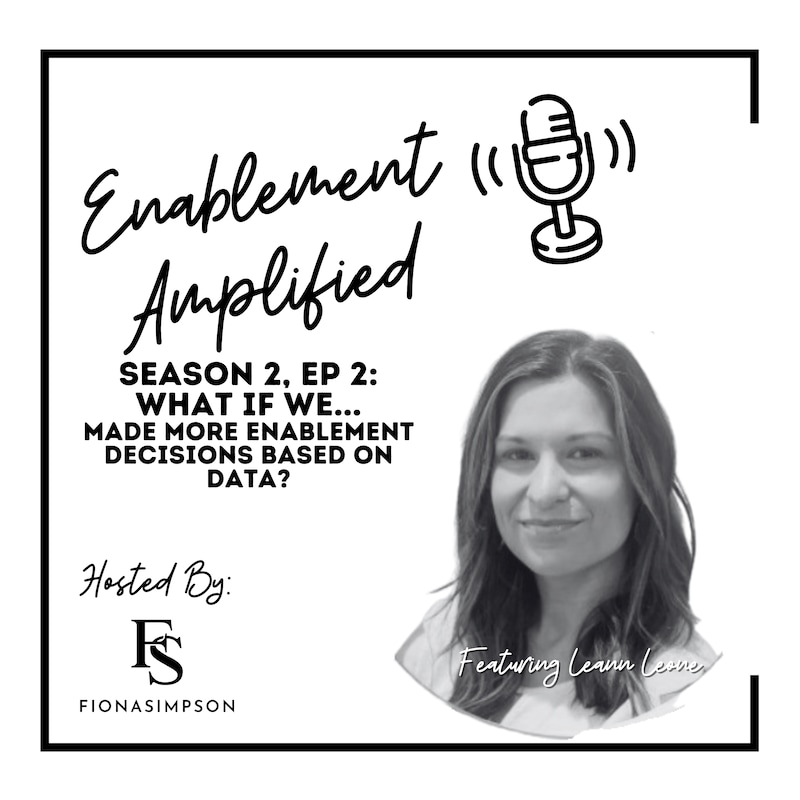
Shownotes
Leann Leone on LinkedIn: https://www.linkedin.com/in/leannleone/
Transcripts
Hello, everyone, and welcome to Enablement Amplified.
2
:I'm your host, Fiona Simpson.
3
:Welcome to the brand new
season of enablement amplified.
4
:This is the very first episode of
season two, and I am so excited to
5
:share it with you all before we jump
into the episode, I just wanted to
6
:say a quick, thank you to everyone who
supported season one of the podcast.
7
:The folks who've signed up as a
members, as part of the podcast
8
:community, and for everyone who
has cheered along along the way.
9
:And just wanted to express
my gratitude for a moment.
10
:The podcast is growing and we
are going to be doing some really
11
:fun things with season two.
12
:And some great ways for
listeners and people within
13
:the community to get involved.
14
:So stay tuned for more details
on that very soon, but just
15
:so grateful to have you here.
16
:And I hope you enjoy.
17
:Episode one of season two
of enablement amplified.
18
:hello, everyone, and welcome to another
episode of Enablement Amplified.
19
:I am very excited today to
have Leanne Leone on the show.
20
:Hey, Leanne, go ahead
and introduce yourself.
21
:Leann Leone: Hey Fiona, super
excited to be here with you today.
22
:And yeah, I am a revenue
enablement professional.
23
:If you will, I've spent a bit
over a decade working in revenue
24
:organizations in SaaS companies.
25
:That the first half of my career was spent
in sales as an IC and a sales leader, and
26
:then transitioned into enablement to serve
in that more optimization focused role.
27
:So most recently, I was the head
of go to market enablement at
28
:Logics Board, which is a logistics
tech company where I supported
29
:sales, CS, and support enablement.
30
:Fiona Simpson: Awesome.
31
:I love, I always love a blend of a little
bit of sales, a little bit of CS support.
32
:That's my background too.
33
:So love to hear it.
34
:I am super excited about this,
but Leanne, tell us your what
35
:if question for today's episode.
36
:Leann Leone: My what if
question, Fiona, is what if more
37
:enablement decisions were made?
38
:We're made based on data.
39
:Fiona Simpson: There's so many data
gurus out there that are going to love
40
:this question because I almost want
to ask the question, why aren't you
41
:making decisions based on data, right?
42
:We'll dig into it.
43
:We'll dig into that.
44
:We will, for sure.
45
:But to start us off, give me a
little bit of the context here.
46
:What made you start thinking about this?
47
:What made you ask the question
in the first place so that
48
:we can really kind of unpack?
49
:Because there's a lot in that
question, but let's start unpacking.
50
:Leann Leone: There is.
51
:There is, you know, I think there's a
lot going on in the enablement function.
52
:Obviously a lot of people's
roles have been cut.
53
:Teams have been Consolidated.
54
:And I think what's happening is it's
hard for organizations to justify the
55
:spend because they're not looking at
the function as a revenue optimizer.
56
:They're looking at the
function as a revenue
57
:Fiona Simpson: as cost of goods, right?
58
:Yes.
59
:Yes.
60
:As
61
:Leann Leone: a cost center.
62
:Exactly.
63
:Yeah, a cost center.
64
:As a cost center.
65
:So.
66
:The, and the reason for that, I think, is
because it's being seen as an execution
67
:function, and I'll talk a little bit
more about that, but if enablement had
68
:the right seat at the table to bring
data driven decisions, to the team rather
69
:than constantly be told what to do.
70
:I think it would transform the way that
the function is seen and its ability
71
:to optimize the performance of all the
individuals that are quota carrying.
72
:Fiona Simpson: Agreed.
73
:I absolutely agree because And
I'll give you a great example.
74
:I was looking at some data this week.
75
:And I noticed a trend about deals
that fall under our ICP versus ones
76
:that don't, and I thought to myself,
aha, this is a trend that maybe
77
:other people have been picked up on.
78
:This is something that we
can coach towards, right?
79
:Let's disqualify our non ICPs faster.
80
:Let's qualify more ICPs.
81
:Let's have marketing, right?
82
:Like there's a lot that comes out
of that one little sliver of data.
83
:And that puts me or the enablement person
in the position to think strategically
84
:ahead of the curve, as opposed to some
of those What I like to call lagging
85
:indicators, like we missed our number
last quarter, we need more enablement.
86
:And it's like, well, let's
unpack that a little more.
87
:Leann Leone: 100%.
88
:And, and that's why I wouldn't
say that a lot of organizations.
89
:Or rather, I wouldn't say that blanket
statement that organizations don't
90
:think in terms of data, don't put
enablement in a strategic place.
91
:But I, I think there's some that
have a hard time putting the
92
:function where it needs to be.
93
:So just consistently seeing
sales leaders telling enablement
94
:what they want them to focus on.
95
:Rather than letting enablement live in the
data, live in the strategic conversations
96
:to determine where to put their focus.
97
:Fiona Simpson: Could not agree more.
98
:I feel like oftentimes sales leaders can
use enablement as like a reactive crutch.
99
:Yes.
100
:Like, we found a problem, we're now
gonna make an enablement problem to fix.
101
:Mm-Hmm.
102
:. As opposed to exactly what you just said.
103
:Letting us have eyes on
things before they happen.
104
:Letting us be a part of the
conversation before the product launch
105
:or the sales reorg or the whatever.
106
:Right.
107
:Yeah, I think we're completely
on the same page, but let's break
108
:this down a little bit further.
109
:So when you say data driven
enablement decisions, what
110
:do you really mean by that?
111
:Leann Leone: Yeah, so what I mean by
that is that we let data drive what
112
:initiatives get enablement attention.
113
:And the measurements and outcomes
that we want to see change.
114
:And I think this is just as much of an
enablement responsibility to fight and
115
:claw improve their ability to bring
these types of things to the table
116
:as it is organizations to be more
supportive of that type of interaction.
117
:And, and you said is typically the,
the revenue leaders will come with.
118
:the thing they think should be
trained upon, whether that's
119
:discovery or the, my favorite is,
Hey, my reps need more negotiation
120
:help or more more closing help.
121
:But when you dissect data, my example is.
122
:You know, revenue started to fall.
123
:Sales leader says we need to focus on how
to have those late stage conversations.
124
:But really what happened and what the data
showed was that we needed to get better at
125
:proving value before presenting pricing.
126
:Cause we would get people that would
say, yeah, your product looks cool.
127
:But then when we put a 50, 000
price tag in front of them, they
128
:would say, not that cool because
we hadn't done a good enough job.
129
:And so the enablement initiative, yes,
it was training, but there was also
130
:some ROI resources that I was able
to worked with marketing to produce.
131
:And.
132
:Ultimately, yes, closed one revenue
increase, but not because we
133
:focused on the end of the funnel.
134
:So I think that, you know, yes, like
revenue leadership team should collaborate
135
:on Everything from anecdotally,
what are we seeing emotionally?
136
:What are we feeling?
137
:But that we should also be looking at
the data to say, what do we want to
138
:see change when we make this shift or
put our enablement resources in this
139
:and and to go off script a little bit?
140
:There's conversations flowing around
some Slack communities that I'm in
141
:about intake forms for enablement.
142
:And so that we can hit, you know, Mr.
143
:Sales Leader, Mrs.
144
:Sales Leader, if you want me to focus
on this thing, you tell me what drew
145
:you to want me to focus on this thing
and what outcome do you want to change?
146
:But I would go even further that,
that ideally enablement is the
147
:one bringing to the organization.
148
:Yes, our, our clothes rates are
trending in the wrong direction.
149
:I've done an analysis.
150
:Here is what I have found.
151
:So that's where I say that it's an
organizational shift to put enablement
152
:in the seat, but it's also, you have
to prove that, that you're able and,
153
:you know, skilled and talented enough
to Analyze the data and make those
154
:recommendations to be seen in that way.
155
:Fiona Simpson: I agree.
156
:And I think what you hit on with the
intake form idea, I want to double
157
:down on that for a second because I
think what we see, right, when we've
158
:talked about that reactive or emotional
ask for some form of enablement is it
159
:almost becomes a distraction, right?
160
:And when we can say, Here are
the KPIs for this quarter.
161
:Here are the OKRs.
162
:You tell me how this ask aligns
with the goals you've set, right?
163
:We're not the ones out there setting
sales metrics and doing all that, or
164
:maybe we could help, like you said.
165
:Right.
166
:But when we kind of shine the mirror
back to our sales leaders and say,
167
:you've asked for something that
doesn't align with what you told me my
168
:responsibilities are for this quarter.
169
:So something's got to give.
170
:And I think when we do that,
We have an opportunity to keep
171
:our focus a little more narrow
for our enablement team, right?
172
:We're not putting fires out constantly.
173
:And I think just truly from like a job
quality perspective that helps our team.
174
:But I think it also helps prove our value
and our authority in the organization.
175
:Like I'm thinking strategically,
I'm thinking about the big picture,
176
:I'm thinking about processes and
the OKRs and the KPIs that we've put
177
:in place and I'm aligned to that.
178
:Are you with me?
179
:Right?
180
:And, and I think it helps cut out a
lot of the noise in a really big way.
181
:And I think we can use
the data for that as well.
182
:Right?
183
:You, you kind of made the
comment like, Thank you.
184
:Letting data drive what, which
initiatives do get attention.
185
:I think we can look at the
reverse side of the coin.
186
:If we don't have a problem,
I'll just make something up.
187
:If we have a really good stage one
to stage two conversion rate, we
188
:don't need to spend enablement time
on stage one to stage two conversion.
189
:Or like you said, You get to
get asked for negotiation.
190
:And if we have a really short time
frame from like proposal to contract
191
:execution, the data is telling us there
might not be a negotiation problem.
192
:Obviously simplifying a little bit, but
I think you get the gist that we can
193
:use that double edged sword to really
kind of keep our nose clean in our
194
:enablement role and in where we're headed.
195
:Leann Leone: Yeah, absolutely.
196
:And I heard it explained as like, If you
come to me and you say my team needs X
197
:training and all I do is say Okay, great.
198
:I'll do that for you That's no different
than a prospect shows up to a conversation
199
:wants to see the demo without a discovery
You have no idea what to focus on but
200
:you want to appease them and say yeah
sure and so If you turn that back around
201
:on the person that's bringing you This
thing they want you to do and you say hey
202
:You This is kind of like this situation
that we don't want our reps to do.
203
:So how about you tell me
what pain points, what
204
:Fiona Simpson: outcomes you're looking
at, exactly what pains, what project
205
:does this align to in your organization?
206
:So then, you know,
207
:Leann Leone: yeah, exactly, exactly.
208
:I love it.
209
:Fiona Simpson: So I think we've unpacked
sort of what we're talking about when
210
:we think about data driven decisions.
211
:But the next thing I always like
to ask is, okay, let's say we
212
:understand data driven decisions.
213
:Let's say we've got the tools in place.
214
:What happens when we start leading
with those data driven decisions?
215
:How does that change the day to
day world of our enablement teams?
216
:Leann Leone: I think at the
end of the day, it changes.
217
:the function from being seen as
very tactical to strategic and it
218
:changes the the revenue situation
associated with the function.
219
:And, and I get it like we're sitting
in a revenue org where everyone
220
:is essentially walking around
with a quota on top of their head.
221
:I like envision this, like walk around
with their number, but we're over here
222
:going like, well, I don't have a number,
but my job is to either get you to.
223
:Get your number or exceed your
number or whatever performance
224
:maximization looks like for you.
225
:If we could quantify that we would
be seen as the force multiplier
226
:that every leader wants us to be.
227
:But isn't isn't always
actually seen as, you know?
228
:Fiona Simpson: Yeah, agreed.
229
:Well, and it, again, what I was
saying earlier about lying indicators,
230
:somebody hitting their quota is
the last indicator that is the
231
:end of the train of indicators.
232
:And so everything that we do before
they get there has an influence
233
:on them hitting their quota.
234
:Right.
235
:So, yeah.
236
:Leann Leone: I think that like in a
perfect world, Rev Ops and enablement.
237
:are so connected that they're the
ones bringing the things to the people
238
:leaders rather than the people leaders
bringing the things to the team.
239
:Fiona Simpson: Absolutely.
240
:So thinking through kind of the
current state of enablement, I think
241
:you hit the nail on the head that
there's so many organizations that
242
:do see enablement as a cost center.
243
:That's why we're the
first folks out the door.
244
:So do you see that as
a direct correlation?
245
:I know you're starting to get there, but
I want to dig down a little bit further.
246
:Like, do we think that there's a
direct correlation between that
247
:high turnover and that high layoff
rate in enablement right now?
248
:And this missing from the picture, the
strategic concept and this data driven
249
:concept missing from the picture.
250
:Leann Leone: Yes, yes, 100%.
251
:But, but again, like, I would
never blanket blame the leaders
252
:that make that decision.
253
:I think it's a combination of the
enablement person, Force forcing
254
:themselves to be represented in this way.
255
:But it's also, you know, because
enablement is still a fairly new function.
256
:If a sales leader has been around the
block and they've been in, they've
257
:been in the industry for a long time,
they're still trying to figure out.
258
:What is enablement?
259
:What am I doing with this person?
260
:You know, you might be hired by a
very enablement focused leader and
261
:then they exit the organization and
you're constantly reselling the value
262
:of enablement because again, like it's
on paper and most people would explain
263
:it as Oh, I want enablement to be a
force multiplier 100%, but then they
264
:don't, it's not treated like that.
265
:Exactly.
266
:And so, yes, I think it relates to
the high turnover, because instead
267
:of being able to justify that
we made this, this improvement.
268
:We, we can't now, the other tough part
about it is if the market is down and
269
:in general, we're not performing that
well, then we have to get in and like
270
:incrementally change small things.
271
:Like at the end of the day, there
are going to be things that are
272
:outside of anyone's control.
273
:And so if you can't force multiply,
274
:Fiona Simpson: well, you can't
force multiply zero, multiply
275
:Leann Leone: anything, then potentially
there's another piece of this that is.
276
:the timing of the enablement hire and
function because and, and, and potentially
277
:it gets cut because we got to go back to
operating like a super scrappy startup
278
:and throwing things against the wall
and seeing what fits and enablement
279
:doesn't work in that environment.
280
:So that's another thing is I think
potentially organizations matured
281
:and then the market shifted.
282
:And so, this isn't the thing that we're
teaching everyone, but here's the problem.
283
:We don't know what is.
284
:And therefore, we gotta recalibrate
the machines a little bit, and
285
:then maybe there's this wave
towards the end of this year where
286
:we're gonna bring y'all back in.
287
:Fiona Simpson: Right.
288
:Well, and I think that's a perfect
example of that, is any organization
289
:that's gone from like a mid market
or an S& B function to an enterprise
290
:function, The way you sell, how you
sell, how you package, how you market,
291
:how your support teams are set up.
292
:There's so many pieces of that
business change that come into
293
:play that yes, enablement needs
to be a strategic part of that.
294
:But I would, I'm with you
that that might mean a pause.
295
:in enablement.
296
:That might mean a different
remit for enablement during that.
297
:Maybe they spend some time really
internally working on the strategy side.
298
:Maybe this is one of the reasons why
fractional or contracts enablement has
299
:become so popular that there are periods
of time where you don't necessarily need
300
:enablement at the front leading the way.
301
:There's other things
that have to come first.
302
:Leann Leone: Exactly.
303
:And I think that as much as I would
argue that enablement deserves the,
304
:the strategic perception, they can
easily be another cook in the kitchen.
305
:So I think, you know, the recipe should
already be decided before all the
306
:ingredients start getting put in bowls.
307
:Problem with that is if
we're then backtracking.
308
:And like you said, we're
making some major adjustments.
309
:It kind of is what it is.
310
:And you have this, like, this is
what I see in the enablement world.
311
:It's like this fruit basket turnover
where everybody's getting put back in
312
:the pot, and then they're going to find
the organization that fits them again.
313
:And potentially, you know, person that
was laid off switches jobs with me that
314
:was laid off just because of, you know,
better fit and timing of the organization.
315
:So I think that that's another thing that,
that is leading to the role being cut.
316
:Because at the end of the day, the
highest revenue leaders are going
317
:to be the ones that want to make
those high level strategic decisions
318
:because they're the ones that are
going to be held responsible for it.
319
:Fiona Simpson: Agreed.
320
:I like what you said about kind of putting
everybody back in the pot and rethinking
321
:where they could be, because I could
also see an organization being really
322
:successful if you have an enablement
person that's really focused on sales and
323
:there are big changes in the sales arena.
324
:What if they worked on CS enablement for
a while or helping the broader sort of
325
:training and development organization
for a while or spent some time shadowing
326
:product marketing or other Arenas in
the business where it's not necessarily
327
:that they're no longer needed.
328
:It's just that their
job function can pivot.
329
:I think really smart companies
look for ways to do that.
330
:Because the last thing you want to
do, especially with somebody who's
331
:helped build something, is lose the,
the tribal knowledge, if you will.
332
:But if you can think through, What
can we rinse and repeat in another
333
:area of the business that has a
little less turmoil and a little less
334
:turbulence and then bring this person
back to sales or go to market or
335
:revenue org when the time is right?
336
:That's the smartest
thing to do in my mind.
337
:Leann Leone: And what makes
enablement people successful
338
:is their ability to flex.
339
:Totally.
340
:Most people that are sitting in roles
like this are able to say, okay, I'm going
341
:to go focus over here on More technical
enablement or like you said CS enablement.
342
:Funny thing you brought that up is
my I went back and forth on this
343
:question or this other question
of what if we really put more
344
:enablement resources into CS because
That's where the revenue growth is.
345
:Everyone understands that.
346
:They want the CS org to function
in a more revenue generating way.
347
:But are they enabling them and
teaching them how to do that?
348
:When you're talking about a significant
shift in the way that somebody operates
349
:in their role, and most CS people are
like, well I'm not in sales for a reason.
350
:So not only do they have to be taught
how to be revenue focused, they have
351
:to be taught how to see themselves.
352
:The fact that like, being a
commercially focused CSM does not
353
:mean that you're basically an AE.
354
:Fiona Simpson: Right.
355
:We could have a whole, we should
have a whole other episode about
356
:that topic, because I am also very
passionate about that as well.
357
:But I think what we're getting to is, When
you have a person in your organization,
358
:and let's say they started off in sales
or revenue enablement, when you have that
359
:person, and they've put in the work to
find the data, analyze the data, present
360
:the data, and prove that they see things
from that perspective, that gives that
361
:organization an opportunity to use that
person as like the Swiss Army knife.
362
:And we might need the screwdriver
today for the sales team, but
363
:tomorrow we might need the switchblade
for marketing or whatever it is.
364
:And I think ultimately becoming
a master of the data and how you
365
:present it is an advantage for us
as enablement professionals, right?
366
:Leann Leone: Yeah.
367
:Exactly.
368
:But, how do you have a conversation with
someone that says, Hey, we need you to
369
:go analyze data and figure out where
you can be more, most impactful, because
370
:you're on the list of people to lay off.
371
:You know, like, like,
what if I lost the case?
372
:Like, what if it was you know,
from the top saying, Hey, we
373
:need to have a conversation
because we know you bring value.
374
:We know you have a lot of skills
and resources, but we want you to
375
:determine where to best utilize
yourself as a department of one.
376
:Like those are the shifts
that, that would make.
377
:a big, a big change in the outcomes.
378
:And I think it just bring
more trust into the function.
379
:Like if you as a leader can't quite
put the pieces together, then come,
380
:come to your enablement person and
let them state their case with data.
381
:Fiona Simpson: I love it.
382
:So thinking about maybe the opposite
side of the coin, what happens when the
383
:data gets left out or like, tell maybe
if you have an example of where this
384
:kind of went awry or somebody misread
the data I think you were telling me
385
:a little bit of a story about closed
rates going down and sales leader
386
:came up with kind of a weird solution.
387
:Leann Leone: Yeah, exactly.
388
:And it's not, it's not any fault of.
389
:you know, the sales leader, but when,
when you're, all you're hearing is
390
:budgets are being cut and your close
rates go down, your first thought
391
:is to argue with finance to reduce
cost or allow us to discount more.
392
:And so that was the first thought.
393
:Fiona Simpson: As an enablement person,
that just makes me laugh because that
394
:can be a sales leader's first thought.
395
:And I'm like, Do you not have an MBA, bro?
396
:Leann Leone: Totally!
397
:It's like what, you know, you, you,
but, but, tell me you haven't been a
398
:part of a sales leadership conversation
towards the end of the quarter where the
399
:sales leader says, okay, what are our
discount strategies for this quarter?
400
:How are we going to use the March 31st
deadline in the next two weeks to get
401
:everybody to sign with a free month or a
15 month contract for a 12 month price?
402
:Like, it's, it's out there,
and, and it's because it is.
403
:They're, they're going on emotion
at that point, and I get that.
404
:I've been there.
405
:When you one step remove yourself
from that emotion, it's so easy
406
:to say like, Dude, that is not the
answer because you're never gonna
407
:get out of this cycle, and your
predictability is going down the drain.
408
:So, it's not, again, it's not anybody's
fault, it's the nature of the way
409
:that people operate in these moments.
410
:Fiona Simpson: And when you do have
that one step back perspective as
411
:the enablement person who's looking
at the data, maybe you can start to
412
:figure out what the issue is that
might avoid having to cut costs or
413
:go extra crazy on discounting, right?
414
:Like, maybe there's something else
in the process that's broken, and
415
:if you are looking at the data,
you can put your finger on it.
416
:Leann Leone: Correct, because
in that situation, when you're
417
:looking at discounting, you
can give it to them for 5, 000.
418
:5, 000 And they don't see the
value and they can't justify.
419
:Fiona Simpson: And you're
commoditizing your product.
420
:Leann Leone: But the time and
the resources that it would take
421
:to implement this thing, you can
discount all you want, but again,
422
:it's not going to fix the problem.
423
:But if you didn't look at movement
through the stage, you wouldn't
424
:see that we get a lot of people to
pricing, then a lot of people fall off.
425
:But then to your point, those that stay
close fast, And probably close without
426
:Fiona Simpson: a discount
because they see the value.
427
:Right.
428
:So, so I think what we're getting
to here in this scenario, right.
429
:Where somebody sees those.
430
:dip and close rates.
431
:They want to solve for that by reducing
the price where we could hold steady
432
:on price, which leads to, you know,
a successful business and profits
433
:and EBITDA and all those fun things.
434
:And we can find the place in
the data, like you said, right?
435
:People are dropping off at the pricing
proposal point and fix that problem.
436
:Without having such a big impact
on the bottom line of the business.
437
:Right.
438
:And that's where we prove
our strategic worth, I think.
439
:I love that we're getting to this picture.
440
:Leann Leone: Exactly.
441
:That's what brings it all full circle.
442
:Now, at the end of the day,
might you still have a packaging
443
:and product market fit issue?
444
:It's possible.
445
:Sure.
446
:But you would find that out by
recalibrating that metric that makes
447
:the most sense and doing testing to see.
448
:If that made a difference rather than if
all of this late stage, you know, madness
449
:or chaos to just get signatures signed.
450
:Like, I think that that's super hard
for enablement person to rinse and
451
:repeat because we just started doing
whatever it took in week, week two
452
:of the last month of the quarter.
453
:And for why?
454
:Fiona Simpson: Right.
455
:Well, and then it's like, okay, we
hit the end of the quarter, we put
456
:out all the fires, maybe half the
buildings burnt down, whatever,
457
:start it all over again tomorrow.
458
:I love that what we're getting to
here is One, the opportunity to
459
:be strategic is constant, right?
460
:That doesn't change whether it's
the first day of the quarter
461
:of the last day of the quarter.
462
:And that it's, to me, as we're unpacking
this, I see it as something that we
463
:as enablement professionals need to.
464
:Own for ourselves.
465
:And ultimately, at the end of the day,
if we can get to this point where we can
466
:analyze the data, we can inject ourselves
into the strategic conversations, it
467
:means we get to stick around longer, and
we get to do more work, and we get to
468
:have a bigger impact on the business.
469
:Leann Leone: And we have the successes
that we can take into our next.
470
:you know, search or organization.
471
:Fiona Simpson: Absolutely.
472
:So just to bring us home for a second,
we painted this beautiful picture of
473
:what the world of enablement looks like
when we are making data driven decisions.
474
:How do you think that impacts The
broader Revenue Org, the broader Go
475
:To Market Org, the broader company as
a whole living in this perfect world
476
:where we have data driven enablement
teams that are focused, they're getting
477
:ahead of those lagging indicators.
478
:What does that do to the bottom line
or the ultimate success of the company?
479
:Leann Leone: You should see an
increase in revenue per employee
480
:because the point of enablement is
to maximize the revenue per employee.
481
:So whether that means you need less SDRs
to set the same amount of meetings or
482
:less AEs to hit quota or higher quota
with the same AEs, but that's where like
483
:we, we're often also process oriented.
484
:So if we're given the ability to
recalibrate processes and make things
485
:more efficient, then we're, we're, we're
dialing down the cost per employee and
486
:we're increasing the revenue per employee.
487
:So yes, we can look at all of these
like salesy metrics, but if you
488
:took this concept to the entire
organization, you could say, hey, you
489
:know, your bonus is based on if you
can increase revenue per employee by 5.
490
:Fiona Simpson: I think there's so many
smart ways to motivate enablement team
491
:members to follow the money, right?
492
:And to do things like increase revenue per
employee, increase transaction averages,
493
:whatever it might be time to first deal.
494
:If they're focused on onboarding,
like there are so many dollar based
495
:and revenue based things that we
can attach enablement success to.
496
:And a lot of companies don't even bother.
497
:And I'm like, Pay me more if I'm doing
a good job and don't pay me the money
498
:if I'm not doing a good job, right?
499
:Yeah, it could go both ways.
500
:All right, Leanne, well,
this has been great.
501
:I think this really dug into not just
a conversation about data and numbers
502
:and like the nitty gritty part, but what
that impact has on the business as a
503
:whole from an enablement perspective.
504
:So thank you so much for bringing
this question to the table.
505
:Before we head out, I always love
to You know, double down on the
506
:theme of enablement amplified
and ask you two quick questions,
507
:starting with how can we amplify you?
508
:What are you up to?
509
:What's going on in your world that we as
an enablement community can help out with?
510
:Leann Leone: Yeah, I mean,
first is just connections.
511
:I would love to build connections.
512
:I am actively looking for my
next role in, you know, revenue
513
:sales, go to market enablement.
514
:So would love to connect with anyone that
has connections to that type of role.
515
:Fiona Simpson: And I'll be sure
to link, link your LinkedIn in the
516
:show notes so people can follow
you, connect with you there.
517
:Yes.
518
:And then piece two, I always like
to pay it forward a little bit.
519
:So anybody come to top of mind as
someone else you want to amplify out
520
:there in LinkedIn land in the go to
market space, wherever that might be.
521
:Do you have anyone in mind?
522
:Okay, I can cut that part.
523
:I don't just like no one, but
524
:Leann Leone: I also think that, like,
how I would answer that question is
525
:not with any one particular person,
but just that we all know that our a
526
:lot of our roles have been affected.
527
:And so when we see a role that maybe
we are a little bit more qualified
528
:for or less qualified for, you know,
you have your people like Stephanie
529
:White, who are very experienced
and built in leading large teams.
530
:And so me that hasn't done
that can connect her with that.
531
:Or if there's someone that's looking
for more of a specialist, maybe
532
:it's just an instructional designer.
533
:If we all challenge ourselves
to get to know our peers.
534
:then maybe that fruit basket turnover
approach recalibrates itself in
535
:a way that more people are put
into the right roles for them.
536
:Fiona Simpson: I, I absolutely love that.
537
:I think we can do a lot to amplify
ourselves as a collective, as, as
538
:a group of professionals that are
all in the same boat, to be honest.
539
:So maybe that's the
challenge for everyone.
540
:If you're out there in the market
right now looking for jobs and you
541
:come across something that's not a
good fit, Go through your brain, go
542
:through your Rolodex, not that people
really have one anymore, but find
543
:someone you can pass that along to or
post it in one of the Slack groups.
544
:Hey, I came across this role.
545
:I don't know if anybody's a good fit,
but I'm putting it out there because
546
:the rising tide raises all the ships.
547
:Right.
548
:I wasn't going to do this, but I am going
to do this because we're talking about it.
549
:Something very exciting
is coming down the pike.
550
:Leanne and I have had a chance to
talk about it just a little bit,
551
:but one comment that you made is,
you know, connecting one on one more
552
:with people in the enablement space.
553
:And I'm not going to go into all the
details, but Leanne and a couple other
554
:people have agreed to come on a little
journey in the enablement community.
555
:So stay tuned for a lot of cool
stuff specifically around connecting
556
:one to one with other folks.
557
:In enablement.
558
:I don't know, should we say more
than that lean, or should we keep it
559
:in mystery for another week or two?
560
:Leann Leone: It's up to you.
561
:I don't know how close you are to launch.
562
:I'm, I'm a big fan of generating
excitement and curiosity before
563
:like laying it out there.
564
:So yeah, that's probably good.
565
:Fiona Simpson: Well, I'll say this,
folks can follow the Enable and
566
:Amplified podcast page on LinkedIn
for a lot of exciting stuff soon to
567
:come, and we'll leave it at that.
568
:Keep people questioning and
in the dark a little bit.
569
:Well, Leanne, thank you so much
for joining the podcast today.
570
:I have had such a good time
talking about data, which is not
571
:a sentence I ever thought I would
572
:say.
573
:Leann Leone: Well, that's
what makes us nerds.
574
:Fiona Simpson: Absolutely.
575
:And I think everybody in
enablement is a little bit of a
576
:nerd in some way, shape, or form.
577
:I agree.
578
:Thank you so much for being here.
579
:It's a pleasure.
580
:And I'm just happy to
have you on the show.
581
:Yeah.
582
:Thanks so much for having me.
583
:It was great chatting with you, Fiona.