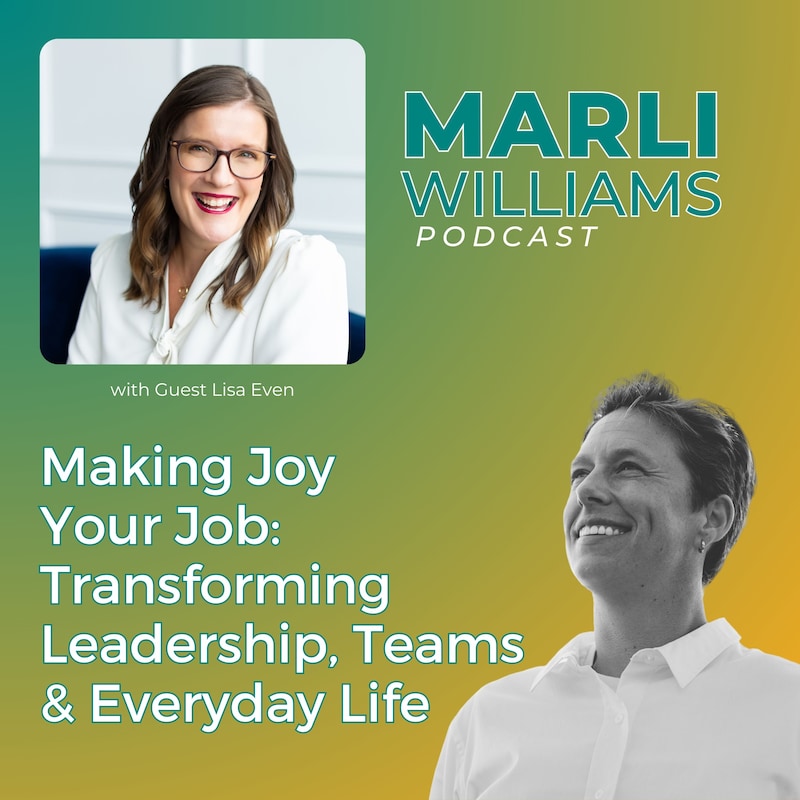
Are you ready to make "joy" your job? Lisa Even, author of Joy is My Job, joins host Marli Williams to spark a conversation about the power of authentic leadership, the ripple effect, and transforming workplace culture.
Curious how to turn everyday tasks from "crappy to happy"? Lisa shares actionable strategies for weaving micro-moments of happiness and fun into your life—even on the busiest days. From creating "joy lists" to simple mindset shifts, discover practical ways to boost team morale and productivity.
Whether you’re a leader, coach, or someone seeking more meaning at work and at home, this episode is packed with inspiration, laughs, and a few challenges to actually try. Tune in for your invitation to stop waiting for joy and start creating it!
Lisa Even is a keynote speaker, bestselling author, and leadership coach who helps teams create what she calls a ‘Good Ripple Effect.’ With a background in healthcare operations and team leadership, she now works with companies like ESPN, SHRM, and Disney to teach leaders how to show up with presence, build trust fast, and shape stronger cultures.
She’s also the host of the Have Good Ripple Effect Podcast— and today, she’s here to bring insight, energy, and practical tools you won’t want to miss.
Marli Williams is an international keynote speaker, master facilitator, and joy instigator who has worked with organizations such as Nike, United Way, Doordash, along with many colleges and schools across the United States. She first fell in love with transformational leadership as a camp counselor when she was 19 years old. After getting two degrees and 15 years of leadership training, Marli decided to give herself permission to be the “Professional Camp Counselor” she knew she was born to be. Now she helps incredible people and organizations stop waiting for permission and start taking bold action to be the leaders and changemakers they’ve always wanted to be through the power of play and cultivating joy everyday. She loves helping people go from stuck to STOKED and actually created her own deck of inspirational messages called StokeQuotes™ which was then followed by The Connect Deck™ to inspire more meaningful conversations. Her ultimate mission in the world is to help others say YES to themselves and their big crazy dreams (while having fun doing it!) To learn more about Marli’s work go to www.marliwilliams.com and follow her on Instagram @marliwilliams
Give us a review on your favorite platform and share this (or any) episode with a friend.
Let's Lead Together and reach more people - we appreciate your support!!
Transcripts
We feel it is important to make our podcast transcripts available for accessibility. We use quality artificial intelligence tools to make it possible for us to provide this resource to our audience. We do have human eyes reviewing this, but they will rarely be 100% accurate. We appreciate your patience with the occasional errors you will find in our transcriptions. If you find an error in our transcription, or if you would like to use a quote, or verify what was said, please feel free to reach out to us at connect@37by27.com.
Lisa Even [:
The hardest thing, I think that if you create a joy list, we created one, and it was going to be like, take our kids to a movie. And in my mind, I had this, like, amazing. Like, it was like, oh, it was gonna be so good. That was the cutest movie. Our kids were little. We get to the theater. Our oldest didn't take a nap. They were so loud and disruptive in this movie, rolling around on the floor, which is disgusting.
Lisa Even [:
And I turned to my husband. I'm like, we have to leave. So we end leaving early. We're in the parking lot, and I'm like, we can't count this as joy. You know, like, being sad that we had carved out the time for this thing and it was not, in fact, joyful. And as we're having this conversation, our kids, he kind of turns and he's like, hey, look at that. And our kids were chasing each other in circles on the grass, having the time of their lives.
Marli Williams [:
Hey, everyone, what's happening? I am super stoked to welcome you to the Marli Williams Podcast, where we will explore authentic leadership, transformational facilitation, and how to create epic experiences for your audiences every single time. I am your host, Marli Williams, bringing you thought provoking insights, expert interviews, and actionable strategies to unlock your potential as a leader, facilitator, and speaker. Thank you for joining me on this journey of growth, transformation and impact. Let's lead together. The Marli Williams Podcast begins now. Let's dive in.
Marli Williams [:
Well, hey, everybody, what is happening? I'd love to welcome you back to the Marli Williams Podcast, where this week you are in for a treat. As always, we have some amazing guests on the show, and this week we get to hang out with Lisa Even, who is the author of Joy is My Job. I am here for it. And she's an author. She's a keynote speaker, an amazing leadership coach. Lisa, welcome to the show.
Lisa Even [:
Thanks for having me.
Marli Williams [:
Oh, my goodness. I'm so stoked to have you. You're just like, this is the book that I wrote. And I'm like, this is the jam. Joy is my job. I am here for it. One of the ways I love to kick things off is invite you to share a little bit of your story, your background, your journey, and what's brought you to doing this work. Speaking on stages, sharing about the ripple effect and joy and bringing joy into, like, the leadership space.
Marli Williams [:
I think that that's like such a cool and important connection now more than ever. So what brought you to that message that called you to bring that out into the world.
Lisa Even [:
Well, I will tell you what. I have a background in leadership, so operational leadership in healthcare. And I always say, like, healthcare is amazing and sometimes kind of awful because you're really kind of, like, saving lives. It's highly protocolized. There's a lot of regulation. The hours are 24 7. And so being in that world as an operational leader, really, when I was leading, I would say to my team, guys, we have got to have good ripple effect. Like, we are here more than we're with our families.
Lisa Even [:
And so it kind of became this social contract of sorts, or like I always say, like an anchor that we could really anchor to. So that's where the have good ripple effect piece came from. Alongside of that, outside of work, I was feeling burnt out, and I turned to my husband one night and I said, I'm exhausted. Like, we have so many responsibilities, and we put them on our calendar. I said, I just want to look at our calendar and see something else. Like, see something other than all the things that we have to do. I want to see, like, some joy. I want some fun things.
Lisa Even [:
And I said, I think we have to make Joy our job. Like, if we wait for our kids to sleep through the night and, you know, for that project to be done and for, you know, to buy a house or all the things that we have lined up in our mind, I said, I think if we get to the end of our lives and look back and think, like, wait a minute, I think we were supposed to have joy. Joy back then. And so he turned to me and he's like, okay, well, how do we make Joy our job? And I said, I have no idea, but give me a few days. And I eventually realized I'm going to buy a whiteboard at Home Depot, and I'm going to have him hang it in our bedroom. So we hung this giant whiteboard right next to our bed. And he looked at me like I was a crazy person. And I said, hear me out.
Lisa Even [:
I think the first order of business for making Joy our job is to create a list, A list of things that we used to do, could do, want to do. And sometimes the only time we're together is when we fall asleep, and I want to add to that list, and I want to wake up, and I want it to be the first thing I see. And I just want to start making that list and checking things off. And after a few months, we were like, we're not only making the list, we're putting it on our calendar. And. And fast forward to today. Almost like eight or nine years later, our kids have joy calendars, they have joy lists. And we sit down once a month, almost like a staff meeting of sorts, and turn to each other and we go, all right, do we have enough joy? Do we need to add some more? So that's really what I'm all about.
Lisa Even [:
I always say life and leadership. And the joy piece has been the best thing we've ever done in our whole entire life.
Marli Williams [:
Oh, my gosh, I love that on so many levels because it's so tangible. It's like we have choice points. Like, I think about, like, this moment where you could make a choice of, hey, I'm burned out, I'm depleted, I'm overwhelmed. And if anybody's listening out there, you know, within the healthcare space and a leadership space where you're. There's just so much coming at you and it feels overwhelming. And I think so often we get stuck in that space and almost kind of like this complacent. Like, this is the way that it is, and this is just how it's gotta be. And that's just how, you know, and we kind of, like, accept that new reality versus having, like, making a new decision and saying, I don't want to.
Marli Williams [:
I don't want to live this way anymore. And what a beautiful perspective. Like, I don't want to get to the end of my days whenever that time may be, and look back and be like, man, I'm so glad I worked so much.
Lisa Even [:
Exactly.
Marli Williams [:
And I was miserable and didn't allow myself to do the things that brought me joy. And it's like, time. There is so much research. Actually. Like, my partner, who's a nurse, just sent me this article of a woman who sat at, like, 300 bedsides for people that were passing. And, like, there's the hospice research of, like, I wish I would have let myself have more fun, experience more joy, spend time with people that I loved. Like that. It's like when we.
Marli Williams [:
It's like to be able to put things in perspective and then to not just have it. I love this. Again, joy is your job. It's not just this, like, extra thing that we do when we have time.
Lisa Even [:
Yeah.
Marli Williams [:
For when the quarter's over, when this project's done, or when this thing is like. And then. And then. And then. It's like I always say, if happiness is always on the other side of success, we're never going to get there. Whatever success is the to do list, the project, the thing, and having a visual right when you wake up and actually asking yourself those questions, right? What used to bring us joy that we don't do anymore? What do we want to do that we're not doing? Right. And to take that and then put it on your calendar and have it feel like again, it's really tangible and like, that is something that everyone can do.
Lisa Even [:
Oh, a hundred percent. And I think, you know, I would say it's really, really hard at first because I say desire, permission and belief. We desire it. But then it's this bit of, like, how do I flip my mindset to know that I have permission, that, yep, we're going to do joy even if we don't have time. Like, we're going to find 5, 10, 15 minute things. And there's a ton of ideas in the book. There's joy challenges and ways to slip it in when you, I would say, like, don't find extra time. Do it in the things you're already doing.
Lisa Even [:
Like, are you eating meals? Hopefully, right? And then I'm like, okay, let's start there. Let's kind of mix up your meal with, you know, a little umbrella or a different colored drink or just something that kind of is like a little sprinkle almost. And you have to give yourself that permission. And then the third piece is that you need to decide that it's possible. Like, I can be two things at once. I can be really darn stressed and still have a little joy, right? I can have no money and still have joy. And there's a spot in the book where it asks you to write down the barriers to joy. Like, what are you telling yourself if I said to you, you know, Marli, okay, two o' clock today, let's have some joy.
Lisa Even [:
And then you catch yourself being like, well, I gotta check my email or I have to wipe my, you know, counter down in my kitchen, we tell ourselves lots and lots of things, and depending on the season of life, right. The amount of joy will look different. But usually I find the people that aren't having joy, it's somewhere in between desire, permission and belief. And so if you start to make your joy list and you're like, this is hard. It is. But hopefully be in the book. And just a little bit of Internet scouring, you'll come up with a couple of things that you're like, no, I could find five or ten minutes for that. Like, I can do that.
Marli Williams [:
Yeah. And I appreciate what you said. It's not always about adding more to our plate. And I think that's what a lot of people think it's like, I don't have time for that because of XYZ and my job and my work and my kids and my family and my, like, all of these things that I, quote, unquote, have to do. One of my mindset tricks is to help have people turn their have to's into get tos. And it's like, how do I turn those things and, like, bring more joy into the things that I'm already doing, right? Where it's like, I have to pick up the kids from school, and it's like, I get to listen to a really cool podcast or listen to my favorite songs or, you know, like, get to learn something new or get to have a meaningful conversation with my kids along the way. Or, you know, it's like, how can we. It's like, oh, I.
Marli Williams [:
I have to cook dinner again. And it's like, oh, I get to cook a fun meal I've never made before. It's like, well, we have to. We're gonna eat anyway. And it's like, how are we choosing to do the things that we, quote, unquote, have to do and that have to, have to, have to feels so hard, and it feels so heavy. And so it's like, it's not just about changing the things that we're doing. It's changing the way we're thinking about the things that we're doing.
Lisa Even [:
Boom. And actually, I call that crappy to happy. And I give some ideas in the book about there are so many unglamorous things that we do every day. Laundry, dishes. If you turn to, like, our professional worlds, maybe it's emails or spreadsheets or phone calls. And so even with my team, I would walk up to them and I would say, all right, crappy to happy. What do you got? Because they knew that we would do something crappy because we have to. And then before, during, or after, it was our job to.
Lisa Even [:
To add a little joy. And so they would often say, we've got 300 of these today. I'm like, all right, that's the crappy. What's the happy? And then they're like, all right, when we get halfway through, we're ordering Starbucks or we're walking around the building, or like, it just invited their brain to kind of say yes. And. And even, like, with laundry and chores, all of that, you know, my. My kids now know crappy to happy. Like, we got to clean the garage or we got to make beds.
Lisa Even [:
All right, crappy. Now what's happy? Like, where does that go? And it really? Just like you said, it's a mind shift to be able to say, like, well, it was this, but now it's that.
Marli Williams [:
Yeah. And I think it's not ignoring those things that feel hard and that feel heavy and that feel annoying or it's like, yeah, we're humans. We're quote, unquote, adults. I guess, you know, we gotta. There's things that we get to do as adults that might feel crappy. To acknowledge that, to name it, and then to like, I like what you said. To add something happy before, during, or after. And like, bringing in that dopamine of like, oh, we have something to look forward to.
Marli Williams [:
We're going to celebrate. And I love that what you said. We're going to celebrate when we're halfway through. Not even waiting. Like, oh, because some people, oh, I'm only going to celebrate when it's finally done.
Lisa Even [:
Yeah.
Marli Williams [:
No, and sometimes things, you know, it's like, oh, we're going to celebrate halfway through because it's like, we can appreciate and acknowledge what we've done and we can fuel ourselves and replenish ourselves to do the rest of it and have both. And so that's such a beautiful thing. It's like, turn crappy to happy. What can you do before, during, or after maybe a challenging or annoying or draining task at home or at work and bring more joy? And so it's brilliant. It's brilliant.
Lisa Even [:
Thank you.
Marli Williams [:
So I'm curious, so you have desire, permission, and belief. What are the things, like, when you have people, when you've worked with teams or companies or organizations and they're like, what do you think people believe about joy that stops them from having joy or creating joy or, like, bringing more joy in, like, what's like the. It's like, I kind of want to acknowledge, like, the pushback or the resistance or the like, Lisa, this sounds great, but. Da, da, da, da, da, da, da.
Lisa Even [:
Right.
Marli Williams [:
What do you hear or see from again, individuals or organizations or teams or leaders where they're like, meh.
Lisa Even [:
I often will hear. And I do keynoting on this. I do workshops on this. We will talk in two directions. So individually, I once had a woman stand up in more of a workshop setting, and she was like, you know, Lisa, I have enough joy, thanks. And I loved it. I let it hang because I wanted the room to hear it. If you don't have a desire for it, perfect.
Lisa Even [:
But if you do, right. Like, joy is a choice and it's yours to have when you want it. And then we talk about it from a team perspective, and usually I will. If they kind of give me some pushback, I'll say, hey, actually, hold on. Can you tell me a little bit about your team? And they're like, we're burnt out, we're stressed, we're overwhelmed. And I'm like, what does burnout, stress and overwhelm due to your productivity? And they're like, it's terrible. And I'm like, I bet it is. I bet it is.
Lisa Even [:
If we were not in fight or flight mode, right? Especially like the world I came from, we were because we were saving lives. I was like, what if I could carve out just a bit of time for your team to get out of fight or flight mode? And I can actually say to you, we're going to give them a little joy that's going to feel like jet fuel. And you're going to see a difference in your satisfaction from your engagement surveys. You're going to probably see some satisfaction on, like your morale turnover. What would that look and feel like? Because oftentimes the thing that they want and the thing that they're doing have a disconnect. So they want to be really productive, but the thing that they're doing is just working themselves to death. And we all know, like, if we take a day off, we feel a little bit refreshed, right? Like, we were just talking, Marli, about a vacation that you're going on. You're not, you know, like, you're like packing for it.
Lisa Even [:
And when you think about that vacation, you probably think to yourself, like, oh, I can't wait to relax. I can't wait to be a little bit more refreshed. And in the professional setting, I say if you can carve out. And I'm talking bite sized, right? Like, I'm not talking because I worked fast and furious, but if you can start to identify areas where you're going to build a little bit of that in, Doyle looks a lot more productive on the pushback front. And that's where we start, is really having that conversation and tying it right to their metric, but also to how they're feeling right now.
Marli Williams [:
Yeah, I love that so much. It's like, what's the current narrative or the story? And it's like, well, you say we want to be like efficient and effective and productive and innovative and creative and all these things, yet our team is exhausted, overwhelmed and burned out. You said something that I love that, like, what if joy was the jet fuel? And it is, you know, because when people are in their joy, they have more energy to give to their teams, their companies, their patients, their organizations. And like you said, it's. It doesn't have to be. Sometimes we think it has to be like a huge, long vacation or these big, grand moments or this, like, again, this. The vacation that you wait for all year versus having these, like, micro moments of joy that you get to choose and create throughout the day.
Lisa Even [:
Yeah. One of the. One example that I'll give that would probably feel a little non traditional in a more of like a leadership setting, and I think it works for entrepreneurs and speakers and coaches is all of the things that you have to do. What if you actually got 15 or 20 minutes to do something you want to do on my teams once a week, even in. I'll give you examples of someone who has to sit at a desk, right? Like, they can't just stop what they're doing and be like, oh, just kidding. But oftentimes what we would do is we would rotate so they would get 15 or 20 minutes each week to work on something that they were passionate about in our space, Something that maybe they enjoyed. Now, are we talking vacation level joy? Probably not, but it was just this, like, cat nod to saying, I want you to enjoy a little bit of, like, the work that you do. And I kid you not, some of those people who are taking their joy time that 15, 20 minutes where basically they weren't doing the normal job that they do, and they got to think about something they either wanted to fix or something they wanted to create or something they were just curious about.
Lisa Even [:
Like, sometimes they would go into a job Shadow in another department for 30 minutes because they're like, I want to go see what that's like over there. It did wonders for our morale because people got to think about, you know, what is it that I care about now? Some weeks were better than others. We couldn't always rotate, and it wasn't easy to coordinate from a leadership standpoint. But joy can actually be like taking a few minutes to work on the thing that you want to. And I try to do that in my business of. I have a. If you saw my to do list, it's. It's nuts, right? But I try to take 20 minutes every week and just work on something that's like, the flavor that I want to taste like.
Lisa Even [:
Maybe I want to work on writing a book or creating something new, and it's actually okay that it's not gonna get me, like, the thing on the to do list checked off. That's joy.
Marli Williams [:
Yeah. It's like Those little things. And it accesses, like, a different part of our brain. And I think, you know, sometimes it can reframe of, like, what are the parts of my work or my job that do excite me or light me up, that maybe I'm not giving myself the time or permission. Right. Which permission is a big piece of it to explore. Because we're so focused on this, like our should list, our have to list. And it's like this, the want to list.
Marli Williams [:
What do I want to like again, what do I want to focus on and work on? What am I curious about? And how much that can fuel us in our. Again, in our creativity, in. You know, like, when you're doing the cross department, you understand what people do better. There's maybe, like you said, better morale, better communication. And I love this idea of like, to create a culture of joy. You know, it sounds like having language around it, having ritual around it, like the crappy to happy. And I'm curious, you know, as a leader, if there were any other tools that you instilled or that you use, like some of these principles, like, what do you want to do? Turn crappy to happy. Which I love these.
Marli Williams [:
And it's like, I think sometimes we live in a world of society and a culture where like, work equals hard. Work is supposed to be hard. If I'm. If it's not hard, then it's not work. And we have this association with it where it's like, well, what if it could be fun? And especially when we have a job that feels like, again, serious or heavy, you're saving lives, you're having important work and documents and all these things. And we take ourselves so seriously that we think if we expand experience, fun, player, joy, then people aren't going to take us seriously. Or that, like, I think it's like changing the narrative and changing the paradigm around, like, what work is and what it gets to be. Because so often our mindset is like, I have to have a job, I have to go to work, I have to do these things.
Marli Williams [:
And again, we run ourselves ragged and we run ourselves because we have this story and this narrative and to weave joy into the conversation. Not just it's like, do joyful things outside of work, which is important, but, like, bringing joy into the work.
Lisa Even [:
Yeah. And for me, you know, it's funny, I tell a story in one of my keynotes about how I was sitting there with my supervisors and we were listing out all of the. I was. We were basically acting like firefighters, TV news reporters, as if, like, Here are our metrics. And today we've got, you know, da, da, da. As if our team wasn't already a part of that, you know? And I. And we kind of then moved into cheerleading. So we were doing those three things.
Lisa Even [:
Firefighting, news reporting, and cheerleading. And we were. My supervisor and I were sitting in my office and they were listing out all of the things of the day. And I got thinking, all of those things of the day aren't actually getting us to where we wanted to be. Why aren't our metrics changing? Why are people feeling a little bit overwhelmed? Like, what are we going to do about it? And I said to them, I said, what if we shifted and we became almost captains of a ship, where we had, like, our end destination in mind, and then we would start to, like, chart our course to that. And I said, well, I think we need some, like, anchor points. And so they became our team statements. And we really had two main ones and a few, like, sub ones.
Lisa Even [:
And they were have good ripple effect and work hard, play hard. And at the time, which really then spawned joy as my job, that was what we said to ourselves day in and day out. Like, I want to see good ripple effect, whether it's with each other, with the work that we're doing. Like, I want to see the chain reaction of good coming out of it, potential possibility, productivity, innovation, friendliness, kindness. Like, I should be able to look and see that everywhere. The other one was work hard and play hard. And I wanted people to know the expectation from senior leadership me was that. And so we started to have the conversation just kind of in passing with people, and we would drop those lines almost like stones, creating little mini ripple effects of like, well, that's good ripple effect right there.
Lisa Even [:
And we just started to add the language into our department and our team so that people got used to it. And then we had an official staff meeting where we said, hi. Like, these are really, really important things to our leadership team, and we would love your help in continuing to do that. So when we actually interviewed people, there were questions on our interview sheet that our staff would use with potential candidates. So three or four of our staff would usually interview with a candidate. And I would say to them, okay, you know, on your question sheet, there's questions about what is good ripple effect to you? And what does it look like out in the workplace? And then there was also a question around, what do they like to do for fun? And so when my test, you know, staff would go in the room before they'd go in I'd be like, you know, this candidate is going to drop their guard with you because you're not the leader. They act all professional with me and you. It's your job to figure out if this.
Lisa Even [:
If this candidate should get a spot on our team, can they have good ripple effect and are they going to work hard and play hard? And if the answer is no, they had at the top of their sheet, they could tell me whether they thought we should hire this person, not hire this person, or, like, hold, like, maybe, like, they're a maybe. And those were some of the best I would get some of the best responses of, like, told me about a time where they yelled at a patient. And I'm like, that's not good ripple effect. And the person literally would write on their sheet, not good ripple effect. And so it really became our way of, like, policing one another. And so I wanted to infuse it everywhere. So if you don't have team statements, even if you're a party of one, like, if you own your own business, like, you need team statements. And then you need to be kind of thinking to yourself, like, are those showing up in everything that I do? And that's really how we started to shift the needle, because we didn't always need to play firefighter, TV news reporter, or cheerleader.
Lisa Even [:
We need to really kind of be the ship captain of, like, this is the expectation that we set and we're going to charter for that direction.
Marli Williams [:
I so appreciate that. And it's like having infusing those statements into the hiring process and interview process and saying, like, this is how we do things here. I mean, this really is like, how do you build team culture, company culture? Do you feel like when you brought this into the workplace that people were like, this is a great idea. I'm super bought in. Did you have any, like, inner resistance to the, like, they're like, okay, were they, like, eye roll? Were they excited? Like, did it take time for people to kind of get it, like, the crappy to happy? Like, some of this stuff, you're like, okay, I am listening to this and it's like, yes. I'm like snapping my fingers. I'm like, I'm here for it. But, like, you know, whether you're leading yourself or you're leading a team, and you bring these new concepts or principles into play and, like, joy is our job and have a good ripple effect and work hard, play hard.
Marli Williams [:
And, like, this is what that looks like. This is what that sounds like. Was that something that you brought in and yeah, they were like, great. Sounds good. Was it co created with them? Like, because I think that this idea of like building a company and team organizational culture around joy and understanding, like, you know, my whole thing is about energy.
Lisa Even [:
Yeah.
Marli Williams [:
And the big question I ask people is what shows up when you show up? Bring the weather, baby. You walk into a room, a meeting, an organization, a team working with a patient, a client, a team member, or like some people, you know, especially in healthcare or like education, it's like they're really, really, really good with the patient or the student. They have so much patience. And then when it comes to the team dynamic, they're like, like, cutting each other. Like, it's like, I will cut a bitch. You know, like, people get. People get crazy with each other because they're like, I use all my patients on the patient, and now I'm like, have none left to like, share with my team.
Lisa Even [:
Yes. And to answer your question, at first I just started saying, like, work hard, play hard, and have good ripple effect for about a month. I would just try to sneak it in. I was just like dripping it, you know, and nobody said too much about it. No one cared, really. And then as a leadership team, we were talking about the importance of having those anchors, having those, like, pieces that we really felt were kind of like our values and our ground rules. And so we came to the team and we said, hey, we would love help developing team statements. The leadership team, we came up with two have good ripple effect, work hard, play hard, but we need help coming up with more.
Lisa Even [:
And so they helped us come up with three or four more. I led many teams, so each team had their own set because it was their own ecosystem. And then the other things that we did is we actually. It's so funny, you and I are like kindred spirits because, like, in my keynote, I talk about how you show up first. So we started a lot of it with, like, how do we show up? Like, how are we showing up with each other? And. And then we kind of tipped into how are we engaging. So how like, the people that drive you bonkers, like, how do we do that better? And then the third piece was really around this idea that if we zoom out, culture is all of the ways of being. It's our habits, it's our traditions, it's our behaviors, it's our attitudes.
Lisa Even [:
And so in my keynote, I talk about attitudes, behaviors, and beliefs. And we started to really notice what behaviors, what attitudes, what beliefs were going on. So things like, nothing ever changes around here. You can imagine Attitudes turn into behaviors which turn into beliefs. And so one of the behaviors that I tackled really early on was, are we too busy to be friendly? I actually asked 20 people in my one on ones.
Marli Williams [:
Wow.
Lisa Even [:
I just, like, real, you know, casual was like, are we too busy to be friendly? I got eight yeses.
Marli Williams [:
Wow.
Lisa Even [:
And I was like, so we are. And they're like, we are. And then I would start to have conversation around, like, tell me why, like, I wanted to try on their glasses and see it from like, what they saw. And I'm like, oh, I see, like, got it. And then, you know, it takes time. And then we circled back in smaller pods and our staff meetings and had the conversation around, like, what if we could be busy and friendly? Like, could we? And some of the people loved it. Some of the people were slow to like, they resisted it. But over time, it became just the way that we are.
Lisa Even [:
If I said to people, you know, do you order online? Probably 85, 90% of people will be like, yeah. And I'd be like, can you remember what it was like before you could order online? And they're like, geez, I barely remember. It really was this idea that if we started to infuse it slowly, that after a while people would forget what it was like before. It's kind of like the Internet. It's like, I kind of remember what it was like before that, but not really.
Marli Williams [:
I really appreciate you sharing that because I think sometimes when we get a new idea as a leader, we're like, we want to, like, kind of like bulldoze our ideas. And we're like, this is how we're doing it now. You know, it's like planting those seeds. And I always tell it's like, people do what you do, not what you say. Am I modeling this too? Am I saying these things? Do I believe these things and am I doing these things? And I like this, like, the soft launch approach where it's like, we're saying these things. What are people saying? Am I getting feedback? I appreciate that question. Are we too busy to be friendly? I mean, for any leader in any organization where people are constantly saying they're busy, what a brilliant, beautiful question. And it's like, can we be both? And there was something that struck me in that, because it's like, oh, if we're busy, we can't be friendly.
Marli Williams [:
Or if I have joy, I also can't be stressed. And it's like, it's the power of duality. It's like, I can be both busy. And I Can also choose to be friendly. I can be maybe have a stressful day or week or feel overwhelmed. And I can also experience joy, think. Sometimes we kind of get in this black or white, all or nothing mentality. Either we're friendly and we are patient.
Marli Williams [:
We have time with people. And, like, this is like. That feels like never never land. Or you're like, great, sounds good, or we're busy, stressed out assholes to each other. And it's like, what would both look like? And can we. It's like, can I hold the duality? And that. That is like, being human. Hold the duality of, like, wow, this is a really hard moment.
Marli Williams [:
And how can I bring some love, joy, or compassion, grace for myself, grace for my team, like, to this moment and, you know, really taking. I think it's like I say, I always say leadership is about taking 100% responsibility for the energy you bring when you walk into any room. And again, it's like, leadership isn't just, like, the person at the top. It's like we're all leading in some capacity. And, like, it's really starts with, like, am I. Am I showing up for myself? And again, when I. When joy is my job, it's not extra. It's essential to both at my work and at home.
Marli Williams [:
Because sometimes people give so much to their job that when they get home, their friends, partner, family, roommate, puppy dog, kitty cat gets the worst of them. You bring your best to your work and your worst when you leave because you're just so drained and so depleted. And when we can bring joy into both arenas, it's like, when you go home, what are you excited about or what are you looking forward to or what? Like, again, creating those, like, little joyful micro moments as, like, you say, it's like an umbrella in your mocktail or whatever it is. It's like those little things. What are some of your favorite. I'm so curious. What are some of your favorite little, like, micro. I mean, definitely for people listening, get this book, because this is the jam.
Marli Williams [:
But, like, give us a little taste. I know that you have a list, but I like, for those things that we, quote, unquote, like, have to do as adults, what are some ways that you have made those more. That you've brought more joy to those moments?
Lisa Even [:
Yes. And I will give it to you in. I'll give you it in a joy challenge, and then I'll give you, like, what we do.
Marli Williams [:
Ooh, I love it. I love a challenge. Let's go.
Lisa Even [:
All right, so the challenge that I would give you. And I give this to teams is one hour challenge. If you. If I told you, look at your calendar and find one hour for joy. Our family, this is how we do it. My husband and I, we don't have time for date night. Like, that would be nice. But our kids have sports and we have activities.
Lisa Even [:
So oftentimes, once a week, once every couple weeks, our kids get home from school, you know, 3, 3:30. We turn to them because they're older now, and we say, would you like technology and a snack? And they say, why, yes, we would. And then my husband and I say, perfect, we're going on a date. And we literally go on a date for one hour. And most of the time, it's actually. We have a list of coffee shops printed on our fridge. And we literally, like, go and we go to the place that, like, we're like, we're going here. So we get in our car, we drive to the coffee shop, we order our coffee.
Lisa Even [:
Sometimes we have time to drink it there, Sometimes we drink it in the car. And then we get back home, and we're like, hey, back to life. I have this thing with a friend. She'll literally call me, and she says, hey, you got 15? I say, yeah, I got 15. Where are you at? And usually, you know, she's somewhere in the area. And she literally is like, all right, I'll be there in five. I grab, like, two LaCroix out of my fridge. Sometimes a beverage of, like, alcohol.
Lisa Even [:
If it's later in the day, we stand in my driveway, we drink our LaCroix for 15 minutes, and then she leaves, and I'm like, back to it. Bye. So it's like, what could you do with a one hour challenge? And if you say to yourself, one hour is too much. Okay, 30 minutes. And if 30 minutes is too much, you say, okay, what do I. What can I do in 15? So that's my first one.
Marli Williams [:
Love it.
Lisa Even [:
I'll give you three.
Marli Williams [:
I am here for it. This is so good.
Lisa Even [:
One of the things that I always say is, get in someone else's joy. Like, be in someone else's joy. Because part of me is like, I can't think of anything to do for joy. Okay, great. So once a month, I sit down with my husband and I get in his joy. He loves sports. So oftentimes we're watching, like, the game of his choice. Now, could I care less about this game? No, I could not.
Lisa Even [:
But I sit there, and he turns it on. And my whole job in that moment is to enjoy his joy. So he's like, did you see that guy running for 30 yards? And he threw to so and so and he ran the whatever. And I'm like, he did. I'm like, is that a lot? And he's like, it's so much right. Like, he just gets more excited and inadvertently, like, his contagious joy is contagious to me. And so if you can get into someone else's joy, whether it's a friend or a family member, like, go do the thing that they love for none other than just loving the thing that they love. So that would be number two.
Lisa Even [:
And then I would say, probably one of my other favorite things that we do is to host a party. And what I mean by that, because if you're sitting here thinking, lisa, I hate parties. We have hosted freezer meal parties where people bring crap from their freezer and we make it at our house. We have hosted. Last year, we hosted a frozen and flannel party where you literally could dress, like, sparkly or wear flannel. We have had fake Thanksgiving. My good friend texted me. She goes, lisa, you know how you always tell people to host a party? And I'm like, yeah.
Lisa Even [:
And she's like, you know how I hate people? And I'm like, yeah. And she goes, I had a party. And I said, you did? And she goes, I did. I had a garden party. And I was like, oh, my gosh, this is amazing. And this is what she did. It was the cleverest thing I've ever seen. She literally went to Goodwill, bought empty vases, put them in her garden, texted all her friends, and said, hey, I'm hosting a garden party where you can come and pick your own flowers.
Lisa Even [:
I left you a vase. I won't be at my own party. Love you. And people all day long were stopping by when they had a minute to, like, pick flowers out of her garden, put them in their vase, and texture a picture. And she goes, it was the best party I've ever not been to.
Marli Williams [:
And I'm like, oh, my God.
Lisa Even [:
Like, that is how it's done.
Marli Williams [:
I am here for it. That's so good.
Lisa Even [:
I am here for it. So if you can just come up with something where you can kind of tweak what you're either already doing or, you know, get people centered around an idea, I would just say, and if you. A theme is a great thing. ChatGPT or Google will give you, you know, Mexican themed or Halloween themed. You could theme a meal, an hour of your day, a party like, get after it.
Marli Williams [:
Get after it. That garden party idea is the funniest shit I've ever heard. I'm here. I love it.
Lisa Even [:
I know. I was like laughing. I'm like, I did not get an invite. I just want you to know she actually lived about two hours from me. But yeah.
Marli Williams [:
Are you going to drive two hours to get some flowers?
Lisa Even [:
Yeah.
Marli Williams [:
I love these because it's just like, it helps us to sometimes like, think outside the box. I think we can get stuck if we've been out of our joy for so long. You know, sometimes that, that initial question of like, what brings you joy? People are like, I don't know, what's that? I'm not familiar with the term, the word or the feeling.
Marli Williams [:
Exactly. You know, I had a friend, you.
Lisa Even [:
Know what he does for Joy? He goes, I make a pot of coffee every morning and before it's early, before my kids wake up, before I head to the gym. And he goes, my joy is standing at that coffee pot for like five minutes and just watching it brew. He goes, it smells delicious. I have like five minutes to myself. And he goes, and I'm just grateful to be alive. And I was like, huh. So I caught myself like standing at my coffee machine just like, you know, 20 seconds longer of like, this is joy.
Marli Williams [:
This is joy. Yeah. And so it's like, I think that that invitation to everybody of how can I find joy? And maybe the mundane moments or the normal everyday moments that we have, you know, it's like to really like ever, you know, you make that cup of coffee and like that first sip and it's like, I think that Brene Brown has a great term. She calls it foreboding joy. And I don't know if you talk about that or speak to that at all, but it's like so often I think that we limit ourselves. We like dampen our own flame and we don't allow ourselves to feel the joy of those moments because in some way, like, we think that again, it has to be like the big trip, the big vacation, the big party, where it's like every morning you wake up and you, yeah, you savor the beautiful fall leaves that are changing and falling from the tree, you know, and like going for a walk. And it's like, maybe it's not your hour long walk, maybe it's a five minute walk, but it's like, can I savor the sweetness of my life? Can I be present to those moments and like that I'd like to see. It's like I can choose joy in these moments.
Lisa Even [:
Yeah. And I will say the hardest thing. I think that if you create a joy list, we created one, and it was going to be like, take our kids to a movie. And in my mind, I had this, like, amazing. Like, it was like, oh, it was gonna be so good. That was the cutest movie. Our kids were little. We get to the theater.
Lisa Even [:
Our oldest didn't take a nap. They were so loud and disruptive in this movie, rolling around on the floor, which is disgusting. And I turned to my husband, I'm like, we have to leave. So we ended up leaving early. We're in the parking lot, and I'm like, we can't count this as joy. You know, like being sad that we had carved out the time for this thing and it was not, in fact, joyful. And as we're having this conversation, our kids, he kind of turns to and he's like, hey, look at that. And our kids were chasing each other in circles on the grass, having the time of their lives.
Lisa Even [:
And I. I think it was mission accomplished. No. And so sometimes it's like if you set out to create joy and maybe it looks a little bit different, like the vacation you planned, you're. You're delayed on your flight or, you know, you were like, we saved this Friday night for this thing. I would say, like, crappy to happy. Like, in those moments, how can you shift and still find the joy? And I think that's one of the biggest pieces of advice that I have for folks is to get out there and do it, but also be a little like, you know, give it some grace of maybe it's not as nostalgic or exciting or it just doesn't go the way you want. But that doesn't mean you can't count it as joy.
Marli Williams [:
Yeah, I think. Yeah. To not put so much pressure on it or to force it. It's like we can be intentional with creating the joy, but like.
Lisa Even [:
Yeah.
Marli Williams [:
Not be so attached maybe to.
Lisa Even [:
Yeah. To the outcome.
Marli Williams [:
That's the whole point. That's the whole point. Well, this was absolutely phenomenal. And what I love about all of this is this is like, it's so tangible. There are challenges that people can do, whether it's finding that joy hour, getting into others joy, which I love. Like, my partner talks. There's a word called conversion, which is like finding joy in other people's joy.
Lisa Even [:
Yeah.
Marli Williams [:
And like throw a party. Throw a party for yourself. Throw a garden party, throw a Halloween party, whatever it is, you know, Christmas party, it's like holiday party. Season, whatever your flavor, whatever your version is of that. So I would love, as we wrap for today, maybe for you to share any final thoughts, words of wisdom, advice as we send people out there to make joy their job and then where people can find you, learn more about you, all that good stuff.
Lisa Even [:
Absolutely. I would say the last thing that I would want people to be thinking about is that you happen to the world, not the other way around, that there are so many things that you can't control, but you can control how you respond to it, whether it's having good ripple effect or joy. And so, yeah, you happen to the world, not the other way around. And you can find me at lisaeven.com and then I'm also on social media, Facebook, Instagram and LinkedIn. I put out a weekly newsletter with fun and funny stories and joy ideas and leadership things so you can sign up on my website. But yeah, you happen to the world, not the other way around.
Marli Williams [:
Dig it. It's so good, Lisa. Oh, my gosh, this was fire. This was magic. And you know, I could feel all of the joy bubbles, people having all of these ideas of how can I bring more joy into my life, my days, my work, my family, my friends, my partnership. And definitely check out the book and information. Without implementation, my friends, is just information. So it's what we do with it that will change your life.
Marli Williams [:
So take one of the, the moments, the challenges, pick up the book and really bring this to your life in a, in a deeper and bigger way. So thank you, Lisa, so much for sharing your joy with all of us today. For those of you out there listening, take action on this. Like this, Love this, rate it, review it, share with a friend who needs more joy in their life. Think about them, send this over, create more joy, be the joy, see the joy. And until next time, take care.
Marli Williams [:
Thank you for joining us on another inspiring episode of the Marli Williams Podcast. We hope you're leaving here with renewed energy and valuable insights to fuel your leadership, coaching and speaking endeavors. I'd love to invite you to subscribe, rate and review this podcast to help us reach more aspiring leaders and speakers like you. You. We have more exciting episodes and remarkable guests lined up, so make sure to tune in next time. Until then, keep leading with purpose, coaching with heart, and speaking with conviction. This is Marli Williams signing off. See you next week.