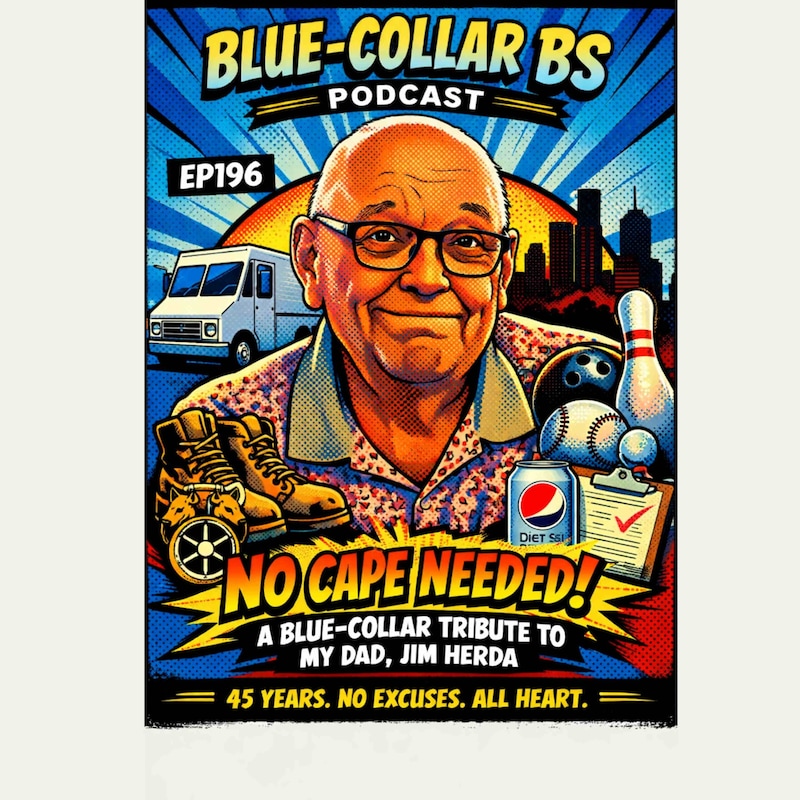
Brad's father recently passed away, inspiring us to take time to honor the everyday heroes who show up without seeking recognition the people who teach us the most important lessons without even realizing they're doing it.
Brad shares memories of his father who worked as a Teamsters driver and never missed a day of work, taught discipline without lectures, and showed integrity by owning mistakes when his job was at risk.
The lessons came through presence rather than instruction being available when needed even if lengthy conversations weren't his style, showing up consistently for 45 years regardless of how he felt, and demonstrating values through actions instead of words.
We explore how the most powerful teaching happens through observation rather than explanation, why consistency builds the credibility that matters when mistakes happen, and how being present counts more than being perfect.
Highlights:
How daily consistency builds the kind of credibility that carries you through mistakes and tough times.
Why the most important lessons get taught through actions and presence rather than lectures or explanations.
What integrity looks like when you have to own up to decisions that put everything at risk.
The difference between being available and being perfect why showing up matters more than having all the answers.
How learning to observe patterns and connect dots comes from watching people who lead through example.
Please subscribe to Blue Collar BS where we talk about the real gaps between generations in blue collar work and what it takes to lead across different age groups in today's trades. Sometimes the most important episodes aren't about business at all they're about the people who shaped who we become.
Welcome back to this episode of the Blue Collar BS podcast. I am your cohost Brad, along with the wonderful cohost sitting in Detroit, Michigan.
Doyle (:
Steve, we got it. Yeah, got it. Yeah, got it. So today we kind of want to talk a little different topic and we want to talk about maybe some of those everyday heroes that we don't necessarily give. We don't talk about a whole lot. We don't talk about our influences a whole lot, but.
Brad Herda (:
There you go. Hit your marks, Steve. You gotta hit your marks. People don't have time for no there.
Doyle (:
I want to take a moment today to actually talk about one of Brad's everyday heroes that never wore a cape. So Brad shared a little bit online that his father passed away recently and that he never wore a cape and that he never needed to. So I want to talk more about what that actually means from how that impacted you,
and how your father helped shaped who you are today.
Brad Herda (:
Alrighty, we'll see if we can get through this. This will be back to the 1980s, a very special episode of Dallas.
Doyle (:
Yeah, so this might be a little heavier and a little different than...
Doyle (:
For those that know what Dallas is other than it's a town in Texas.
Brad Herda (:
Yes, this may be a very emotional journey. might not be. We'll see what happens. We'll see where everything hits.
Doyle (:
Yeah. Yeah. So you happen to post on LinkedIn that your father, showed up for work every single day, matter how he felt.
Brad Herda (:
I don't remember a sick day ever and if there was it was because he had a surgery or actions and while he got hurt, right? I remember him blowing out his Achilles when we were at a softball tournament. So he couldn't necessarily go to work that week that couple days. It was medical, but the sniffles, the colds, the coughs, the flus, the whatever's. don't remember a single day being missed.
Doyle (:
Mm-hmm.
Doyle (:
So your dad, tell everybody what did your dad do?
Brad Herda (:
So when I was really young he worked at a grocery store called Red Owl as a produce guy and then Red Owl grocery stores went away here locally and then he went to work for an organization called American Industrial which was all of your the old rotary hand towels that were in the in the locker rooms and bathrooms industrial towels uniforms rags all that type of stuff so a driver
Doyle (:
Mm-hmm.
Doyle (:
Mm-hmm.
Brad Herda (:
driver sales for them and then went and was there until he retired. Teamsters local driver, drivers union, he was a union steward, union rep, management rep for the union, did a lot of different things there. I remember him going through some negotiations where, right, they're trying to get some insurance costs and pension things and the contract that was offered by the company supported that, but they were
Doyle (:
Mm-hmm.
Doyle (:
Mm-hmm.
Brad Herda (:
Union rejected it because they wanted like 25 cents an hour.
Doyle (:
Mm-hmm.
Brad Herda (:
And he was so frustrated and so pissed off about that. It's like, no, he was at a different point in life because he was, he had his family, different things. He was probably 40s ish at that time. Um, where everybody else is in their 20s, early 20s, early thirties. So it's like, yeah, give me the money. Yeah. So, you know, if I put him at 40, so 44 plus 40 that in 1984, 85 ish.
Doyle (:
Mm-hmm.
Doyle (:
Mm-hmm.
Brad Herda (:
So why my junior, junior, maybe might have been little younger than that. Junior, senior year in high school might have been before that. Might have been freshman year.
Doyle (:
OK. So what we're.
Brad Herda (:
So we did that driving and I so one of the things that was awesome back then is that got me on my path for loving industry is you could act he would have some if there was a holiday week there would be a Saturday time so I would jump in the truck and I'd go with them so we'll go see you know the body shops that he serviced the Falk Corporation in the valley here in Milwaukee right do thing walk around go see all these things
Doyle (:
Mm-hmm.
Brad Herda (:
Put my safety glasses on as this little kid doing all these things and seeing all the big machines and having all the smells and all the things and seeing all the stuff and probably did two or three of those rides. You'd never get away with that today, but back then it didn't matter. Sit in the big old truck with not just, hey, sit down on the stoop that goes to the back and hold on if something happens, right? There was no seatbelt. was no seat. There was nothing. It didn't matter.
Doyle (:
Yep.
Doyle (:
Right.
Doyle (:
Yes.
Brad Herda (:
Right, but being able to see all that industrial stuff was pretty cool as a young person to see what was going on. Now, my dad was not mechanically inclined, was not creative and willing to try to fix anything or do anything, so didn't really have a lot of that experience. That all came from my neighbors and my neighbors growing up had...
Doyle (:
Mm-hmm.
Brad Herda (:
First neighbors growing up down at the end of block they raced motorcycles God's ampak was a actually got in to be like a level one high high profile Asphalt bike race what started out in dirt and her back right in our neighborhood and we'd go down there and work on his work on his motorcycles and Do all the things and the one thing was never put wda-40 on the seat
Doyle (:
Mm-hmm.
Brad Herda (:
You know, you can put it on this on the other boots and things like that to keep it dry. But don't ever put WD-40 on the seat.
Doyle (:
Did you ever do it?
Brad Herda (:
Nope. No, no, because he's not gonna let him fall off and slide off as he was driving. No.
Doyle (:
No?
Doyle (:
You didn't ever do it just like you knew like hey if you put wd-40 on the seat, this is what
Brad Herda (:
No, no, was a wreck on his on the non race bike. Yes. But back in the day when Honda had the three wheelers, right, they had a they had one of the three wheelers and we would use that the back and the side of the alley and all that stuff. But my dad had no interest in any of those things or or any of that stuff. And I would take things apart, put it back together, do different things. But that was not his strong suit.
Doyle (:
Yes.
Doyle (:
Mm-hmm.
Doyle (:
Mm-hmm.
Brad Herda (:
I mean, I was doing break jobs of so at let's see, this would have been eighth grade. Parochial grade school, the principal nun brings her vote wagon or whatever to our house. I do the brakes on the car for her. Doing the brakes for a car and then I'm driving around the block, just doing just driving right. So we're on a dead end.
Doyle (:
you
Doyle (:
Okay.
Brad Herda (:
There's three houses alleyway right next to the freeway 100 % residential area and I'm taking this car on the block four or five six times making sure the brakes work and holy shit They were so pissed my dad was so pissed. It's like what are you doing driving that car? Like I gotta make sure the brakes work How'd you learn to do that like what do you how do you learn is I've watched you guys drive cars forever
Doyle (:
You
Doyle (:
In eighth grade, eighth grade.
Doyle (:
that's fantastic.
You know, looking back, one of the things that you had pointed out is how he taught you discipline.
Doyle (:
So how?
Brad Herda (:
There was this, so that would have been the get off my lawn, right? So he was very much, right? The lawn, the yard, the hill, the things that was, was a way to do it and there was only one way to do it. And then unfortunately I have some of those characteristics built into me now. And the same thing with snow blowing or shoveling the alleyway or the sidewalk, the stairs.
Doyle (:
Get off my lawn approach.
Doyle (:
Yeah.
Doyle (:
Mm-hmm.
Doyle (:
Mm-hmm.
Doyle (:
Mm-hmm.
Brad Herda (:
If the sidewalk is 48 inches wide, then you shovel 48 inches, not 47 and a half.
Doyle (:
No, yeah. Not 48 and a half. Not 48 and a half.
Brad Herda (:
You shovel for all of them. Well, because that would be the grass and you don't mess with the grass. Right, running up and down the hills or things like that or, you know, cut corner riding our bikes and putting the big old divot on the corner and run it. It's like that type of stuff was just not right. There was things that were in place and things you had to do and this is what you did. Right, so.
Doyle (:
huh.
Doyle (:
Yeah.
Brad Herda (:
That's where some of that structure came from, I believe, is here's that. So my yard and stuff, I like taking care of my yard. It's some of my, right, when it's done and it looks great, I'm very happy about that. And I'm sure that came from watching him take the electric motor out and doing all the stuff and edging the lawns and making it be that way and all the stuff.
Doyle (:
and
Doyle (:
Mmm.
Doyle (:
So do you have all the lines, lines in your lawn are straight?
Brad Herda (:
No, they're not straight because the lawn the yards not straight so but I will I will cut cross cut and so Yes, I will do different things to put them. Yes
Doyle (:
You will do the things. You will do the things the things that I know. No, as long as it gets cut. And the grass clippings are not laying on top of the lawn. Totally fine.
Brad Herda (:
Yeah, so yes, he was very meticulous about that, all those types of things. I remember growing up as a kid, just very young, we had a fence, a privacy fence, because we were on a corner alleyway and this deck in the backyard, so we put up this red cedar.
Doyle (:
Mm-hmm.
Doyle (:
Mm-hmm.
Brad Herda (:
privacy fence for the backyard and we would. This is the shit that said to be like third or fourth grade. We would use that fence. We put a football on a tee and we try to and we kick over the fence and we tried to play you know 500 or whatever and then we had bushes along the side of the fence and different things in the yard and you know it's like OK so we kick it and if you kick it low you'd hit the fence and you'd be banging on the fence like and then every time he'd hear the thud it's like what are you guys doing out there?
Doyle (:
Mm-hmm.
Doyle (:
yeah. Yep.
Doyle (:
You
Brad Herda (:
Sorry, or it ends up in the bushes and now we're climbing the bushes to go get stuff out of the bushes. Like, what do you get out of the bushes? There were all those types of things.
Doyle (:
Uh-huh.
Doyle (:
So what would you say is one of the greatest life lessons that your father taught you?
Brad Herda (:
So there was a point. I don't remember when it was.
school. There was a point where...
there was an integrity piece. he had to, he, he decided to put my sister and I in the kitchen. We were sitting there. I was standing there. He was sitting down to tell us about an incident that he and some others were doing some things that weren't the, what should have been done from a sales perspective. And at that
point in time that lesson was probably, he was scared and I'm like, okay, I can't really control whether or not what they do or don't do. But he had built up enough trust within the organization, enough credibility within the organization and tarnished the reputation probably a little bit.
Doyle (:
Mm-hmm.
Brad Herda (:
But had done all the things up to that point to be able to survive that and that that situation But having to come out and tell your kids that situation that your job or your family our lifestyle might be at risk to your family was That is one memory that is sitting there For sure and then the other ones making it to almost 45 years over
Doyle (:
Hmm.
Doyle (:
Mm-hmm.
Doyle (:
That's cool.
That one's cool.
Doyle (:
What is also your dad taught you about sacrifice?
Brad Herda (:
Tom, well, there was lots of stuff. I wouldn't say, with more observation, I wouldn't say it'd be teaching, right? mean.
Doyle (:
Mm-hmm.
Doyle (:
Mm-hmm.
Brad Herda (:
When we were kids that right playing Cub Scouts, whatever softball baseball heart, parents weren't going to every game. You weren't doing the things. mean, I'm a grade school basketball. He coached grade school basketball and he'd drive us around and those were on that means a parochial school. So it was on Sunday afternoons. It was one day a week. It was practice one day a week. It's like it was like it is today for.
Doyle (:
Mm-hmm.
Doyle (:
Mm-hmm.
Right.
Brad Herda (:
Well for my kids words like hey, it's five days a week and you're doing this and you're doing that. It's like you're expected to be at your kids games like I don't think he well. The reason he saw any of our games because we played together when I started when we started playing for the Knights of Columbus together when I was about 16 years old. So. That's how we got to see my aim, so to speak. But the. Other stuff it's it kind of just.
Doyle (:
Mm-hmm.
Doyle (:
Thank
Brad Herda (:
do what you gotta do and move forward. Finances were never ever talked about in our house. No, those things, yeah, mom, cook, dad. Although dad did the grilling. Dad did, so I guess that's where all the grilling and stuff kinda came from and how the smoker and all that stuff is kinda, okay, here's that. he get into smoking and that? No, but put the turkey on the grill every year. Ham on the grill for Easter.
Doyle (:
Yeah.
Doyle (:
Mm-hmm.
Brad Herda (:
burger, steaks, all those things when we were growing up. If it was summer, we were grilling mom-liz and cooking in the kitchen.
Doyle (:
Mm-hmm.
Doyle (:
Okay, that's good. You know, I'm kind of curious. Like, what is the what's the one thing that you say? This is what my dad taught me.
Doyle (:
that's really shaped who I am as a person.
Brad Herda (:
So, it's gonna go through a bunch of stories, because I can't put a finger on it. And I'll let you summarize what that comes out to be as you have gotten to know me through our Pokemon franchises and doing the show and just in life in general. So, in the post, as I talked about early on when I was really, really young,
Doyle (:
Okay.
Doyle (:
Okay.
Doyle (:
Mm-hmm.
Brad Herda (:
Bat boy for softball teams, baseball teams, right? So having that discipline and awareness of what's going on around you, getting yelled at for going to get the bat without paying attention to the play, what was going on, like don't get in the way or all those types of things, right? Wait for the opportunity to come and get the bat and do those. So that was part of that early on.
Doyle (:
Mm-hmm.
Doyle (:
Yeah.
Doyle (:
I know.
Brad Herda (:
Then, you know, as I mentioned, sober 45 years, you know, we would go Saturday mornings to to go to the bar and, know, we'd get there at nine nine thirty. You know, learn to play pool or play pinball, watch the things, learn how to operate the cigarette machine when he needs to go get more cigarettes. That was always fun. Hey, go get me some cigarettes on the machine. Great. Here's the here's the coins. Go put it in and go pull the levers and all that stuff. Or, you know, go to the bowling alley and watch, watch them bowl on Friday nights.
Doyle (:
Mm-hmm.
Doyle (:
Mm-hmm.
Brad Herda (:
of that and play video games there and just watch and see what's going on in the interactions. And then playing baseball or softball with him, you know, learning that.
How to play how to play in his mind how to play the games correctly? how to When when to go from try to turn a single into a double or when to throw from? Not hit the cutoff man when to do the things when to make all that happen is all part of that and then as I Got older right so pretty much once we once I got into
college, still lived at home till I got married, but I wasn't home much, right? I was working, going to school and going out and all the fun things that went with that. So there was the only interaction was those couple nights a week playing softball, so to speak, right? And even though I was living there, I wasn't present. So those last few, those last years of him.
Doyle (:
Mm-hmm.
Brad Herda (:
going to work, doing the thing, the retirement party. There wasn't a lot of that there because I was out living my life as teenagers do, right?
Doyle (:
Yep.
Brad Herda (:
And then he got back into when he retired and then he moved out to Conowalk after they moved sold their house in Milwaukee. He started. He started golfing now. His dad was a avid golfer and he wanted nothing to do with the game. But then he started golfing now. I was already golfing before he started. I started getting on my own when. Must that be so hard, so this had to be probably start golfing until.
Doyle (:
Mm-hmm.
Doyle (:
Mm-hmm.
Brad Herda (:
2012, 2013 ish. Is when he probably got started golfing again, you know, so we would have conversations and talk and you know, he would complain about how golf balls don't make a difference and all this other stuff. Like they do. And then he finally realized he talked to the club pro and goes, I switched out my golf ball and it really made a difference. Like no shit. Yeah. Wow. Cause I get geeked out on stat, all that type of stuff and the data and the stats and
Doyle (:
Mm-hmm.
Doyle (:
You
Doyle (:
Yeah.
Brad Herda (:
and the technology and all those things. He's like, Oh, it doesn't matter golf balls, a golf ball golf clubs, a cough club. doesn't matter. It does. It really does. You know, but he was always there for the family right or wrong. And then as he got older, he didn't necessarily want to go places and do things. And that's the part that I wish he would have done more of to go see things that he didn't get to see or go.
Doyle (:
Mm. Yep. Mm-hmm.
Doyle (:
Mm.
Brad Herda (:
They went down to Florida for a few years, off and on for maybe five or six years for three or four weeks out of the South winter. That was a stretch for them to go do that, but it would have been nice if they would have done some other things differently that they could have done more along the way.
Doyle (:
Mm-hmm.
Doyle (:
Mm-hmm.
Brad Herda (:
So I don't know what that one thing is out of all of those pieces and bits.
Doyle (:
Really? this is easy. This is easy. This is easy. And I'm kind of surprised. Because what is one thing that you're known for,
Brad Herda (:
Good for you, mother trucker.
Brad Herda (:
There's lots of things that I don't know where you're going.
Doyle (:
There are lots of things. there are lots of things. But, you know, from a from a general perspective, what's one thing I've heard you say over and over again, is you have a unique ability to connect the dots.
and to see what people don't see. And as you were describing all of this...
Doyle (:
He showed you without telling you that you were connecting the dots, how you go observe, how to wait for the opportunity, how to go do this, go figure these things out. He was giving you the instruction, he was giving you the playbook, the recipe for how to go connect dots that people can't see on your own.
Brad Herda (:
Never would have seen that.
Doyle (:
So that's just by that you relaying those stories. That to me is one of the legacies that he's left you.
Brad Herda (:
Alrighty.
Doyle (:
So it's very cool.
Brad Herda (:
That's why I asked you to come up with it because I'm like, I don't know what the answer is.
Doyle (:
Mm hmm. Yep, but it shapes who you are every day. How you work with your clients. Operate with your family. That's what I see every day, so it's really cool that your dad was able to instill that in you.
Brad Herda (:
Okay. Yeah. Learn how to shake bardais for the young.
Doyle (:
Mm-hmm.
Brad Herda (:
I'm gonna play ship captain crew, learn how to do a lot of things that probably shouldn't have that in today's world if somebody took an eight year old to the bar do those things on a Saturday morning, they would get well, just ask.
Doyle (:
Well, you had to learn how to hustle for your quarters too.
Yeah.
Brad Herda (:
But I did. I absolutely I guess I would play pinball for right. I might do my chores. Here's my dollar. Take my take my dollars to go get quarters and. Play some of the regulars for pinball. I'll play it for you know and they got really pissed when they when they lose this 9 year old kid.
Doyle (:
Mm-hmm.
Doyle (:
Mm hmm.
Doyle (:
you
Brad Herda (:
My favorite game though is the puck bowling. That was my favorite thing to do. Yeah.
Doyle (:
Puck Bowling?
Brad Herda (:
You got the bowling pins sitting on the one end and you got the little pit the the You got a steel puck that goes down the lane and you got to go over you got the two Two middle lanes that are red dot right two middle lanes If you hit little lanes you get a strike if you miss the middle lanes you get this other thing and you got to try to get it's it's it's if man do I got to a screen? Let's see here. What do I want to call this?
Doyle (:
I don't remember this.
Doyle (:
Okay.
Doyle (:
I do not remember this.
Brad Herda (:
Let's see if can find a screen. What are they called? There it is. Vintage bowling.
Doyle (:
Hmm, interesting. That's exactly the game you're gonna have to get one. You're gonna have to go get it.
Brad Herda (:
Strike Zone, this is exactly the game. It was a mechanical one too, it wasn't a digital one. And had the little powder you put on it and all the things. Vintage Arcade Bowling.
Doyle (:
What? man.
Brad Herda (:
Arcade bowling, yes, that was one of the things. One of the other pieces that I remember is he so Christmas, really young Christmas, I got he Santa brought this bowling game, this arcade bowling game that so the pins are on the strings and and you take it's like it was almost like you didn't roll the ball, but you kind of used a little
Doyle (:
Mm-hmm.
Doyle (:
Okay, yeah, yeah.
Brad Herda (:
shooter gunny thing to move the ball, propel the ball down the lane. And I just remember that Christmas night waiting and waiting and waiting and waiting to get this done. And he couldn't get the string that I was like, one string wouldn't tie properly or whatever. It had little clips to connect the balls. And back then plastic stuff wasn't necessarily the same as it is today. wasn't easy. was instructions were, it's like way different.
Doyle (:
Mm-hmm. Mm-hmm.
Doyle (:
Yeah.
Doyle (:
Correct.
Brad Herda (:
And again, like I said, not a mechanical guy, right? Not a let's fix person. Oh, that was he was so pissed that night as I was waiting. It was. It was wow.
Doyle (:
Yep. Yep.
Doyle (:
you
huh. Yep.
Brad Herda (:
But yes, the arcade bowling was my favorite.
Doyle (:
Hmm. That's cool. Well, that's cool. How would you? If you looking back, what's one thing that you would want people to know about your father that they may not know?
Brad Herda (:
Wait, I don't know.
Brad Herda (:
He was always there. Regardless of all the things, he was always there. Was he going to have a carry on a lengthy conversation? No, but he was always there and available if something was needed. was that always taking advantage? Was it? No. As a kid, grow up and you try to do all the things on your own and do all the stuff and go forward. It's like, okay, cool.
Doyle (:
Mm-hmm.
Doyle (:
Mm-hmm.
Mm-hmm.
Brad Herda (:
So he was always there.
Doyle (:
Cool. That's cool, because that doesn't always happen for everybody.
Brad Herda (:
Now, am I going to say he was always there, right? And I don't want to. There were lots of things we everybody's got their own stuff. But if if I wanted to have a conversation over something, he was there for those conversations and stuff with my my kids, myself, my family, whatever, that he would have made himself available, whether or not.
Doyle (:
Yeah, I know.
Doyle (:
Mm-hmm.
Doyle (:
Mm-hmm.
Brad Herda (:
His demeanor would have allowed that to be seen in many cases. Probably not, but he was always there.
Doyle (:
Right.
Doyle (:
Very cool. Very cool. Well, thank you for taking the time to share about your dad today.
Brad Herda (:
So thank you for taking the time to do this show.
Doyle (:
Yeah, anytime, man. Anytime for this.
Brad Herda (:
Alrighty, till the next show, sir. I appreciate it very much.