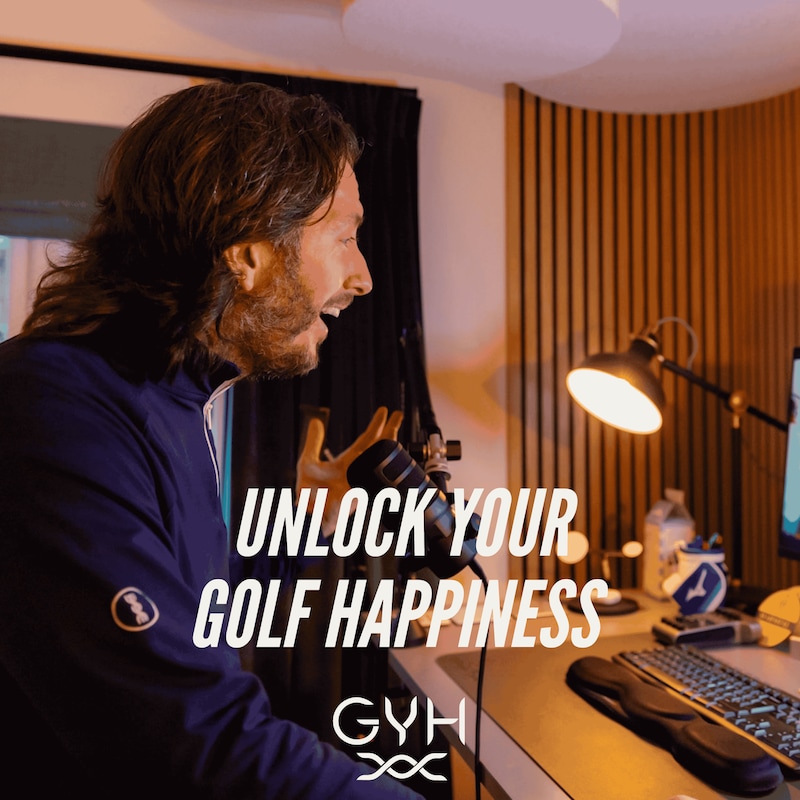
In this episode, Kris introduces the innovative HAPPY Framework - a mental game system designed specifically for recreational golfers. Discover how acceptance, presence, purpose, and commitment can transform your golf experience, reducing frustration and amplifying joy.
Key Topics:
The fundamentals of ACT (Acceptance and Commitment Therapy) applied to golf
The five components of the Happy Framework: Habits, Acceptance, Presence, Purpose, and Call to Action
Practical insights on accepting difficult feelings and embracing the game’s challenges
How psychological models tailored for everyday golfers can boost happiness on the course
The upcoming launch of a supportive golf community for average players
Differences between elite mental toughness training and approachable mental strategies for amateur golfers
The importance of aligning your golf game with your personal values
Timestamps:
00:00 - Introducing the Happy Framework for recreational golfers 01:20 - What is ACT (Acceptance and Commitment Therapy)?
02:47 - Core belief: lean into difficult thoughts and feelings
04:10 - How happiness in golf is about values, not fleeting victories
06:04 - Breakdown of the five components: Habits and Acceptance
07:20 - Understanding and auditing your mental habits
08:02 - Embracing acceptance: golf is hard, and that’s okay
08:57 - The importance of presence and being in the moment
09:53 - Clarifying your purpose in golf: why do you play?
11:16 - Moving from mindset to action: commitment as progress
11:51 - Personal story: accepting current skill level
14:23 - Accepting conditions and refraining from self-criticism
15:49 - The Happy Framework is for the 95%, not just elites
16:25 - Upcoming community launch to support your golf happiness journey
I've spent years trying every mental game tip I could lay my hands on, visualising my shots, thinking positively, being confident. But none of it is really stuck. But then I've discovered Act Acceptance and Commitment therapy with thousands of published studies. It's a model used extensively now within sport, and particularly in elite settings where golf is concerned.
It's being used as we speak on the PGA tour and DP World Tour. But until now, this hasn't been adapted for you for the everyday recreational golfer, which is why I'm doing exactly that. I'm calling it happy five letters, a complete system. It has changed how I experienced the game, and I think it can change it for you to.
Hey everyone, welcome back to our latest.
Episode with me, Kris Lynch, your founder. And also maybe think of me as like your golf happiness coach. And any good coach ultimately needs a framework. So today's episode is going to be about three things. It's going to be firstly about introducing the happy framework. It's secondly going to be about deep diving on the A for acceptance in the happy framework.
st of April:
We are designing and going to be launching a golf community that is for recreational average golfers who really adore the game, love the game, but often leave the golf course feeling more frustrated than they did when they first set foot on it. So if that sounds like a community that you would like to be a part of.
st of April:
So in that introduction, I briefly mentioned acceptance and commitment therapy. Now, I am not a therapist. I am a coach. And this model that I have found and will be using to work with you and to support this community will be used in a coaching context. So it is called act as a model, as the psychological model that was developed by a guy called Steven Hayes.
Um, but for the purposes of, of of the happy framework, it's, it's AAC, it's ACC. So acceptance and commitment coaching is really how I'm then taking that and putting it at the core of the happy framework. And basically this psychological model is one which is, uh, relatively newer as compared with more traditional, uh, psychology models.
And we can see this about acceptance and commitment. Basically, as a model, what it holds as a core belief in principle is that we as human beings should not run away from difficult thoughts, feelings and emotions. Rather, we should lean into them, discover what we can learn about ourselves in the process, and actually develop tools to deal with those feelings.
Help manage them, not necessarily to remove them, but to help manage them, and to take some of the sting out of those and help us move towards a better version of ourselves. Basically, any happier version of ourselves critically. Uh, so that's one thing to think about. And you then contrast that with traditional psychology.
And again, if you're thinking about that in the context of sports psychology or maybe golf psychology, often traditional psychological approaches take the approach, which says we want to eliminate negative feelings. We want to try, uh, you know, to try and help you perform as well as you can under pressure.
The key difference with this model is that, like I said, it's not eliminating those feelings. This is actually saying that that's actually not particularly helpful by trying to just push it down like whack a mole, it's just going to keep rearing its head again. And unless we do something about it. So that's something to consider.
The other thing I want to see about where where happiness is concerned and why. I've then taken this, this psychology model and then, uh, put this happy wrapper around it is to see that it's version of happiness is not gained by.
Fleeting moments of joy, such as draining a long birdie putt or breaking 90 for the first time there is arrived at by living and playing a game of golf that is values led, and that fundamentally looks at why you play golf. What you want to get out of golf. Understand your relationship with golf so that you are in a more informed and better position to enjoy it and get from the game what you want to.
If I just briefly give you an introduction to the five components, the five letters, the happy first of all, we've got habits. Okay, so habits are
typically defined as automatic behaviour patterns I suppose that we engage in and we indulge in almost without thinking. It's our go to course of action in any given Situation. And so what I want to do in working with you everyday golfers is to firstly help you almost take an audit of your current and existing habit patterns in your game of golf.
So I'm not so much talking about, um,
I'll have to explain before this is not about the technical side of golf's. Like your swing habits. This is more about your mental habits more than anything. So I'm looking at things like, how do you talk to yourself before, during and after a round of golf? How what is the what is the mental outlook and approach that you take, and what do you believe about yourself in terms of your game of golf?
So if we establish a a view and a picture of what your current habits are in the as is current state, that will then help us to strive towards and identify what's the future state in terms of habits, the healthy habits that you want to identify, design and implement in your golf life, versus the unhelpful and hindering habits that you possess at the moment.
So that's the H that A is for acceptance. And a little bit later on, after this section of the podcast, I'm going to go I'm going to lift the hood, pop the trunk a bit and go go beneath the surface and acceptance a good bit more. But just for now, I want you to think of this idea of acceptance simply as saying we need to be able to accept that golf is a hard game, and golf is therefore going to generate feelings of frustration, and it's going to bring up difficult feelings and emotions.
So it is accepting that those things will invariably happen, and it's accepting that actually allowing those thoughts to come in and to work with them and not against them, and to try and run a million miles away from them. Is he better course of action than, like I say, just burying it and never dealing with it.
So that is. And that is the idea of acceptance. Okay. Moving on from there. The the two P's. So the first is presence. So
presence I suppose you could think of in the sense that golf is a beautiful game. It is played in very nice settings and surroundings. And not only that, when you're out on a nice golf course, there's an opportunity to stop and take in your surroundings and just appreciate them and be present in the moment.
Also, from a performance perspective as well, presence really matters. Being present in the moment and playing one shot with one swing at a time also has a lot of value. And ultimately it is, in my experience, something which a lot of golfers at all levels really struggle to be present. And actually, let's face it, the world that we live in today.
It's incredibly difficult to be present with all the multiple different technological distractions that we've got going on trying to steal our attention. Some of those show up on the golf course, like using your phone, for example. So that's to contextualise and bring this idea of presence. The second P is on purpose.
So very simply I want us to be looking together at again at the top headline level is what is the purpose of golf for you? Why do you play golf? What do you want to achieve from playing golf? Is that to be competitive? Is it to be social? Is it to just simply participate? Uh, it could be it it it could be all manner of different things.
So it's identifying your why really for playing golf in the first place, but then, then bringing it down to like a mac. That's the macro level. Bringing it to a micro level. We want to, on an ongoing basis, identify, you know, why are we playing this specific round of golf and what do we want to achieve from a particular round that we play or a particular competition that we play, or in a certain scenario or group of people that we're playing with?
What's the purpose of that? Because being clear on that is going to go a long way to introducing the why, which stands for your call to action. I mentioned before that acceptance and commitment coaching the word commitment there is so critical because basically what we're trying to say is you need to take action and you need to do that in a committed way in order to achieve your goals in golf and achieve the results in the outcomes that you want to in golf, because none of the previous for each app and the work that we do there becomes possible without then turning that into a plan of action.
So that is a short overview for you of the happy framework. Let's move on now and go a bit deeper on acceptance.
When I first took up golf, I was given a 28 handicap, which truthfully was quite generous, but it was the maximum you could get for a male golfer at the time, and I desperately wanted to get 27, just in the hope that I'd feel better about myself and that playing partners and members would accept me. Yet I've since learned that that was a deeply flawed logic.
Acceptance for me, today is much more about being comfortable with my current playing ability, excepting that it won't necessarily be that way forever and that my worth in golf doesn't need to be defined by my handicap.
Now, this word acceptance is a really interesting one, isn't it? Because there will be those of you watching or listening to this thinking, it sounds to me like you're saying that you yourself, Chris, uh, forced yourself into accepting that you were mediocre and had no hope of improving in, in that situation and that that example that I just gave.
That's not the case at all. And I want to dispel that thought straight away that in acceptance, what it is saying is that we need to allow difficult thoughts to rise to the surface, see them for what they are, and use them as fuel to help us get to to where we want to go, to help us achieve our goals. It's saying that we should have a willingness for another word, to acknowledge that things are not as we would like them to be right now. And crucially, don't just try and ignore that difficult feeling.
Today I'm a 20.7 on the.
I am still average today as I was then. Yes, my handicap has come down quite a bit, but I have got to a point now where I have just accepted that is where it is right now. My reality today is that I'm not playing often enough, I'm not playing in competitive formats, and I don't have the time with a young family and kids to be getting out playing.
As much as I would like to or need to to get my handicap down, whether that's competitively or in general play. So I have had to accept that the difference in me today is I know that I play golf to my version of golf. Today is about going out and just simply enjoying myself and being grateful for the fact that I even can play.
Because right now, um, certainly at this time of year where I live, courses are really wet. There's been an unbelievable amount of rainfall where I live. And there's another thing where acceptance can creep in. It's when you're playing winter golf, especially in parts of the world where the courses are boggy and muddy, that goes hard enough as it is.
Add extra layers of difficulty when you're hitting balls mud balls. So again, I had to the other day when I went out and played. Except that actually the chances of me playing good golf that day were slim because the conditions just didn't really allow for it. So that's how I want to help you understand, uh, acceptance.
I find that most golf psychology tends to be built and is intended for the elite for the top 5% who compete at elite levels. But if you play once or twice a month, you shoot in the 90s or the 100. If you just want to enjoy your Saturday reign without hating yourself by the seventh Hall, it's not more mental toughness you need.
It's a different relationship with the game that you need, and that is who the happy framework is for. It's for you, the 95%, not the 5%. So with that being said, and if you've been sitting there watching or listening through to this and thinking, yeah, that's me, I need a bit more happiness in my golf life, and you think the happy framework is for you?
st of April:
But until the next time, I'm going to remind you and ask you to always embrace the rough and forever cherish the free.