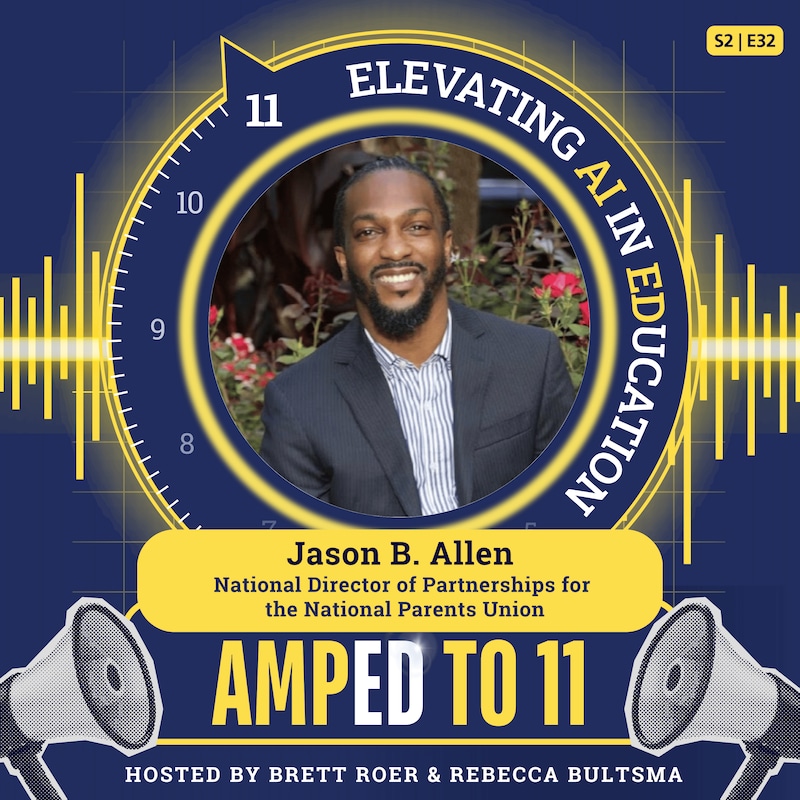
Shownotes
Parents discover their teenagers are using AI in school, but they're learning about it after decisions are already made. Jason B. Allen, National Director of Partnerships at the National Parents Union, isn't interested in fixing a communication gap. He's here to close a partnership gap.
Jason brings 21 years in education as a certified teacher, special educator, and former school and district leader. He knows what happens when schools make tech decisions without families at the table. He also knows what it looks like when they do it right, and it changes everything about how students, teachers, and parents experience innovation together.
In this conversation, we dig into why 70-84% of students are using generative AI while only 16-20% of parents believe they are. We explore the real tension between technology departments and family engagement departments—and why ego, not resources, is often the barrier. Jason shares NPU's vision for technology fairs where parents and students evaluate EdTech tools before purchase, and he walks through the questions every parent should ask their school board about AI right now.
We also play the AI Effect game, a scenario-based exercise that shows how AI can actually support human connection, not replace it. The moment: using AI to prepare for a difficult conversation with a parent. Everyone at the table agreed it works.
What You'll Learn:
- The AI awareness gap - why 70-84% of students are using generative AI while only 16-20% of parents know
- Five questions for your school board - what every parent should ask about AI adoption and student data
- Technology fairs - how open partnership can shift schools from closed decisions to shared vetting
- The department turf war - why ego between tech and family engagement slows everyone down
- "We come when we're called" - what NPU's approach means for school districts ready to listen
- 2 million members strong - how NPU and 1,800+ partners are reshaping education policy
The AI Effect Game: We use a real scenario to show how generative AI can deepen parent conversations instead of replacing them. Listen for the moment the room shifts.
Brett Roer and Rebecca Bultsma guide the conversation, Rebecca as an AI ethics researcher and voice of structural thinking, Brett as the translator between what schools are doing and what families need to understand.
Tune in, subscribe, and share if you're ready to turn up the volume on what's possible in education.
Transcripts
Brett Roer: Teachers cannot be the experts on backend data privacy. Right. There's people that should be vetting it, that should make it even stronger and more secure, and laws should follow that.
the decision making process.[:Brett Roer: Greetings everyone, and welcome to the AmpED to 11 podcast. We are honored today to be joined by Jason B. Allen, the National Director of Partnerships for the National Parents Union. Jason, how are you doing this lovely Monday.
Jason B Allen: Happy Monday everyone, and also Happy Women's History Month, and I'm doing excellent on today.
Jason B Allen: I'm super excited to be a part of the podcast and this amazing conversation.
Brett Roer: Joined as always by my amazing colleague and co-host, Rebecca Bultsma. Rebecca, how are you doing today?
Rebecca Bultsma: I'm good. I have 40 AI agents cooking in the background while we're recording this podcast, doing lots of interesting research and fact finding and admin tasks for me, so I just get to be present and enjoy.
Rebecca Bultsma: I love that for me.
ittle bit about who you are, [:Brett Roer: Let's learn about you as the person first, though.
the country, and we also have: do this through our. This in:Jason B Allen: So I'm excited to talk a little bit more about how we are engaging parents and families in those four areas through ai .
Brett Roer: You're talking about you have your eyes and ears on, you know, really the most trending topic, at least when we're speaking to parents out there. I'd love to hear your vantage point.
Brett Roer: What are some unique voices and insights that you're hearing out in the field? What's something that parents are saying that we might not be privy to if we weren't in a, in in your shoes, we'd love to hear just what are some of the things that they're most concerned about, and then we're definitely gonna get to the positive too.
Brett Roer: Where are they most hopeful about?
rents union.org, we have two [:Jason B Allen: Um, a lot of parents and families do have confidence in their teachers now. With that, they also are saying we're advocating for what our teachers are wanting, which is more training around ai, how it's advancing our way of living. And you know, the initial intent around education with AI for it to be a tool and a resource.
h and you know, a lot of the [:Jason B Allen: Now, I also will say a huge fear of parents is that AI is gonna replace Ms. Betty, who is the school secretary at the front desk, and so. This is my 21st year in education and being a former school leader and district leader, I know that the way that schools operate, Ms. Betty is still gonna be needed for at the next 20 years because schools, you know.
e can use AI as a tool and a [:Jason B Allen: But they also want social balance, like time away from the screen and time away from devices to make sure that, you know, there is a social, emotional, physical balance to how we operate in an advanced technological society.
Rebecca Bultsma: Jason, your work with parents is fascinating to me because it's something I advocate for a lot too when I go around.
Rebecca Bultsma: The country and work with districts. I always add on, uh, a parent information night while I'm there, because I don't know if this is what you're seeing, but what I'm seeing is we're having these conversations about students. Teachers and training them to use ai. But that gap seems to be the families, they don't necessarily understand what AI is.
literacy wasn't taught to us [:Rebecca Bultsma: Are you seeing that?
Jason B Allen: Yes, we are seeing that as well. You know, we have parents and it's not just, you know, things that we are seeing and also feedback we receive from our partner networks parents across the spectrum. You have parents who rely on tutors that does, you know. All of the academic, you know, learning aspect of home for families.
g class. You have, you know. [:Jason B Allen: You know, component of home life for them. So they're not actually engaged with tools or they don't know the safety alarms or they don't know the ins and outs of what AI actually is because they are reliant on someone else to, to lead it. I also will say in our rural communities and our lower income working class communities.
learn about it if you don't?[:Jason B Allen: So yes, what you're seeing is definitely something that at least 34% of modern American families are, I would say, experiencing firsthand, and it does include very little knowledge of ai, but even the access to learn about ai.
Rebecca Bultsma: I just. I wanna point out, and this is just familiar for me 'cause this is something I talked about recently, but it was a common sense media, uh, survey that was done between students and parents.
ause we know it's built into [:Rebecca Bultsma: And so a kid could just be chatting with their Snapchat AI or their meta AI as an AI companion or friend, but parents might not even be aware of that. So I guess my question to you as someone who's leading this work is around like, whose responsibility should this be? Everyone get on the same page here.
Rebecca Bultsma: At least get a common level of understanding and literacy so that we can start having meaningful conversations about what to do next.
Jason B Allen: So this is such a powerful question because one major shout out to Common Sense Media. They are a partner of ours. We collaborated with them last year and the Ed Safe AI Alliance on an AI advocacy toolkit.
ders, our caucus members and [:Jason B Allen: There is a technology component integrating technology into the lives of the families that you are, you know, supporting. Now we have some partners across the country who are doing a phenomenal job. San Diego, I have to shout out their school district. Okay, let me also say Phoenix, because if I don't name some people I'll get in trouble.
several school districts to [:Jason B Allen: Now, that's who is responsible. I want to give you this and let's go here. What are the barriers to partnerships that. Are preventing parents and families from quite frankly continuing education at home. Then you have the battle between the technology departments and the family engagement departments because the technology departments are all excited.
Jason B Allen: You know, I'm a nerd. I love to read. I love to like really do a lot of research and be engaged in what is it that we're learning about. So I know how I can truly be engaged. And so with AI, it's so much to learn and know, and we have seen. A lot of the technology departments are excited. They are ready to go.
so we need to be in control [:Jason B Allen: And what we've told people is that it actually works best when both organizations or entities are working together to meet the needs of not just parents and families, but teachers also rely on both of these departments. Again, to help continue education at home.
Rebecca Bultsma: It's interesting because a lot of the, you know, conversations I have, I'm not sure how much technology department should even be involved with the parent facing things.
Rebecca Bultsma: And all of the groups that you're mentioning are under that school board and superintendent piece. Ultimately, who should be coordinating that? Correct.
t we tell parent leaders and [:Jason B Allen: What is it? How is it showing up in the classroom? How is it being used in curriculum and instruction? Heard that survey, which goes to whichever department is housed, you know, or you know. As to handle collecting that data. It ultimately does get to the superintendent and the school board, and so it is their responsibility to read through that data and say, wow, we have over 34%, or we have over 50%, or we have 78% of our families who are saying they don't understand ai.
't know what we're doing. So [:Jason B Allen: Who's responsible, how it should look for their school district.
Rebecca Bultsma: Do you assign. Parents themselves or point them somewhere they can go, if I, I don't know many parents who would request,
Jason B Allen: it's all of the responsibility is actually on the parents and caretakers. So we come in as a partner to support. One of the things our national president, Kerry always says is that we don't parachute in.
Jason B Allen: We come when we're called and we come as a resource. And so we make sure the parents, caretakers families have what they need in order to, uh, get the best. Educational opportunities for their children. And so helping them to understand the policy, and again, this goes to the question of who is accountable?
of the school board. And so [:Jason B Allen: They are to hold that person accountable to doing that, and so that's a part of what we do to support parents in making sure that they're making those phone calls, sending maybe email correspondence, showing up to meetings, asking the teachers, Hey, how are you being trained on ai? And what can we do to continue this at home?
Jason B Allen: Those are some of the tidbits and strategies that we provide to our network on how to get those things accomplished.
Brett Roer: Yeah, I'd love to ask you, you know, you talk about a couple different ways to engage with parents, and similar to Rebecca, you know, we're the work we're doing, parents are at the center of it.
o are trying to engage their [:Brett Roer: In whatever facet you're gonna do that, is it teaching them here's how your children are using AI at our school, and therefore here's tips on how to support them? Or is it something like, here are tools that you, as an adult slash parent should be engaging with in order to, you know, further yourself, your own skills, your personal professional lives, et cetera.
Brett Roer: What, what's your answer to something like that or a roadmap you could provide to, to partners out there?
Jason B Allen: So what I would say to partners is the reality is all three of these things are needed now from a district standpoint, you have. Families who fall in one of each of the three ca categories that you named for teachers?
at home. That's the teacher [:Jason B Allen: Now, I would say from the standpoint of a school leader, maybe a policymaker such as a school board member. The focus would be on how are we scaling the training and development? How are we making sure that parents actually know what AI is and how we're using it? So those first two things would be what those leaders will be looking to provide to parents, to families.
rative and policymaker side, [:Jason B Allen: Engage with how they're spending money on resources for AI and also what it looks like in regards to the tools that their children are using.
Brett Roer: We talk a lot here at the AmpED to 11 podcast, and it sounds like you do as well, right? You're really focused on the individual, the children, their parents, right?
Brett Roer: You're trying to solve a national challenge, but. At the end of the day, each of these parents really are, you know, hyper concerned about their own child and the outcomes they're gonna get in the education system. So we often play a game here, the AI effect. It's a nonprofit, the Rhithm Project, who has created this.
hat sound okay to you, Jason?[:Jason B Allen: Totally. I love that.
Brett Roer: Alright, so here's the way it works. I'm gonna give you a scenario you are going to, while you can say it depends and obviously there's gonna be nuance and please do so if needed, we'd love it. If you could start with, I think it would support human connection or I think it would erode human connection and then just say because.
Brett Roer: Got it. Okay. So a teacher uses AI tools to prepare for an upcoming difficult parent conversation that support human connection, a road human connection, and whichever you choose why?
Jason B Allen: I feel like it would support human connection because, you know, again. It gives the teacher more time to study those things, to prepare for the in-person engagement.
I would look at immediately [:Jason B Allen: So I feel like. Yes, it definitely is a resource and it would advance the connection in that way.
Rebecca Bultsma: I think I feel exactly the same way. I have no notes on that. That's exactly kind of what I would have to say about them.
Brett Roer: I also, you know, I also concur, so this wasn't the most, usually what the diversity of thought is one of the best parts of it.
Brett Roer: But I think in this case, yeah, we're all, we're all very, very much aligned here. Well, and that's the case, obviously. That was one from the perspective viewpoint. Is it okay if we, uh, if we show you some of the other choices and maybe, um,
Jason B Allen: yeah, totally.
rett Roer: Okay. Alright, so [:Brett Roer: Alright, so, the Rhithm project, the AI effect game, we are gonna be playing this actually on, uh, national AI Literacy Day with people from around the world also. And they're gonna get to, yeah, they're gonna get to chime in and talk about it. So any, any that strike your, that strike your, uh, that strike your eye.
Jason B Allen: Creating an AI holographic version of yourself to attend a far away family gathering and report back.
Brett Roer: Is that even possible?
Jason B Allen: I was about to say. That's very interesting. I don't know how that, I saw
Brett Roer: Tupac at Coachella. Tupac was at Coachella. I don't think that was really him.
Rebecca Bultsma: You never know. There are a lot of rumors.
Brett Roer: Yeah, that's,
nging us together, you know, [:Jason B Allen: You may be represented, but it's not the same as actually being present. My response to that one.
Brett Roer: Rebecca, would you like to go next or would you like me to go?
Rebecca Bultsma: Yeah, again, same as Jason. I don't, I don't even think that's possible right now, so I,
Brett Roer: unbelievable. Unbelievable. We've never had such alignment before.
Brett Roer: Alright. And you could get next one, Rebecca. And this time, Ooh, I gotta, good one. We're gonna play the counterclaim game, so this time you have to say the opposite side and defend it. Okay. Jason?
Jason B Allen: Okay. Opposite side of what I would
Brett Roer: think is opposite side to where your gut reaction is starting now. Go ahead, Rebecca.
Rebecca Bultsma: Using AI to rate your physical appearance and offer tips to improve it,
Brett Roer: what would anti Jason say?
Jason B Allen: So let me [:Jason B Allen: Uh, it can help prepare me for what others may say that could be mean and harmful to me. So that's my counter.
g or hygiene that might lead [:Brett Roer: So therefore, this could be a great tool for people who just don't have that kind of guidance and support at home. So it might help them really just acclimate or assimilate when that is something that that makes them feel self-conscious and they just don't have people at home that can help them with it.
Brett Roer: Jason, I wanted to offer this though as something, obviously this is a free tool and resource by the Rhithm Project, but one of the things I found in my travels when we talk about wisdom collection is many teachers and administrators. Like having these kind of conversations with students about like rules and policies and best practices.
Brett Roer: And they're like afraid sometimes to speak to parents, which is their words, not mine. And these kind of games or ways to show these things, get parents immediately engaged. 'cause no one's an expert on ai, but everyone has opinions. And I just wanna highlight like, this is such a way to like lower the temperature, get everyone to engage.
helps you build those, that [:Brett Roer: So
Brett Roer: might be nice.
Jason B Allen: I love that.
Brett Roer: Yeah.
Jason B Allen: So what I would add to this part. You mentioned National AI Literacy Day, which is a major day of learning celebration and also teaching about ai.
Jason B Allen: So of course we will be having a national town hall for parents and families to be connected. And we also are sharing out a lot of cool resources, again through the Ede AI Alliance and the National ai. Literacy day advisory board. So some of these things I feel like would be very befitting to ensure they're included in our newsletter, that we'll be going out, not just on National AI Literacy Day, but also it will be available to our parents and families within our network.
aring and hoping that we can [:Jason B Allen: You know, modeled for everyone. Also, I'm thinking about healthier generations. That is a part of our socio-emotional coalition and they do a lot of, you know, connections with AI and using tools of parents and families similar to this resource we just use. So lots of connections we can make, not just with parents and families, but also just across our network.
nities. So one of the things [:Brett Roer: One, bring students to these discussions when parents come because they will act much more civil. If it's something that they feel strongly about when there are children there, I dunno if that bears in your opinion. The second thing though is by making people have to say a counterclaim, it forces them to at least acknowledge there's another perspective.
Brett Roer: And so that was something I've learned from doing this around the country. It just makes you have to acknowledge that there is a differing perspective and it's absolutely not yours, but you can at least figure out how someone could arrive at that viewpoint. So just wanted to, that's
Jason B Allen: really good.
Brett Roer: Yeah, it really helps lower the temperature and at least shows like, yeah, we might not agree and we're not supposed to agree, but we can at least acknowledge there is another point of view to this that's not ours.
rk that you're doing. Jason. [:Jason B Allen: So we actually launched it for. We had two. We have the safety, uh, toolkit for the Kids Online Safety Act, and then we have one for ai.
Jason B Allen: Both were launched last year, one on National AI Literacy Day, and then one in November for national family engagement. So it was a connector. We kept families engaged all year with focusing in on ai, advancing technology safety for our children and using these tools and resources. And we also have, you know, I mentioned this with school districts and what they can do, but we also have a presentation and a workshop series that we do with parents, families, school districts.
Allen: And communities that [:Rebecca Bultsma: So my question for you is, what is the single most important question that a parent should ask their school board today about how AI is being used in their classroom?
Jason B Allen: That's, that's a great question. For specifically inside of the classroom, I think the number one priority of. Parents and families is how are we keeping kids safe with these AI tools and specifically student privacy in classrooms and making sure that their information is not being leaked, which again, accountability wise, school boards, do we have regulations in place for, you know, companies that we are purchasing, curriculum or licenses, or we're utilizing.
e we done our due diligence? [:Rebecca Bultsma: Great questions. And I guess the final question for me has to do with this idea of the AI inflection point.
of an AI inflection point and: there are really good models [:Jason B Allen: How are we making sure we're connecting the dots there with the need for more data centers and advanced, you know, technology outlets in our communities? Four connections to hospitals and. You know, homes as well as schools, which connects to, again, safety, health, education, and economic stability. So there's a conversation there around how AI is connecting to all of these areas.
Jason B Allen: And you know, again, parents and families want to be engaged in the process. They don't want to just be updated on what's happening to them. They want to be engaged in the decisions and the vision and the plans for the future.
had to make a prediction of [: Jason B Allen: You know, by: be. A state of perfection by: ow other countries are doing [:Rebecca Bultsma: Something interesting that you bring up about those conversations about Earth Day and data centers. Uh, it was a conversation I had recently with people who work in the environmental section who said this fundamental kind of disconnect around what data centers are and what they're for is confusing for people because they've been told everything just lives in a cloud and it sounds natural and it sounds like it doesn't require a physical space necessarily.
our, your thoughts and ideas [:Brett Roer: We've got two last things that we wanna offer up to you, Jason, and to our audience. And then, then we're gonna let you go continue the important work, especially here during National AI Literacy. Week one is, you know, we, a longstanding tradition here is. We let you take over the reins of the show for a moment and you get to ask us any question you have that you think might resonate with our audience or something that, that you'd love to know about the world of AI in education.
Brett Roer: From our vantage point, you are now officially the host.
between, you know, right now,:Jason B Allen: What do they wanna see?
y. Following that. I'll try. [:Rebecca Bultsma: Jason, something you need to know about me is I struggle with Ed Tech big time as an ethicist, right? At least the way that Big Tech operates in the United States.
Rebecca Bultsma: Um, uh, I, I don't love the idea of money being the amount of money that's being paid out of education too private. Companies that are then also benefiting from the data to build their systems. Uh, avoiding a lot of the legislation that, and responsibility that comes with a lot of that. So my answer might be a little more pessimistic and I think there are wonderful ed tech companies who are doing things for the right reasons.
, I'm, I'm not a huge fan of [:Brett Roer: I actually, you know, I'm so fortunate we just had Aaron Moat on our podcast and Rebecca, so you know, between the two of them folks like you, I get to listen and learn a lot. And on Saturday I actually was part of a public hearing for the state of Connecticut on they have three state laws that they're trying to pass, and I felt a lot more.
Brett Roer: Informed and equipped on what things they should look out for in ways they could potentially strengthen those bills because of listening and learning from folks like Rebecca. What I would say is, if EdTech is getting it right, everything Rebecca said, plus a million, but what I hope they actually do is kind of what I'm sure your organization and many other really strong nonprofit organizations are trying to do, which is go show parents what you're doing before you try to sell it to a school and students and teachers and make it more of a communal.
nd there's all this urgency, [:Brett Roer: Truly personalized learning, right? Use that data for good, keep it safe, but like you authentically can take what you know about that child. You have all the test scores somewhere, but like now talk to the tool and be like, you know, this, this child like really excels in this type of scenario. So it might help you build the lesson plan better.
Brett Roer: It might help you tailor that, that that resource that's right in front of them to their lived experience. So that's if they get it right, that's what I hope's happening in education.
Rebecca Bultsma: And I am still waiting for data to prove that that is gonna be effective at all. I'm hoping it arrives at some point, you know, technology and
Jason B Allen: I would agree
ultsma: data to back that up.[:Jason B Allen: I also would say, and I know we're at the closing, so I'm curious to just, and I'm gonna go on the limb and put this out here. From what I've heard from those in our network, it would be cool if public school districts could reorganize their technology fairs to. Not so much of the students are presenting on this is what we have learned through our, you know, technology department.
parents to actually kind of [:Jason B Allen: school choice. You know, go through a lot of it at their school. Give a ranking of these are the tools that we saw that we think will work best for our kids. And this is why I'm saying this because when I've had conversations with our partners and we have parents that are learning around their school budgets and how their school budgets are organized, when we look at waste and what school districts have wasted things on.
Jason B Allen: Even your teacher unions and your teacher organization advocate organizations will say, the school districts waste so much money on curriculums and resources and books that they don't use because it doesn't work for children. And so in our minds we're like, well, why don't we solve that problem? Why don't we allow the parents and the children to say, Hey, I'm struggling with.
hink would work great for me [:Jason B Allen: So I'm throwing that out on the podcast. Maybe outside of our sphere that can influence school districts and, you know, policy makers to consider setting things up like that. I feel like that would be a better way for companies and organizations to also get connected to schools and school districts. And it's, it's a true engagement.
Jason B Allen: It's not just, oh, we received the bottom line and, you know, we're going around our way. We now can really tell if our product is serving children and families will, because we know based off of parents and families actually choosing or having the the opportunity to choose our product.
Rebecca Bultsma: I'm gonna give that a solid Yes.
se I think that we'd have to [:Rebecca Bultsma: And so I think yes, and we spend time training. Educating parents and students on what's important, what matters, what questions to ask, and then letting them have some firsthand experience doing that.
Jason B Allen: I know we can't get into the nuts and bolts of this, but this is a really cool idea because we actually thought about teachers being the buffer between that, because to your point, Rebecca, we know that.
'll even, we'll say this. We [:Jason B Allen: I'm excited about this because be parents and families to do these processes Now, getting them to think. School board members are gonna ask, well, how does this meet our budget? Well, if you want your product to be adopted by a school district, then you should provide a stipend to teachers to vent your product, to make sure that when it's, you know, that way we know teachers are already trained, right?
Jason B Allen: Because the school districts already trained them in these things. We know that. The companies want to get in front of families and parents to see if it works. It really is a, a win-win. Now, this may be bringing me back and we talk more about this on the next podcast, but yeah, these are things that we're exploring in our technology coalition.
g, for example, AI tools and [:Jason B Allen: So parents and families are being innovative, they are thinking. And the role that NPU plays in all of that is making sure that school districts, school board members are building strong partnerships with parents and families and bringing them into the decision making process.
Brett Roer: Yeah, I think two things you said, I just wanna highlight as we, uh, as we close up this amazing episode with you, Jason B.
Brett Roer: Allen one is. You're talking about seats at the table. Table. And so like to Rebecca's point, teachers cannot be the experts on backend data privacy, right? There's people that should be vetting it, that should make it even stronger and more secure, and laws should follow that. But like you're talking about the user experience and ultimately you're talking about parents who their tax dollars are, what are funding.
thing that I'm hearing in a [:Brett Roer: Otherwise, there's no renewal. Make them show you that it's working. And I promise you I've seen in both sides, right? We see this in public ed when, you know, there's a, there's a, a bar that's gotta be reached. People sometimes reach it, you know, they're, they're more incentivized and they're more motivated.
Brett Roer: And in private industry, that's the same thing. So you're allowed to do that. You're definitely allowed to raise the stakes on them. Don't, don't settle for what they're offering you in the first go around. Well. Jason, we know we gotta get you outta here. So if you don't mind, can you let our listeners know a little bit more about where they can find you, where they can learn more about the important work you're leading and any other organizations you wanna highlight in your final minutes here?
ts Union on all social media [:Jason B Allen: Um, that is where you can get all of our resources and our information. I also will give my email address in case you wanna ask, how do we become a partner of NPU or how can NPU support us in what we're doing to organize or bring parents and families together to ensure that policies are putting kids first.
Jason B Allen: My email is jason@npunion.org. That's n as in national, P as in parents union.org.
t the National Parents Union [:Brett Roer: Thank you again, Jason. Thank you Rebecca, always for pushing the envelope on what we're discussing here.