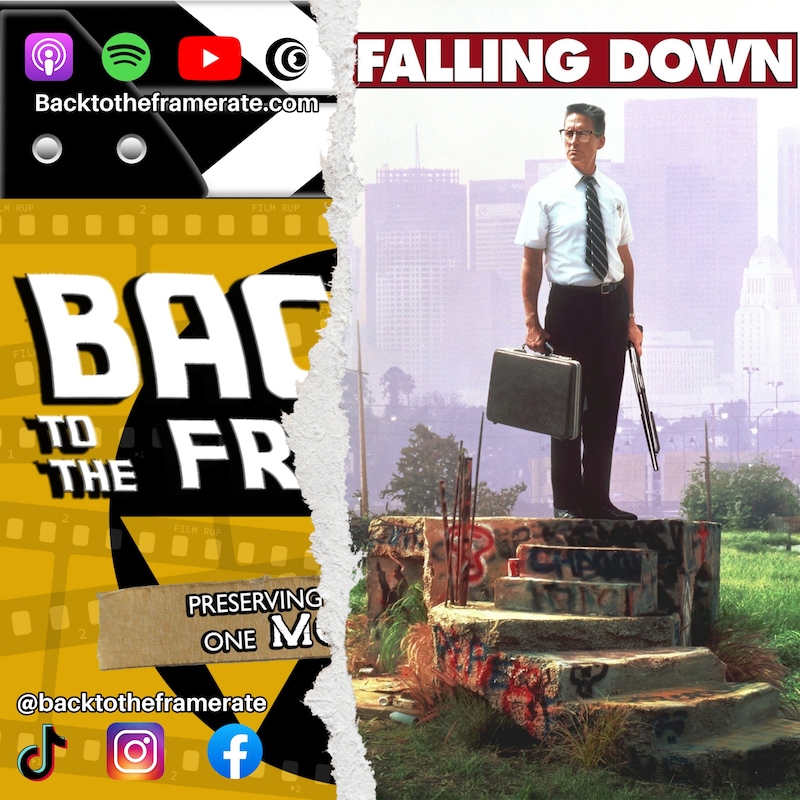
Shownotes
We return to our Robert Duvall retrospective with good friend and guest Mark Krawczyk of the Spoiler Room Podcast, as well as the Chief, Cook, and Bottle Washer at Special Mark Productions. Together we dive into Joel Schumacher’s 1993 thriller FALLING DOWN.
Stick around for our Recommendation Shelf segment centered around “People at Their Boiling Points,” and to cap off the show, we ask Mark to adjudicate two films that have been hanging in the balance to determine whether they will be SAVED or PURGED.
It’s a packed episode. So packed, in fact, that it makes L.A. freeway traffic look relaxing.
To find Mark Krawczyk, The Spoiler Room Podcast, his Youtube channel visit: https://www.specialmarkproductions.com/
Companies/movies/shows mentioned in this episode:
- Weston Media Podcast Network
- Apple Podcasts
- Spotify
- Warner
- Gilmore Girls
- Subway
- Polo Lounge
- Mark Productions
- Lemon Ace
- Orion Pictures
- RoboCop
- Colors
- Dying Young
- Flatliners
- A Time to Kill
- Muppets Take Manhattan
- Death Wish
- God Bless America
- Elden Ring
- Ocarina of Time
Find all our episodes here or on your preferred Podcast app:
https://backtotheframerate.com
Back to the Frame Rate is on Letterboxd: https://letterboxd.com/backframerate/
Be sure to Follow us @backtotheframerate
https://www.facebook.com/backtotheframerate
https://www.instagram.com/backtotheframerate/
https://www.tiktok.com/@backtotheframerate
https://www.youtube.com/@backtotheframerate - Where you can watch video versions
Email us at [email protected]
Follow Nathan on Letterboxd: https://letterboxd.com/nathansuher/
Follow Bee on Letterboxd: https://letterboxd.com/mambobumbles/
Copyright © Back to the Frame Rate
Transcripts
In the dying embers of human existence.
Speaker A:As the asteroid, a behemoth the size of Texas, hurdles relentlessly toward Earth, the world braces for an apocalyptic end.
Speaker A:Deep beneath the bunker, a refuge plunges into the bowels of the earth.
Speaker A:Here the chosen gather their purpose clear to preserve the very soul of our civilization.
Speaker A:The 35 and 70 millimeter prints that encapsulate the magic, the emotion and the dreams of generations past.
Speaker A:These masterpieces, each frame a testament to the human spirit, are carefully cataloged and cradled in the cavernous confines of the bunker.
Speaker A:Perhaps there was room for more, for friends and family yearning for salvation.
Speaker A:But sacrifices must be made.
Speaker A:The movie nerds stand united, the keepers of a flame, promising a future where the art of storytelling endures, transcending the boundaries of time and space.
Speaker A:God help us all.
Speaker B:Welcome to Back to the Frame Rate, part of the Weston Media Podcast Network.
Speaker B:In the cinematic crusade, we journey through films on VOD and streaming platforms deciding their fate, salvation in our vault of legends, or eternal banishment to the flames of the asteroid apocalypse.
Speaker B:You can find all of our episodes of our show on Apple Podcasts, Spotify, or your favorite podcast app, or find us on our socials at Back to the Frame Rate.
Speaker B:I am Nathan Shore, and accompanying me is my movie compadre, who I understand in order to make it on time for the podcast tonight, started his day in Pomona, made his way through Pasadena scouting film locations, then ventured into Burbank for a tour of the Warner lot to visit the set of Gilmore Girls to ponder whether we as a society can ever again achieve that level of quaint Connecticut charm nationwide.
Speaker B:From there it was over the hills for a power lunch with studio executives at the Polo Lounge in Beverly Hills, followed by a quick hop in a skip and nervous existential spiral into downtown Los Angeles, where he reportedly performed a one man show in a damp alleyway, reenacting scenes from seven for confused passerbys, repeatedly chanting lines like the city's riding from the inside.
Speaker B:And now, somehow, after all of this, has arrived at his ocean adjacent artist enclave, known to local simply as the Salt House.
Speaker B:For his podcasting appointment, Sam Cole.
Speaker C:That is all true, but Sam Cole got arrested in downtown Los Angeles and me, Gerard Butler, had to take over.
Speaker C:You may recall my performance in Greenland Part one.
Speaker C:Greenland Part two.
Speaker C:Olympus has fallen.
Speaker C:Olympus has risen.
Speaker C:Paris is gentrified, and my favorite Amsterdam is non bold binary.
Speaker C:I'm Gerard Butler.
Speaker C:That's my name, Gerard Butler.
Speaker C:G E. No, I'll stop.
Speaker C:Yeah, no, it's me and all that's true.
Speaker C:I did walk across Los Angeles, but you forgot to mention I stopped at Subway sandwiches and it was incredible.
Speaker C:But all the people there, it was, you know, it was crazy.
Speaker C:And there were gang members shooting at me.
Speaker C:It was just like the movie.
Speaker B:All right, Eat fresh, Sam.
Speaker B:All right.
Speaker B:Also joining us as, as well, is a longtime friend of the podcast and he holds the record, I believe, as not only our most prolific guest on our show, but now going back three years ago, our very first guest we ever had on our show.
Speaker B:And, you know, we've discussed classic films with this man, such as the Exorcist and See oh, the Flash and Mad Max Beyond Thunderdome and 65.
Speaker B:Yay.
Speaker B:He is the host of the Spoiler Room podcast and he has a YouTube channel special, Mark Productions.
Speaker B:Is that the umbrella that it's under?
Speaker A:Yeah, that's the umbrella.
Speaker B:And with incredible content and movie reviews, short form.
Speaker B:Mark Kroczyk, welcome back to the show.
Speaker B:Mark.
Speaker A:Well, thank you for having me.
Speaker A:It's a pleasure to get back with you guys.
Speaker A:Talk movies.
Speaker A:Always love talking movies.
Speaker A:Passion of mine.
Speaker A:And yeah, just excited to be here.
Speaker B:I'm so happy to have you back.
Speaker B:It's been a while and it's just great to see you again.
Speaker B:So, Mark, I'm gonna give you a chance to, for our listeners that may not have listened to those episodes, for you to, for them to hear a little bit about what you do.
Speaker B:But I do have an important question.
Speaker A:Yes.
Speaker B:For both of you.
Speaker B:And here it is.
Speaker B:So it's kind of tied in tonight's discussion.
Speaker B:So if you were trapped inside a Los Angeles fictional, it's just LA fictional fast food nightmare scenario.
Speaker B:And you must decide which scenario you rather be in.
Speaker B:So picture this.
Speaker B:You got fluorescent lights buzzing overhead and there's grease in the air.
Speaker B:You have two options.
Speaker B:You either spend the next half hour trapped inside Big Kahuna Burger during the Pulp Fiction holdup with Pumpkin and Honey Bunny waving their guns in your face, or you can find yourself seated at Whammy Burger across from Defense as he compares the sad, lifeless burger to the photo on the menu board while psychologically unraveling in real time.
Speaker B:So, gentlemen, which hostage situation are you choosing and why?
Speaker C:I might have to choose The Whammy Burger one just because the restaurant seems closer to McDonald's and I and that food.
Speaker C:Like, if I could, if those fries and that salt is so good that if I could just, I would still be able to enjoy my burger and enjoy my large Diet Coke because he wasn't going to shoot anyone but they weren't going to either.
Speaker C:So I think I'm just choosing that one because it depends on the food.
Speaker C:And Whammy Burgers seems to satisfy my junk food taste more.
Speaker A:And for me, I, I mean, I'm.
Speaker A:I'm a big cafe person, greasy spoon type of guy.
Speaker A:So, you know, I, I probably go with.
Speaker A:I'd probably go with Honey Bunny and, And the cafe in Pulp Fiction.
Speaker A:You know, good coffee, good pie.
Speaker A:I love pie, you know, and.
Speaker A:But yeah, I'd go with that.
Speaker A:You know, survival, it's a little bit better chance of survival.
Speaker A:It's a larger area.
Speaker A:There's more people in the way.
Speaker A:You know, they don't seem to initially really want to hurt anybody so much as just scare folks and that, you know, I make sure I take my money out of my wallet before I give them my wallet.
Speaker A:So if they pulled the guns, I'd immediately go in my wallet and take out, you know, the cash.
Speaker A:But other than that, you know, you know, I, Yeah, I'd go with that.
Speaker A:I would go with that versus the whammy burger, only because they don't actually shoot at all, you know, and Whammy burger, he.
Speaker A:His gun goes off.
Speaker A:So I'd have to, I'd have to.
Speaker A:It edges towards thinking with the stomach here, right?
Speaker A:You know, it edges towards that.
Speaker A:And, and you know, I, I could still get pie or after my dinner, after they leave.
Speaker A:So, you know, that's true.
Speaker C:That's true.
Speaker C:That's a good point.
Speaker B:Okay, any, Any.
Speaker B:Any situation that ends in pie is the best.
Speaker A:It all comes down to the pie, man.
Speaker A:It all comes down to the pie.
Speaker B:Okay.
Speaker B:All right, well, thank you for playing along.
Speaker B:Am I ridiculous?
Speaker B:All right, Mark, so please tell our audience a little bit about yourself for a minute or two and, and what you do.
Speaker B:You have a festival that you're associated with.
Speaker B:You have film reviews.
Speaker B:You dabble in many things.
Speaker A:I always, I always say I can't pick a lane, but no, I've been on you.
Speaker A:I've been on YouTube.
Speaker A:This is our 20th year.
Speaker A:We're celebrating 20 years on YouTube.
Speaker A:Started out doing pretty much means you started YouTube.
Speaker A:I, it, I was on the ground floor basically, when it was just kids with flip phones recording themselves at malls, which both those things no longer exist.
Speaker A:So it tells you how old I am, but I started it there.
Speaker A:And, you know, the, the.
Speaker A:I, I didn't really dump a lot of content out until my kids got older.
Speaker A:And then I really focused on movie reviews and then found a passion for covering independent films.
Speaker A:And that's really been my focus over the last, I would say 13, 14 years now is focusing on reviewing mostly indie stuff.
Speaker A:I do wide release stuff too but they only get about a minute because that's all, you know, that's all the Hollywood film usually needs.
Speaker A:But yeah, so I started doing that then I also started getting into podcasting about 14 years ago.
Speaker A:So I've been doing this, I've been doing this a while and met lots of wonderful filmmakers and folks like yourself, you know, who are creatives and.
Speaker A:Yeah, that's.
Speaker A:And, and I do written reviews occasionally too.
Speaker A:I've been involved in a number of different website and yeah, I, I just can't pick one lane though I like to dabble in a little bit of everything.
Speaker A:I do vinyl record reviews, I love collecting vinyl.
Speaker A:Became a vinyl head about eight years ago and I, my collection is just exploded.
Speaker A:And I love physical media too.
Speaker A:So yeah, I, yeah, I love how.
Speaker C:Like you do a lot of up to the minute reviews whenever there's a new release.
Speaker C:I'll always see like your Facebook or something where you're like reviewing it the day day that it comes out.
Speaker A:And that's pretty cool.
Speaker C:Like I like that.
Speaker A:I try, I try to.
Speaker A:Occasionally they get a little delayed depending on real life stuff.
Speaker A:Cuz I do get video game streaming too the last few years on Twitch.
Speaker A:So yeah, I, I dabble in everything.
Speaker A:My wife doesn't mind this hobby as referred to it because she knows where I am, I'm in the basement.
Speaker A:So you know, she.
Speaker B:Okay, well thank.
Speaker B:So before we continue, Mark, is there any one or two places where people can find your content just so right at the top of the show they can look you up?
Speaker A:Oh yeah.
Speaker A:Special mark productions.com for all your movieman needs if you go there.
Speaker A:While the website itself isn't completely updated a lot, the links to my other stuff there is.
Speaker A:So you get links right on the front page to The Spotify, the TikTok, the Instagram, the YouTube, the, you know, all the links are right there on the web page that you, if you go right to the homepage, you can go to my other stuff and find it from there.
Speaker A:So kind of like a hub for things.
Speaker B:Okay, great.
Speaker B:All right, so let's carry on with the rundown of the show we're going to do.
Speaker B: going to be talking about the: Speaker B:This is part of our Robert Duvall retrospective, our third film in this series.
Speaker B:And we took a little break last week or two weeks ago.
Speaker B:You Might get a kick out of this.
Speaker B:Mark, we.
Speaker B:We reviewed Moonraker, our first James Bond film.
Speaker B:We'll get to that a little bit later on.
Speaker B:I have a question for you on that.
Speaker A:But.
Speaker B:So we're going to discuss this.
Speaker B:We are going to also do a recommendation shelf segment later on.
Speaker B:And before we get to our discussion of this, I.
Speaker B:We don't get a ton of reviews on our show and I.
Speaker B:Maybe I shouldn't be admitting that, but there is one that popped up on Apple podcast.
Speaker B:So when there's all of a sudden like I get an alert that there's a.
Speaker B:Somebody left a review.
Speaker B:Like I did a lap around the house because I was like, wow, some person did this.
Speaker B:And that is special for me.
Speaker B:So I want to read it and maybe this will entice other people to leave a review.
Speaker B:So this is from Lemon Ace.
Speaker B:I hope this is a real person, but this is from this from April 29th and they said some really nice things.
Speaker B:So I'm gonna read this.
Speaker B:Lemon Ace, if you're out there, this is exciting.
Speaker C:I know.
Speaker B:Yes.
Speaker B:Yeah.
Speaker B:First one in like two years.
Speaker C:Does that mean that a real person likes us?
Speaker B:I hope so.
Speaker B:And they gave us five stars and they said, this is a fantast podcast.
Speaker B:It's a great way to explore movies you might not hear about otherwise.
Speaker B:It also brings insightful commentary to movies that you may quote, think you know well.
Speaker B:But the team's solid research and analysis frequently open a new dimension of perspective and understanding.
Speaker B:I wonder if they listen to our podcast.
Speaker B:I don't know.
Speaker B:It's not pretentious, just thoughtful, honest and good humored.
Speaker B:Highly recommend.
Speaker A:Wow.
Speaker B:Yes, I know.
Speaker B:Glowing endorsements.
Speaker C:That's very genuine.
Speaker A:That is.
Speaker B:Yes, I'm.
Speaker B:Yes, it made my week.
Speaker B:So.
Speaker B:Okay, we got that out of the way.
Speaker B:So if you have.
Speaker B:If you want to leave another five star review, we'll read it.
Speaker B:That shows you how desperate we are for.
Speaker B:For your reviews.
Speaker B:All right, closing.
Speaker A:Read the one, one star review.
Speaker A:Read all the reviews.
Speaker B:I will read a one star review because that means you took the time.
Speaker A:That's right.
Speaker A:That's right.
Speaker A:No, I always take that.
Speaker A:I always say, don't read the comments, but I end up reading comments on YouTube and let me tell you, that's an experience.
Speaker A:So.
Speaker A:Yeah,.
Speaker C:I can never not read comments.
Speaker C:My favorite comment when I posted a short film on YouTube was like, this movie sucks and you suck too.
Speaker B:I was like, well, that was constructive in the poster.
Speaker B:Put that on the poster.
Speaker A:Yeah, that's.
Speaker A:That's a tagline.
Speaker A:Right there.
Speaker A:What are you talking about?
Speaker C:Now?
Speaker A:My favorite, real quick, my favorite comment for what I got was, I really enjoy this review, but your voice made my fist want to punch you in the face.
Speaker A:And I'm like.
Speaker A:And I'm like, thank you for watching my video.
Speaker A:Yeah.
Speaker B:Oh, that would get to me because I'm already very self conscious about my voice.
Speaker B:So I would be like, oh, I'm just gonna stop talking now.
Speaker A:I bet that age I know exactly how I am.
Speaker A:So, you know,.
Speaker B:All right, let's, let's, let's talk about falling down.
Speaker B:And let me just.
Speaker B:I have a little snippet of the trailer here.
Speaker B:I hope I do, because I see that I have last week's trailer for Moonraker, and that is not what I want to play.
Speaker B:Here it is.
Speaker B:I got it.
Speaker C:See, this is what I'm talking about.
Speaker C:Turn around.
Speaker A:Look at that.
Speaker A:You see what I mean?
Speaker A:It's plump, it's juicy, it's three inches thick.
Speaker A:Now, can anybody tell me what's wrong with this picture?
Speaker A:Having a bad day, going nowhere fast.
Speaker A:The economy making you tense, afraid to walk the streets.
Speaker A:Life in the 90s got you down.
Speaker A:What are you gonna do about it?
Speaker A:Hey, where do you think you're going?
Speaker A:Going home.
Speaker A:I am just trying to get home to my little girl's birthday.
Speaker A:If everybody will stay out of my way, then nobody will get hurt.
Speaker B:You know the first part of that, I was worried that I captured the wrong clip.
Speaker B:When he said, it's plump, it's juicy, it's three inches thick.
Speaker B:And I was like, what?
Speaker B:Wait, is this the right thing here?
Speaker A:I forgot, I forgot on that trailer that they used Beetlejuice music for the opening.
Speaker A:Because I remember that trailer because it played quite often.
Speaker A:And that's Danny Elfman's Beetlejuice playing in there.
Speaker A:And I'm like, well, that's an interesting choice for the type of film you're promoting.
Speaker C:That was so weird because I just, I hadn't listened to that trailer before.
Speaker C:I just heard that music too.
Speaker C:And it sounded like he.
Speaker C:With that, with the Beetlejuice music that he was about to like, break out into song.
Speaker C:I'm not economically viable.
Speaker A:You just needed him to go.
Speaker A:It's showtime.
Speaker B:Read a quick little plot synopsis here and we'll get into this.
Speaker B:A middle aged man dealing with both unemployment and divorce, William Foster is having a bad day when his car breaks down on a Los Angeles highway.
Speaker B:He leaves his vehicle and begins a trek across the city to attend his daughter's birthday party.
Speaker B:As he Makes his way through the urban landscape.
Speaker B:William's frustration and bitterness become more evident, resulting in violent encounters with various people, including eventual gang and a dutiful veteran cop.
Speaker B:All right, so Sam, I didn't even ask you beforehand, do you want to bring up any facts, movie facts or are we.
Speaker B:Okay, cool.
Speaker B:Yay.
Speaker C:Absolutely.
Speaker C:So this is a Joel Schumacher film.
Speaker C: ,: Speaker C:And regarding Joel Schumacher, like with that and like Lost Boys, this is actually one of his more restrained movies visually because he's very like kind of a flashy director.
Speaker C:But I will say that I did like and oh man, I apologize, I'm going to botch this guy's name.
Speaker C:But I really, I did like the cinematography.
Speaker C:Andresi, Bart Kowiak.
Speaker C:Apologies there.
Speaker B:Close enough.
Speaker C:And also I really like James Newton Howard's score in this movie.
Speaker C:The music, when things go dark, the menacing, there's this kind of.
Speaker C:It makes the experience a little bit more epic.
Speaker C:This is distributed by Warner Brothers and it did, it was, it did better than I thought it.
Speaker C:So it had a 25 million dollar budget.
Speaker C:It actually made 96 million.
Speaker C:I'm guessing that's worldwide because.
Speaker B:Yeah, 40, 40 million domestic.
Speaker B:96 Total for domestic.
Speaker C:So it certainly wasn't a big splash.
Speaker C:But I was, I, I never knew anything about the box office of the movie.
Speaker C:I was just glad to see that it wasn't like a, like a dud.
Speaker C:Like so that was starring Michael Douglas, Robert Duvall, two really good performances.
Speaker C:The whole movie is set in Los Angeles and it was, it's really interesting to me because this is early 90s Los Angeles and I live here.
Speaker C:So like just looking at like the geography of downtown, like there's whole skyscrapers that don't exist yet.
Speaker C:Santa Monica Pier looks so empty to what, like what it looks like just because there's 30 years plus of time gap between that.
Speaker C:But yeah, that's just like basic production stuff.
Speaker C: Linwood, California when the: Speaker C:So controversial timing there.
Speaker C:But yeah, LA movie and yeah, any other.
Speaker C:That's just kind of a basic overview.
Speaker C:Any other thoughts?
Speaker C:Like, Nathan, I didn't do like a deep dive.
Speaker B:I'm just curious.
Speaker B:Wasn't it the Manhattan beach or Venice Pier or which one?
Speaker B:Down there.
Speaker B:Not Santa Monica, Wasn't it?
Speaker C:Oh my God, you're right.
Speaker C:It was the Venice Pier.
Speaker C:And that actually makes sense because I actually walk there all the time.
Speaker C:And no wonder.
Speaker C:It Looked like that because it actually still does look like that.
Speaker C:So it's not that different.
Speaker C:So yeah, I was thinking for some reason Santa Monica with the Ferris wheel and all that stuff.
Speaker C:But yeah, Venice Pier is still the fishing pier.
Speaker C:There's nothing in the center of it anymore.
Speaker C:But that made, they may have put there that there for the movie.
Speaker C:So Robert Duvall could like eat popcorn and stuff like that.
Speaker C:Right, right.
Speaker C:But yeah, no, Venice Pier, that's, yeah, she lives in Venice.
Speaker C:Whoops.
Speaker B:Dirt.
Speaker B:It's okay.
Speaker B:No, I don't, I don't really have much else.
Speaker B:I know you mentioned that it was happening during the LA riots.
Speaker B:I think that was a big story behind the scenes story during the filming of this.
Speaker C:Yeah.
Speaker C:And they were like kind of mixed to positive review.
Speaker C:Like Roger Ebert gave it a really interesting review.
Speaker C:And, and one thing I just.
Speaker C:The Rotten Tomatoes.
Speaker C:The site's consensus states Falling Down's popcorn friendly take on its complex themes proves disquieting and ultimately fitting for a bleakly entertaining picture of one man's angry break with reality.
Speaker C:And I'll stop there because anything else I say goes kind of right into my review of it.
Speaker B:So yeah, I, I, I can't.
Speaker B:Okay, I'll be honest, what Rotten Tomatoes does, just the accumulated like algorithm, all these reviews, it just distills it down to like a byline that I just find.
Speaker A:So I have my reserved opinions on Rotten Tomatoes and it's probably why I'll never be a rotten tomato critic.
Speaker A:Even though I've submitted three times.
Speaker A:They must have watched my videos and go, yeah, no, we're not going to take that guy because I have, it's,.
Speaker C:Yeah, it's like sort of off the mark.
Speaker C:It's sort of like Rotten Tomatoes.
Speaker C:If they reviewed like Lord of the Rings or Fellowship of the Ring, it would be like interesting take on medieval time periods involving magic that doesn't necessarily exist.
Speaker C:Lord of the Rings, the tough part.
Speaker A: who won't watch anything past: Speaker A:So the reviews you do get for older films on Rotten Tomatoes, it's a crapshoot, you know, and it's gonna be, you know, less people weighing in on it, you know.
Speaker A:And let's not forget, yeah, this is 93, so there were the rights, 92.
Speaker A:And let's not forget Colors, Colors, colors, Colors.
Speaker A:Another Duvall film in la.
Speaker B:Colors was close to being on this retrospective series, I. I actually liked Colors a lot.
Speaker A:That's another odd film.
Speaker A:That was.
Speaker A:That was five years before this one, but Duval was in that one as well, so.
Speaker A:LA and Duval, you know, who knows?
Speaker C:It's so funny.
Speaker C:You just.
Speaker C:I know that exact song when it opens, like, Colors.
Speaker B:I wrote the trailer for that.
Speaker B:I think more than the movie.
Speaker C:I.
Speaker B:It was on so many.
Speaker B:I think, vhs.
Speaker A:Oh, yeah.
Speaker B:Like the beginning of so many.
Speaker B:I don't.
Speaker A:What.
Speaker B:I don't know what studio did Colors, but I just remember I had.
Speaker B:Whatever I was renting or watching, it kept coming up all the time.
Speaker B:The Colors trailer before whatever I was trying to watch.
Speaker A:Yeah, well, that was.
Speaker A:And it was directed by Dennis Hopper.
Speaker A:Yeah, yeah.
Speaker A:Colors.
Speaker A:Colors was directed by Dennis Hopper and starred Sean Penn and Robert Duvall in it, you know, and so to see Duvall in another LA film, this.
Speaker A:You know, in this film as a cop again, it's like, dude, you know, and that was Orion Pictures, at least,.
Speaker B:Like, 15 years between these movies.
Speaker A:Yeah, he did, though.
Speaker A:He got like.
Speaker A:It was only like five years between them, but looks like he aged 15, because, you know, that just what happened back then.
Speaker A:And that was Orion Pictures, May it rest in peace.
Speaker A:Okay.
Speaker A:You know, so.
Speaker A:But Colors.
Speaker A:Yeah.
Speaker A:So it's just fun watching him in another LA film, especially an LA film that takes place mostly in the inner city of la, though part of it then heads towards the suburbs and.
Speaker A:Well, I'm sure we'll get into it.
Speaker A:But it was interesting revisiting it.
Speaker A:I've got it on VHS somewhere.
Speaker A:I ended up watching on Amazon, but I know I have it on VHS as well in my huge collection.
Speaker A:I just haven't sorted it in ages.
Speaker C:But definitely, you know, rest in peace.
Speaker C:To Orion Pictures.
Speaker C:It brought us the magic of Prancer, the most boring, like, flying deer movie.
Speaker C:You know, it's like the freaking deer gets stuck in the barn and you watch it for two hours.
Speaker C:It's like, somebody get me a scotch over here.
Speaker C:I'm bored, you know?
Speaker B:Wow.
Speaker B:Yeah.
Speaker A:But Orion also brought us RoboCop, so.
Speaker A:Come on.
Speaker C:That's true, that's true, that's true.
Speaker C:I was being unfair there.
Speaker C:I apologize.
Speaker C:All right.
Speaker C:May it rest in peace.
Speaker B:So, Mark, why don't you give us a quick take on.
Speaker B:And then we'll get into, like, the.
Speaker B:The plot machinations of this film.
Speaker B:What.
Speaker B:What is your.
Speaker B:First of all?
Speaker B:When did you see this initially?
Speaker B:And what is your take on this?
Speaker A:Well, it was 93, you know, it.
Speaker A:The thing is, it comes Out a year after Basic Instinct.
Speaker A:So Michael Douglas is kind of the hot item right now because Basic Instinct just, you know, thanks to Sharon Stone.
Speaker A:And not only just that scene, but that movie in general, seemed to capture this weird, almost De Palma esque type of era of Phil where people are suddenly discovering these type of grittier films.
Speaker A:And so, you know, Michael Douglas was the thing.
Speaker A:I'm a big fan of his, and so I'm like, oh, okay, he's in this.
Speaker A:And it's really weird how they promote this film.
Speaker A:It's an unusual film.
Speaker A:And watching it now, because I've watched it a number of times, but watching it as an older guy closer to his age, there's.
Speaker A:There's aspects of his character now I at least understand.
Speaker A:I don't justify, but I understand more than I did when I was 18 and watching this.
Speaker A:You know, I liked it when it.
Speaker A:When I was 18 because it.
Speaker A:It had Duvall, it had Douglas.
Speaker A:It's an interesting story, but I, you know, I.
Speaker A:At that age, I didn't catch a lot more of the nuance and a lot more of what it was trying to say.
Speaker A:And now revisiting it, watching it again, I'm like, I think this is an underappreciated film because it's.
Speaker A:It's not.
Speaker A:Not so much in its subject matter itself, but its characters and everything.
Speaker A:And I forgot that it was Joel Schumacher till his.
Speaker A:His name showed up.
Speaker A:And I've enjoyed a lot of Joel Schumacher's stuff that don't have Batman in the title.
Speaker A:So, you know, I. I love.
Speaker A:I love, you know, most of the films he's had, you know, and so when you get him doing this one, it's interesting because the characters you have here feel very real.
Speaker A:And it.
Speaker A:He.
Speaker A:He takes you on this journey to where he throws these elements of these characters at you to make you.
Speaker A:You start to feel one way.
Speaker A:Like, with the wife of which I'm sure we'll get into the wife of Defense, you feel one way about her.
Speaker A:But then there's a couple other scenes where you're starting to feel a different way about her because you haven't really gotten a known defense yet.
Speaker A:So you're just like.
Speaker A:And he does that with a number of these other characters to where you have the one expectation.
Speaker A:But then he adds this other scene that totally makes you recontextualize their character and you're just like, I don't know how to feel about this person.
Speaker A:It's even defense, even our main character defense.
Speaker A:On one hand, there's elements that I don't like.
Speaker A:On the other hand, some of the things he does feels a little.
Speaker A:He makes a point.
Speaker A:The way he goes about making his points is completely wrong.
Speaker A:But the problem is the points he is bringing up the subjects.
Speaker A:He's not wrong there.
Speaker A:He's just going about this at a, at a very wrong way to go about to present his opinion.
Speaker A:But that doesn't make what he's saying any less true.
Speaker A:So you're really conflicted with his character throughout this entire film.
Speaker A:And I, I liked that.
Speaker A:I like that because, you know, you really.
Speaker A:The only, only character you know how to feel about is Duvall's character, Pendergast.
Speaker C:He's.
Speaker A:Him and his partner are about the only two that you could like.
Speaker A:Okay, good guys.
Speaker A:We got two people.
Speaker A:We could connect.
Speaker B:And I don't want to spoil my take yet, but I actually think that there are layers that we peel back with Duvall, that we underestimate him, that I think we see him as a certain type.
Speaker B:But then we realize there's something that we learn later on, especially with his relationship with his wife and the tragedy that she's had.
Speaker A:Right.
Speaker B:And, and how there is an arc to him.
Speaker B:And I think that.
Speaker A:Oh, yeah.
Speaker B:Oh, you know, I'm gonna get to my thing later.
Speaker B:I don't want to like.
Speaker A:Yeah, no, no.
Speaker A:It just.
Speaker A:A long story short, it is, it's a, a far more complex film than I think people or the way they promote it really is.
Speaker A:And when you sit down, attention of what is exactly going on.
Speaker A:There is so much to unpack in this film and to appreciate what Joel Schumacher is juggling here and the fact that you think, oh, it's going to be one sided.
Speaker A:He's traveling through the inner city, suddenly he's in rich town, you know, basically, you know, the richer part of town.
Speaker A:They're not immune either from defense.
Speaker A:And so it's really interesting how there's this balance that ends up coming to the surface as this film goes along, you know, and you know, you're not supposed to like defense.
Speaker A:You're not.
Speaker A:But then he starts making some sense and you're like, no, stop that.
Speaker A:And that's.
Speaker B:Yeah.
Speaker A:And that's just what I love about this film.
Speaker A:I think this film is a far more complex film than what say the synopsis in that goes.
Speaker A:And there is a lot going on in here with every character.
Speaker A:And I appreciated that quite a bit.
Speaker A:And I, I appreciate this film even more now than when I watched it when I was younger, because watching it now I'm just like, yeah, this movie, man.
Speaker A:The way he directs us and this script that they have is very fascinating and very relevant today still.
Speaker B:All right, Sam, pass it over to you.
Speaker B:Some initial thoughts, and when did you first see this?
Speaker C: rst saw this on VHS in May of: Speaker C:I was 14 years old.
Speaker C:And I vividly remember it because my parents were not home.
Speaker C:The house was empty, and there was, like, scaffolding all over the roof because they were redoing the shingles.
Speaker C:So, like, it was an afternoon like.
Speaker C:Like summer was about to come.
Speaker C:It was one of those, like, formative, like, early teenage awesome summers.
Speaker C:So this is a good time period.
Speaker B:And you perfectly timed it when your parents weren't there.
Speaker B:This was like, you snuck it in, right?
Speaker C:Oh, my dad would have watched it with me if I was there.
Speaker B:Okay.
Speaker C:He.
Speaker C:He.
Speaker C:He showed me, like, Jaws and RoboCop when I was, like, 5.
Speaker C:So I was corrupted.
Speaker B:This is not a hard R movie.
Speaker B:So.
Speaker C:Yeah, but.
Speaker C:So this review is interesting for me because I like this movie.
Speaker C:But the memory of the experience that I had with it back then, then is stronger than how I feel about the movie now.
Speaker C:I still like the film.
Speaker C:I think it's.
Speaker C:It's interesting for some reason this time.
Speaker C:And maybe it's just because I'm a lot more, like, dialed into filmmaking.
Speaker C:I agree.
Speaker C:I think Michael Douglas's performance is excellent.
Speaker C:I love Robert Duvall.
Speaker C:I think they're the two, like, strongest character actors in the movie.
Speaker C:For me, it's good, but.
Speaker C:But when I saw this when I was 14, I'd never seen anything like this movie before.
Speaker C:And I watched it, like, a million times that summer, and I just thought it was incredible.
Speaker C:And I, like, showed it to all my friends now.
Speaker C:I enjoy it.
Speaker C:I'm just more aware of the construct of it.
Speaker C:And I like some scenes more than other scenes.
Speaker C:Some scenes, there's a kind of artifice to it for me.
Speaker C:Like in the opening scene when he's in the car and every single annoying person is all condensed around him, like kids on a bus, a Garfield thing on the window.
Speaker C:It's like.
Speaker C:And everywhere he goes, every single situation is designed to have, like, obnoxious people.
Speaker C:Like, get in his face.
Speaker C:Like, you can't walk this way, man.
Speaker C:Hey, give me some food.
Speaker C:Hey, this is my turf.
Speaker C:You gotta pay a toll, bro.
Speaker C:Like, it's very.
Speaker C:I'm aware of the construct of the screenplay.
Speaker C:And so some moments land for me more than others.
Speaker C:But when it comes to that kind of deeper message, it's there.
Speaker C:This movie for me at my age is a little bit more surface level than how I remembered it.
Speaker C:Because when I saw it at 14, I was like, this is the deepest, most.
Speaker C:Like, he's like firing a rocket launcher and the kid thinks he's making a movie.
Speaker C:And this is so awesome.
Speaker C:And there's exploring explosions, but there's meaning behind the explosions.
Speaker C:And now I was like, yeah, that's a.
Speaker C:That's a pretty interesting scene.
Speaker C:But I must say, I do love the golf course scene and the moment where I really like Michael Douglas defense when I'm not supposed to because he's doing horrible things.
Speaker C:But when the guy says on the.
Speaker C:On the golf course, he's like, 4.
Speaker A:4.
Speaker C:And Michael Douglas takes out his gun and he's like, five.
Speaker C:I was like, yeah.
Speaker C:And I'm like, what's wrong with me?
Speaker C:Why am I cheering him on here?
Speaker C:But the movie purposefully does that.
Speaker C:I will say, the ending on the.
Speaker C:On the Venice Pier held up really surprisingly strongly to me to the fact where that climax for me basically almost made the movie that was way more emotional than when I saw it when I was 14.
Speaker C:I was like, oh, this is cool.
Speaker C:And there's a shootout.
Speaker C:But this time it was emotionally brutal to me when he takes out the water gun and he falls off into the water.
Speaker C:And like, I love that, that Robert Duvall is still going to be a cop.
Speaker C:And I love that moment when he, like stands up to his wife on the phone and he's like.
Speaker C:And shut up.
Speaker C:I was like, oh, damn.
Speaker B:Yo, yo, Prendergast.
Speaker C:So the movie, what it does in a manipulative but good way, is it makes you root for.
Speaker C:For things where you're like, why am I. I feel weird that I'm enjoying this moment, but that's the whole point.
Speaker C:So for me, this is a very good three star kind of a movie that I like and I admire.
Speaker C:I'm just aware of directorial construction where there are scenes that make Los Angeles look like this, you know, jungle of horror.
Speaker C:And it's kind of like it.
Speaker C:To me, some scenes land more than others and some scenes don't land.
Speaker C:The one I really do like is when he's walking through a tunnel and the guy, like, wants his briefcase, but he's like, hey, I haven't eaten in three days.
Speaker C:Oh.
Speaker C:I mean, except for this, because he's.
Speaker A:Like, yeah, he's got a sandwich in his hand.
Speaker C:I was a. Nah, man.
Speaker C:I was a nom.
Speaker C:And he's like, what were you, a drummer boy?
Speaker C:You were 10, like you must have been 10 years old.
Speaker C:He's like, no, I, I meant the golf.
Speaker C:Like this guy is just so full of it and like Michael Douglas is just like fact checking him.
Speaker C:Those scenes I love some scenes just feel kind of more manipulative.
Speaker C:So solidly enjoyed it a little bit surface level.
Speaker C:And there are visual moments that are a little bit on the nose and a kind of like I get it.
Speaker C:Subtext.
Speaker C:Like there's a scene at the very beginning in the Korean store where he like takes a bat, knocks over stuff and it shows these close up of American flags like smashing on the floor surrounded by glass.
Speaker C:And I was like, whoa, I get it.
Speaker C:The American dream is like, you know, so the movie does some of those things that irritate me.
Speaker C:So ultimately I enjoyed it.
Speaker C:But that's my review.
Speaker C:This is an interesting film.
Speaker C:I don't think it's a great film.
Speaker C:But what's fascinating to me is the experience I had now versus when I saw it in 95.
Speaker C:Totally.
Speaker C:Back then I thought it was like a masterpiece as a 14 year old.
Speaker C:And now I'm like, huh, this is an interesting film, but it is not the same experience for me at all.
Speaker B:That's interesting.
Speaker B:So you really felt like a lot of the manipulation and, and I did,.
Speaker C:I didn't, I didn't mind it.
Speaker C:I was just aware of scenes being geared.
Speaker A:Oh yeah.
Speaker C:Push him a certain way.
Speaker C:Like when he's trying to cross the road and the guy's like, not this way, you're not going, buddy.
Speaker C:He's like, I'm here, I'm a day player, I'm SAG Aftra and I'm gonna yell at you, you jerk.
Speaker A:You know, like no, I, I, the thing is I, and I caught it more this time than last time.
Speaker A:All valid points for sure.
Speaker A:And the, the smashing of the glass, you know, in the America and his attitude and everything.
Speaker A:For me, I think I never took this as being reality reality.
Speaker A:I took this as being a hyper reality.
Speaker A:Like you're right.
Speaker A:I mean it's like every extreme situation we've ever been in.
Speaker A:Hits defense throughout his course of his journey, which I can totally see is kind of take some folks out or whatnot or think it's a little bit, you know, too on the nose.
Speaker A:But I think also that's part of the point with it is presenting these daily situations.
Speaker A:Some people run into individual, not all at once, but, you know, and having him do something that some people wish they would be able to do, like, you know, really yell at A convenience store guy for the extraordinary prices.
Speaker A:You know, the 85 cents for a Coke, which I'm like, oh God, I'm like, I'll pay 85 cents for a Coke.
Speaker A:Classic.
Speaker A:Are you kidding?
Speaker C:It's like, it's like three to like $4.
Speaker C:And I think also like there's a, I think I remember this right.
Speaker C:I didn't look it up tonight, but there's a, a short story by a famous author called the Swimming Pool, where a guy just swims through people's pools to get home.
Speaker C:And the screenplay was loosely based on this where he's just like cutting across a cross section of la.
Speaker C:So I like that, I like the journey, like quest aspect of it where he's like, I'm getting home no matter what.
Speaker C:And that's the fun part where you're like, oh man, what's going to happen to this guy?
Speaker C:We're going to a golf course now.
Speaker C:This is going to get crazy, you know.
Speaker B:Well, I'll throw in my 2 cents.
Speaker B:So I think I might be leaning a little bit toward Mark on this, but maybe in the middle.
Speaker B:But when I think what people talk about this film, I think it is often reduced to that.
Speaker B:The byline like the guy finally snaps and on the surface that is the hook of this.
Speaker B:But I think that this is, you know, we got a man trapped in this pressure cooker of a situation in Los Angeles traffic.
Speaker B:He abandons his car.
Speaker B:So that's kind of like the premise.
Speaker B:But you know, revisiting this film now, I think what surprised me most is how much of more of a layered and tragic story it is.
Speaker B:So I, I, I, this movie I haven't seen in good 25 years.
Speaker B:And I like you, Sam, I saw this many times.
Speaker B:I saw this in the theater.
Speaker B:I remember it.
Speaker B:Me and my best friend saw this when it came out that February actually was the second run theater.
Speaker B:Remember Apple Valley Cinemas?
Speaker A:Oh yeah.
Speaker B:So I saw it.
Speaker B:It wasn't a big screen, but I remember we saw it there and I got this on VHS shortly after that.
Speaker B:And this was a, one of the tapes that I wanted to, to own.
Speaker B:So I, I had this and I watched it a lot in the 90s.
Speaker B:This is one of my few VHS tapes.
Speaker B:I didn't have a big collection in the 90s, but I think now again, also this is a Duval retrospective.
Speaker B:So I thought about this, like, did we pick the right movie for this?
Speaker B:This is such a Douglas film.
Speaker B:He gets all of the great scenes and the great lines in this and, But I also realized that.
Speaker B:And he gets the one.
Speaker B:He's the one that gets to externalize his rage and decides, you know, the world owes him something.
Speaker B:But this movie is really a dual performance, when I really thought about it.
Speaker B:And what Duvall is doing is very subtle, but if he wasn't doing what he's doing, I think this movie would have been.
Speaker B:If it was just Michael Douglas just raging through Los Angeles, it could have been that movie.
Speaker B:In fact, there are plenty of movies, you know, we've.
Speaker B:We've got like Charles Bronson movies out there, vigilante films out there, and this could have been that.
Speaker B:But with Duvall, who is the opposite side of the coin of everything that Michael Douglas is.
Speaker B:Michael Douglas, the defense character, is externalizing all of his rage and decides that the world owes him something.
Speaker B:But Duvall, he is absorbing disappointment and punishment.
Speaker B:And he's.
Speaker B:They're both.
Speaker B:These characters, though, are struggling to.
Speaker B:With living in society that has discarded them, which I think is interesting part of this movie that I know never noticed the growing up with this movie, that they are two characters that are on a parallel course in this movie.
Speaker B:And Douglas used to work for the.
Speaker B:Not the def.
Speaker B:Defense.
Speaker A:He had a defense contract with the.
Speaker A:The company that he worked for did a defense contract.
Speaker B:So he's laid off the Soviet.
Speaker B:The communist regime's overthrown.
Speaker B:You know, they're.
Speaker B:They're done.
Speaker B:And Duval, he's a dinosaur.
Speaker B:And he.
Speaker B:But he's also comes off as like this weak, emasculated character wife.
Speaker B:And he doesn't have any respect in his department as well, so he's just kind of like fizzling out in his career.
Speaker B:But so they're both kind of both sides of this.
Speaker B:And what Duval is doing, which I think is fascinating, is that he is not lashing out with vengeance.
Speaker B:He's.
Speaker B:He just absorbs the punishment and just gives back compassion constantly.
Speaker B:It just takes it until there's a point in the movie where I think there's a great scene that something does change in him a little bit, where he realizes that this is.
Speaker B:This Douglas character is not some mythic hero, folk hero, which I think is what he is perceived to be maybe a little bit by like.
Speaker B:Maybe like the news or like the.
Speaker B:The community to some degree.
Speaker B:But when he visits Douglas's mom, and I love that scene a lot.
Speaker B:And then this is where Robert Duvalls kind of has this, I think a full arc to this, where he now becomes somebody that realizes that Michael Douglas has to be stopped.
Speaker B:And he does make a very difficult decision at the end of this.
Speaker B:And I love the ending of this movie.
Speaker B:We'll get to that in a little bit.
Speaker B:But anyways, both these characters on this parallel path and this movie would just be, I think some really un.
Speaker B:Very forgettable like B movie vigilante movie if it wasn't for what Robert Duvall is doing, who brings a lot to this.
Speaker B:And it's not something I even noticed the first time.
Speaker B:First five times I watched this probably growing up.
Speaker B:I think the visuals in this film are great.
Speaker B:I think.
Speaker B:Who do you say that?
Speaker B:I can't even say the.
Speaker B:The DP's name.
Speaker B:But like I love how this looks.
Speaker B:This.
Speaker B:Everything.
Speaker B:There's this harsh sunlight in this.
Speaker B:The suff.
Speaker B:Suffocating heat, the.
Speaker B:Everyone's sweaty and there's no place to hide in this movie.
Speaker B:I love that it's all done in almost like a real time in daylight.
Speaker B:There's.
Speaker B:There's Everything's exposed and overcooked and there's very few shadows.
Speaker B:I just love the.
Speaker B:The.
Speaker B:The way that this is shot.
Speaker B:So I just think that it's unique in that matter.
Speaker B:So I don't know.
Speaker B:I just.
Speaker B:Those are my initial thoughts.
Speaker B:There's so many little plot mechanics I want to get to, but those are my initial ideas on.
Speaker C:I really loved Nathan Robert Duvall's arc.
Speaker C:Like, I did not notice that.
Speaker C:I mean I like saw it on a surface level when I was 14, but him like just going through it and then when he like excuse me, tells off the police captain or like at the very end when the guys.
Speaker C:The chief is on the.
Speaker C:Is the report.
Speaker C:It was with the reporters like, and this is our best man.
Speaker C:He's like you captain, you very much.
Speaker A:Well, that comes all the way around.
Speaker A:And what I loved is I caught this time that I didn't.
Speaker A:I've never caught when I watched it before.
Speaker A:But watching it on Amazon with, you know, headphones on it and I caught it more is his captain actually says thank you.
Speaker A:Because up until that point his captain has a scene earlier where he says he never trusts.
Speaker A:He's never trusted Pendergast because Pendergast hasn't sworn.
Speaker A:Not a shit.
Speaker A:Not a.
Speaker A:He's.
Speaker A:So we get the impression Pendergast has always been the nice guy of the department.
Speaker A:He's been always the almost, you know, mouse mousy.
Speaker A:Like, you know, he had something that happened to him where he got injured and he rode the desk.
Speaker A:But he's riding the desk because of his wife.
Speaker A:But everybody thinks he just doesn't have the Gusto anymore.
Speaker A:And then, yeah, when the captain tells him, you know, you.
Speaker A:I don't trust you.
Speaker A:You never swear.
Speaker A:And then to have him come full circle in front of reporters that just go, you, Captain.
Speaker A:Yeah, you.
Speaker A:You know, and then you hear the captain, and I didn't hear it before, goes, thank you.
Speaker A:And I'm just like, oh, you know, suddenly it's like the captain, if you look at his expression, too, he almost has this kind of like, yeah, that's the guy I was hoping you would be sort of, you know.
Speaker A:And then you have that touching scene at the end, too, where he talks to the wife and he says, don't tell the little girl today.
Speaker A:Let her have her birthday.
Speaker A:I mean, you know.
Speaker A:But more importantly, it's the way Duval plays his character as.
Speaker A:There's the scene when he decides to go on the beach.
Speaker A:He's been writing a desk for a couple years since whatever event happened, happened.
Speaker A:And you watch his demeanor and energy suddenly change in his character when he finally decides to go out on the street to track defense down himself.
Speaker A:There's a.
Speaker A:There's a switch in his character.
Speaker A:And suddenly you see him with more energy.
Speaker A:He's got, you know, he's cheering defense.
Speaker A:He's figuring this out.
Speaker A:This is stuff that you get that he's keep.
Speaker A:Been keeping repressed because he's been behind the desk for his wife.
Speaker A:And to see that in his character comes through because of Duvall's performance.
Speaker A:And at that same time, it's.
Speaker A:It goes along with what you said, Nathan.
Speaker A:I'm sorry, I'll shut up in a minute.
Speaker A:But it goes along with what you were saying, Nathan.
Speaker A:Up until that point in the movie, we're not sure how we're supposed to feel about defense, because defense up until this point's been kind of this gray character to where most of the stuff he's been doing has been to bad people.
Speaker A:He's not really looking to hurt people while he's.
Speaker A:He's clumsily going about trying to make his point.
Speaker A:At the same time, you're like, okay.
Speaker A:It's not until Pendergast decides, hey, I'm going to go and be a beat cop, you know, detective again.
Speaker A:I'm going to actually do detective work.
Speaker A:And he seems very excited.
Speaker A:At the same moment is when he goes.
Speaker A:Meets Defense's mom, and that's, you know, well, he first tracks down, you know, the license plate, and they figure it out.
Speaker A:But then he meets his mom, and when we find out from his mom how defenses.
Speaker A:Defense now becomes a Villain.
Speaker A:A complete villain.
Speaker B:Yes.
Speaker B:Until that point.
Speaker B:That is the turning point.
Speaker B:It is.
Speaker B:Hey, by the way, I did capture just a little bit of.
Speaker B:This is the one clip I did capture.
Speaker B:This scene right here.
Speaker B:It's only like a minute long.
Speaker B:Can I. I'm gonna play here, but this might.
Speaker B:You can carry on with your point.
Speaker A:What's he been doing lately?
Speaker A:Same as ever.
Speaker A:He's building important things to protect us from the communists.
Speaker A:He works at Notec, the defense plant.
Speaker A:Defense.
Speaker B:Why don't you call Notec, see if you can't get him on the horn.
Speaker A:Okay.
Speaker C:So now what's going on with your son?
Speaker A:How do you mean?
Speaker A:You know exactly what I mean.
Speaker A:Sometimes he sits through an entire meal without saying a word.
Speaker A:He just keeps shoveling food into his mouth like he's some kind of a machine.
Speaker A:I get so nervous, I can't swallow.
Speaker B:I'll sit there with the same piece.
Speaker A:Of food in my mouth.
Speaker C:I just have to spit it out on the plate.
Speaker A:And when I do, he loves.
Speaker C:Looks at me like he would like to kill me.
Speaker A:Don't tell him that I said that.
Speaker C:I promise I won't.
Speaker A:Try not to be a burden.
Speaker B:I'm not just talking financial now.
Speaker B:How could you be a burden to anyone?
Speaker B:Yeah.
Speaker B:He's so good in this because he's also offering the mom so much compassion in this as well.
Speaker B:That scene goes on for, like, five minutes with this.
Speaker B:With the interaction with the mom.
Speaker B:It is brilliant.
Speaker B:That's why.
Speaker C:The two, like Michael Douglas and Robert Duvall, both being sort of marginalized in different ways.
Speaker C:That's what makes their showdown on the pier even more poignant, because it's the two characters coming together, and Michael Douglas is 100% the villain.
Speaker C:But at the very end, he takes out the water gun, and so it's like a death wish.
Speaker C:But he has this.
Speaker C:It's so.
Speaker C:It's.
Speaker C:It's certainly not a redemption arc for Michael Douglas, but he has this poignant moment where he's like, I'm the bad guy.
Speaker C:How did that happen?
Speaker C:But he's realizing I'm the bad guy.
Speaker C:And so he's like, I no.
Speaker C:I don't want to see her grow up behind bars.
Speaker C:And then he's like, all right, I'm going out with a bang.
Speaker C:And then he's like, I would have got you.
Speaker C:And he.
Speaker C:And it just falls.
Speaker C:And I was just like, oh.
Speaker B:That moment is.
Speaker B:Is.
Speaker B:Is.
Speaker B:It gives me chills.
Speaker B:Because that's when Michael Douglas, his character, realizes that is.
Speaker B:It's that moment of self Awareness, because it really.
Speaker B:There are very few.
Speaker B:There's a.
Speaker B:There's one other moment, I think, when he holds.
Speaker B:There's a family that is like at one of those, like, rich people's houses where they're, like, working at the pool.
Speaker B:Yeah.
Speaker B:Where I think he realizes for a moment that he.
Speaker B:It is a moment of self awareness where he's grabbing the little girl a little too tight or something like that.
Speaker B:And he's.
Speaker B:He seems genuinely concerned of his actions for a moment.
Speaker B:But he also realizes that this is just a working guy as well, you know.
Speaker B:But the other thing is that this.
Speaker B:That moment where he realized I'm the bad guy, I get chills at that moment because he realizes at that very moment, I think, that what he has become.
Speaker B:And he consciously chooses death at that moment.
Speaker B:He really does.
Speaker B:He realizes that there is no getting out of.
Speaker B:That's powerful.
Speaker C:And I think Michael Douglas said in an interview that this was his favorite character to play.
Speaker C:And I can understand why, like, you know, as an actor, the things that he got to do with that was just amazing.
Speaker C:By the way.
Speaker C:Random shout out to his mother, aunt Meg from Twister 96.
Speaker B:Yes.
Speaker A:Yes, yes.
Speaker A:I mean, well, the thing is, this was a diff.
Speaker A:What's funny is when you see.
Speaker A:This came out while Douglas was the hot item in Hollywood.
Speaker A:Like I said, Basic Instinct, you know, there was disclosure, there was.
Speaker A:You know, I mean, he was.
Speaker A:He was the guy for a while then in that, you know, early to mid-90s, he was the guy that kind of the.
Speaker A:The IT guy.
Speaker A:And so to see him play a character like this who's.
Speaker A:Who's so dark.
Speaker A:I mean, darker than what you might have seen in Wall street.
Speaker A:You know, I mean, darker than.
Speaker A:I mean, this is.
Speaker A:This is.
Speaker A:This is a side of Douglas that you don't normally see him cast in, like, ever.
Speaker A:I mean, even when he's playing a bad guy, he's not.
Speaker A:He's like a white collar bad guy.
Speaker A:But in this one, yeah, he's a white collar, but he's dark in this.
Speaker A:And you don't see him in many roles in this.
Speaker B:And I think because he's morally ambiguous, that's what's scary about it.
Speaker B:Like Gordon Gekko.
Speaker B:You'd know where his.
Speaker A:You know, you know him.
Speaker B:You know him, you know, but.
Speaker B:But this is a loose cannon.
Speaker B:You don't know what he's gonna do.
Speaker B:He got a person that is unpredictable and could snap is some of the scarier people.
Speaker B:That's what's so relatable about this Because I feel there.
Speaker B:This is what people.
Speaker B:These people I feel like do exist.
Speaker B:That's the other thing.
Speaker B:Or they're close to it, you know, And.
Speaker B:And that's what is.
Speaker B:Is disturbing about his character, is that it's not far off the mark.
Speaker B:That's why it's.
Speaker C:It's like purposefully uncomfortable when he does things, when he gets like, mad stuck in traffic and you're like, oh, man, I've.
Speaker C:I've been stuck in traffic.
Speaker C:I would never do that.
Speaker C:But then you feel a little bit of sympathy.
Speaker C:But then he does things, you're like, well, you can't agree with that.
Speaker C:And so you're taking on this ambiguous journey.
Speaker C:And I'll say really randomly, the one scene that disturbed me more now when I was 14, is that the, like, Nazi bad guy at that.
Speaker A:That.
Speaker C:That is just like, oh, my God.
Speaker C:I just thought.
Speaker C:Honestly, when I was 14, I thought that was kind of like a slow, like, midpoint scene where I was like, this is all right this time.
Speaker C:I was really uncomfortable watching that scene.
Speaker C:That guy just made me really nervous.
Speaker B:Frederick Forest, who.
Speaker B:Yeah, we lost a couple years ago.
Speaker B:He was in Apocalypse Now.
Speaker B:I. I love this role for him.
Speaker B:This is.
Speaker B:He talks about it, how much fun he had performing this.
Speaker B:And there's.
Speaker B:I. I actually, I have.
Speaker B:I have falling down on.
Speaker B:On Blu Ray.
Speaker B:And he is on the commentary and he just talks about for.
Speaker B:During that scene how him and Michael Douglas were just working it and going back and forth and he was having time of his life in the scene with Douglas.
Speaker A:Well, what I love about that scene is that shows you where Douglas, where Defense's frame of mind is because he's been going about and he thinks he's kind of been justified or just, you know, reasonable about these things.
Speaker A:And he's been doing these things.
Speaker A:But then he meets someone who he thinks is rather vile.
Speaker A:I mean, he doesn't care for this guy from the start, but then when he starts showing the Nazi stuff, he's like, what do you do?
Speaker A:You know, because a guy thinks he's found a kindred spirit and, you know, and even though he's done some horrible things in the movie at this point or some very gray area, they, you know, just some things that he's like, I'm not you.
Speaker A:You know, and to see the Nazi, the neo Nazi guy suddenly turned realizing he doesn't have a kindred spirit.
Speaker A:Yeah, that whole sequence is just it.
Speaker A:It shows you how Defense sees his character versus how others are seeing his character and how he's Kind of blind to it, you know.
Speaker A:Yeah.
Speaker C:And see, that's the thing.
Speaker C:Like, at 14, I obviously, I knew, like, what the Nazis were, and I knew, right, the guy was a bad guy.
Speaker C:But this time when he used more like racial slurs and some things that he said that I didn't know what they meant back then just because I had nerd.
Speaker C:Now, when he said it, the depth of that character's evil was more disturbing.
Speaker C:And so that scene landed a lot more for me because of exactly what you just said of Michael Douglas being like, well, this guy's awful.
Speaker C:Like, I'm not this guy.
Speaker C:Like, I'm not a bad guy.
Speaker C:This guy's a whack job.
Speaker C:You know what I mean?
Speaker C:So that was a good, good character moment there.
Speaker B:What's, I think, really important about that scene also, you know.
Speaker B:You know, it ends with.
Speaker B:With Defense killing him, really murdering him.
Speaker B:And this is the first real, like, point of no return, I think, for him.
Speaker B:And I think Douglas's character knows this also.
Speaker B:He's a murderer now.
Speaker B:And I think even.
Speaker B:I think also my gut is that the Defense character knows that.
Speaker B:He makes.
Speaker B:I think he makes a decision at this point also that he's probably going to kill his wife and kid after this, because he's gone.
Speaker B:He knows that there is no out after this.
Speaker B:And he changes his clothes.
Speaker B:And that phone call with his wife after, from that.
Speaker B:That store, that surplus store is really disturbing as well.
Speaker B:His cadence in his voice.
Speaker B:And he's.
Speaker B:He's saying he's coming for her.
Speaker B:At that point, it's no longer like, I want to see my kid.
Speaker B:It feels different.
Speaker B:And at that point, it.
Speaker B:I really, you know, upon watching this is like, you are not.
Speaker B:We're not friends with him anymore.
Speaker B:We're not rooting for him anymore.
Speaker B:Even though he just killed.
Speaker B:Murdered a bad person, he is now at a point now where his wife and child are in true danger.
Speaker B:And so y. Yeah.
Speaker A:And talk.
Speaker A:Talking and talking it through with you guys on it right now.
Speaker A:I just.
Speaker A:Something just clicked with me as well.
Speaker A:It's the classic white hat, black hat situation with his character to where up until he kills the guy, he's still in his white shirt.
Speaker A:He's got a black tie, but he's in his white shirt.
Speaker A:And he doesn't have.
Speaker A:He's done some really bad things, but they were still things that you could make maybe come back from not.
Speaker A:Well, you.
Speaker A:You would need.
Speaker A:You know, I'm not forgiving him, but it's.
Speaker A:They're just things to.
Speaker A:Where you could see his character.
Speaker A:Maybe you could make up for something and he could be rehabbed and you could kind of understand and you don't necessarily need to forgive, but understand and accept that he did those things.
Speaker B:And he.
Speaker A:But when he kills the guy, not only does he kill him and go over past that point, but he dresses all in black.
Speaker A:He's in.
Speaker A:He's more.
Speaker A:He's more put together now as if he's, you know, completely turned now to be the villain.
Speaker A:And that's when we see his mom, too.
Speaker A:In between those scenes, we get to meet his mom.
Speaker A:And so that.
Speaker A:That really is the turning point for his character to where he comes from being the gray area who's being a spoken voice for those inner voices.
Speaker A:We have to just being the bad guy.
Speaker C:You know, it really is like a turning point.
Speaker C:And I didn't realize that until you mentioned that this movie has a lot of good plant and payoffs.
Speaker C:And this is a totally random comment, but, Nathan, for some reason, I was thinking of you in this scene because I pictured you watching this exact moment smiling.
Speaker C:It was just a cool Robert Duvall moment where he's up on the hill and he sees Michael's car still there.
Speaker C:And it's like later in the building, and he's like.
Speaker C:Like, Mr. Lee, defense.
Speaker C:And Mr. Lee looks at him like, what the is this guy?
Speaker C:What is he talking about?
Speaker C:I love that scene.
Speaker C:And I just.
Speaker C:For some reason, Nathan, I pictured you watching that and, like, laughing at that.
Speaker A:That was like.
Speaker C:That was a good Robert Duvall funny character moment.
Speaker C:Like, I love that scene.
Speaker B:Very cool.
Speaker B:What else here?
Speaker B:I mean, we've even talked about the ending here.
Speaker B:Any other.
Speaker A:I think.
Speaker A:Oh, I. I like to bring up his wife because in the beginning, it's.
Speaker A:It's the way they write him, the way the actress portrays her as, well.
Speaker B:Defense.
Speaker A:Huh?
Speaker A:Defense's wife.
Speaker A:Yeah.
Speaker A:Defense's wife.
Speaker A:Well, you've got both ways, but in particular, Defense is white.
Speaker B:Yeah.
Speaker A:Until we get the scene which is the turning point in the film and starts pretty much the third act where.
Speaker A:Where he kills the neo Nazi.
Speaker A:Up until that point, we think, okay, he's been pushed to the limit because of these outside factors.
Speaker A:And that's why he's acting out like this more so than internal.
Speaker A:And we saw.
Speaker A:We cut back to his wife a few times who has called the cops saying, he's going to come and hurt me.
Speaker A:And the way they even play it is kind of like she's overreacting.
Speaker A:You know, she's being the hysteric.
Speaker A:Pardon, my friend, but she's being the hysterical woman, so to speak.
Speaker A:You know, everybody treats her kind of like that, you know, especially after she calls the second time she meets that female cop who says, hey, if you want more coverage, how about you vote for more cops on the next, you know, ballot?
Speaker A:Or what?
Speaker A:But she's not being taken seriously and she acts it.
Speaker A:And it's even directed in a way to where the audience is intended maybe not to take her quite as.
Speaker A:Maybe she is blood.
Speaker A:Maybe they divorce because she suspect, you know, she overreacted and thinking he was going to be this way.
Speaker A:But then he kills the neo Nazi.
Speaker A:We see how he is like, no, she's not reacting, but she's cried wolf so many times now, she can't get the protection.
Speaker A:And suddenly her character has changed in a subtle way and she's a, you know, supporting character.
Speaker A:We don't get a lot of scenes, but there's that setup.
Speaker A:And then, you know, Deval, you know, Pendergast's wife, same thing.
Speaker A:He stands up to her and she has.
Speaker A:Suddenly we've got her in a complete change to where we're like, oh, you know, she can become, you know, she.
Speaker A:She doesn't have to be as erratic.
Speaker A:She just needs someone to kind of reality check her.
Speaker A:So, yeah, they juggle a lot of different characters and a little, a lot of things in here.
Speaker A:And they present these characters to where you're not sure how they're supposed to feel until the end.
Speaker A:And then everybody falls into the slot where you're supposed to feel the way you're supposed to about these characters.
Speaker A:But up until that last 15 minutes, you are on the fence on how you're supposed to feel about pretty much everyone in this movie.
Speaker C:And I think that ending lands really well where it's.
Speaker C:It's not too convenient.
Speaker C:Like, the characters get, like, dispatched to, like, their destinies.
Speaker A:Right.
Speaker C:Of the karma of who they are in a good way.
Speaker C:Also, I will say, man, this movie is a condemnation of the Venice Police Department apartment.
Speaker C:They do like, they suck.
Speaker C:They're like, they.
Speaker C:She's like, please stay at the house.
Speaker C:They're like, well.
Speaker C:And like, that was the only thing where it's like, they're like.
Speaker C:I basically felt like the cop was going to turn around and be like, look, the big Michael Double Douglas climax is coming up.
Speaker C:We have to leave so you can have the action scene.
Speaker C:So we're just gonna leave right now.
Speaker C:But I will say, though, that of Joel Film Schumacher's filmography, this is probably One of his better directorial efforts, I would say.
Speaker C:Joel Schumar.
Speaker C:And this is just like my opinion, this is not fact.
Speaker C:But a movie like Lost Boys seems more inherently in tune with what Joel Schumacher is like attracted to as a filmmaker.
Speaker C:Like, that just seems more his wheelhouse.
Speaker C:Whereas this film to me feels like Joel Schumacher trying and for the most part succeeding on doing a more kind of.
Speaker C:Of like straightforward drama with his style.
Speaker C:But this is definitely one of like, if you were ranking his filmography, this would be near the top, for sure.
Speaker B:This would be in my.
Speaker B:In my top two or three of his.
Speaker B:Yeah, for sure.
Speaker A:Yeah, yeah, yeah.
Speaker A:It's really, for him, it's really sharply directed.
Speaker A:You're right, it is.
Speaker A:It is completely a different type of approach.
Speaker A:Especially considering, you know, you had him doing Flatliners and then I forgot he directed Dying Young before this.
Speaker A:But Flatliners is great.
Speaker A:That's one of my all time.
Speaker A:I love that movie, Flatliners.
Speaker B:I will never watch the remake.
Speaker B:I don't know.
Speaker A:No, I watched it one.
Speaker A:I watched it once and I'm like, I just want to watch the original because this remake totally for it's lost the entire point of the movie.
Speaker A:And Flatliners was wonderful, but that is more as wheelhouse.
Speaker A:It's more kind of weird, surreal stuff.
Speaker B:So to throw such great range as a director, it's.
Speaker B:It's really sad.
Speaker B:Over the last, you know, whatever, 15 years or whatever, he really, I don't know.
Speaker B:You know what?
Speaker B:He did one of the best courtroom dramas, A Time to Kill.
Speaker C:Yes.
Speaker B:So amazing.
Speaker B:I watched that about three years ago.
Speaker B:Revisit for the first time.
Speaker B:I don't know, like 25 years.
Speaker B:It is almost like a forgotten film.
Speaker B:But it is really great.
Speaker A:Right?
Speaker A:So we actually, we covered Time to Kill in on the spoiler room, if you pardon my plug.
Speaker A:Don't mean to plug, but we covered A Time to Kill and it was.
Speaker A:Sorry, Pardon my.
Speaker A:Pardon me.
Speaker A:My shill was showing there.
Speaker A:My show was showing.
Speaker A:I'm sorry, but no, I mean, we covered it too.
Speaker A:And you're right, that's a film too.
Speaker A:I forgot it was Schumacher till we watched it.
Speaker A:And that's, I think, a film that doesn't get talked about enough.
Speaker A:Especially with that cast that they had in it too, you know, and that's the thing about Schumacher.
Speaker A:While I will put his two Batman films really in my not favorite.
Speaker A:I will not watch those films if I can all help it category.
Speaker A:But his other work, he always managed to get talent.
Speaker A:Talent.
Speaker A:Wanted to work with him.
Speaker A:You look at the cast he gets for his films.
Speaker A:It's crazy who he got for his film.
Speaker A:Like this movie alone, you know, even the side characters and the supporting characters, he got talent.
Speaker A:He always seemed to manage to attract talent to work with him, you know, and I think that helped with his directing, because when you get talent like that, you know, in A Time to kill, Matthew McConaughey, but Sandra Bullock, Samuel Jackson, I mean, you're just like.
Speaker A:You're sitting there going, you know, and here we've got Duvall and Douglas just chewing every scene they can.
Speaker A:And, yeah, Schumacher, given the material, you know, you're right.
Speaker A:He's a diverse director, and he shows he can handle it.
Speaker A:Because as much as I dislike Batman and Robin and Batman Forever, which I discovered I hate forever now more than Batman and Robin.
Speaker A:Before it was Batman and Robin was my most hated film.
Speaker A:But you look at those.
Speaker A:It's not his direction.
Speaker A:It was the story.
Speaker A:It wasn't his work necessarily.
Speaker A:Even though we attached the director to the film, it was pretty much everything around those two movies.
Speaker C:Can you imagine Michael Keaton sticking around for those Batman movies?
Speaker C:How weird that would be in that?
Speaker A:Like, so weird.
Speaker A:That'd be so weird.
Speaker C:I'll give a shout out to Raquel, to Coton, who was Pendergast's partner.
Speaker C:She was really good.
Speaker C:I like their lunch scene together.
Speaker C:Like, that was a good dynamic.
Speaker A:Yep.
Speaker A:Yeah.
Speaker A:And I like that dynamic because they kept it plutonic.
Speaker A:Yeah.
Speaker A:There was no even, like, oh, possibility.
Speaker A:Oh, him being partners with her is the reason why he has problems with his wife.
Speaker A:You know, he's attracted to her.
Speaker A:No, you get this.
Speaker A:Just.
Speaker A:Just very mutual respect that they're partners.
Speaker A:And I like that.
Speaker A:And it stays consistent.
Speaker A:Thank you very much.
Speaker C:It would really break the tone if they made out.
Speaker C:Or, like, another thing that would break the tone is if, like, when Michael Douglas falls off to his death, if he happened to, like, land on a surfer who was passing by and the guy was like, oh, Jesus, you'd be like, the mood is broken.
Speaker B:So I just want to say one other thing about the.
Speaker B:The ending here.
Speaker B:And.
Speaker B:And I didn't finish my whole thought in it, but I. I just love that.
Speaker B:You know, we talked about.
Speaker B:I mentioned how the whole scene where he realizes that he's the bad guy, and that's a very strong moment of self awareness.
Speaker B:But we may have already mentioned this, but I just love what's happening with the.
Speaker B:The whole duality of Douglas and Duval in this, because what's.
Speaker B:Like I said, it's it's so tragic.
Speaker B:But Pendergrass doesn't want to kill Defense in this.
Speaker B:He's doing everything he can to save him, and he's talking to him with compassion, and he's giving him every opportunity for him to save himself in this.
Speaker B:And there's almost a bond forming between them because in so many ways, they understand each other in the scene.
Speaker B:And I just really.
Speaker B:And this is what makes it so really just tragic and.
Speaker B:And memorable, because there's so many things about that.
Speaker B:Even though I've seen this movie a lot and there's so many.
Speaker B:You remember all the memorable scenes in this, like the convenience store and the whammy burger.
Speaker B:All these things.
Speaker B:But a lot of these little conversations I forgot.
Speaker B:But this is what makes the movie just elevated for me is that relationship that these two characters have and why I truly love this film.
Speaker B:In Pendergrass, after he shoots him, he doesn't feel victorious.
Speaker B:He's.
Speaker B:He's heartbroken about this.
Speaker B:And I think that the film twists the knife a little bit even more when back at the house, he's sitting with Defense's daughter.
Speaker B:And we haven't really mentioned about this.
Speaker B:The whole problem, the whole thing with him with Duvall and his wife is that they lost a daughter around that age.
Speaker B:Yeah.
Speaker B:And that it's not even mentioned, really.
Speaker B:But you see them talking, and it gives me goosebumps just realizing that this is a conversation that he's having with this little girl, and you just know what's going on in that character's head.
Speaker B:And it's so great how this is all staged.
Speaker C:So it's so poignant.
Speaker C:And I just love that he decides to stay a cop.
Speaker C:Like, it's just because he feels like he's making a difference.
Speaker C:I love that he's doing that.
Speaker C:I don't hate his wife at home, even though I enjoy the scene where he tells her to shut up.
Speaker C:But we realized that dynamic.
Speaker B:She's not some crazy woman.
Speaker B:She is dealing with trauma and grief.
Speaker B:And we think this whole movie that's just, oh, my God, he's married to this crazy lady.
Speaker B:And how.
Speaker B:How does he deal with this?
Speaker B:Oh, and he's so emasculated.
Speaker B:No, he's actually being a very loving, compassionate husband, dealing with somebody who is going through a very difficult time.
Speaker B:And how would we handle that in that similar situation if we were married to somebody who was going to steal with the.
Speaker B:That trauma maybe hasn't slept in 20 years because they lost a daughter?
Speaker B:You know, all these things exactly all add up and we don't get.
Speaker B:We get little pieces of this as we go along in the movie.
Speaker B:And I just.
Speaker B:The way these layers of the onion are revealed, I think is really genius and brilliant.
Speaker C:And I feel like such a horrible person for laughing at the line when Robert Duvall is like, she thought I died, and when I came home, she thought I was a ghost and I had to chase her around the house.
Speaker C:I was like.
Speaker A:But he plays that with so seriousness, too, though, because Duvall is.
Speaker A:But, yeah, no, you could.
Speaker A:No, I. I don't.
Speaker A:I know you want to wrap it up a little bit, but I'll just say with the little pieces.
Speaker A:What.
Speaker A:Also about this ending is something that I didn't catch really the first time, but here it really had meaning because there is a legitimate curse among cops or whatever where it's their last day, and they tend to get injured and.
Speaker A:Or killed on their last day.
Speaker A:And that's brought up a number of times, which is why they're like, oh, Pendergast, you're just going to stay behind the desk for your last day, right?
Speaker A:You're not going to go out anywhere.
Speaker A:Because people.
Speaker A:Cops tend to get shot on their last day.
Speaker A:If it was a real gun, he would have been shot on his last day by defense.
Speaker A:If he.
Speaker A:If defense actually had a gun.
Speaker A:So it would have came true that he goes on his beat out into the streets the last day and actually has that happen.
Speaker A:Would have had that happen to him.
Speaker A:And I. I just caught that more this time.
Speaker A:That.
Speaker A:That was a bit of a running under, you know, underlying theme with his character of like, you know, people are giving him crap, but at the same time, they're like, yeah, just stay behind your desk.
Speaker A:You know, what the hell are you doing?
Speaker A:Going out and getting the curse.
Speaker A:And he would have had that.
Speaker A:And that just bam.
Speaker A:It's just like, wow, you know, and he even realizes it when he wipes the water from his face.
Speaker A:He's like, oh, yeah, yeah.
Speaker C:The screenplay is really airtight in this movie.
Speaker C:All those plants and payoffs all over the place.
Speaker C:They're really, like, solid script there.
Speaker C:Yeah.
Speaker B:All right.
Speaker B:I think we've summarized this movie a lot.
Speaker B:I think we have gotten through a lot of this.
Speaker B:So why don't we take a quick break and come back with our.
Speaker B:Just any final thoughts in this and ratings and verdicts, whether we're going to save or purge this film.
Speaker A:What is this?
Speaker A:This man, sir.
Speaker A:Pretty bad, sir.
Speaker B:About the only thing that hold his guts in, sir, is that pot, man.
Speaker A:What do you have to say this.
Speaker C:Area is dirty busy.
Speaker A:He wants water.
Speaker A:He can drink petty water.
Speaker A:Get out of here.
Speaker A:Give me that.
Speaker A:Give me that candy.
Speaker A:You just brave enough to get out of here?
Speaker A:K your ass.
Speaker A:Including a lot of our people.
Speaker A:Any man brave enough to.
Speaker A:Why would you think of my canteen any day, Colonel, I think one of those sellers.
Speaker A:Lance Johnson, the surfer.
Speaker A:Wait,.
Speaker B:We have a body count.
Speaker A:We have.
Speaker A:What's your name, sailor?
Speaker B:Gunnar's mate third class Gail Johnson, sir.
Speaker A:Gunn is made third class.
Speaker A:Lance Johnson, the surfer?
Speaker C:Yes, sir.
Speaker A:Well, it's an honor to meet you, Lance.
Speaker A:I've been buying your nose riding for years.
Speaker A:I like to cut back too.
Speaker B:And if you're the best cutback therein they thank you.
Speaker A:S better you can cut out the starcraft.
Speaker A:Lance, I'm Bill Kilgore.
Speaker A:I'm a goofy.
Speaker B:So before we continue, we just want to thank you for tuning into our show.
Speaker B:We really appreciate you listening and we would love to hear your feedback, especially those reviews.
Speaker B:Well, maybe we'll read it on the show.
Speaker B:If you agree with our opinions or disagree with them or just want to join the conversation, reach out to us.
Speaker B:You can email [email protected] find us on Facebook or Instagram threads or Tick Tock.
Speaker B:We're back on Tick Tock at back to the frame rate and if you enjoy the show, help spread the word by sharing the episodes with friends or anyone who loves movies.
Speaker B:Leave comments on our socials or even by sending us a voice message.
Speaker B:I want to play a voice message on a show someday day.
Speaker B:You can also visit back [email protected] where you can find all of our episodes across dozens of PL podcast platforms.
Speaker B:Okay, so gentlemen, let's just any summarizing thoughts on this and please give me your rating of this film and whether we're going to save or purge this film.
Speaker B:Mark, you are our guest.
Speaker A:Oh sure, put me on the spot.
Speaker A:Okay.
Speaker A:Yes, there you go.
Speaker A:I think, you know, I'm more of a fan of it now.
Speaker A:While I know it's got some of the stuff in here is a little over the top or very on the nose.
Speaker A:I think it's supposed to be Shout out to the economically viable gentleman is a wonderful little scene in here that just I. I love this little humanistic scene in here of a guy protesting in front of a bank because he.
Speaker B:Curtis hall, great character actor who I've seen in TV and films here and there.
Speaker C:Don't forget me.
Speaker C:I love that line.
Speaker A:Yeah, he just the way he delivers it, too.
Speaker A:He gets.
Speaker A:You know, the cops come to arrest him, he's like, oh, okay, here we go.
Speaker A:He doesn't resist.
Speaker A:And they're pulling me.
Speaker A:He just says, don't forget me.
Speaker A:And it's like, you know, my.
Speaker A:Suddenly defense kind of snaps out of it for a moment.
Speaker A:He goes, I won't.
Speaker A:He's like, holy crap.
Speaker A:You know, But.
Speaker A:But in general, for what this film's trying to say, even if it's.
Speaker A:It kind of in your face at parts, I enjoy it.
Speaker A:I give it a. I give it a four out of five.
Speaker A:I wouldn't give a complete five because, yeah, there are.
Speaker A:There are some things in here where you're just like, okay.
Speaker A:But overall, for what it's doing and what it's trying to do, absolutely.
Speaker A:And I think it should be saved because it's this window, especially into the 90s, that covers subjects that, as I mentioned earlier, some of them are still relevant today.
Speaker A:So, you know, I think that shows you how it resonates and how there's some universal themes in here that are going on, unfortunately, still today about things.
Speaker A:So even though it's on the nose, what they are saying is still.
Speaker A:Is still relevant.
Speaker A:And so, yeah, I think it should be safe.
Speaker B:Great.
Speaker B:Okay.
Speaker B:Sam, how about you?
Speaker C:I will say that this conversation about the movie has actually elevated my opinion of it slightly.
Speaker C:I. I didn't.
Speaker C:I didn't dislike it.
Speaker C:I just.
Speaker C:It's my memory of 14 and seeing it was so strong and so positive that my experience was kind of like, revisiting a more youthful time at my middle age.
Speaker C:And so that kind of played a role.
Speaker C:But I would say I was originally three.
Speaker C:I'm.
Speaker C:I would.
Speaker C:I'm gonna go up to three and a half stars, and I think it's good.
Speaker C:And I would save it, too, for the reason that this is a movie that I would watch again in, like, another five years or, like, 10 years, like.
Speaker C:And I.
Speaker C:It's a movie that I would never forget about seeing.
Speaker C:Like, that was such a.
Speaker C:When I was young, that was such a.
Speaker C:Like me watching a whole bunch of movies, getting into filmmaking.
Speaker C:Like, it was such a wonderful, defining early time in my life, and this movie's forever a part of it.
Speaker A:So.
Speaker C:So there's an emotional experience that's wrapped up in it for me.
Speaker C:But, yeah, I. I would save it.
Speaker C:Three and a half positive,.
Speaker B:I say.
Speaker B:I mean, I feel like I'm just gonna rehash a lot of things.
Speaker B:I've already mentioned this, but I don't know.
Speaker B:I Think I've said everything I can say about this.
Speaker B:I love.
Speaker B:I do, I do.
Speaker B:I do really love this movie.
Speaker B:I think it's just as fascinating that over 30 years after seeing this, the pressures that we see in this movie have not disappeared.
Speaker B:The alienation, the anger.
Speaker B:Yeah, it's the.
Speaker B:The feeling of being invisible.
Speaker B:That sense that society is becoming less human and less patient.
Speaker B:Those anxieties are still here.
Speaker B: e bottom line as they were in: Speaker B:And the film doesn't offer any answers.
Speaker B:No, it.
Speaker B:And forces to confront that.
Speaker B:And I think that's important.
Speaker B:It's.
Speaker B:This film does feel a little dated.
Speaker B:And Sam, I think it's really.
Speaker B:As far as the filmmaking goes, I think you brought up actually something in the very beginning that is true.
Speaker B:I.
Speaker B:There is moments where I do feel very manipulated in this.
Speaker B:Like it's not realistic that somebody would have such a day.
Speaker B:You know, it's.
Speaker B:It is.
Speaker B:It is just bonkers and.
Speaker B:But I think it's still capturing, you know, something that is just a cultural artifact.
Speaker B:It captures a very specific American anxiety that.
Speaker B:Still addressing emotions that people are continuing to wrestle with today.
Speaker B:I. I don't know what else I can really say about this.
Speaker B:So, you know, for me, this.
Speaker B:This is a highly entertaining movie and I don't know why I went so long before revisiting this.
Speaker B:I ca.
Speaker B:I'm giving this a 4.5 out of 5 just for how much I still love this film.
Speaker B:And, you know, yes, I do want to save it.
Speaker B:I know, I know.
Speaker B:It was a very like, bongled final thought on it.
Speaker C:No, no, I. I think the only thing is that, you know, it's.
Speaker C:I.
Speaker C:It would have been better if instead of Michael Douglas, it had been played by Rob Schneider, but other than that,.
Speaker A:You know, it's a total joke.
Speaker C:Yeah.
Speaker A:Talking with you guys, though, I realize.
Speaker A:And watching.
Speaker A:Watching it this time too.
Speaker A:Just my.
Speaker A:If you.
Speaker A:I'll build on what Nathan says is I think Defense's point while he's put in these situations to where, yeah, not all of this would happen the same.
Speaker A:Same person the same day, but in those situations, he's saying the quiet, as they kids say nowadays.
Speaker A:He's saying the quiet parts out loud.
Speaker B:Yes.
Speaker A:This entire film, he's the guy who's saying the quiet parts out loud.
Speaker A:Whether or not he's saying them properly or not.
Speaker A:You know, that's.
Speaker A:You know, we've discussed that, but he's still bringing up these things that normally people may not comment on or just deal with or, you know, but he's saying it out loud.
Speaker B:Well said.
Speaker B:Well said.
Speaker C:And I, I think your opinion is.
Speaker C:Is spot on, Nathan.
Speaker C:I just.
Speaker C:I always like to throw in jokes when I can, but I don't mean to undercut your thoughts.
Speaker C:What you said, like, I totally agree it.
Speaker A:Yeah.
Speaker B:All right, let's put it in the vault.
Speaker B:Okay, so one other piece of business that I want to take care of here.
Speaker B:So since this has become a two host format, we have encountered a little predicament here.
Speaker A:Mark.
Speaker B:Mark.
Speaker B:Where if Sam and I are split on a movie, we're not really too sure whether it goes in the vault or we purge it.
Speaker B:And it's because we have not changed the rules to our format yet.
Speaker B:Format.
Speaker B:We used to be that it would be majority decision.
Speaker B:When there were three of us, two of us would say yes, it'd go in, and it was as simple as that.
Speaker B:And I think going forward, we're going to change that.
Speaker B:But since we have.
Speaker B:There's two movies that we have discussed that are in limbo right now.
Speaker B:We need to ask you to adjudicate two movies for us.
Speaker A:Oh, no pressure.
Speaker A:Okay.
Speaker B: uple weeks ago, and it is the: Speaker A:Okay, Is this.
Speaker B:And.
Speaker B:All right, and what I want to ask you right here on the spot is give me Your, your, your 10 cent review of Moonraker.
Speaker B:And, and would you save Moonraker?
Speaker B:You know, because is it essential viewing?
Speaker B:Is this worthy of vault status?
Speaker B:And then I'll tell you about the other movie.
Speaker A:James Bond needs camp.
Speaker A:He needs some camp in there.
Speaker A:I mean, if Godzilla gets camp and gets a son of Godzilla, we could have James Bond.
Speaker B:We've not put Son of guns Godzilla in the vault.
Speaker B:Fault.
Speaker B:Just so you know.
Speaker A:Okay.
Speaker A:If I would say.
Speaker A:It's tough to say, I mean, but I would say no.
Speaker A:Moonraker.
Speaker A:Yes.
Speaker A:And here's why.
Speaker A:Here's why you need.
Speaker A:You need that comparison, okay?
Speaker A:For Moonraker, you need that, that.
Speaker A:Okay, folks, you think this is odd James Bond film.
Speaker A:Whoa, whoa, wait, I've got Moonraker.
Speaker A:I could show you.
Speaker A:And then they watch.
Speaker A:And then that totally recategorizes like so many Bond films after you watch Moonraker, you know, it's like watching that and Thunderbolt.
Speaker A:You watch those two, you're just like, yeah, you know it.
Speaker A:I'm a big, I'm a big fan of camp and quirky films and odd films.
Speaker A:And James Bond's Moonraker is just so, like, wow, you guys went there.
Speaker B:With.
Speaker A:This character you had there, showing no one is immune from going to space.
Speaker A:But, yeah, I. I would.
Speaker B:There.
Speaker A:So, you know, I would say there because of the ridiculousness, the cheesiness of it, how different it is from many of the other Bond films.
Speaker A:I would say you vault it for a comparison.
Speaker A:While it's not a great movie by any means, I would say that it is one of those odd pieces that you kind of need to preserve, if for nothing else to watch and go, wow, okay, you know, so that's where I am with Moonraker, is it?
Speaker B:Great.
Speaker A:Bond.
Speaker A:No, but it is just fascinating that that's where they went with James Bond and Moonraker, you know, that's where they decided to go with this guy.
Speaker A:They could have gone many other places.
Speaker B:Nope.
Speaker A:Moonraker.
Speaker B:Wow.
Speaker B:Okay, well, Moonraker is now saved in our.
Speaker C:This is the best day of my life.
Speaker A:To.
Speaker C:To quote some of the bank robbers from Point Break, the fact that Moonrake.
Speaker C:Moonraker just got in.
Speaker C:Holy shit.
Speaker C:I can't believe we're going to the fucking vault.
Speaker C:We never go to the fucking vault.
Speaker A:I'm sorry, Nathan, I'm sorry, but I can't.
Speaker B:He's just assuming I did not want Moonraker in the.
Speaker A:Just given the reaction of the look on your face, like, ah, crap.
Speaker A:Ah, crap.
Speaker B:It's okay.
Speaker B:Okay, well, here.
Speaker B:Here's the more contentious one, Avatar.
Speaker B:Fire and Ash.
Speaker C:Oh, I forgot about that.
Speaker A:No, here's why.
Speaker A:And why I say no.
Speaker A:I say no because you did well, did you vault Avatar?
Speaker A:The second one?
Speaker B:We have now.
Speaker B:We've only reviewed one of these movies.
Speaker A:Okay.
Speaker A:You've only won.
Speaker A:Okay, okay.
Speaker A:And the reason I would say no is because I was a bit on the fence of the.
Speaker A:The Fire and Ash has some good moments in it, but it is such a rehash of the second film that I don't think it adds enough to where you could keep it.
Speaker A:Maybe if you edit like a Cliffs Notes version of Fire and Ash, Take some of the bits out, you know, whittle it down, maybe vault it, like, edit it together.
Speaker A:But for me, I. I can't.
Speaker A:Only because it was so many familiar beats to number two that I don't think there's a lot.
Speaker A:And that's.
Speaker A:It's hard for me to say because I love.
Speaker A:I'm a hardcore Jim Cameron, I love his movies.
Speaker A:But when I watched Fire and Ash, I'm going, dude, come on, you gotta do a little bit more than what you're Giving.
Speaker A:Because for of the.
Speaker A:What, almost three hours of that film, maybe an hour of it actually adds some new stuff to it.
Speaker A:And the rest of it, it is all this.
Speaker A:Even the final climactic battle feels just like the climactic battle we had.
Speaker C:Funny.
Speaker C:I was in denial.
Speaker C:I really like Way of Water.
Speaker A:I do.
Speaker A:Yeah.
Speaker C:And I was, like, trying to, like, make myself like Fire and Ash because I really like the franchise.
Speaker C:But Fire and Ash, it is repetitive.
Speaker C:It repeats the story beats.
Speaker C:And that they have the potential to go to the volcano place and make that a whole new world.
Speaker C:And if we go there for 15 or, like, 10 minutes, get one scene, and then it's just repeated beats.
Speaker C:And it was really frustrating.
Speaker C:And I. I even, like, drifted in the.
Speaker C:I was so into Way of Water.
Speaker C:Like, I love.
Speaker C:I thought I like Way of Water better than the first one and the third one.
Speaker C:Really, Like, I don't.
Speaker C:I don't hate it, but I. I just have to, like, come down.
Speaker C:I have to, like.
Speaker C:Yeah, it's.
Speaker A:I was.
Speaker A:I was.
Speaker B:Yeah.
Speaker A:With.
Speaker A:With Fire and Ash.
Speaker A:I was hoping they would do with the fire people that they did with the water clans in Way of the Water.
Speaker A:And they don't.
Speaker C:Exactly.
Speaker A:And they don't.
Speaker A:And I think I'm with you in that It's a missed opportunity because I found that culture fascinating.
Speaker A:It is different than the water.
Speaker A:You know, they're more aggressive.
Speaker A:They've got this, you know, interesting mysticism to.
Speaker A:And everything.
Speaker A:I wanted to see more of the fire guys.
Speaker A:And you ended up making just this group of bandits rather than another whole group of clans that you're implying are across Pandora, where you've got all these water clans and then you have all these fire clans.
Speaker A:I was hoping we would get that, but we get very little of that and we go back to the same character beats with our guy Sully that we've already.
Speaker A:I'm done with Sully.
Speaker A:We've had nine hours of Sully.
Speaker C:How many times can they get captured and escape and get captured and escape?
Speaker C:And, like, I'm sure, like, what.
Speaker C:Like, Nathan, you could, like, play audio of me defending this movie.
Speaker C:And it's like, I'm a congressman in Congress who's like, you said that before, senator, and now you change.
Speaker B:I have nothing to say.
Speaker B:All I know is that what Mark.
Speaker B:What's going on right here sounds like was lifted from our conversations four months ago.
Speaker B:Like, every.
Speaker B:Every.
Speaker B:All these plot things that.
Speaker B:That Mark is bringing up.
Speaker C:No, exactly.
Speaker C:And, like, not to be, like, not to, like, be totally cynical But I.
Speaker C:But I think the reason that the bot.
Speaker C:Like, obviously the third one, big hit, but the reason that the first two are bigger hits by significant amounts is because they both have flow states that introduce you to new place.
Speaker C:So the first one, you get to the forest and you're in this flow state.
Speaker C:The second one, you're in the ocean world.
Speaker C:And the audience wanted to be taken to the fire world, but instead it was like truncated repeat beats.
Speaker C:We go, here we go there, we go back to Bridgehead, we do this, we do that.
Speaker C:And there's interesting character stuff, but it just.
Speaker C:It.
Speaker C:Oh, man.
Speaker C:Yeah.
Speaker C:So, yeah, it's.
Speaker C:The flow state is not there.
Speaker C:And that translates to literally, like $700 million less in box office.
Speaker C:Now that sounds so cynical.
Speaker C:But, like, people want the dream, like, let's go to another world.
Speaker C:And that movie didn't do it as strong as the other two.
Speaker A:So, yeah, I would have.
Speaker A:I would have to say.
Speaker B:Let's say before, like, everybody tunes out of this.
Speaker C:Just.
Speaker B:No, we're.
Speaker B:I think we can move on from.
Speaker C:Oh, yeah.
Speaker A:No, no, we're fine.
Speaker C:You're gonna say one.
Speaker A:What?
Speaker C:You said the one thing you were going to say.
Speaker A:What was it?
Speaker C:What was it, Mark?
Speaker C:I'm just curious.
Speaker A:Well, I was just gonna say.
Speaker A:Yeah.
Speaker A:Unfortunately, I wouldn't agree to vault it just because we've got way of water already.
Speaker A:And, you know, especially if he comes out with a fourth one, if that one's structured anything like second part two.
Speaker A:You don't need to see part two.
Speaker A:I mean, part three, because part four will probably rehash a lot of part three.
Speaker A:So.
Speaker A:You know what I mean?
Speaker A:But there you go.
Speaker A:Sorry.
Speaker B:Okay.
Speaker B:Which we're.
Speaker B:I mean, I'm gonna hit the button now.
Speaker B:Hit the button.
Speaker A:Okay.
Speaker A:I disappointed Nathan on both choices.
Speaker A:I'm sorry.
Speaker B:No, no, no, no.
Speaker B:I. I'm okay with this.
Speaker B:Okay.
Speaker B:All right, let's.
Speaker B:We're.
Speaker B:We're gonna move on to our recommendation.
Speaker B:She.
Speaker A:Excuse me.
Speaker A:Can you help me?
Speaker A:I'm at an absolute loss.
Speaker C:I've been looking for over an hour,.
Speaker A:And I'm losing my mind.
Speaker A:What I'm in the mood for is sort of a Katherine Hepburny, Cary Granted kind of thing.
Speaker B:Nothing heavy.
Speaker B:I couldn't take heavy.
Speaker B:No.
Speaker A:Something zany.
Speaker A:I'm looking for something zany.
Speaker A:Or something modern will be fine too.
Speaker A:Like a Goldie Hannie, Chevy Chasey kind of thing.
Speaker B:You know, funny.
Speaker A:I want to laugh.
Speaker B:I have to laugh tonight, really.
Speaker A:Oh, oh, oh.
Speaker A:Do you have anything with that cat comedian?
Speaker A:He's on that show, It's a on the radio.
Speaker A:You know the guy, he says, hey, forgive me.
Speaker A:I get such a kick out of the way he says that.
Speaker A:He's so goddamn adorable.
Speaker A:That would be perfect.
Speaker A:Didn't he make a movie?
Speaker A:Ordinary Peepholes.
Speaker B:All right, it is time for our recommendation shelf.
Speaker B:This week, our subject is.
Speaker B:I Lost My Agenda.
Speaker B:People at boiling points, tying into our discussion of Falling down.
Speaker B:Because I couldn't think of anything better.
Speaker B:Such a stretch.
Speaker B:But, yeah, it'll be fun.
Speaker B:Let's see what everyone here has bring to the table.
Speaker B:Who would like to begin with a movie?
Speaker B:Maybe pairing well with Falling down.
Speaker A:Or Sam can go first.
Speaker A:Sam.
Speaker C:So I just realized that I completely forgot about this section, and that is my fault.
Speaker C:So I'm gonna have to go with a very unexpected answer.
Speaker C:And I'm gonna do the Muppets Take Manhattan because Miss Piggy drives Kermit absolutely nuts because she's spying on him and he's trying to get the gang back together.
Speaker C:And, you know, he's.
Speaker C:He's trying to get the show together for New York, and he's, like, trying to make it all good, and she just, you know, sends him over the falls to the point where he actually gets hit on the head and suffers amnesia.
Speaker C:So she drives him to the brink.
Speaker C:But luckily, they all come back together, and they perform Manhattan Melodies and it becomes a big hit, and they end up getting married at the film.
Speaker C:At the end of the film.
Speaker C:So I'd have to go with.
Speaker C:With that.
Speaker C:But as a second one, I would also go with Adam Sandler and Uncut Gems, because he's absolutely pushed to the brink and he's off his rocker.
Speaker C:He's addicted to gambling.
Speaker C:So I guess that would be the more serious.
Speaker B:I know.
Speaker B:I. I want to stick with Muppets Take Manhattan.
Speaker C:Stick with Muppets Take Manhattan.
Speaker C:Miss Piggy pushed him too far.
Speaker B:I, I feel like they both are dealing with some sort of, like, identity collapse or, you know, performance versus reality.
Speaker B:I, I, I don't know.
Speaker B:There's.
Speaker B:There's something in there.
Speaker B:They're both fables.
Speaker B:Maybe that's true.
Speaker C:That's true.
Speaker C:Yeah.
Speaker C:Commentaries on society, you know?
Speaker B:Yes, yes.
Speaker B:Humanity.
Speaker B:The.
Speaker B:The human condition are the humans.
Speaker B:And there are some.
Speaker B:Good pick, Sam.
Speaker C:All right, the sound effect that you really need to have ready, Is that.
Speaker C:Is that like a foghorn boat?
Speaker A:Like,.
Speaker B:Wait, wait, hold on.
Speaker B:I guess.
Speaker B:Does that work?
Speaker A:Here we go.
Speaker C:I hear.
Speaker C:I hear crickets.
Speaker B:That I've got.
Speaker B:Hold on.
Speaker B:Where is it?
Speaker B:No,.
Speaker C:That works well.
Speaker B:Okay.
Speaker B:There you Go.
Speaker B:Okay.
Speaker A:Wow.
Speaker B:Mark, do you want me to go?
Speaker B:Do you want to go next?
Speaker A:You could go.
Speaker B:Okay.
Speaker B:So my pick for recommendation, recommendation shelf.
Speaker B:I'm going with a movie called God Bless America.
Speaker B:Have either of you seen this?
Speaker A:I have.
Speaker C:I have not.
Speaker C:I have it.
Speaker B:I haven't seen this in a long time, but it never really kind of left my brain when I saw it.
Speaker B: And this is a: Speaker B:And this film follows a very deeply unhappy middle aged man who he teams up with this teenager and they embark on this violent crusade against people and against cultural behavior.
Speaker B:They, I guess, deem that make America unbearable is the best way I would put it.
Speaker B:And I say, for me, this feels like a spiritual cousin to Falling down in some ways.
Speaker B:And it's tapping a lot into the same ideas about alienation and frustration and people who just feel completely disconnected from the world around them.
Speaker B:But where I think Falling down is about, like, urban pressure and this person's personal collapse.
Speaker B:God Bless America takes that same anger and pushes it almost into an idiocracy territory.
Speaker B: You know, the: Speaker B:And this movie is basically screaming about, like, media culture and reality television and narcissism and the whole world's lost its mind in this one.
Speaker B:So, Sam, if you think this people are having a.
Speaker B:This guy's having a bad day, like, just.
Speaker B:It's just absolutely everything's bonkers in this movie.
Speaker A:Movie.
Speaker B:But I will say, though, fair warning, this movie can be triggering and pun intended.
Speaker A:Can be.
Speaker A:It will be.
Speaker A:It will be triggering for some people.
Speaker B:Yes, it will be.
Speaker B:And it's.
Speaker B:Yeah, it's very provocative.
Speaker B:It's very uncomfortable.
Speaker B:But like Falling Down, I think it's fascinating that it's definitely confronting a lot of, you know, how dangerous and toxic, you know, that mindset that can be.
Speaker B:And right now it's streaming on Hoopla in Tubi.
Speaker B:So maybe check it out if you're of a sound mind and want something that's different.
Speaker B:But yeah, it's on vod, of course, as well.
Speaker B:But it's.
Speaker B:It's interesting.
Speaker C:I don't recommend it.
Speaker B:I don't recommend it for everybody, but it is.
Speaker B:It's something.
Speaker B:If you like Falling down, it is taking it.
Speaker B:It's go.
Speaker B:It's taking off your white business suit and putting on that blackout outfit is what this.
Speaker A:Yes, exactly.
Speaker A:It is.
Speaker C:I've heard about it.
Speaker A:I will.
Speaker C:I actually would like to check it out.
Speaker A:Yeah, yeah, it's.
Speaker A:It's actually really well directed too.
Speaker A:Bobcat actually does very well with it.
Speaker B:So have you ever interviewed him or.
Speaker A:No, I never got a chance to talk to him.
Speaker A:I would love to though, because he seems to be a fascinating individual.
Speaker A:Okay, for sure.
Speaker B:All right.
Speaker A:Okay.
Speaker A:I guess we're down to my pick, which is maybe a little bit more obvious.
Speaker A:But it, I have it on vhs, so I have to.
Speaker A:Death Wish.
Speaker B:Yeah, nice.
Speaker A:The, the Death Wish.
Speaker A: ct turned vigilante here from: Speaker A:This is the one that was the first one, was done by Paramount.
Speaker A:Dino De Laurentiis.
Speaker A:This is, was done by Paramount, but Canon picked these up and they did three other sequels.
Speaker A:Now I don't have Death Wish 2 on VHS, but I've got three.
Speaker A:I've got three.
Speaker B:It's probably the closest to falling down like.
Speaker A:Yeah, right at Death Wish 4.
Speaker A:Well, Death Wish 3's got a rocket as well because he, at one point.
Speaker A:Yes, but the Death Wish series, especially Death Wish 1 is a gritty 74 film.
Speaker A:You know, the common guy pushed to the limit because, you know, guys break into the house and, and do a horrible thing to his wife and he just, he's tired with the underground, the society of underground winning, basically, or nobody doing anything about it.
Speaker A:And he feels like a guy pushed to his edge and he goes around, but then he, you know, you start to question, okay, does that guy actually deserve to be shot?
Speaker A:Are you baiting these people now?
Speaker A:You know, so there's a little bit of that with his character too, to where you're kind of like, on one hand you're cheering him because yes, he is going after the guys who did a horrible thing to his wife.
Speaker A:At the same time, some of the other folks along the way, you're like, dude, are you, are you, you don't, you know.
Speaker A:Now the people he's dispatching, most of them are truly bad people, but at the same time, it's just, it's, it's interesting.
Speaker A:And, and you know, Charles Bronson in it is just, he's wonderful in this because he's doing, dispatching folks in like a suit and tie and you know, but not like, not like hitman suit and tie.
Speaker A:He's like business casual, suit and tie guy, you know.
Speaker A:But Death Wish, yeah, I mean, there's a reason why it resonates, you know, and the sequels were ridiculous.
Speaker A:They're so ridiculous, but wonderfully canon ridiculous.
Speaker A:But yeah, that's my pick.
Speaker A:I, I'd say Death Wish.
Speaker B:Fantastic.
Speaker B:I haven't seen the Death Wish movies in so long.
Speaker C:I have not seen them before ever.
Speaker C:I gotta check them out, to be honest.
Speaker A:Oh, no.
Speaker A:Yeah.
Speaker C:Watch me.
Speaker A:Yeah.
Speaker A:The first one is played far more serious than the other three by Canon.
Speaker A:Glenn Globulus.
Speaker A:Yeah.
Speaker A:Are just wild rides.
Speaker A:Yeah.
Speaker A:But they're definitely fascinating films to watch.
Speaker C:Interesting.
Speaker B:All right, well, great picks.
Speaker B:And is a Death Wish only.
Speaker B:Is it streaming anywhere, do you know?
Speaker B:Or is.
Speaker A:I'm not sure offhand.
Speaker A:I've got.
Speaker A:I've got like physical media here, so I don't usually look for streaming if I got it physical media, but actually this VHS is in really good shape.
Speaker A:I got it at a rummage sale, but I'm not sure.
Speaker A:I think Amazon may have it.
Speaker A:You'd have to.
Speaker B:You'll find out somewhere.
Speaker A:I'm sure it's probably on vod on Amazon because Amazon, MGM bought the Canon catalog, most of it, when they went under and then Amazon bought mgm.
Speaker A:So a lot of those films ended up in Amazon's catalog.
Speaker A:Not all of them, but a lot of them on streaming.
Speaker A:I don't know if it's still up there, but it was up there a while ago.
Speaker B:Okay.
Speaker B:I'm just taking a peek here.
Speaker B:I do see that it's looks like it's just.
Speaker B:It's on Canopy for free and you can just rent it on VOD Death Wish right now.
Speaker B:So.
Speaker B:Okay, well, fantastic.
Speaker B:Thank you both.
Speaker B: t to it with the apostle from: Speaker A:So that was interesting.
Speaker A:Interesting choice for Robert Duvall films.
Speaker B:He was nominated, I believe.
Speaker B:That had several nominations, I believe.
Speaker A:Yeah.
Speaker B:So, yeah, I have.
Speaker B:I saw that shortly after it came out, but I have not revisited it since.
Speaker B:So I. I remember almost nothing about it.
Speaker B:But yeah.
Speaker B:So.
Speaker B:All right.
Speaker B:So, Mark, thank you again for gracing us with your presence on our podcast tonight.
Speaker B:And one more time, can you just give us a plug where people can find you your show and.
Speaker A:Yeah, sure.
Speaker A:Yeah.
Speaker A:SpecialMarkProductions.com for your links.
Speaker A:For most of the stuff that I do, there's links goes out from there.
Speaker A:Otherwise, if you're on YouTube and you search for Special Mark Productions, it should bring up my channel fairly quickly in the search results.
Speaker A:And I do various versions, the name, however long I can make them on like Instagram and TikTok is special Mark Productions and yeah, but if you go to the website specialmarkproductions.com the links are all there for all the other venues and outlets where material that I create is at.
Speaker C:Nice.
Speaker C:Okay, I'm definitely going to check out some of the video game.
Speaker A:Yeah, well, for the last three months I've been playing.
Speaker A:Well, four months now I've been playing Elden Ring.
Speaker A:So it's been the Elden Ring playthrough.
Speaker A:And yeah, it's my first Dark Souls type game.
Speaker A:And if anybody out there who's a gamer who knows what a Souls type game is, you know, a lot of people have thrown their controllers and put their through monitors with Souls games because they have a reputation of being inordinately hard and I normally don't play them, but this game's gorgeous and yeah, I decided to play it before that.
Speaker A:I did whip out the old PS2 and I played Call of Duty Finest Hour, which was a hard game but it was still World War II one.
Speaker C:So yeah, here's hoping for the Ocarina of Time Remastered Switch 2, please.
Speaker A:If they do a remaster, I may have to do a playthrough video.
Speaker A:I might be done by Elden with Elden Ring by then.
Speaker A:So I don't know a long game.
Speaker B:All right, well, I'm gonna wrap it up.
Speaker B:That is our show for this week.
Speaker B:Back to the Frame Rate is part of the Weston Media Podcast Network.
Speaker B:Special thanks to Brian Ellsworth for our show opening.
Speaker B:On behalf of all of us, we bid you farewell from the fall shelter.
Speaker B:If you're enjoying our show, please subscribe.
Speaker B:Believe a rating and review on Apple Podcasts, Spotify or your favorite podcast platform.
Speaker B:You'll always find our [email protected] this is the end of our transmission.
Speaker B:Back to the Frame Rate.
Speaker B:Signing off.
Speaker A:Want you to know it's over.
Speaker B:Well, here's to us.





