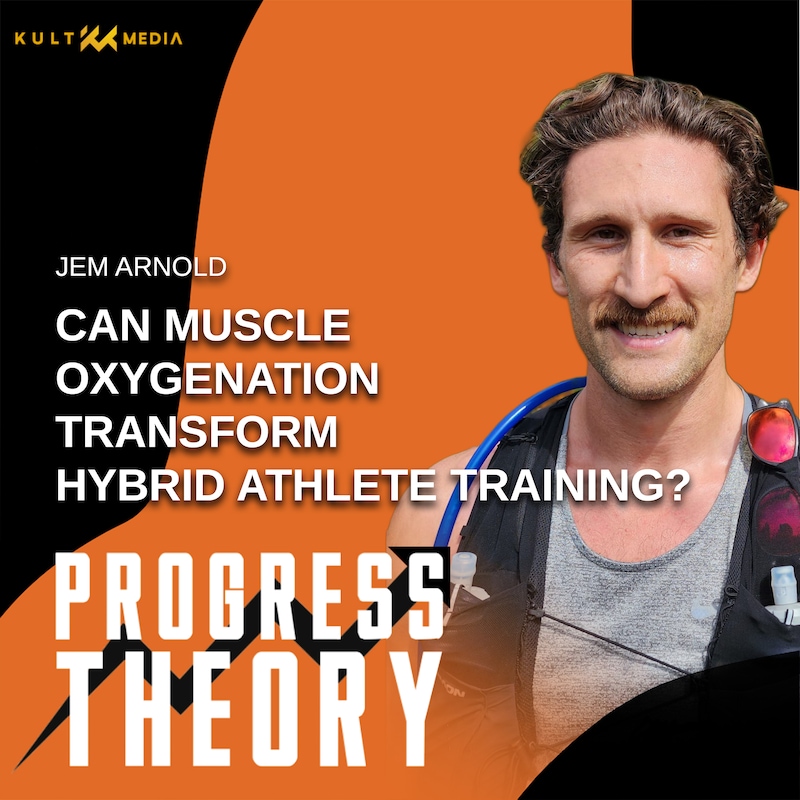
Welcome to another episode of The Progress Theory, where we explore the latest scientific principles to help you optimise your performance. In this episode, Dr Phil Price sits down with Jem Arnold—a physiologist, physiotherapist, and PhD candidate at the University of British Columbia with a fascinating dual focus on high-performance sport and clinical research.
Jem’s work dives deep into individual responses to training and the use of Near Infrared Spectroscopy (NIRS), a cutting-edge wearable technology that measures muscle oxygenation both in the lab and out in the real world.
In this episode, Jem breaks down what NIRS is, how it works, and why its ability to capture local muscle oxygenation is so useful for endurance athletes, hybrid competitors, and anyone interested in interpreting the body’s signals during exercise. Drawing from both his research and personal experience with vascular conditions affecting elite cyclists, Jem shares insights on programming, individual variability, and how blending subjective feedback with objective tech can revolutionise our approach to training.
Whether you’re curious about the next frontier of monitoring tools, want to understand performance plateaus, or just love to geek out on physiology, you’ll find plenty to stimulate your thinking in this conversation. As always, don’t forget to follow The Progress Theory for more episodes and resources. Let’s dive in!
In this episode, we discuss:
00:00 Introduction
05:17 Iliac Artery Compression in Athletes
09:03 From Clinic to Laboratory Journey
11:28 Cyclists' Arterial Strain Issue
13:58 Rare Condition in Endurance Cyclists
18:28 Quadricep Oxygenation and Flow Limitation
22:04 Compensation and Performance in Athletes
27:01 Understanding Metabolic Demands in Exercise
30:33 Metabolic Limitations in Athletic Performance
33:10 Steep Deoxygenation: Overexertion Warning
37:05 Device-Specific Trends in Oxygen Measurement
40:04 Assessing Athletes' Functional Oxygen Range
44:04 From Data to Actionable Insight
49:04 "Assessing Power and SMO2 Balance"
52:53 Selective Use of Training Gadgets
56:04 Incremental Training Feedback Process
58:06 Inconsistent Data Interpretation Challenges
01:00:48 Blogs: Informal Idea Sharing
Takeaways
NIRS for Real-World Monitoring: Wearable NIRS devices provide invaluable real-time insight into local muscle oxygenation, allowing coaches and athletes to better understand individual physiological responses during both training and competition.
Individual Variability is Key: Jem emphasised that group-level sports science research doesn’t always translate directly to individual athletes. NIRS can help tailor interventions and programming by capturing each athlete’s unique response, especially when combined with subjective reports.
Practical Application Requires Context: Having all the gadgets is great, but Jem highlighted the importance of integrating NIRS data with athlete sensations, performance metrics, and expert guidance. It’s about turning data into tailored, actionable information—don’t let the numbers overwhelm the athlete or the process!
The Progress Theory newsletter. If you want the latest information and recommendations on how to optimise your physical and mental performance, then subscribe to the free Progress Theory newsletter on Substack today.
Click the link in the show notes and subscribe to get the best information on human performance sent straight to your email.
https://theprogresstheory.substack.com/
Sign up today.
Before we wrap up, I want to give a shout-out and my thanks to my production partner, Kult Media. If you are thinking of launching a podcast or want to grow your audience, head to www.kult.media to get started today.
It was originally thought that you could not effectively train for both strength and endurance at the same time because they required different adaptations which were not compatible with each other. It was claimed that ‘an interference effect’, blunted the adaptations for strength if you simultaneously trained for endurance.
However, recent developments in sports which require both strength and endurance have really challenged this idea, with hybrid athletes producing impressive performances in both strength and endurance sports together. This had led scientists, coaches, and athletes to rethink what is humanly possible and suggests the interference effect is not as influential as originally thought.
But what is a hybrid athlete? What is the ‘interference effect’? And how can we maximize our training to improve at the same time our strength and endurance performance?
In this book, Dr Phil Price provides insight into the misconceptions surrounding strength and endurance training by distilling the past 50 years of research and drawing on the conversations he had with great scientists, coaches, and athletes on The Progress Theory podcast. This book is essential reading for hybrid athletes and coaches who are looking to understand the key training variables and their effect on the simultaneous development of strength and endurance performance.