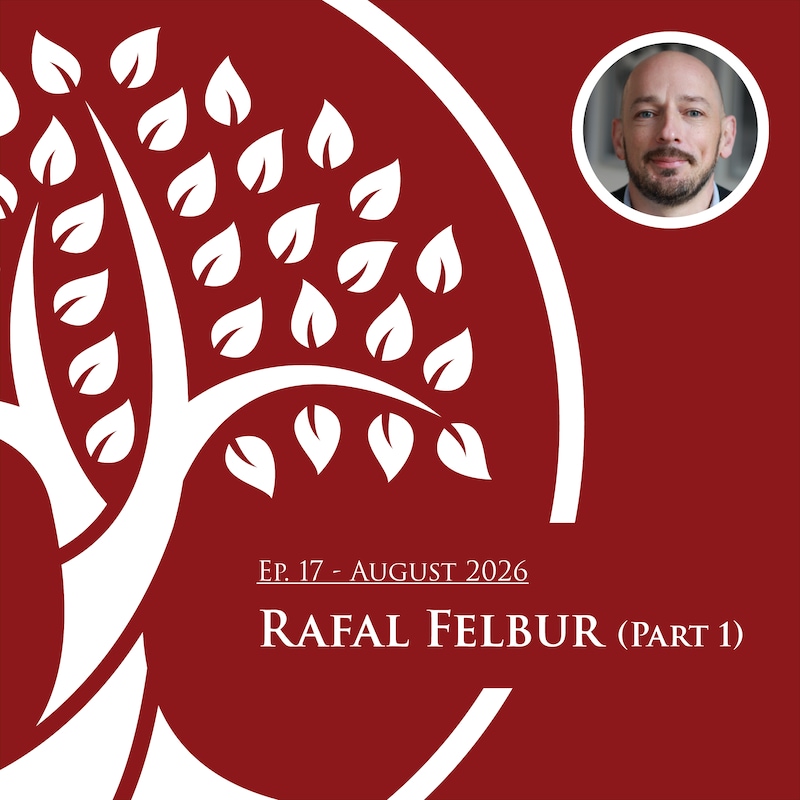
Shownotes
Rafal Felbur talks about Chinese and Tibetan texts that preserve Indic sources lost in Sanskrit, the early Chinese exegetes who imposed a restrictive orthodoxy even while compiling their inclusive Buddhist canon, and the digital tools that can help us triangulate the content of original scriptures from these enduring translations. Interview by Miles Osgood. Part 1 of 2.
Part 2 of this interview will be published on September 1.
Transcripts
[Prologue]
MILES OSGOOD: Welcome to “The Ho Center for Buddhist Studies at Stanford” podcast. Come join us by the tree.
[music - Ani Choying Drolma, guitar]
Hundreds of Mahāyāna sūtras were composed in India, but we only actively study a few dozen. Some may have been lost forever. Some never caught on with medieval practitioners, and as a result, never caught the attention of modern scholars. But there remain many that were preserved and whose study could still be revived. The original Sanskrit forms of these sūtras may have vanished, but the texts linger on in Chinese and Tibetan compilations. Gifted a second and third life in translation, they now await a fourth in some yet unpublished critical edition.
Such a project would revive the legacy of the earliest scribes and exegetes who worked to compile a Buddhist canon: scholars like the fourth- to fifth-century Chinese monk Sengrui, who accumulated and assembled what he could of all manner of Buddhist texts.
At the same time, such a project would also welcome the latest cutting-edge tools from the digital humanities. To efficiently and accurately compare extant translations, and then try to work out what the Sanskrit would have been, today’s philologist partners with programmers.
RAFAL FELBUR: What we have here is the Chinese translation. Here is the Tibetan. We know that they should go together. [...] We must read one against the other or in combination with the other in a kind of Rosetta Stone triangulation method to try to recreate this Indic. [...] So we wanted to develop a computer application that will allow us to do that automatically, right? You throw in the Tibetan, you throw in the Chinese, you press the red button, and out come both texts beautifully aligned, ready for us to work. And we learned that, again, the expert judgment of the human philologist remains absolutely indispensable, in that kind of work…
[music - Ani Choying Drolma, Oṃ maṇi padme hūm̐]
My guest today is Rafal Felbur, Wissenschaftlicher Mitarbeiter to the Chair of Buddhist Studies at Heidelberg University.
Rafal received master’s degrees in Sinology from University of Warsaw and in Chinese Languages and Cultures from Leiden University, and then arrived here at Stanford for his PhD, where he completed a dissertation in twenty eighteen on Sengrui and early Chinese formulations of “buddha-nature” thinking. We’ll be sure to cover the Chinese origins of Rafal’s training in Buddhist Studies in the conversation ahead.
As postdoctoral research fellow at Leiden University from twenty nineteen to twenty twenty-two, Rafal co-authored Digital Humanities initiatives including a procedure for the automatic detection of textual similarities between Chinese and Tibetan scriptures, and an “Editing Environment” tool on the platform “Open Philology” for tracking variations within a single Buddhist text. As part of the Buddhist Open Philology Project, Rafal also edited Volume 1 of “Ratnakūṭa Studies” in twenty twenty-five, in print with Brill Publishers.
This will be a two-part interview, starting this month with a conversation about the monastic scholars who compiled the Chinese canon and the role of the individual linguist in an age of large language models. You’ll want to tune back in next month to hear about Rafal’s forthcoming project: a study of the “Sūrata-sūtra,” a singularly surprising example of a forgotten Mahāyāna scripture.
For now, let’s head into the library for the first half.
[bell chimes]
MILES OSGOOD: So welcome Rafal and welcome back to Stanford.
RAFAL FELBUR: Thank you. Thank you, Miles.
MILES OSGOOD: We're really excited to have you back, and I thought I would take the occasion of you being here at Stanford to open with a conversation a little bit on the chronology of your academic training, both before and after you were here, and a chance maybe to talk about the thesis work that you did here. I'm thinking specifically of a way that you introduced yourself to me and to the group as you were returning, where you described the sort of funny, maybe chronologically backward, way in which you've taken yourself through Buddhist Studies as somebody who, as we were just learning, focused on Chinese culture and the Chinese language in your master's degrees, and indeed at the beginning of your later graduate studies as well, as a way back to, eventually—or outward to—Tibetan and Indic sources. And you mentioned that there's one way in which you could think of this as being backward, but it could also provide you a certain kind of advantageous or different look at Buddhist Studies, insofar as now that also mirrors the direction of the texts that you look at. You're looking at texts that only survive in Tibetan and Chinese, for which we have to infer something about the Indic sources. And so I thought I would ask you a little bit about that: about the particularity of getting into Buddhist Studies in that direction, and then continuing to find that as a vehicle—to use a word that we're going to be returning to—for going through textual history.
RAFAL FELBUR: Yeah, it's true. Thank you for this question. It's true that I began with Chinese. I was fascinated primarily in Chinese—in fact, in the Chan or Zen tradition. And I set out trying to understand the cultural, philosophical, literary, conceptual underpinnings of that movement. And that brought me gradually from the medieval period—that is from the sixth, seventh, eighth centuries backwards—to the period in which Buddhism was first introduced into China: that is, a process that began in the second century. And though I began with Chinese, eventually I found myself interacting and trying to make sense more and more of the Indic input. Even though still my focus was on the Chinese developments, Chinese reformulations of Buddhism, I found myself having to increasingly engage with Indic sources. And then at a certain point, due to factors outside of my control, basically where positions were available for people like myself, I ended up working with colleagues who were experts in Indian and Tibetan materials. And so eventually, biographically speaking, I ended up becoming someone who spent more or less an equal amount of time dealing primarily with the Chinese materials as with the Tibetan and Indian. But coming back to a formulation that you used in your question, this going from Chinese to the Indian, in a sense, it's going back: in the sense that, fundamentally, Chinese Buddhism is a later development, and Indian Buddhism is chronologically earlier.
MILES OSGOOD: Right.
RAFAL FELBUR: But in another sense, actually, it's not going back. Actually staying with and engaging with the Chinese sources is, in one sense, going back, in the sense that Chinese sources are still, in many cases, much, much earlier than the Indian so-called “original sources” of Buddhism. Because, as you know, while Buddhism developed in India—Mahāyāna Buddhism flourished in India, and several hundreds of Mahāyāna sūtras were composed in India—eventually, Indian Buddhism vanished from India and survived in Chinese and Tibetan. And for many Indian scriptures, for some at least, we do have Indic—that is, Sanskrit, and increasingly, Gandhāri—evidence. But in most cases, even when we do have Indic evidence for these Indian scriptures, that evidence is actually quite late.
MILES OSGOOD: Hmm.
RAFAL FELBUR: And the Chinese evidence is much, much earlier. So yeah, going to the Indic sources was, in a sense, going back.
MILES OSGOOD: Yeah.
RAFAL FELBUR: But at the same time, the ability to engage with the Chinese sources—that is, the Chinese translations of Indic Buddhist scriptures—allows me to stay close to the beginning.
MILES OSGOOD: Yeah. Yeah, that's wonderful. And you've described it—you’ve characterized it as knowing an India that is lost in Sanskrit. Could you say a little bit more about that? Yes, so there's one way of thinking about it chronologically. There's another way of thinking about what it offers you cross-culturally, geographically. What are you able to intuit or learn about what Indic Buddhism must have been like by way of these texts that then predate what we actually have from that region?
RAFAL FELBUR: Yeah. Well, we don't know exactly how many Indic scriptures—Indic Buddhist scriptures—in general, and specifically Indian Mahāyāna sūtras, were written. I don't think scholars know exactly how many of these things were written, but a fair estimate is a couple hundred.
MILES OSGOOD: Hmm.
RAFAL FELBUR: And that's a lot. That's a lot. So far, Buddhist Studies as a discipline of academic inquiry has been around for more or less two centuries. And after two centuries of really hard work by really dedicated people, we—that is, the discipline of Buddhist Studies has produced reliable, good quality studies of maybe a couple dozen of these Indic Buddhist Mahāyāna scriptures. But there are hundreds. We don't know exactly, and it would be valuable to know precisely how many were composed. We don't know, but hundreds.
MILES OSGOOD: Yeah.
RAFAL FELBUR: And the vast majority of them are lost in Indic sources for various reasons: both cultural—right, the presence and the ascendancy of Islam in India from a certain point on—but also material factors. Manuscripts were simply very fragile, and, especially in the humid and hot Indian climate, perished very easily. So various reasons.
MILES OSGOOD: Yeah.
RAFAL FELBUR: Let's not get into that.
MILES OSGOOD: Yeah.
RAFAL FELBUR: But when Buddhism entered China starting in the second century, and especially in the first four or five centuries of translation activity, a large proportion of that vast corpus was translated into Chinese, and we have those translations. So we often find ourselves in a situation in which we are dealing with a scripture composed in India, but a scripture all evidence for which has been missing from the Indian world for centuries, but which has been preserved in a Chinese translation, often a very early Chinese translation going as far back as the second, third, fourth century. The Tibetan element is also important.
MILES OSGOOD: Right.
RAFAL FELBUR: But Tibetan translations are considerably later...
MILES OSGOOD: Yeah.
RAFAL FELBUR: ... than the Chinese. The Tibetan translation effort really developed momentum towards the end of the eighth, the beginning of the ninth century.
MILES OSGOOD: Yeah, great. So let me dwell a little bit on the Chinese side of it, and then we'll think about China and Tibet head-to-head with regard to your digital work. So you mentioned the factors of preservation. And we think about geography. We think about politics. We think even about climate. But of course an important part of this is also just the scholarly work, the translating work, that is being done. And this makes me think about the dissertation that you wrote, the thesis that you wrote on this, I think, fourth-century scholar, right, Sengrui. And a question that seems to animate your argument in your dissertation, that seemed to animate Chinese scholarship in that time, in those early years of Buddhist transmission, is: “How much are we going to keep? “What are we going to keep? Especially as our own “developing philosophy of something like a ‘buddha-nature’ “might kind of be a wedge issue with regard “to which scriptures fit or don't fit within a coherent philosophy?” And you say that one of the distinctive features—and helpfully for us, being able to gaze backward—of this Chinese canonization process was that it was fundamentally pretty conservative and comprehensive—it wanted to include it all—but that this potentially posed doctrinal or philosophical issues about how to make things align, how to make things fit together. And so this scholar Sengrui becomes very important for you because of his specific intellectual commitment to wanting to insist on a unity of things that seemed like they could otherwise be very disunified. Can you tell us a little bit about that case, that scholar, and how you perceive him in his work?
RAFAL FELBUR: Yeah, well, these are many, many complex, very important questions. I'll begin—and this is only a beginning of an answer.
MILES OSGOOD: Sure.
RAFAL FELBUR: So if I miss important points, important aspects of your question, please call me out. But just to get us started, I'll begin by addressing the very concept of canon.
MILES OSGOOD: Mm.
RAFAL FELBUR: In your question...
MILES OSGOOD: Yeah.
RAFAL FELBUR: Correctly: this is not a critique... (Miles laughs) But correctly—which is common practice, right...
MILES OSGOOD: Yeah.
RAFAL FELBUR: ... to invoke the concept of the Chinese canon.
MILES OSGOOD: And I can't help it with the books that are behind us.
RAFAL FELBUR: Right, I mean, here we have various editions of canonical collections. So the concept of the Chinese canon is used very widely among experts, among non-experts alike, but it is a problematic usage for various reasons. Now, obviously, the word canon, right, itself originates from the European cultural context, and especially in connection with Judeo-Christian religions, in which context it means a group—a narrow, well-defined set of scriptures that have been selected as particularly authoritative...
MILES OSGOOD: Hmm.
RAFAL FELBUR: ... sanctified by some form of ecclesiastical authority, and sanctified in reference to some higher transcendental principle—more or less.
MILES OSGOOD: Right.
RAFAL FELBUR: But when the formulation “Chinese Buddhist canon” is used, it is used in reference to something quite different. So, in a sense, the formulation “Chinese Buddhist canon” is a misnomer. What scholars and non-scholars alike usually have in mind when they speak of “the Chinese Buddhist canon” is, for instance, what we see here on the shelves. We have here several editions of what in Chinese obviously is not called “the canon.” It's called literally “the great accumulation of texts,”
MILES OSGOOD: Hmm.
RAFAL FELBUR: “Great accumulation” ... And this is what these things actually are. They are just vast assemblages of everything identifiably Buddhist: not just specially selected, historically authoritative, sacred scriptures, but all manner of other writings that were thrown into this big collection.
MILES OSGOOD: Mm-hmm.
RAFAL FELBUR: Biographies, historiographies, bibliographies, catalogs, things like narrative cartography—so basically descriptions of different places. All kinds of literature thrown into this big box and called “the big accumulation of writings,” “Dazangjing.” And so, commentators, Western commentators, scholars, seeing this state of affairs, frequently observed that the Chinese Buddhist canon is somehow different...
MILES OSGOOD: Mm-hmm.
RAFAL FELBUR: ... from European, Christian, Jewish canons, right? That it's different fundamentally, structurally. It's much more capacious.
MILES OSGOOD: Yeah.
RAFAL FELBUR: It's open as opposed to closed. I think... And therefore, they also tend to conclude that the kind of canon that European, or Judeo-Christian cultures, traditions, had simply did not exist in the Chinese Buddhist context. Right, they say, “Oh, in Judeo-Christian traditions, “canon—with all of its associated dynamics of ecclesiastical authority, orthodoxy...”
MILES OSGOOD: ... And principles of selection.
RAFAL FELBUR: Selection, but also all the other cultural dynamics that go with that. For example, the possibility that there is a church-like structure that will identify and persecute those who do not adhere to the canon. So basically, the dynamics of heresy, persecution, scriptural fundamentalism. Right, commentators say, “No, that's all missing “in the Chinese Buddhist tradition or in the Buddhist tradition more broadly.” “It's a fundamental difference,” they say, “between the Judeo-Christian traditions, “which are fundamentally based on scripture, and those other Buddhist traditions.” I don't think so. (Miles laughs)
MILES OSGOOD: So now another shoe drops.
RAFAL FELBUR: I think... Yeah, exactly. And the particular figure that I focused on in my dissertation—and you kindly invoked this figure's name. I'm interested in this particular figure, yes, but as a kind of—as a token, as a representative of this bigger problem of canonicity: as a case study, or as evidence, that in the Chinese Buddhist context, we find the same dynamic of ecclesiastical authority coming in to implement, to establish an authoritative body of knowledge, and to arrogate to itself the power to demand that everybody follows this authoritative body of knowledge, and to punish those who will not. So that's basically the problem that I was getting at in my dissertation.
MILES OSGOOD: Yeah. So I wonder about this with regard to the talk that you're going to give tomorrow, and the topic that I think we will dwell on later in this conversation: the question of what we do about the fact that there are Mahāyāna scriptures in this Chinese world that are frequently repeated, that are practiced, performed, that are given—as we've learned from other guests on this show—mystical powers in terms of what it can mean to devote one's life to a specific sūtra, and therefore—whether it's the “Diamond,” the “Lotus,” the “Garland Sūtra”—have a sort of pride of place, and are replicated in various recensions and forms, but nevertheless, are more likely to persist and endure, versus scriptures for which—that never made it back to Indic translation or an Indic form, and are therefore maybe more neglected. When you look at the variety of different religious texts that are then on offer, what do you think about the problem of inclusion and unification and an open canon, paradoxically, on the one hand, versus the need to impose orthodoxy, to punish heresy, to consider the bounds around what is believed and what is allowed on the other? Where does this amorphous mass of alternative scriptures belong in that Chinese conversation?
RAFAL FELBUR: Where does that mass of amorphous scriptures belong in this Chinese conversation? Well, I think one way to get at this question is to first consider from whose perspective?
MILES OSGOOD: Hmm.
RAFAL FELBUR: Right? For communities of active Buddhist belief and practice in East Asia, the answer to this question will be different, right, than the answer that we as scholars might contemplate. And there are, of course, scales in between these two identities. For communities of living religion and practice, these scriptures, I think... I'm not in a position, of course, to speak for these traditions. But they have been preserved throughout the centuries in various editions of the great collection of scriptures, but at least based on my own study of several examples of these forgotten or neglected scriptures that never became central...
MILES OSGOOD: Mm-hmm.
RAFAL FELBUR: ... to living religious belief and practice in East Asia, they are essentially filler material. Yes, sacred filler material, right, because of the assumption that all scriptures are the words of the Buddha...
MILES OSGOOD: Yeah.
RAFAL FELBUR: ... but there is no explicit engagement with them.
MILES OSGOOD: What does that neglect look like? Is it they're not read, they're not studied, they're not recited? How far down does it go?
RAFAL FELBUR: I mean, that's a very difficult methodological question...
MILES OSGOOD: (laughing) Yeah.
RAFAL FELBUR: ... because basically what I'm saying is that throughout the centuries, actual historical individuals—for example, let's say in China–did not use a particular text.
MILES OSGOOD: Mm-hmm.
RAFAL FELBUR: But how can I prove that something didn't happen?
MILES OSGOOD: (laughing) Right. Right. Yeah.
RAFAL FELBUR: All that I can prove is that I have no evidence...
MILES OSGOOD: Yeah.
RAFAL FELBUR: ... for active use, active engagement.
MILES OSGOOD: As opposed to the positive evidence you have of other sūtras.
RAFAL FELBUR: Right. But I have no—I cannot...
MILES OSGOOD: Yeah, you can't definitively say.
RAFAL FELBUR: Right. As is often said, "Lack—” or, “Absence of evidence is not evidence of absence." So who knows? And in fact—sorry, now this is a tangent, but a delightful one. (Miles laughs) As you very kindly pointed out, I have a study coming out in which I tried to make sense of one of those scriptures that fall in this category of scriptures that never became very popular in Asian Buddhist traditions: in India, in China and Tibet. And I came across evidence that in fact, roughly six decades after this text was first translated from some Indic source into Chinese, there was at least one important—important, by whatever metric—important exegete preacher, leader of the nascent Buddhist movement in China, who thought this was really great stuff (Miles chuckles) and who was actively going about and preaching and propagating this particular text. But how do I know about it? From a letter written by another of his contemporaries. And the author of the letter says, “You know, one of my friends, he loved that text. What was he thinking?” (Miles laughs)
MILES OSGOOD: “Yeah, but he was crazy. He was an outlier.”
RAFAL FELBUR: That's right. Yes.
MILES OSGOOD: Your only evidence is when it's already on the wane.
RAFAL FELBUR: Exactly. We only know that the text in question was used by at least that one outlier...
MILES OSGOOD: Yeah.
RAFAL FELBUR: ... is because his friend, his colleague, decided to write a highly critical doc(ument)...
MILES OSGOOD: Yeah.
RAFAL FELBUR: But we don't know how many other such people were out there throughout the centuries.
MILES OSGOOD: Yeah, but that's great that that anecdote and that kind of multiple levels of remove from the original scripture gives us a sense both of the possibility of inclusion—to the conversation we were having before about canon—and the sort of policing of the boundaries of the canon. So, you mentioned at the beginning of this part of the conversation that there might be a substantial difference between how scholars would look at this and how practitioners would look at this today as well. And that makes me curious about, sort of: do you find you relate to certain monks and scribes in this tradition who see themselves as includers and unifiers insofar as that's, (in) a way, your project now?
RAFAL FELBUR: Right. Do I... Do I feel that I relate to—if I understand you correctly—to an individual like Sengrui?
MILES OSGOOD: Yeah.
RAFAL FELBUR: If I understand correctly, he was... Yes and no. That's the short answer. If I understand correctly, he was kind of like an early church father figure. He was out there in the trenches trying to do what looks very much like establishing a kind of unified identity for this new presence in the Sinitic culture: Buddhism, which hadn't been there. Now it's here. We need to find a way to make sense of this tradition, both for in-house use for but also vis-à-vis other established sources of culture. So in a way, yes, in a way, no. In a way, yes, I relate to him because he was trying to make sense of things. Right? He was confronted with, he was presented with, he was dealing with this vast quantity of textual material, all of which was trying to address big questions but which were giving often incompatible answers. This aspect of his project, as a scholar, as a human being, it's hard not to relate to. He was just trying to make sense of things.
MILES OSGOOD: Yeah.
RAFAL FELBUR: At the same time though, he was very much in the business of establishing, imposing, and then policing a hegemonic discourse.
MILES OSGOOD: Yeah.
RAFAL FELBUR: In one of his documents, which fortunately survived somehow—again, a lot of this is fortuitous. A lot of that is pure chance. And then we take these little elements of evidence that fortunately have survived over 17 centuries and based on them, we try to erect a kind of comprehensive picture of that historical period, which we have to be aware of the limitations of our evidence...
MILES OSGOOD: We have to be cautious about that.
RAFAL FELBUR: ... Constantly, constantly push back against our... In any case, we have a document that survived from him, which is this kind of internal memo—at least based on my reading—in which he says essentially, “Yeah, we're going to have to start excommunicating people.”
MILES OSGOOD: Hmm.
RAFAL FELBUR: And especially if—since we are... This is nominally... This is a Buddhist actor that we're talking about.
MILES OSGOOD: Yeah.
RAFAL FELBUR: To see a Buddhist actor invoking these tropes of heresy, excommunication: I think it's quite eye-opening, both to popular explorers of Buddhism who are accustomed to the notion that one of the fundamental differences between Christianity and Buddhism, let's say, is that Christianity has that history...
MILES OSGOOD: Yeah.
RAFAL FELBUR: Buddhism doesn't. It's actually...
MILES OSGOOD: It's there.
RAFAL FELBUR: Yeah. He's a complex figure.
MILES OSGOOD: Yeah. As a scholar, you would never say, “Oh, I'm on the team of excommunicating.” (both laugh) Yeah.
RAFAL FELBUR: Yeah.
MILES OSGOOD: Okay, this is fascinating. Can I just ask one more question on this before we move forward, which is: what is, then, heretical? For somebody who is pretty committed to accepting and trying to stitch together texts that might be pretty diverse and that might themselves have pretty different positions, what's outside the lines for him then?
RAFAL FELBUR: Yeah, well, that's another excellent question. And once again, I think different answers will be available depending on the perspective that we assume in giving an answer. From my perspective as an outsider, I think what he's particularly sensitive about, in his effort to create this complete, closed, and authoritative hegemonic discourse, is simply any presentation of Buddhism that he identifies being offered by his contemporaries—he's mainly in dialogue or in kind of critical engagement with his contemporaries—that will not subscribe to a kind of universal, unified, totalizing vision. (Miles laughs)
MILES OSGOOD: That's a funny irony.
RAFAL FELBUR: But—it's an irony?
MILES OSGOOD: Well, insofar as, “You have to be inside my universal, totalizing vision or else you're not included.”
RAFAL FELBUR: Exactly. Yeah. Yeah, so this is what I see him doing. This is the game that I think he's playing. Of course, he doesn't say it like that.
MILES OSGOOD: Mm-hmm.
RAFAL FELBUR: He has all kinds of holy ways, (laughing) all kinds of arguments, theological arguments. For example, arguments concerning this notion of “buddha-nature,” which enters the Sinitic Buddhist world more or less at that time. And it's interesting because in a lot of what has been said about this notion of “buddha-nature” in scholarship, but also in popular literature to date in Western languages, has come down to this idea, this kind of Weberian notion, that the reason why this idea of “buddha-nature” found such great success in China was because the Chinese mind...
MILES OSGOOD: Hmm.
RAFAL FELBUR: Right? This kind of universalized concept.
MILES OSGOOD: Yeah..
RAFAL FELBUR: This Chinese mind was particularly receptive to thinking in terms of immanence, as opposed to transcendence: a kind of egalitarian potential for everyone to become a sage. Right? So scholars and popular commentators said, “Oh, ‘buddha-nature’ became so popular in China “because the Chinese culture, “before even the first contact with Buddhism, “already thought in terms of kind of inherent potential for something good.”
MILES OSGOOD: Yeah.
RAFAL FELBUR: But Sengrui used it for a very different goal.
MILES OSGOOD: Right.
RAFAL FELBUR: He was in the business of creating that orthodoxy and policing heresy.
MILES OSGOOD: Yeah, that there's a universalism in the philosophy, but not necessarily in the practice.
RAFAL FELBUR: Yeah.
MILES OSGOOD: Right. Yeah. Fascinating. Okay, just to take a very sharp turn now, we've thought about the foils of the scholar who starts from Indic sources and the scholar who starts from Chinese sources—maybe also the foils of the scholar and the monk as doing different kinds of work with regard to literature that they receive. Based on the nature of some of your recent work, I thought I'd also ask about the foils of the philologist—the person who knows this literature and these languages inside and out—and the natural language processor: this sort of new digital being among us that is also processing texts in a particular way. Because you've done this digital humanities work of trying to do what we might see as a version of kind of scribal editorial practice that's been going on for millennia, but accelerated and enabled in a hypertextual way where people can collaborate on creating authoritative versions of these scriptures that track edits and recensions and whatnot, that are training models that are non-human to be able to read and translate and compare these things, right? Okay, so big turn, big new question. But I just want to ask about that a little bit. What are you finding to be the evolving nature of this relationship now between the scholar and the machine, as it were, instead of the scholar and the monk? What have you learned from your years working in that space?
RAFAL FELBUR: Ah, a sudden chill has taken over the room. (Miles laughs) You invoked the topic that is on the minds of so many of us, the topic of large language models—broadly speaking, AI—and how it is already impacting and how it will continue to impact what we do. The short response is: I have stopped making predictions for how it will impact, specifically, the work of the philologist Buddhist Studies expert. My experience so far working with computational approaches to philology... My experience so far—which may be disproven by the next big announcement from Anthropic or whatever, tomorrow—is that as effective, as powerful, and indeed as helpful as some of the new tools out there are—and indeed they are extremely powerful and increasingly helpful—so far, the human philologist, the human expert, is indispensable. This has been our experience in the work that my colleagues and I did in twenty twenty-two, as we developed... And that was before the publication—that was just a month or two before the publication of—the public...
MILES OSGOOD: Wow. Yeah.
RAFAL FELBUR: ... announcement of ChatGPT.
MILES OSGOOD: Right. RAFAL FELBUR My colleagues and I—and here the main credit goes to my two colleagues, Marieke Meelen and Paul Vierthaler, who did most of the programming on the NLP side. I was just the philologist hanger-on. What we were trying to do in that project was basically create a helpful tool for the philologist: the philologist who is working in the way that we talked about, right? So the philologist who's trying to recreate these lost Indic scriptures based on their surviving Chinese and Tibetan evidence. So what takes up a lot of time for us scholars engaged in this work is: yeah, we know, okay, we're working on this particular Indian text. Fine. We don't have it in Sanskrit. Let's just go with the default case. We don't have any Indic evidence. What we have here is the Chinese translation. Here is the Tibetan. We know that they should go together, right? We must read one against the other or in combination with the other in a kind of Rosetta Stone triangulation method to try to recreate this Indic. But we don't really know which passages in the Chinese actually correspond to which passages in the Tibetan, and it's extremely time-consuming...
MILES OSGOOD: Mm-hmm.
RAFAL FELBUR: ... to align the corresponding passages before we even can start to do the real work of trying to make sense of this material, right? So we wanted to develop a computer application that will allow us to do that automatically, right? You throw in the Tibetan, you throw in the Chinese, you press the red button, and out come both texts beautifully aligned, ready for us to work. And we learned that, again, the expert judgment of the human philologist remains absolutely indispensable in that kind of work, in the development of such applications. Again, that was before GPT. Now, amazing new developments are happening almost daily, and you had here Marcus Bingenheimer...
MILES OSGOOD: Mm-hmm.
RAFAL FELBUR: ... who is on the forefront of these developments, together with Sebastian Nehrdich, who is now in Tōhoku in Japan.
MILES OSGOOD: Yeah.
RAFAL FELBUR: Wonderful new applications being developed. But I know—I'm not keeping up with the technical aspects—but I know from conversations with Marcus and with Sebastian, that even now, even with these new technologies available, still human judgment—how long?—is indispensable? How long that will remain? Maybe I'm just grasping onto str(aws)—trying to be hopeful.
MILES OSGOOD: Right.
RAFAL FELBUR: Because I want to be needed.
MILES OSGOOD: Yeah.
RAFAL FELBUR: But that's my perception.
MILES OSGOOD: Yeah, and I think based on what you published, what I learned about that was, it's not just as we might imagine, that the human is necessary at the end stage of saying, “Okay, I've got these texts aligned. “Now the interpretive work of looking at these two together and trying to intuit what the third missing text was...” That kind of makes intuitive sense to us, that that role would continue to exist and be needed, and in fact, be the purpose of what we do. But it's also the preliminary work, right? That it was training the model in the first place to have the right guardrails, to set the “golden standard,” as you put it, to be able to do this matching properly. That was also necessary.
RAFAL FELBUR: Yeah, and from what I understand, the LLM-based technologies and their applications for Buddhist Studies, they have—as all of these applications—they have to be trained on training data.
MILES OSGOOD: Right. Yeah.
RAFAL FELBUR: Your ChatGPTs, your Geminis, and the others have been trained on basically everything that is out there, copyrighted or not. That's a sensitive topic.
MILES OSGOOD: Yeah. (laughs)
RAFAL FELBUR: But when it comes to training these tools for Buddhist Studies applications, there is really very little of quality.
MILES OSGOOD: Hmm.
RAFAL FELBUR: Mm? And that's the bootstrap element. Without this human training data, this high-quality human training material, these applications will continue to underperform.
MILES OSGOOD: Yeah. So we talk about these trainers and these collaborators as philologists, but it sounds like it's important to also think of them as curators in a way for the material that the engine is being trained on. Would you say? Or is there a different professional title you would give them?
RAFAL FELBUR: Well, I am a little bit concerned... “Curator” sounds lofty.
MILES OSGOOD: Mm-hmm. (laughs) I sometimes feel that we have become or we are becoming... (Rafal sighs) I'm looking for a different term than “curator.”
MILES OSGOOD: Well, can I ask you a little bit...
RAFAL FELBUR: Something more ephemeral.
MILES OSGOOD: Yeah.
RAFAL FELBUR: Something more expendable.
MILES OSGOOD: Hmm.
RAFAL FELBUR: Who knows? Maybe once we have trained these models, they will become so efficient...
MILES OSGOOD: Yeah.
RAFAL FELBUR: ... that we will be rendered obsolete.
MILES OSGOOD: Yeah, so they're putting up scaffolding, but it's unclear whether it's a true long-lasting innovation.
RAFAL FELBUR: We are the booting program (Miles laughs) once the system is running.
MILES OSGOOD: Oh, no. We've turned over to giving over the metaphors to the technical side of things. Okay. But this makes me ask a little bit about, you say how hard it is to look forward into the crystal ball in terms of what this relationship, this collaboration is going to look like going forward, and I take that point. What about looking backward? Is there a way in which doing this kind of digital work gives you a perspective on what scribes and editors did for centuries over time when they had texts together that they were trying to maybe compare or didn't have the access to the two texts and were kind of working with one eye closed? What does it tell you looking back?
RAFAL FELBUR: Yeah, it is sometimes gratifying and reaffirming to see that some of the historical individuals, historical figures, whose work we engage with—in the form of texts, primarily, in the case of a philologist, but also institutions, et cetera—that they were engaged in something fundamentally similar.
MILES OSGOOD: Hmm. Yeah.
RAFAL FELBUR: Hmm? Philology is often presented as a quintessentially modern scientific enterprise, having its origins in 19th-century German universities where the humanities wanted to establish themselves or present themselves to the German public as just as—every bit as scientific as mathematics, physics, evolutionary biology, and whatnot. But philological practices in the broad sense, right—understanding philology as the art of reading texts closely, carefully, and devotedly—is a far more ancient enterprise. Whether it has a future, that's of course another matter.
MILES OSGOOD: Yeah, so it's not as though we're talking about two nodes of connection in the 21st century and the fourth century. It's a kind of continuity of this kind of scholarship that has just taken different forms over time. Yeah, that makes sense.
[Epilogue]
[music - Ani Choying Drolma, guitar and bells]
This concludes Part 1 of this two-part interview with Rafal Felbur. If you want a preview of the second half, check out Rafal’s lecture for the Ho Center on our YouTube channel, titled, “In the Great Vehicle Down Roads Less Traveled.”
If you’re interested in Rafal’s “Editing Environment” tool, built with Marieke Meelen and Paul Vierthaler, you can create an account on openediting.eu, or read about the programming process in the “Journal of Open Humanities Data.”
[music - Ani Choying Drolma, Oṃ maṇi padme hūm̐]
We hope you’ll tune back in next month, and keep listening to the “The Ho Center for Buddhist Studies at Stanford” podcast.
[music - Ani Choying Drolma, Oṃ maṇi padme hūm̐]

