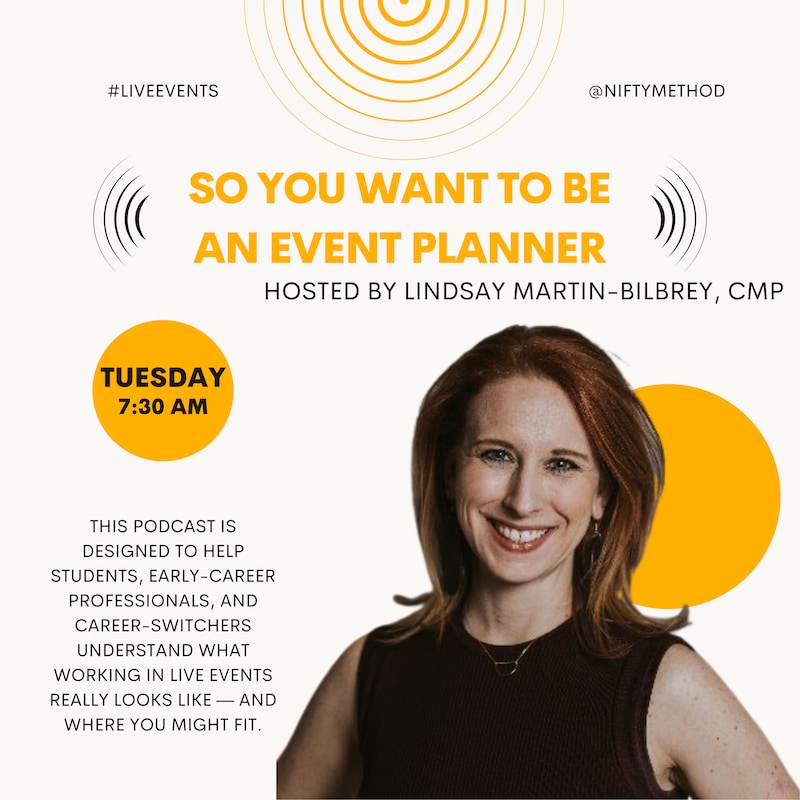
Shownotes
🎙️ Episode 5 — Exploring Undergraduate Majors for Jobs in Live Events
“What should I major in if I want to work in events?”
It’s one of the most common—and most stressful—questions people ask.
In this episode of So You Want to Be an Event Planner, we explore the academic disciplines that feed into event planning and event management careers. We look at how hospitality, business, communications, sport management, theatre, social sciences, design, and technology each contribute different capabilities to event work. This episode reframes events as an interdisciplinary field and explains why skill stacking and applied experience matter more than choosing a single “right” major.
If you’re a student, parent, counselor, or advisor navigating event management degrees and pathways, this episode brings reassurance and clarity.
🔑 Key Ideas
- No single major owns the event field
- Events draw from many academic disciplines
- Interdisciplinarity is a strength, not a weakness
- Skill stacking matters more than major choice alone
- Most successful event professionals build toward the field over time
🧠 Language We’re Using
- Source majors
- Interdisciplinary field
- Skill stacking
- Academic pathways
- Applied experience
✍️ Try This
List what your major—or past education—already contributes to events.
Then identify one complementary skill you’d like to build next.
🎧 Coming Up Next
Episode 6: The Formats of Events — A Taxonomy
Once you understand pathways, it’s time to look at the events themselves. Next, we’ll break down the different types of events—and why format matters more than you think.
🔍 Examples Referenced in This Episode
- Hospitality and tourism programs
- Business and marketing degrees
- Theatre and performing arts backgrounds
- Sport management programs
- Sociology, psychology, and design disciplines
Transcripts
Episode 5 live event source Majors and what they Feed into welcome to so youo Wanna Be an Event Planner, a podcast about how people actually find their way into the live events and experience industries.
Speaker A:I created this show because live events are everywhere in our lives conferences, concerts, weddings, festivals, sports and civic moments.
Speaker A:But the field itself is surprisingly invisible.
Speaker A:People work in live events for years without ever being able to explain what the industry really is, how they got into it, or what career paths even exist.
Speaker A:My name is Lindsay Martin Bilbrey.
Speaker A:I've spent over 20 years working across hospitality, live events strategy and operations in agencies, venues, brands, associations, and classrooms, and I've seen firsthand how many talented people stumble into this work without a map.
Speaker A:This podcast is designed to for students who think that they might belong in events but don't quite know what that means yet.
Speaker A:It's for career switchers who found themselves adjacent to this field and are wondering if there's a place for them here.
Speaker A:And it's for parents, advisors, and educators who want better language for explaining what this industry actually is and why it matters.
Speaker A:This isn't a how to show about planning live events.
Speaker A:It's about understanding the fields, but roles, the pathways, the identities and the systems behind live events and experiences so you can decide where you fit inside it.
Speaker A:Let's get into It One of the most common questions I hear is what should I major in?
Speaker A:If I want to work in live events or I think I might want to work in live events?
Speaker A:Do I need to go back into school?
Speaker A:I studied political science, business, etc.
Speaker A:And the honest answer is there isn't one right major.
Speaker A:Today we're going to break down the live event source majors that feed into this field, what each one contributes, and why.
Speaker A:Your academic path matters less than you've led to believe.
Speaker A:If you've been worried that you picked the wrong major or that you didn't discover live events early enough, then this episode is for you.
Speaker A:Because live events don't belong to a single academic discipline, they're built at the intersection of many.
Speaker A:Now, why does this question cause so much stress?
Speaker A:Academic choices feel permanent, especially early on.
Speaker A:Students worry, Did I pick the wrong major?
Speaker A:Am I behind?
Speaker A:Do I need to transfer?
Speaker A:Are live events even legitimate as a career?
Speaker A:Parents worry also about employability.
Speaker A:Are they wasting tuition dollars?
Speaker A:Counselors and advisors worry about coherence.
Speaker A:Can you get with this degree into this job?
Speaker A:So let's slow this down and get precise.
Speaker A:Live events is an interdisciplinary field.
Speaker A:What that means is they don't emerge from one discipline or one Academic department.
Speaker A:Instead, live events borrows from many.
Speaker A:It's not a weakness in my opinion.
Speaker A:It's the reason that the field works.
Speaker A:Different majors feed different capabilities into live events, and most live event teams are intentionally interdisciplinary.
Speaker A:So let's start with some of the most common academic departments and how it fits in Hospitality and Tourism Hospitality is the most common academic home for live events in the US which is interesting because I think I had worked in live events for almost 10 years before I met somebody who actually had a hospitality degree.
Speaker A:Jamie Murdoch graduated from Cornell and he'd worked in hotels and DMOs his entire life.
Speaker A:I, however, who had been running large scale citywide events for my entire career up to that point, went to school for political science.
Speaker A:We did the same thing, but from different ways of thinking about it and training, and it turned out neither of us was right or wrong, but better together.
Speaker A:So hospitality and tourism, the most common academic home, contributes service, design, guest experience, food and beverage systems, lodging and venue operations, logistics and risk management.
Speaker A:Hospitality students often move into venue management just like Jamie.
Speaker A:They manage the venue.
Speaker A:That means they sell it or or they go out and represent the marketing so that you are aware of it.
Speaker A:They provide the operational support there, on the ground, on property, at the franchise or at the corporate level.
Speaker A:Hospitality students could move into catering and banquets.
Speaker A:You provide the banquet food for the coffee break, for the gala dinner, for the food trucks that pop out outside of the convention center.
Speaker A:They work in conference services.
Speaker A:So what that means is it's your equal.
Speaker A:If you're the in house event manager, you work with a CSM or conference services manager at the hotel or venue to help you put your vision for the event into action at their venue.
Speaker A:And then operations leadership, the people who make the things work.
Speaker A:This is a variety of job titles usually trained inside a hospitality or STEM program to help you do it.
Speaker A:That could go from the GM or all the way down to someone's executive assistants whose job it is to make sure that the room drops happen at the venue.
Speaker A:Hospitality teaches live events how to run business is another common area where we see many students work.
Speaker A:They tend to be more on the brand side or in house roles.
Speaker A:Business majors bring strategy, finance and budgeting, marketing and operations management.
Speaker A:They often move into brand side event roles.
Speaker A:They work in sponsorship and partnerships.
Speaker A:They are the corporate event teams or they become entrepreneurs and run the agencies.
Speaker A:Business majors help live events connect with organizational, typically economic but organizational goals.
Speaker A:So let's dive into a little bit further inside business school and look at the pr, communications and marketing Programs.
Speaker A:Now maybe you went to journalism school or maybe you were a marketing major who focused in advertising or pr, or maybe you're a marketer, whatever that is.
Speaker A:Communications and marketing managers contribute messaging, storytelling, audience segmentation, campaign thinking.
Speaker A:They tend to approach it from a very system wide management approach, but they tend to be some of our strongest brand side event managers.
Speaker A:They work in experiential marketing, brand marketing, audience management, content and programming, and community engagement.
Speaker A:Brand side communication.
Speaker A:Marketers help events communicate why they exist.
Speaker A:Sport management.
Speaker A:Now sport management might be aligned with the tourism or the hospitality school where I got my graduate degree, the University of South Carolina.
Speaker A:That school housed hospitality, tourism and sport management.
Speaker A:Sport programs teach large scale operations, the fan experience, facility management and scheduling and compliance.
Speaker A:So what does that mean?
Speaker A:Sports programs teach large scale operations like the weekly football games that the NFL hosts or the fan experience.
Speaker A:So if you're going to watch the Lakers play, what happens when you get to seat corporate, port side or in one of the suites?
Speaker A:These programs teach facility management, the actual facility itself, the practice facility, the arena that they operate in.
Speaker A:And they work with the scheduling and compliance because what happens when there's not a game?
Speaker A:How can they sell and use the space?
Speaker A:Sports majors often move into event operations, venue roles, tournaments and competitions, and crowd management.
Speaker A:Sports managers bring comfort with scale and pressure.
Speaker A:Another academic discipline we see quite commonly, though often back of house, is our theater, music and performing arts friends.
Speaker A:These disciplines contribute production, logic, run of show thinking, rehearsal processes and cue based execution.
Speaker A:Now what do I mean for that?
Speaker A:When I first became an event manager, I struggled for years because I was working as a back of house show caller as well as the public, public facing event director.
Speaker A:So I managed what happened just from the overall event design, but I also managed the general session and how the event itself had to flow for those 60 to 90 minutes.
Speaker A: In: Speaker A:How to get from basically the play selection to production.
Speaker A:It's a book by Robin Schraft and it changed the entire way that I approached run of shows and production logic.
Speaker A:That's because in theater, music and performing arts, they bake this into your training, everything.
Speaker A:As many planned live events over and over again.
Speaker A:If you think of a Broadway production, they do it eight times a week without fail, absolutely perfect, even though they know it's not always perfect.
Speaker A:And what happens in a time if they can't have that stargo wand for backup?
Speaker A:These disciplines are some of our strongest producers.
Speaker A:Stage Managers, programming leads and show callers.
Speaker A:They help our events feel intentional and cohesive.
Speaker A:Another department that is active inside live events is the sociology, anthropology and psychology.
Speaker A:Social science majors bring an understanding of group behavior, the cultural and ritual elements to why we meet, how we meet, what, what you need to feel emotionally as you meet.
Speaker A:They help with identity formation.
Speaker A:What really turns a group of attendees into participants and those participants into a community of practice.
Speaker A:They help us understand and implement social dynamics.
Speaker A:I like this club.
Speaker A:Ichi is one of my favorite experiments in this.
Speaker A:Now I have no idea background wise what their founders went into, but from a social dynamics and the very essence of gathering, they're literally the social club for many live event managers I know in my network.
Speaker A:And it's all focused on how we come together and get better at what we do, but feel better about what we do as well.
Speaker A:Sociology, anthropology and psychology majors often find homes in live events.
Speaker A:Careers in event design, research and evaluation, community focused events, and civic and cultural programming.
Speaker A:They help live events mean something.
Speaker A:Design, media and technology is another really almost disparate depending on the university you're at.
Speaker A:For instance, my husband is a graphic design major, so what he brings for it is that visual communication and the user experience.
Speaker A:What does it look and what does it feel like?
Speaker A:He can take anything that I script and turn it into something that is beautiful, beautifully understood through graphics, art and motion on the screens themselves in the one sheets we leave behind.
Speaker A:That's one element.
Speaker A:Also inside design is the tech side of it, the user experience.
Speaker A:When you go to a registration site, how does a user move through the interaction?
Speaker A:How does it work on multiple device types, those digital platforms and spatial thinkings?
Speaker A:Combine what you find from the theater, music and performing arts side and meld it to help make sure that our event design looks and works across mediums.
Speaker A:As the modern live event has gotten much more technical on both the front and the back of the house.
Speaker A:They tend to work in AV and production tech, our registration and data systems, and those hybrid and virtual events that since the pandemic, we've learned are not just a nice to have, but a must have for the types of ways we need people to join and engage.
Speaker A:Design, media and technology majors help us make live events work in modern context.
Speaker A:So why is interdisciplinary an advantage?
Speaker A:Well, because we've said before, live events are complex systems.
Speaker A:They combine creative thinking, operational rigor, human insight and strategic alignment.
Speaker A:No one single academic major does all of that.
Speaker A:Strong live event professionals shouldn't be defined by their degree.
Speaker A:They're defined by how well, they integrate perspectives, collaborative team approaches, and the different humans that help create and deliver a complex system that is a live event.
Speaker A:So what matters more than your major?
Speaker A:Yes, this is me telling you that you can go tell your mom I said let's be clear, your major does matter, but it is not the deciding factor.
Speaker A:What matters more is what's the applied experience you're getting out of it.
Speaker A:If you're going to go into a hospitality or tourism program, do they have an applied internship that will allow you to go and learn hands on what you've been learning in theory to put into practice?
Speaker A:Do those internships and part time work allow you to find and work through different parts of what you think the live event experience should do?
Speaker A:Maybe you hate working registration, but you love seeing what happens behind stage.
Speaker A:That's an easy way to move from one to the other.
Speaker A:What matters more is skill stacking.
Speaker A:Every time you try something out, whether it's in those last two years of your undergraduate experience or in the first five years your career, you stack skills and abilities that you're learning in different facets of a complex live event and taking it to the next point of your career.
Speaker A:It provides you the vocabulary, the reflection and the language that we speak inside live events.
Speaker A:It's the language of business, the language of tourism, the language of KPIs, the language of hospitality and the quirkiness that is just live events then compounded.
Speaker A:Whether or not you work in corporate events, festival events, association events, social events, each one has its own particular dialect.
Speaker A:And then finally it's understanding how your background fits in that despite whatever your major is.
Speaker A:Again, I started as a political science major.
Speaker A:I never really have worked in political events.
Speaker A:Now have I Supported them from afar through something I've done through one of my other roles?
Speaker A:Absolutely.
Speaker A:Do I understand the mechanics of how they work?
Speaker A:Partly because of my training, yeah.
Speaker A:But my background primarily is a meld of all of the different experience I've had from my business school experience, my graduate hospitality school, my political science training, and then my applied experience since I've had in each of the roles I've had since the mid-90s.
Speaker A:Live events reward people who can connect the dots and then who want to take those connections and try the next thing.
Speaker A:So should you switch majors?
Speaker A:This is the quiet question behind the loud one.
Speaker A:And the honest answer is not necessarily.
Speaker A:You don't need to abandon your current major to enter live events.
Speaker A:However, you should seek out opportunities within your major to add that applied experience, seek interdisciplinary exposure and learn the language of the field.
Speaker A:Now, that might mean, yes, you will need to move out of your major into the major your school deems the appropriate one.
Speaker A:Some schools are more resistant than others from an interdisciplinary approach.
Speaker A:And that's not a detractor to your school.
Speaker A:It just means that the faculty that they have at your program are not as trained in helping you get to where you need to be.
Speaker A:From a career perspective, most success live event professionals didn't start in events academically.
Speaker A:There's actually more practitioners that are joining in the last five years working at undergraduate and graduate levels.
Speaker A:But we've all been building towards it, which means you can build towards it too.
Speaker A:You don't have to change your major, but ask questions, talk to your advisor, write in and talk to us, and let's help you see where you can find the best path forward.
Speaker A:Understanding source majors does two things.
Speaker A:It lowers panic.
Speaker A:You saying, oh my gosh, am I in the right major?
Speaker A:Your mom saying, oh my gosh, are you in the right major?
Speaker A:You're never going to get a job, right?
Speaker A:And it restores agency.
Speaker A:It allows you to say, is my major going to change the result I have for the career I need?
Speaker A:It's not the question, right?
Speaker A:Instead, it allows you to go, what skills and knowledge do I have currently?
Speaker A:And is my current major path going to support that?
Speaker A:You don't need permission from an academic department to belong here.
Speaker A:In a career in live events, you need clarity about what you bring and what you can learn.
Speaker A:Once you understand majors and pathways, the next question becomes structural.
Speaker A:What kinds of live events actually exist and how are they different?
Speaker A:And that's where we're going to go next.
Speaker A:In the next episode, we're creating a taxonomy of event formats.
Speaker A:Corporate, festival, sport, social exhibitions, mega events, and why format matters more than people realize.
