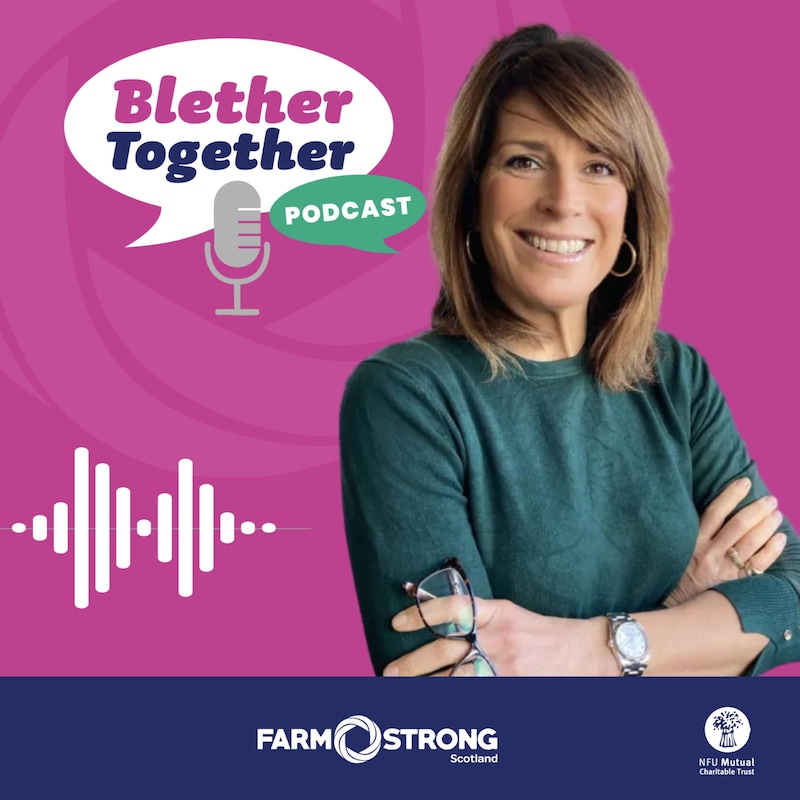
Helen Stewart took over her family's farm in Pitlochry quite suddenly - when her older brother decided he wanted a different life.
The farm has a high wild deer population, which was making it difficult to graze cattle or sheep.
To tackle this problem, Helen has set up Fair Feast - a social enterprise that has so far placed 2.5 tonnes of culled and butchered venison in nearby food banks and community pantries.
She's come a long way since doing an English Literature degree at Glasgow University.
Farmstrong Scotland helps farmers, crofters and their families cope with the ups and downs of rural life by sharing practical ways to look after themselves and the people around them. It’s a peer-to-peer programme, shaped by scientific insight and real-life stories, so together we can share, learn and support each other’s wellbeing.
You can also subscribe to our Spotify Playlist including hundreds of tunes, recommended by farmers and crofters across Scotland.
Mentioned in this episode:
Explore Foundations of Mental Strength
Read more about Farmstrong's Foundations of Mental Health programme: https://www.farmstrongscotland.org.uk/news-events/farmstrong-scotland-launches-new-mental-strength-programme-in-response-to-survey-findings
Contact us to find out more or book a session: [email protected]
Transcripts
Sarah Stephen:
Welcome to Blether Together from Farmstrong, Scotland.
I'm Sarah Stephen.
Thank you very much for being with us.
Our chat this time is with Helen Stewart.
She's from Pitlochry, she has a sheep farm, she is a gin distiller and she's launched a social enterprise called Fair Feast placing culled venison into local food banks.
Helen Stewart:
There was a moment when I went to a food bank and I saw people I knew in the queue.
I saw someone I went to school with.
I felt like we were putting a lot into the food bank that day, but it still wasn't enough.
Sarah Stephen:
Helen had been told all her life that as a girl and as the youngest child she wouldn't inherit the farm.
But life had other plans.
Helen Stewart:
My brother decided he didn't want to be a farmer anymore and he left.
And he just left.
He didn't come back.
It took me, took me quite a while to kind of get my head around it.
Sarah Stephen:
The farm has been in Helen's family for four centuries and she was determined not to be the last link in.
Helen Stewart:
That chain since:
So there is this kind of sense of responsibility and roots.
Sarah Stephen:
This is a really fascinating chat.
Let's get into it.
Introducing Helen Stewart.
So, Helen, I tend to start these podcasts with a round of rapid fire questions.
We tend to throw people in at the deep end.
Are you ready to be thrown in at the deep end?
Helen Stewart:
Yeah, I think so.
Go for it.
Sarah Stephen:
Well, first answer, don't give it too much thought.
What is the first thing you do in the morning?
Helen Stewart:
Straight to the coffee machine.
Sarah Stephen:
What is a favourite thing about your job?
Helen Stewart:
I love the place.
The place is really fantastic, beautiful.
Sarah Stephen:
What is the one thing you'd like to do in the next year?
Helen Stewart:
Have a holiday.
I've not had a holiday in so long.
Have some time off now.
Sarah Stephen:
You're relatively young, you're a youngie compared to me.
But if you could go back to any age, what age would that be?
Helen Stewart:
I don't know.
I honestly feel like I'm having the best time now, to be fair.
Oh, university maybe.
I was having a great time in Glasgow back in the day.
Sarah Stephen:
Yeah, it seems to be a good place to be.
Okay.
Is your bed made right now?
Helen Stewart:
No, I was running late.
Sarah Stephen:
Now this can, this is typically for yourself but it could be of somebody else.
So you just interpret it any which way.
But what is your favorite body part?
Helen Stewart:
Hands maybe.
I.
Sarah Stephen:
As I said, don't think too deeply.
Okay, we'll go with hands.
One subject you would like to learn more About.
Helen Stewart:
Oh, hydrology.
I'm listening to podcasts on hydrology at the moment.
Sarah Stephen:
Wow, that's impressive.
Do you have any tattoos?
Helen Stewart:
I don't.
Sarah Stephen:
What's something you notice about someone when you first meet them?
Helen Stewart:
This is a good question.
Gosh, I've never thought this deeply inside myself before.
What do I notice about people?
Not a lot.
That's terrible, isn't it?
Their accent.
Sarah Stephen:
What do you think people misunderstand about you?
Helen Stewart:
Sometimes people say I make it look so easy because they think I'm really chill and I'm just exhausted most of the time.
Sarah Stephen:
You do seem very chilled, so that's.
You've obviously just.
You've honed that skill.
Helen Stewart:
I've just pushed through the stress into, like, complete disassociation.
Sarah Stephen:
So people think you're chill, but there's a lot going on behind there in.
Helen Stewart:
Terms of just potentially the most stressed person.
I think I know.
Sarah Stephen:
Okay.
Right, there we go.
There we go.
It's amazing what these quick questions bring up.
But it's funny.
We go back to the hands.
Thank you for being a good sport, Helen, but going back to the hands.
When I met my husband, who's a farmer, I noticed his hands.
His hands were huge.
I know that sounds really odd, but I really liked his hands because his hands were really like worker's hands, but they were big.
And I always thought he's, you know, it's like his big hands mean that he's always going to look after me.
Helen Stewart:
That's really strange because that's why I said hands, because my.
My big forestry husband also has huge hands.
Sarah Stephen:
Well, listen, thank you very much for being a good sport.
Right, Helen, I've just arrived in your farm.
I'm leaning on the farm gate.
I'm taking it all in.
What do I see?
Helen Stewart:
I honestly think I might have the most beautiful farm.
The location is fantastic.
You know, you're just on the start of the heather hills, but you're kind of 10 minutes out of pitlochray.
So you can see.
You can see the town just on the horizon.
And this time in the morning, there's, like, the mist, so it's properly like Brigadoon, like, floating on the horizon, and it's just big open skies.
I think it's part of the reason I work so hard to stay on the farm, because the place is just so serene, so beautiful.
And when I came back from university, I was just, like, seeing it with fresh eyes.
Sarah Stephen:
It sounds stunning, especially in that part of the world.
The nuts and bolts of your farm.
What's going on.
Helen Stewart:
So we have a hill sheep farm.
So we've got about five miles of heather hill and some fields either side.
So it's quite a big farm.
But a lot of it is quite steep, quite rough hill, quite a traditional sheep farm.
We have black faced sheep and Texas and north country cheviots.
We also have an awful lot of wild red deer.
So we have a social enterprise where we process the deer on site in a butcher unit and then we sell a portion and that funds the rest being donated.
So alongside the farm, I run a nonprofit.
Then I also do contract distilling for different companies so that I can actually fund a lot of what I'm doing.
Sarah Stephen:
Have you got enough fingers for all those pies?
Helen Stewart:
Yeah, I'm pretty sure I could be diagnosed with something.
I had a business mentor last year and they were like, I'm not really one that could diagnose you, but I'm, you know, might be worth thinking about.
Sarah Stephen:
They left you hanging.
I don't know if that's good or bad.
So tell me about your path to becoming a farmer, because I understand that it wasn't maybe part of young Helen's life plan.
Helen Stewart:
Oh yeah, no, it's rocky.
So I grew up pretty much knowing one thing, that I wouldn't end up on the farm.
And I got told from quite a young age, pretty much by everybody, that I would not end up on the farm.
I was youngest and a girl.
I actually.
One of my earliest memories.
This is gonna sound really dramatic.
One of my earliest memories is when my cousin took me to a tree in the middle of the farm and the family had like put their initials on it and this kind of thing, different people that had been there over the decades.
And she wrote her initials and her brother's initials and my brother's initials and then turned to me and said, we won't bother with you because it's not like you'll be here long.
And I think I spent a whole year of my childhood kind of just thinking, like, am I dying?
Like, what's happening?
Cause like just life off the farm, you know, when you grow up and that's all you know, is just this kind of big unknown.
Yeah, actually I was quite young.
I must have been like, so seven or eight.
And I nicked a pen knife and went back to the tree and climbed up a couple branches and like scrawled my name in the side of it.
And I thought I'd actually imagined all of this until I passed it the other day and I could see like a Big like Helen, like quite high up.
Which makes me think kind of a, how unattended I was as a child.
Sarah Stephen:
I mean, I think that's a pretty ballsy move, isn't it?
Gutsy move for a young eight year old girl.
Helen Stewart:
Yeah.
I just think even back then I really loved the place and really wanted to kind of leave my mark.
Sarah Stephen:
So Helen, so you've been told, off you go, seek your fame and fortune elsewhere.
What happened?
Where was the change?
And just expand on that a little bit.
Helen Stewart:
I knew I wasn't going to be a farmer so naturally I made the next logical step and I went to study English literature.
I actually, I want to study English literature since I was like nine.
I think I got really.
I just love reading, reading and writing.
So I went to Glasgow, I had a great time.
I loved doing English Lit.
I got involved in different stuff, different scholarships, went abroad.
I was having a fantastic time to fund my way through university.
I started working at a local distillery.
I didn't drink whiskey at all before I started working at the distillery.
I didn't drink full stop.
And then I got kind of hyper fixated on whiskey.
The whole process of how it gets made I just find super fascinating.
So got more into that, got more into the industry.
People started saying, you know, would you not come and help run distilleries?
And I just thought, well, you know, I could set up a little distillery on the farm because we have extra buildings, we have a beautiful location, we have lots of beautiful fresh water and that could kind of help supplement the farm to diversify.
Because even back then, you know, the farming industry's been rough for a while.
So whilst I was at university the last two years, I went round and got funding to open a distillery.
I did lots of different pitching competitions, lots of different business grants and opened up a tiny little distillery.
And the week I came home to open it, my plan was to open it, hire someone to run it and go back to Glasgow pretty much within the month.
And the week I opened it, my brother decided he didn't want to be a farmer anymore and he left.
He just left, he didn't come back.
Sarah Stephen:
So the succession up to that point, succession had been your dad and your brother was always sort of always thought or was always told that he was the one that was going to be the farmer.
Helen Stewart:
Yeah, my dad paid out his sister, my cousins, so that my brother could take on the farm.
So it was always he went to agricultural college, went to young farmers, he went shooting twice a week, farming crazy.
So I thought and Then left.
So within a week I had a distillery and a farm and an English lit degree.
Sarah Stephen:
And you know, what went through your, I mean, without.
Obviously your brother's not here to represent himself and I appreciate we'll delve a wee bit deeper.
But what just what went through your mind?
Can you just go back to that time and what went through your head?
Helen Stewart:
I think I was just very, very overwhelmed because it's just such a big change in what you think your life will be.
And it really made me think, you know, ever since you're small, people ask you, oh, what do you want to be when you grow up?
And you really fix in your, your mind this kind of path through life and then when that takes such a kind of dramatic diversion, you know, it's, it's quite shocking.
It took me, took me quite a while to kind of get my head around it.
I honestly think I've maybe just got my head around it now and it's maybe eight, nine years later.
Sarah Stephen:
And how did that impact family dynamics?
Helen Stewart:
I've always got on really great with my parents, so we work really well together, so that was okay.
But I think there's family dynamics and there's working dynamics.
And as I've kind of taken on the farm as the years passed, there was quite a lot of kind of.
Everyone's got their different sector they're kind of in charge of.
I think we probably talk about, we talk about the business pretty much every day between the three of us.
We talk about succession, we talk about our future plans, the day to day running of the business.
So there is, in terms of work life balance, in terms of family work dynamics, it's all very much interlinked and not the most fantastic.
Work life balance.
Sarah Stephen:
Yeah, I mean, of course everyone struggles with that, don't they?
And it's great that you have a good relationship with your parents and a good working relationship.
I'm just wondering about, you know, your, your brother and, and your father's plan and the sort of impact on, on your parents and was it fairly, oh, okay son, no problem.
See you later.
And you go off and do your thing.
Is it, was it quite a smooth transition?
Helen Stewart:
I think it was, yeah.
It was just very, very surprising and very shocking.
But I think they will be the first people to say to anybody, you know, farming's not for everybody.
And it did kind of make us reflect more on the need for communication.
And if someone's feeling like that's not what they want, they should be open to say that in a way it.
Sarah Stephen:
Was quite a brave thing for your brother to do, given the expectation.
Helen Stewart:
Yeah.
Sarah Stephen:
Perhaps he placed on himself as well.
Helen Stewart:
Yeah, I don't really.
Yeah, I really struggle to kind of understand where he was coming from in a respect, but I. I think, you know, you've only got one life and if you're not happy, then you need to make a radical change and go be happy with what you're doing.
And if that means not farming, kind of, so be it.
And I think the more I'm kind of meeting more people in the farming industry, the more I kind of realize how common that is.
Lots of people, when they kind of hear kind of how I came to become a farmer, you know, will say to me, oh, I've got a son.
And, you know, I don't think he wants to farm.
You know, could you speak to him?
And I'm like, go, let him do his own thing, you know, go let him find what he's passionate about.
People can get quite anxious about who will take on the farm and, you know, will need to, like, pick a successor early and like a line.
And it's.
I kind of.
I don't want to be really casual and say everything comes out in the wash, but, like, farming is quite difficult and you really need to want to do it.
So there's no point in really trying to twist someone's arm if they don't want to do it.
Sarah Stephen:
And perhaps there's a wherewithal.
I don't know.
Wherewithal is not the right word, but there's a generation that are unlike potentially our parents generation or the generation before them, who maybe there weren't other options open to them.
You know, down a few generations, people say, oh, there's other things I can do.
I don't need to do this and I can go and do X, Y and Z and I don't need to be here.
Helen Stewart:
I think there are other options.
But I do also think because farming is so challenging now and there's a big range of skills that you need.
When my dad grew up on the farm, for example, he had farm workers helping, so a lot of it was more management.
Whereas now it's just the three of us and we do all the paperwork and all the manual labor and it's a lot to juggle.
And I think it is quite a common story for farms that things are getting increasingly in hand and quite intense and the industry has been rocky and.
Sarah Stephen:
If you're on your own on a farm, it's tricky.
Helen Stewart:
Yes, I think it can be quite isolating.
And I think farming is unique in that respect because, you know, often the farm is your family, your heritage, your community, your job, your housing, your money, like, everything tied up together.
And I think it can be, in that respect, very daunting to leave a farm because it is, you know, what is your life beyond that.
It can be such a bubble that it can be a lot of pressure for people.
Sarah Stephen:
Well said, Helen.
So the return ticket to Glasgow was ripped up.
Helen Stewart:
Yeah.
Sarah Stephen:
You're on the farm, you're home, you're a distiller, you've learned that skill, which is, I think, a fantastic one to have under your belt.
You're back on the farm.
What were the challenges?
What were the big issues initially?
Helen Stewart:
Well, I mean, I could see why other people weren't wanting to run the farm, because it was increasingly challenging is maybe a nice way of putting it.
We didn't have enough grazing, so we had to sell our cattle.
We had less and less sheep.
Everything seemed to be failing.
Everything seemed to be getting worse and worse.
We were struggling to have any hay, any silage, and we weren't fully understanding why we're having all of these issues.
One day I saw a chain of dikes knocked down, and when I rebuilt them, I went up to the hill and I just kind of sat there all day.
And I counted about 400 wild red deer.
So I'm a tenant farmer, so deer aren't really in my remit.
So I think part of the issue with not identifying it as an issue is it's kind of like, outside my scope.
You're not really thinking deer.
I'm always looking inside about management issue I've made.
So I got in touch with the estate and asked them to cull more deer.
And for six years, there was a bit of back and forth about I'd like less deer.
No, we don't have enough deer.
Blah, blah, blah, blah, blah.
Sarah Stephen:
Six years.
Helen Stewart:
Yeah, six years we're going back and forth about deer.
And then eventually, because culling deer can be incredibly expensive, we kind of came to a compromise where the estate said, you can become responsible for your own deer.
And I was kind of at this crossroads.
Nothing was happening.
I'd been fighting it for a long time, you know, in recording it, like, videotaping, like, herds of hundreds and hundreds of deer crashing through the dikes, eating all the grass, calving in the fields all around the house, like, really inundated with deer.
So when I had this option of taking on the deer, I really felt like it was this or it was nothing.
We were so hard up at that point.
Sarah Stephen:
And when you say hard up, you've been parachuted into the farm.
Was it a big surprise to you to find the state of things?
Helen Stewart:
Yeah.
I don't know if it's because deer were never kind of our business that you just don't really look at them, you don't really think about them.
I'd occasionally see deer, kind of when it was really snowy.
I'd see them coming further down near where I lived, but I never, ever saw herds of hundreds of deer.
I've never seen that.
And it took me kind of all my time to kind of realize the ramifications of that.
I didn't know at the time about the extent of the grazing damage they do.
I didn't know the time, at the time about the environmental damage that they do.
Deer are like indiscriminate grazers.
So in a group of like 200, they just group together and just graze down everything.
It's like just big hoovers.
You know, sheep will go out on a hill and they'll take the fresh bite, they'll take the freshest little bit.
So it means that you've still got your biodiversity, you've still got things growing at different regions, different times of the year, whereas deer, they just hoover at everything.
And because they're so heavy on such tiny little feet, they cause soil compaction.
They damage peatland with huge hags of peatland that have been opened and then they start to flood because they can't regulate their own moisture or temperature.
So deer is.
Deer's a really big issue.
I got offered to take on the deer and my.
My actual genuine response was like, how hard can it be?
Like, how hard could it be?
Turns out, quite hard.
I was actually in Holiday in Canada at the time, and I phoned my dad back home to be like, I've just agreed to take on the deer.
And he was like, oh, my goodness, what have you done?
What have you done?
Sarah Stephen:
And I was like, oh, I've got this, dad, I've got this.
Helen Stewart:
Well, I mean, did I?
It was just a bit of a shot in the dark, I guess, in a way, but it was just.
Nothing was happening.
Nothing was happening.
It was having such an effect on the farm.
We had to sell our cows, we had to stop growing hay or silage.
Like, we just could hardly function.
And even in the most basic sense, we'd, like, go to rest a field and then go to put lambs in it, and there'd be no grass in it.
Sarah Stephen:
I'm Just trying to think of this sort of your mum and dad living with that stress.
And obviously the farm wasn't performing and the economics of that must have been hugely worrying and stressful for them.
Helen Stewart:
Yes.
As stressed as I am, my dad, I come from a long line of stress heads.
No, my dad is very, very stressed a lot of the time.
And this is part of the reason, when it came an option to come back to the farm, I had to say yes, because he was really struggling with it.
And it's been in our family for a long time, the farm.
It's been in our family since:
Wow.
So 427 years this year.
So there is this kind of sense of responsibility and roots, but you don't really want to be the last person, the last link in the chain kind of thing.
And he's been very reflective about it.
He said to me, it's difficult that I'm effectively handing over the farm in a worse condition than I got it.
And that's maybe the first time that's happened.
And I was really saying to him, but I don't really know what you can do when you've got so many deer.
It's a bit unprecedented, to be honest.
It's almost five times the legal maximum and we're a specially protected SSSI area, so it's really somewhere that shouldn't be hit with this level of environmental damage and agricultural damage on top of that, it's just had a huge impact.
Sarah Stephen:
So you dive right in.
You've effectively done an audit of the farm.
Do the ideas come thick and fast or is it a slow burn?
Helen Stewart:
So I didn't know anything about deer.
So I started speaking to different people in the industry, kind of doing my English lit style research, made a little booklet, all my questions and who I will.
Who I will ask to answer them.
I must have been so annoying.
Honestly, I went to deer management groups and I turned up with like my pink ring binder.
Hey, guys.
They were like, oh.
But I went to these deer management groups and was talking about our kind of deer density and how many deer we had and how it had been building up and the issues we're having.
And people were pretty shocked and said, you know, somebody took me aside and was saying, what you need to do is shoot deer every weekend.
The game dealer might pick up kind of 10, just bury the rest.
Like buy a digger and just bury the deer and do that indefinitely.
I was pretty shocked.
And as you know, I was coming back to the farm thinking, what a beautiful place.
What A beautiful life.
I wasn't thinking, you know what my life's gonna be Rose tinted guys, deer every weekend.
So I thought, I think I actually said at the time, well, I think that's pretty unethical.
So you can see, see what a hit I was at these deere events.
But I couldn't imagine doing that.
So I thought, well, if we sell a bit, maybe I'll just donate the rest if there's just so many.
And a big part of the issue with deer, just to help people understand is that it's so seasonal, so we're all shooting in the same kind of window.
80% Of the industry goes through just in the month of October.
So actually getting people to pick up and process the deer and getting a place in the food chain, especially when you're new, you know, game dealers have an established relationship with a lot of places.
And you're a new kid on the block being, oh actually can you come and pick up all my deer?
So I was like, I'll just get them butchered and donate them.
So I started interviewing.
Went out with my little ring binder again.
Doo doo doo.
Sarah Stephen:
Kept the pink one, I hope.
Helen Stewart:
Yeah, little pink.
It's that hot pink ring binder.
Went and interviewed different food bank managers.
So I was kind of shuffling my papers around saying, you know, would you take venison?
And it was quite interesting because people were saying, well, yes, we take venison, but we don't want like a leg of venison.
We would want burgers, sausages, mince packs.
You know, it seems really obvious now, but a lot of stuff that can fit into a child's pre existing diets and we took all that on board.
We actually don't hang the deer for that long.
We process everything pretty much in three days so it doesn't taste particularly strong.
Traditionally it can be hung for maybe two weeks to enhance this kind of gamey flavor, which we don't do because we just want everything to be kind of light, fresh, local.
So I started interviewing all these different food banks, some of these kind of food banks, community larders, I use food banks very broadly.
Have hundreds and hundreds of people going to them.
And rural people do have unique challenges in terms of food scarcity.
You know, if your car breaks down, it's not like you can walk to work.
It's not like you can get a bus service all the time.
You need to fix the car.
So people have these extra expenses that can crop up with heating, with the cost of living.
Food's not as Readily accessible.
So I really thought, well, let's focus on rural food banks first and foremost.
So we had our kind of remit.
I formed a board and a community interest company with the head of Okdaraja Food Bank, Jackie Mahoney.
And Jackie is a force of nature.
She's a retired civil servant.
And you can tell she organized the kind of food bank distribution.
And I organized the deer, which, if anybody knows me before this, they will be very profoundly shocked because I actually do faint at blood.
And I fainted at blood chronically growing up.
Like at school, I must have fainted like twice a month.
I was like.
And I couldn't even discuss anything to do with blood.
And now I'm like in a butcher unit.
And the butcher's like, oh, the bullet's gone through the shoulder and like broken the bone.
And like, oh, I'll need to like, cut out all this blood clot.
Like, look, I'm gonna cut out this bitch.
You're green.
I'm like, oh, very impressive.
Thumbs up, Kev.
And then I go out the back and puke.
But do you.
Sarah Stephen:
Are you still sick?
Helen Stewart:
I try not to be, but it's.
Sarah Stephen:
Like you therapized yourself out of it just by sort of like cold going right into it.
Helen Stewart:
I was just so, so horrified at the idea of venison wastage that I thought I need to do the responsible thing and kind of push through, even if it's going to be unpleasant for me at times, because the alternative is either going out of business because the farm can't sustain this level of deer, or having to do a really mass call where there's going to be a lot of wastage.
And if people come in and cull 650 deer in like two days, I don't know what kind of welfare there's going to be there.
It seems like a very convoluted business model, but to me it seemed like the only option at the time.
Sarah Stephen:
Tell me about the other elements of your farm.
Helen Stewart:
Yes.
Sheep.
I've always liked sheep.
I did, even at university, come back for lambing because I've always feel like I've had quite a good way with sheep.
It was quite funny because when I came back to take on the farm, I liked sheep, but I'd never trained a sheepdog and I didn't really know how to.
So for the first year I had this New Zealand huntaway.
So he looks a bit like a German shepherd.
Probably is a German shepherd.
Know them well, I don't really know where I got them.
And people tell me now they're infamously difficult to train.
But I didn't really know how to show him to catch a sheep because we lam everything outside.
So if there's any difficulties, you need to be to catch that sheep.
So for the first month I was just catching the sheep, stopping the quad bike and running after the sheep and catching it.
And then I'd have him run with me and then I'd catch the sheep and he'd catch the sheep and I'd be like, well done.
And then eventually he's managed to do it himself.
But I mean, it's been a voyage of discovery kind of figuring out sheep management.
And it's very full on in terms of lambing.
You know when you get a cold snap or it's snowy and you need to bring in a whole field of sheep with their lambs individually.
And I have this sheepdog that is such a diva.
He will catch four sheep in a day and if you ask him to catch a fifth, he will run back to his kennel and shut the door.
Sarah Stephen:
You know, you should never.
It's never a bad dog, is it?
Helen Stewart:
I have indulged my first son, my first born, spoilt him.
Sarah Stephen:
So, you know, life on the farm daily.
Who's there?
Who are you surrounded by?
Helen Stewart:
Me and my parents.
Well, my mum's always trying to slope off.
Now we have a shop in town, she wants to do hours in the shop, she wants to do three days a week in the shop, which I think is very inconsiderate of her.
So it's me and my dad, by and large, working through the sheep.
You know, we can be doing hill gathers, we're going to be doing land boxes for the shop and then if we come up to the other side of the farm, we've got the deer larders today.
We've got a couple guys up skinning.
We have identical twin brothers that skin all the deer.
Sarah Stephen:
Wow.
Helen Stewart:
So I'll bump into a couple of the kind of butchers as well.
And yeah, my husband works away in forestry so he kind of swans in and out when he's free.
Sarah Stephen:
Oh, dear.
Poor Sam.
He's not here to defend himself.
And you've got a wee one.
Helen Stewart:
Oh, yeah, I forgot.
I've got a baby.
He's just one year, one month and I'm just very relieved not to be pregnant again.
I was huge.
I was really massive.
I was struggling.
But yeah, no, Eddie's, Eddie's great.
And he really.
It's very.
It's very strange because I was Thinking, oh, I should, I should have a girl.
And then it'll be female empowerment through farming, all this.
And then of course, I have like the biggest, strongest, evident farm boy you've ever seen.
But he's just, you know, if he's upset, I'll put him out in his pram with the hens.
And he's loving it.
He loves watching me do the sheep.
I'll take him out.
He's got like a, an off road pram.
I'll take him out and he'll watch the sheep as I'm doing the sheep work.
Sarah Stephen:
Well, that is a blessing, isn't it, given the fact that you sound like you are juggling a lot.
It sounds hard.
Helen Stewart:
Yeah.
I mean, it is quite hard, but it's because I love what I do.
And I'm finding the deer side so fulfilling.
I'm finding getting the farm together so fulfilling.
We've renovated a lot of the farm.
I'm buying in new sheep every year to build up the block.
I'm looking at getting cattle next year.
So I have.
It's going to be me and me and the butcher rocking up at the cattle sales, figuring out what's a good cow.
Sarah Stephen:
Oh, yeah, yeah, I know that feeling.
The distillery side of things.
It's a credit to you that you've brought that back onto the farm.
And how does that work?
Helen Stewart:
Yeah, so it's all.
I specialize in hand foraged gins.
So I make gins for different hotels and Glasgow University.
Actually, Glasgow University asked me back to.
I'm a gin.
I was very touched, very touched that they had me back to make a gin.
So I make their gin.
I make different gins for different hotels and it suits me.
It's contract distilling, making gin for other people.
But it really does suit me because previously I was making my own gin and trying to sell it and trying to work between the farm and then chasing up people for six bottles here at this bar, six bottles there at this hotel and, oh, you've not paid me.
Oh, the manager's not in.
Blah, blah, blah.
It just wasn't possible alongside my farm work.
And then Covid hit and.
And I went really hard into distilling for contracts.
Suddenly it's like a palette at a time going out.
Sarah Stephen:
You're learning as you go.
I wonder what the biggest lessons you've learned along the way are.
Helen Stewart:
Ooh, that is a big question.
Biggest lessons along the way.
Probably something along that vein, actually.
Not to define what you want to do too early and kind of stay open to kind of what life brings.
Because you know, if I didn't go work in a distillery because I'm like, oh no, I want to do something with English lit.
If I didn't want to come back to the farm because I didn't feel prepared or like I was meant to be on the farm, then I definitely, when the deer problem came along, would not be thinking that I could deed deer because I grew up with such a kind of aversion to blood.
So I think it's really just staying as versatile as possible and staying as open as possible because life throws opportunities at you and you don't want to be too kind of rigid in what you think life will be.
Sarah Stephen:
Good, good life lesson.
We've talked a lot about the business but at the beginning of this chat we spoke about how people you come across as very chilled but sometimes you're a bit of a stress cadet, self labeled stress cadet.
And you certainly don't seem that way to me at all.
I would like to be as stressed as you are because you seem super chilled.
How do you deal with stress?
Helen Stewart:
Poorly.
No, how do I deal with stress?
It's a really good question.
I was honestly, I have like this intrusive thought that's like copious amounts of gin, which isn't even true.
No, I think how I deal with stress it is really kind of being out on the farm I actually have this.
I have such a hack for dealing with stress and I don't know if other people do.
This probably sounds quite strange.
I go out on the farm when it's like just gone dark.
We have like a farm road that's half a mile so you could, you can walk in relative kind of safety without tripping over.
But I think when it's just gone dark it's like sensory deprivation and it kind of like helps like switch off your mind a little bit.
So when I'm really stressed out I like walk down the road in the dark and like sit on the road.
I think it really psychs out my parents actually.
But you know, I'll take a.
Take one of my little sheepdogs and we'll amble down just as it's gone dark.
But you know, it's usually you're walking down and you're seeing Pitlochry and you're seeing the neighbours going by and all the cars and you know, you go at night and it's just cool and dark and serene.
It's very peaceful and I find it very, very kind of resetting.
Is that a Word.
I find it very centering.
It really makes me think how privileged I am to kind of have my own space, even though it's been really difficult and challenging over the years with the business.
I did take my sheepdog out with me at one point and it got really, really dark and I went out to pet him and it was a badger.
I did accidentally pet a badger once.
Sarah Stephen:
But apart, do they like.
I don't know if they like being petted.
Do they?
Helen Stewart:
No, turns out they don't.
They don't like it at all.
And I didn't actually.
The noise they make, I didn't actually realize.
I thought it was like a sheep sneezing.
That's what I thought the noise was.
I thought it was like a cough or a sneeze caught.
It was an angry badger.
Sarah Stephen:
I mean, one of the farm strong five ways to well being is to give, which sounds like you're doing in spades.
It must give you a huge amount or you must get a huge amount of reward from knowing that there's people, as you say, in rural communities who are benefiting.
They've got, you know, full bellies because of the venison in the food banks.
Helen Stewart:
Yeah.
It's been the most unexpectedly fulfilling thing of my life because we've donated two and a half tons in like the last year and a half.
So it's a lot of meat.
It's over 25,000 portions for people.
So it's been an awful lot of running around.
But there was a kind of couple moments that really made me so sure this is what I want to be doing in my life.
There was one landowner that took, not my landowner, that took me aside and said I shouldn't be giving venison to food banks.
Venison is a prestige product and I'm ruining the brand of venison.
He would rather bury it than give it to me.
And that venison's not for the poor.
And I think I probably think about that every day.
I probably think about that conversation every day because I just think how ridiculous to be projecting class ideologies onto a readily available meat source.
Naturally occurring, low carbon.
The deer are getting culled anyway.
I just think it's so incredibly frustrating.
Sarah Stephen:
So that's become a bit of a driving force for you, then?
Helen Stewart:
Very much so.
In terms of, like, what drives me forward, what pulls me forward.
There was a moment when I went to a food bank and we were delivering 50, 50 packs and there was over 50 people in the queue.
And when I went in, there was like, nothing on the shelves.
So I knew the people at the queue weren't going to get anything at the back.
And I saw people I knew in the queue.
I saw someone I went to school with.
I saw people who'd always worked in the shops around here, people I know that have always worked, people that had been widowed, people that have been sick.
I felt like we were putting a lot into the food bank that day, but it still wasn't enough.
It's that kind of deep feeling that makes me want to kind of do more and more.
And that's how I've gone from being, oh, I really want to get rid of all my deer, to now actually asking other estate seller farms to donate deer as well.
Because if they are just getting culled to waste, there are options where it can go to good use because it is so healthy.
And like the messages we get from people, you know, saying, I've not had meat all month because I can't afford it.
You know, when you're not here, I go to the food bank and it's just tins and dried pasta.
There's a little cookery support group at one of the food banks for people making, like, bolognese and like shepherd's pies and stuff.
And people are putting in photos of the first Bolognese they've ever made for their kids.
And, you know, there's so much around what we're doing at Fair Feast that's not just kind of throwing burgers at people, it's also creating a bespoke product so people kind of know that they're cared about.
It's great that supermarkets put out food that's maybe going to waste, but it does mean when you go to food banks, sometimes it's literally all yellow sticker stuff.
I went in one day and it was all just prawn cocktails, sandwiches that were going out of date that day.
It has really made me think about the kind of stigma for people going to the food bank.
I've had a lot of people saying, you know, it's, oh, but it's, it's like a free for all at these places and it's not the case.
There's some people that are queuing for 40 minutes and they get to the front of the queue and it's like a tin of tin of hot dogs or like a tin of beans or something.
Like, it's pretty slim pickings.
Sarah Stephen:
Well, perhaps by stating that you've changed one person's perception of, you know, food banks and what can be done and I'm just in awe of what you are achieving.
You spoke about loving the farm, loving your home, loving Pitlochy.
Can you, in a sort of brief couple of sentences, just describe what's your favorite place on the farm?
Helen Stewart:
Yeah, my favorite place on the farm is we've got a waterfall as it's coming off the hill into the fields.
And it's actually where I got engaged because it's my favorite place.
And we go up there and we have big kind of picnic blankets and we go swimming and I take the baby up and he's paddling.
I find the noise of the water really relaxing.
And there's like a little meadow.
It's.
Yeah, it's very kind of special and secluded and you see, you see little fish in it sometimes.
Yeah, it's pretty cool.
Sarah Stephen:
I'm feeling.
I'm getting outlander vibes.
Helen Stewart:
It is.
It is.
I'm living Outlander.
I'm living.
Yeah.
Sarah Stephen:
Okay.
Well, listen, what I'd love you to do is I'd love you to think about a question that we can ask our next podcast contributor.
It could be a rapid fire.
It could be something more profound.
Anything you think would be quite interesting to ask on the next contributor.
Helen Stewart:
What does a bad day on the farm look like?
Sarah Stephen:
Okay, Right, you heard it here first, listeners.
What does a bad day on the farm look like?
Well, Helen, thank you very, very much.
It's been a pleasure.
Good luck with your sheep, your deer, your shop, your romantic walks.
Helen Stewart:
Romantic walks without my husband.
Keep me in a bag.
You keep.
Sarah Stephen:
Oh, you're unavadger.
You keep taking that pink file everywhere you go and show us how it's going to should be done.
Helen Stewart:
Thank you.
Sarah Stephen:
Oh, a huge thanks to Helen Stewart of Fair Feast.
There's links to her business and social enterprise in the written show notes for this episode.